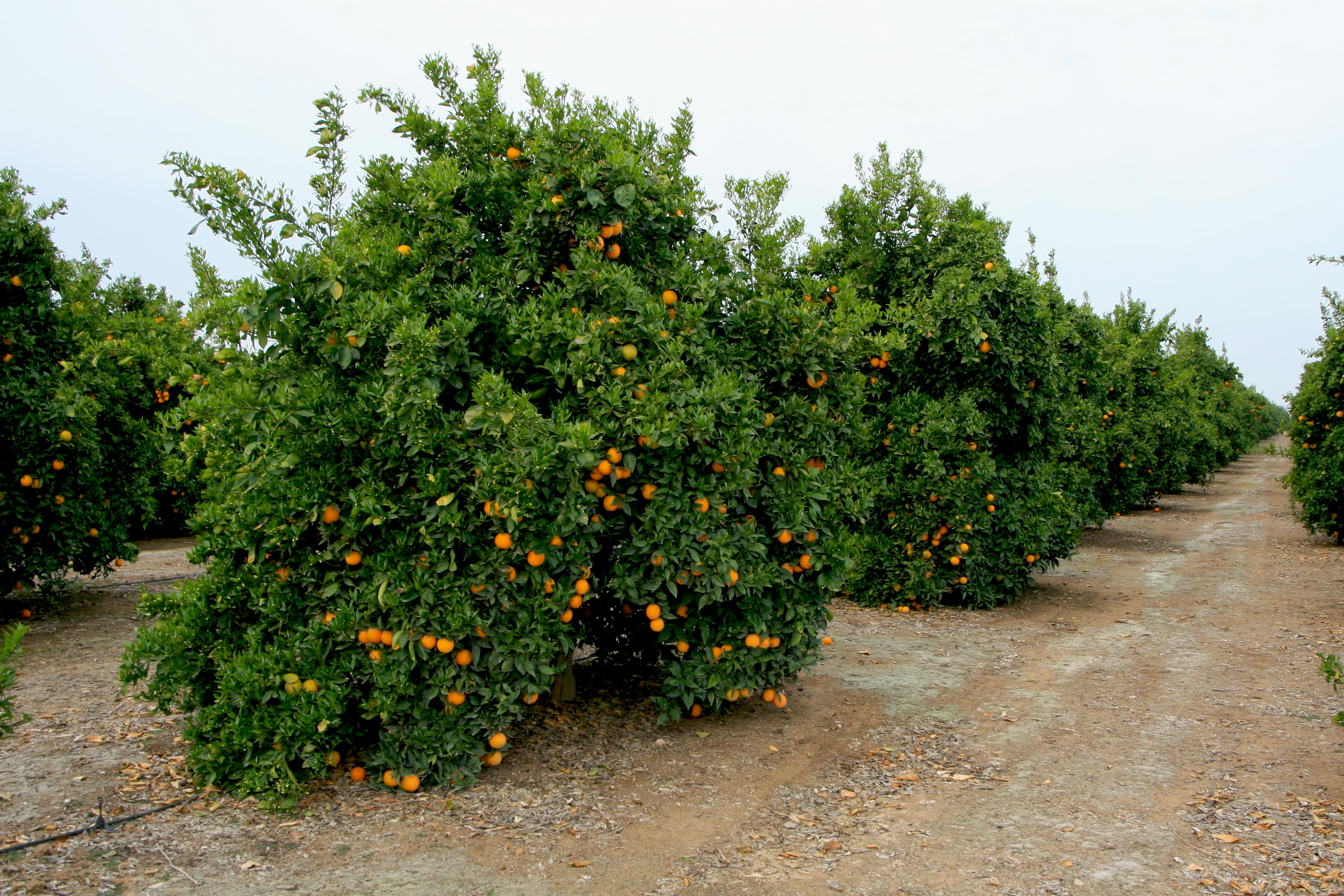
Fire mimicry is clearly showing itself as a useful tool for restoring our native California trees. But what of all the non-native agricultural trees growing in vast orchards across the state? Is there any aspect of fire mimicry that may benefit them?
With these questions in mind I attended the World Ag Expo in Visalia, CA in February of 2007 and met a farmer whose family had been growing oranges in the Central Valley for generations. The farmer was concerned about a decline in the productivity and quality of their oranges in recent years. So in April of that year I returned to Visalia and inspected her orchards.
She first showed me an orchard block that had been consistently under-producing compared to adjacent blocks. I immediately noticed that a dense cover of mosses had formed around many of the trees, indicating to me that the soils were acidified and likely lacking in alkaline-rich nutrients. Most of the moss cover appeared confined to the soil zone of surface saturation along irrigation lines. [Any of you who have read Chapter 6 “The cryptic ecology of mosses and lichens” in my book Forged by Fire knows why this buildup of mosses may be problematic.]

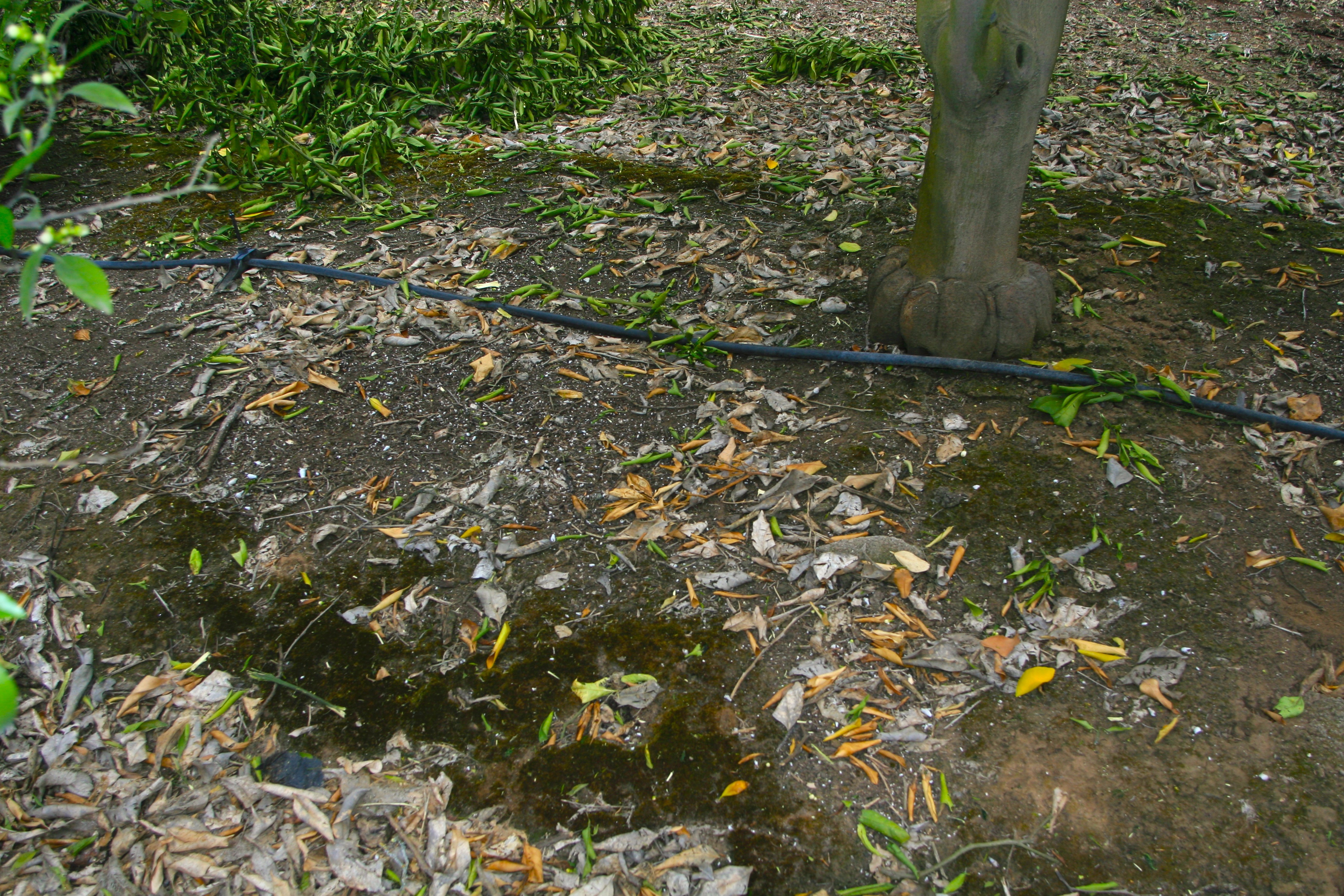
Upon my recommendation she agreed to a trial on two adjacent orchard blocks, an experimental block which was treated with alkaline-rich mineral fertilizers used in fire mimicry (AZOMITE® + micronized calcium carbonate limestone, abbreviated here as AZO-SS) and the other an untreated control block. The trial was set in nearly perfect testing conditions. Both blocks were ten acres in size, planted in the same year (1964), on the same soil type (Exeter loam), and had been managed identically since planting. The blocks consisted of Navel Orange trees (var. Frost Nucellar) on Rubidoux Trifoliate rootstocks. Data for the previous years 2003 to 2007 showed that the test block had consistently under-performed the control block in terms of production and income.


In April of 2007 fertilization treatments were performed on the experimental block using a tractor and spreader at a rate of 1,125 lbs/acre (see image above). In 2008 I obtained the one-year post treatment data files of each block from the farmer. With this data I ascertained the following results based on the mean production and income of each block over the five previous years (2003-2007).
- The total volume of oranges harvested in 2008 (one year after treatment) increased in both blocks, by 16.5% in the control block and by 35.3% in the experimental block.
- The experimental block in 2008 showed a 69.2% increase in the production of the Sunkist (premium) grade oranges, while the two lower grades of oranges, Choice and Juice, showed a decrease in production values of 18.7% and 3.0%, respectively.
- The control block in 2008 showed a 1.8% increase in the production of the Sunkist (premium) grade oranges, while the two lower grades of oranges, Choice and Juice, showed an increase in production values of 23.0% and 54.0%, respectively.
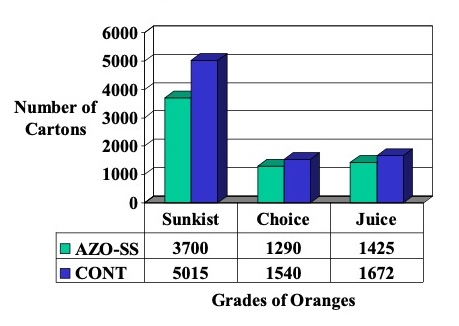
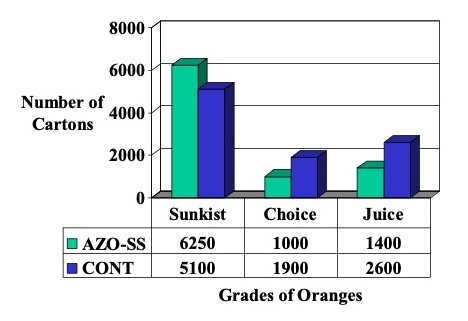
Using these values of fruit quantity and quality in the experimental vs. control sites I was also able to calculate the income data of each block over the past five years. After subtracting the material and application costs, I estimated that the farmer profited over $13,000 that year from just a single mineral fertilization! This represented a nine-fold increase in income from the (consistently under-producing) experimental block compared to the control block, giving a return on investment of $5.28 for every $1.00 invested.
In the farmer’s own words:
I think you’ll be quite pleased with the test results! Thanks for all your help, Lee – this was fun. In my [attached] report, you can see that the plot treated with AZO SS packed out 7,300 of 8,694 cartons (84.0% packout). 71.8% of these cartons were premium grade (Sunkist) fruit – woohoo! That equates to 85.5% of all the fruit in this plot being packed as the highest grade, Sunkist. Additionally, please look at the fruit size breakdown – 80.9% of the Sunkist grade fruit was of the most desirable size.
These findings illustrate that a basic fire mimicry treatment, the mineral fertilization of soils, can be done at scale in citrus orchards resulting in improved health and productivity of the trees, as well as providing farmers profitable returns.


 Sudden Oak Life by Lee Klinger
This is interesting. However, the data is quite old. Have you followed up with the farmer? Did you apply the treatment again? How long did the beneficial effects last?
Also, how much water was the soil supplement applied with? Did the control plot receive a similar boost of additional water?
Thanks for sharing your work out, it always provides food for thought.
Thanks for your comment. I expected your questions, and I sure wish I could report follow up news. Sadly, the farmer retired soon after these results and turned over farm supervision to someone who chose to use “strictly conventional methods” of orchard management. All good. I’d rather work in oak forests anyway.
Also, no additional water was added to either block after treatment.