A more detailed discussion of the science, TEK, practice, and efficacy of fire mimicry is given in my 2024 book Forged by Fire: The Cultural Tending of Trees and Forests in Big Sur and Beyondhttps://www.amazon.com/dp/B0D3ZVMB3P)
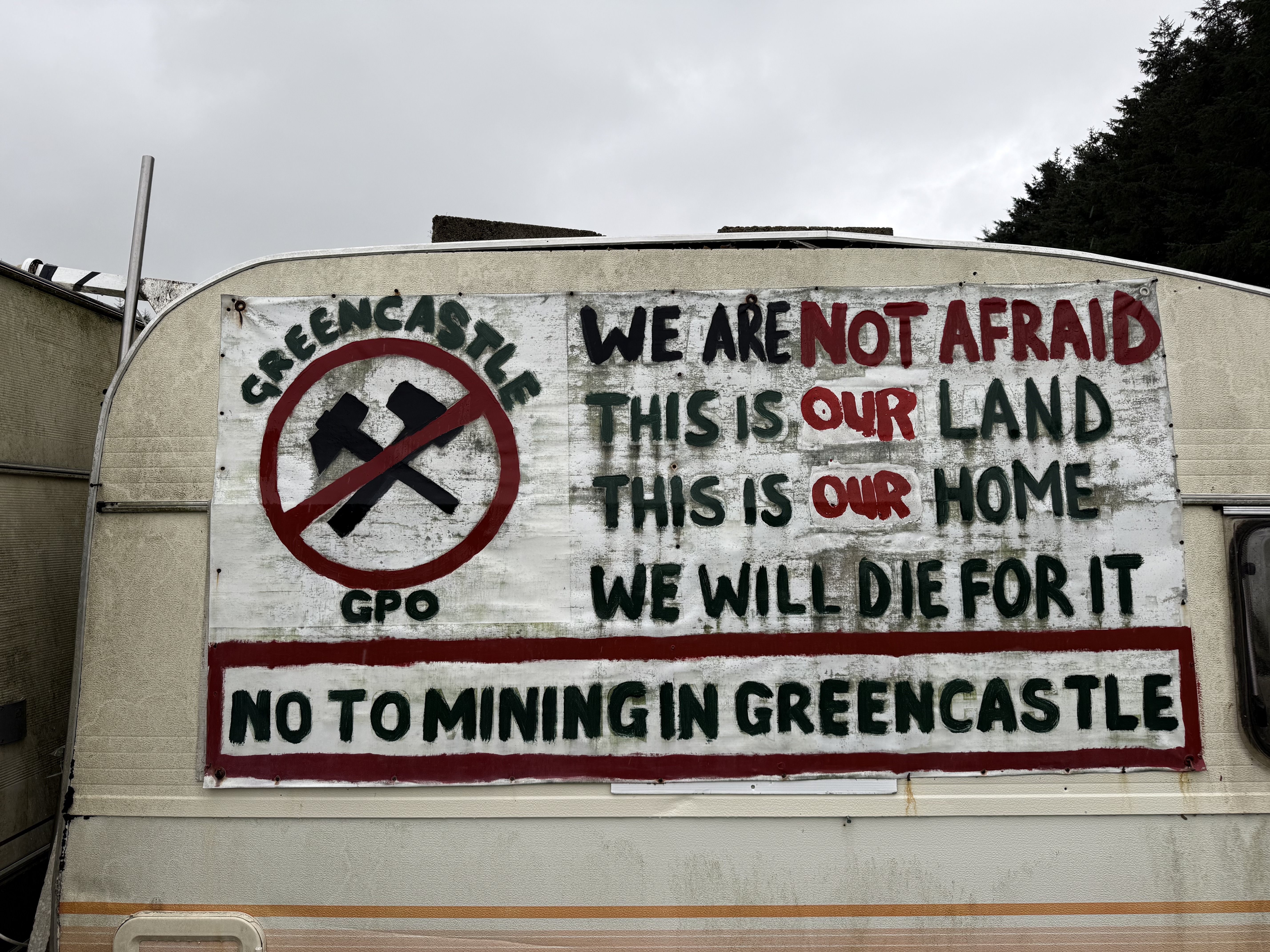
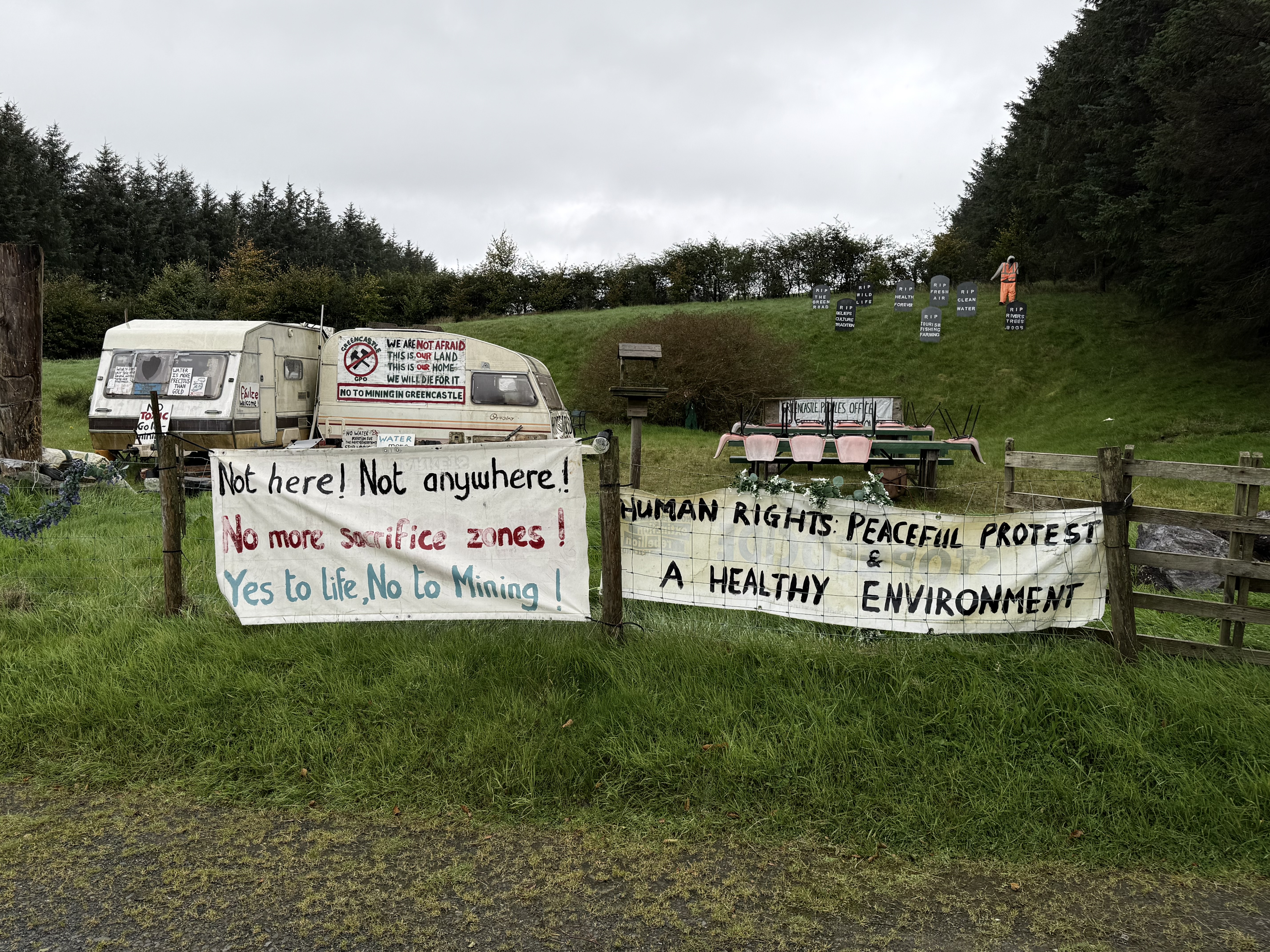
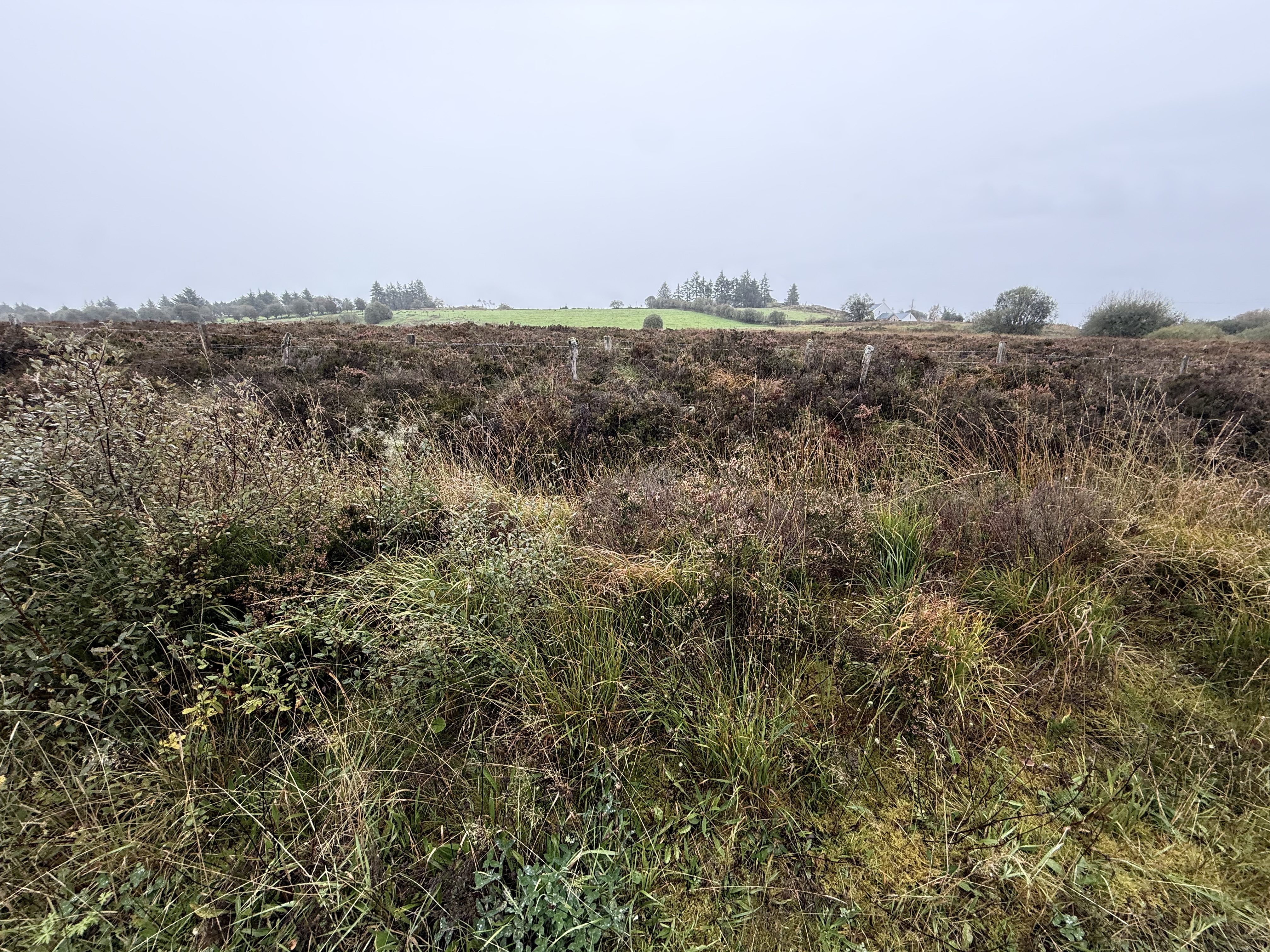
I’ve recently returned from a trip to Ireland where I testified as an expert witness in a public inquiry regarding a prospective gold mine in the Sperrins, a scenic pastoral region of low mountains that supports ancient peatlands and many rare species in northern Ireland. The gold mine is proposed to eliminate approximately 75 acres of peat bogs, most of which are 5000 to 10,000 years old. Legally one of most protected landscapes in Europe, the Sperrins is highly environmentally sensitive and an important cultural landscape.
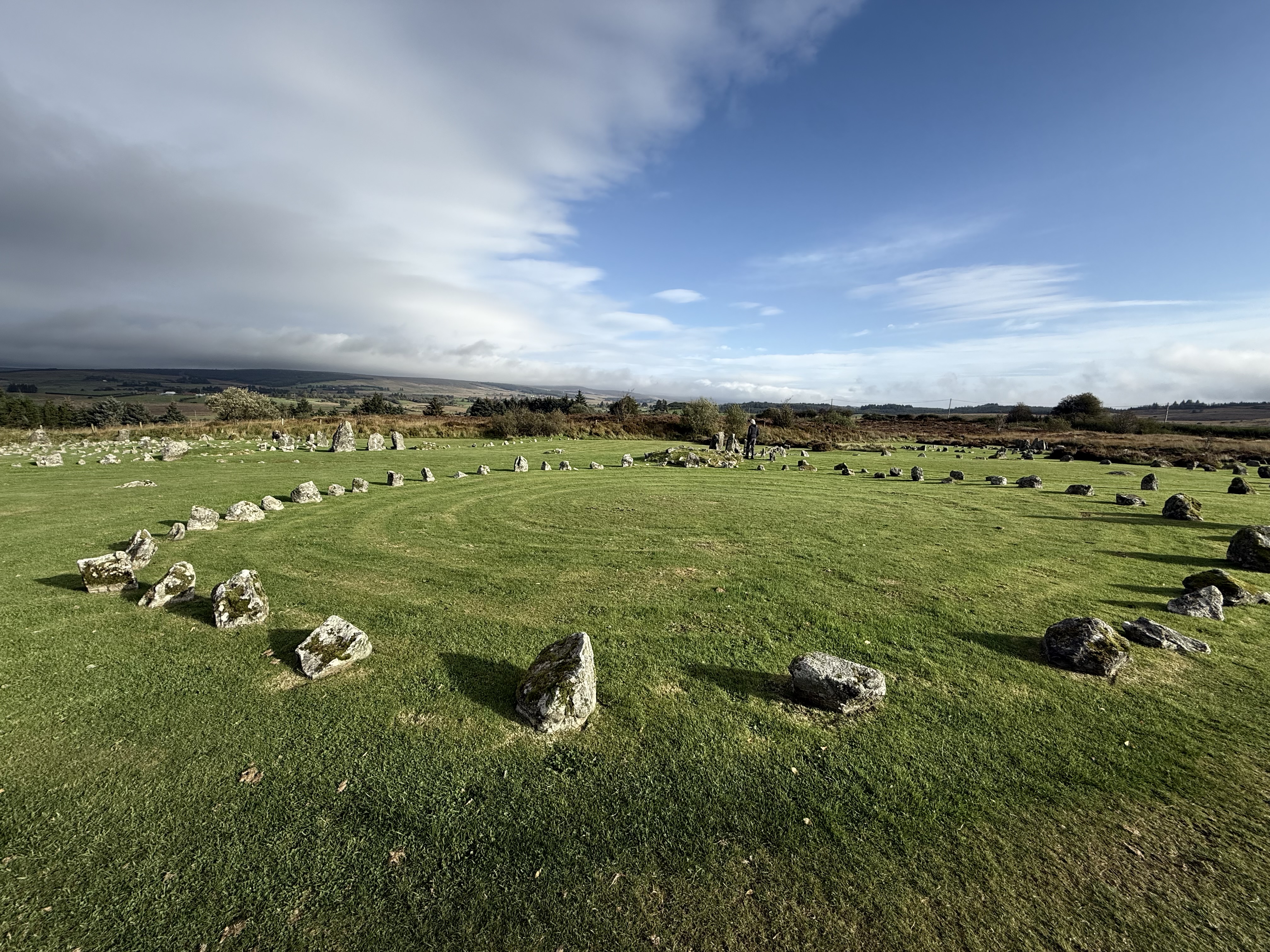
Imagine that a gold mining company here in California proposed to clearcut 75 acres of ancient redwood trees, some dating to over 1000 years old, to simply to access the gold beneath. It follows that it would take up to 1000 years of forest restoration to replace the damage, and likely even longer. Thus, I believe the public outcry here would be deafening with Julie Butterfly Hill-inspired activists occupying the ancient trees. Imagine too that these peatlands may be storing archeological relics such as stone circles and lines of standing stones.
This is the analogy I presented at the Dalradian gold mine public inquiry, except that in Ireland we are not talking about ancient forests, but ancient peat bogs that are 10 times the age of old-growth California redwoods. While most of you know me as a tree and forest care practitioner, my ecological expertise also extends to peatlands and peat bogs. While I’m a passionate defender of old-growth forests, I’m an even more passionate defender of old-growth peat bogs, which I view as climax ecosystems wherever they occur.
The “public inquiry” regarding the proposed Dalradian gold mine in the Sperrins, seemed to me rather asymmetrical. Along the one side of the hearing hall sat the Dalradian contingent, which was anywhere between 20 and 40 people ranging from expert witnesses to regular employees. They were nearly always allowed to comment first on any question posed by the County Tyrone Commissioners. The next group allowed comment were the public agencies who sat in the middle of the hall and included the Northern Ireland Environmental Agency (NIEA) and the Department for Infrastructure (DfI). The final group allowed to comment were members of the public, with labels on our tables reading “3rd parties”. That’s a telling label for the “public” in a public inquiry.
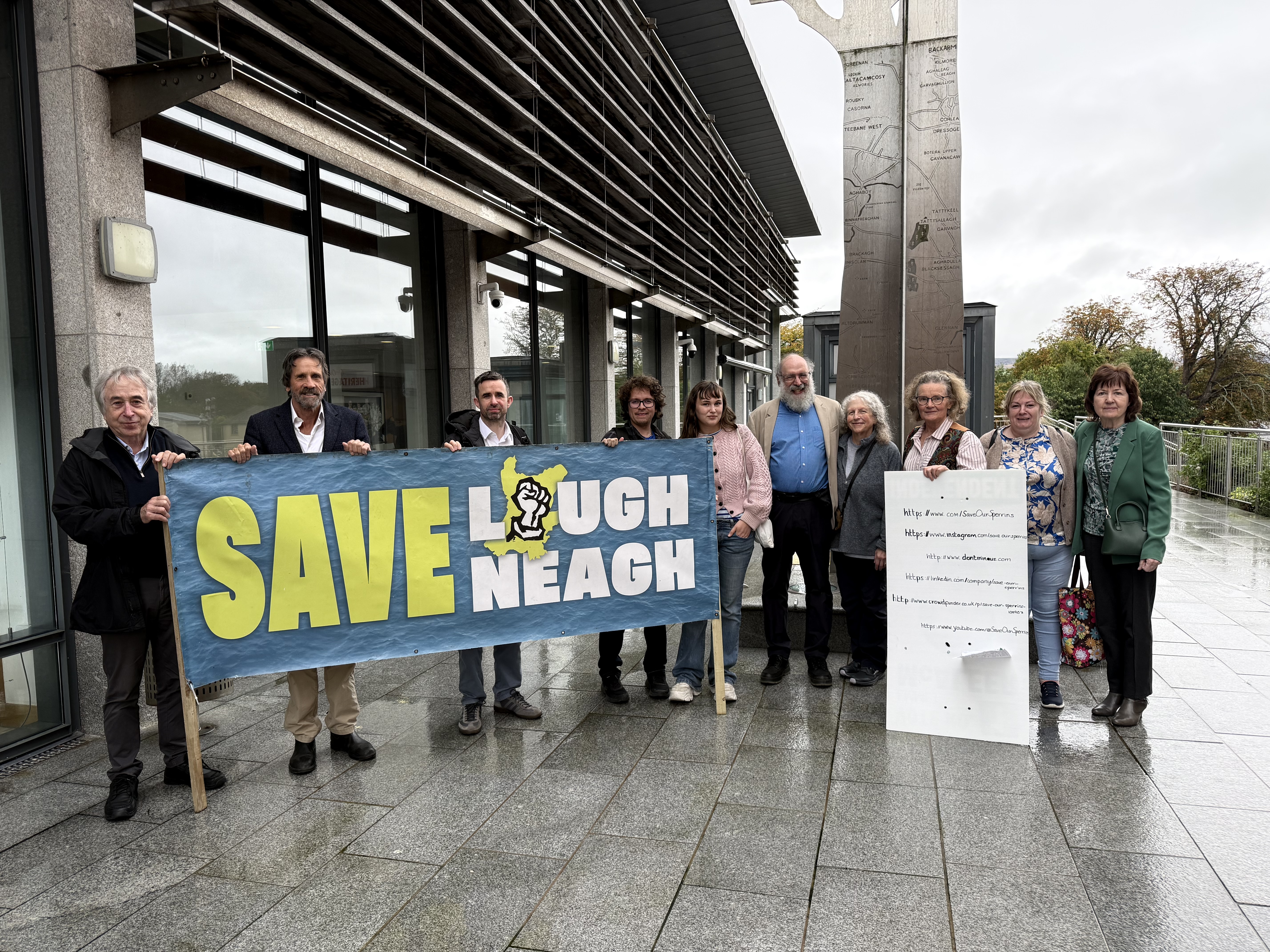
The folks leading the 3rd Parties are the members of Save Our Sperrins (SOS), a local grass roots campaign, led by Fidelma O’Kane and Marella Fyffe, is strongly challenging the proposed gold mine. A few years earlier they engaged with a good friend of mine, Dr. Steve Emerman, who is a expert in mining operations and their harms. His testimonials alone make it clear that the proposed gold mine in the Sperrins violates numerous recommended “best practices” in the mining industry literature, including mine operations, mine waste facilities, and ecosystem restoration.Dr. Emerman’s detailed criticisms in support of the SOS campaign against the gold mine in the Sperrins can be heard in two podcasts. https://www.podbean.com/ep/pb-wv8ar-1b53b36 and https://www.podbean.com/ep/pb-9mq5h-1b3f1dd.
My own testimony focused on the great age of the peat bogs, the detrimental effects of vehicular road dust on Sphagnum mosses, the inability of bogs to function following peatland removal (here involving roughly 217,000 cubic yards of peat), the problematic efforts to restore peatlands with intact sections of peat bog surface vegetation (I’ve already tried that and it simply doesn’t work), and the lack of accounting for the potential release of radioactive Cesium 137 following excavation, which has been tightly bound in the peat since the Chernobyl accident.
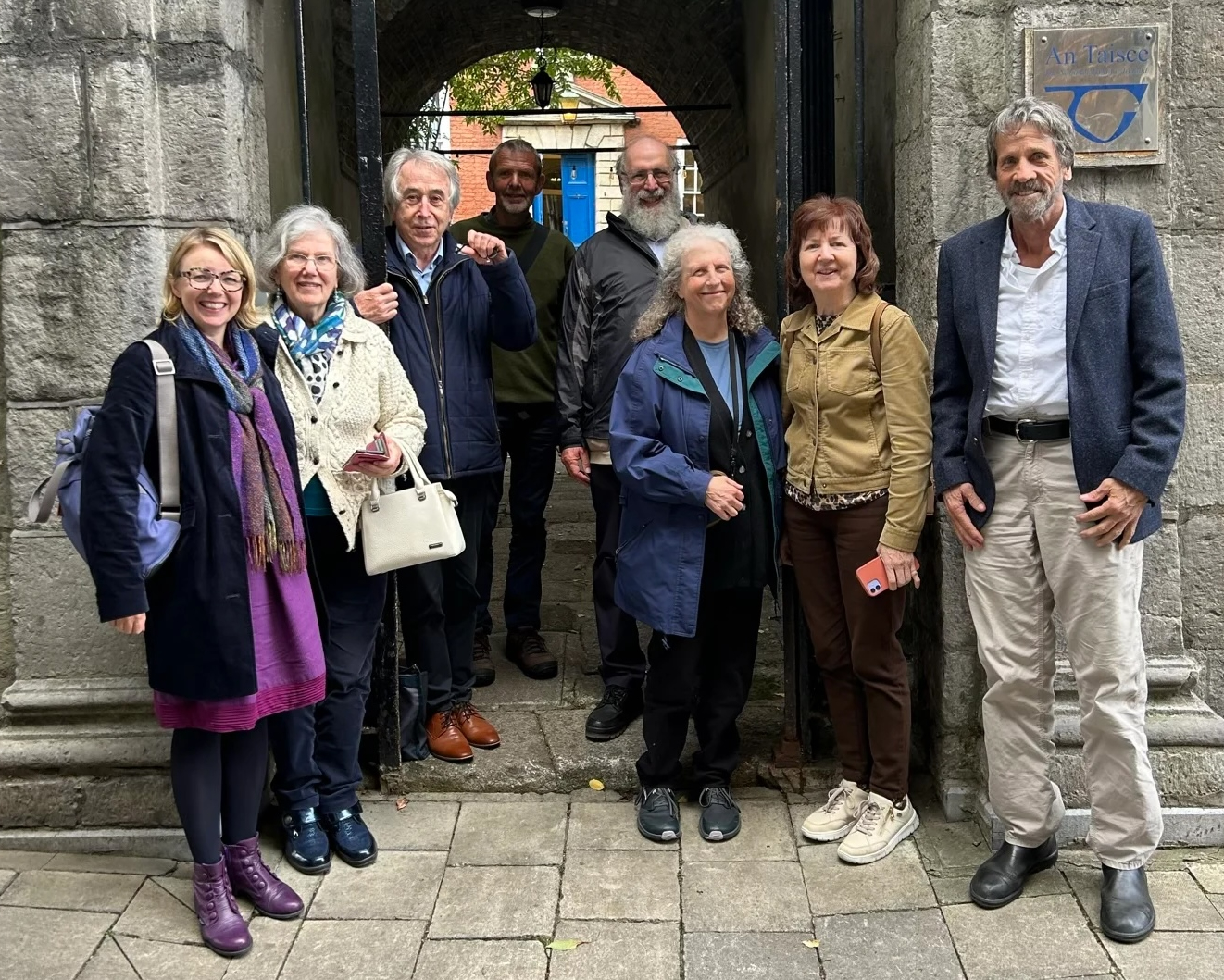
During my visit to Ireland I also attended the 2026 “The State of Mining in Ireland” Conference (4 Oct.) in Dublin hosted by The National Trust for Ireland. Here I was able to connect with many like-minded folks, including Lynda Sullivan, Caroline Whyte, and Amy Strecker, all of whom are, almost single-handedly, waging battles against mining conglomerates intent on profits rather than the care of Ireland and its people.
Perhaps it ‘s relevant that I am part Irish. This was my 4th visit to Ireland and I keep feeling my heritage in this countryside. The one thing that has become clear from during this last visit is that I’ve many more areas of Ireland to explore.
PS. If you’ve read this far, then you deserve a literal gem of knowledge. My next book will explain, in excruciating scientific detail, why gold ore deposits, diamond deposits, and most other ores and gemstones are biological, rather than geological, in origin. In other words, the the gold that the Dalradian corporation plans to mine was formed over many millennia by the ecological and microbial metabolisms of the same peatlands they plan to destroy. Call me crazy, but I truly believe that gem-quality diamonds, like gold ores, are not formed under the high temperature and pressure conditions found in the upper mantle, rather their origins lie in long-lasting microbial metabolisms that are maintained by water and organic carbon compounds released from long-lived overlying peat bog ecosystems.
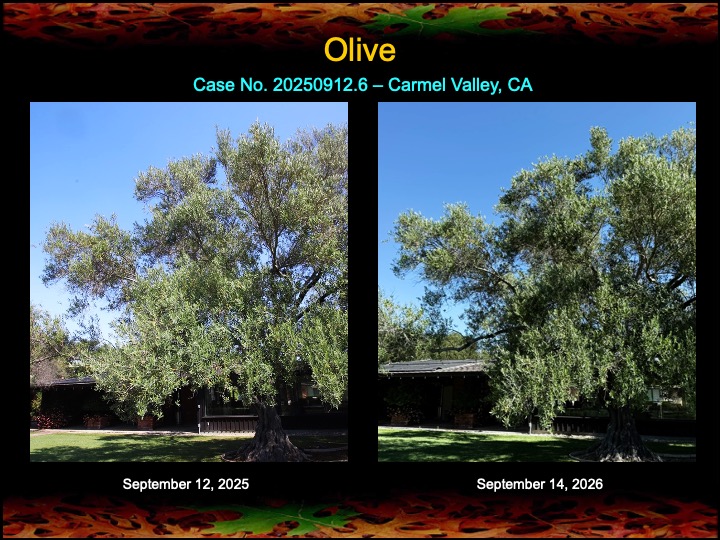
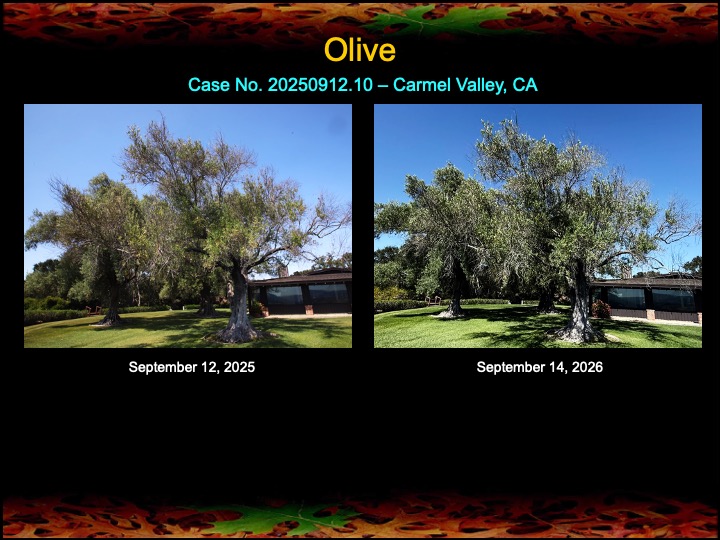
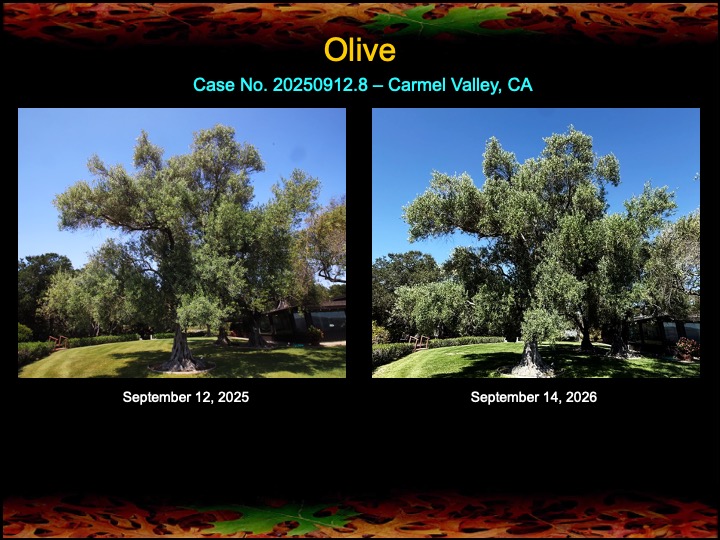
Last year I treated five old olive trees in Carmel Valley, CA that were in variable stages of decline applying the same fire mimicry methods I use on oaks. Their responses after one year are quite encouraging. See for yourself …
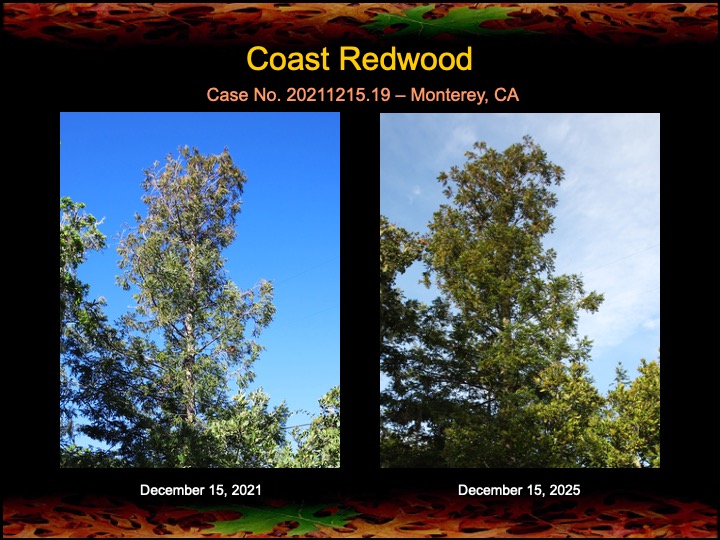
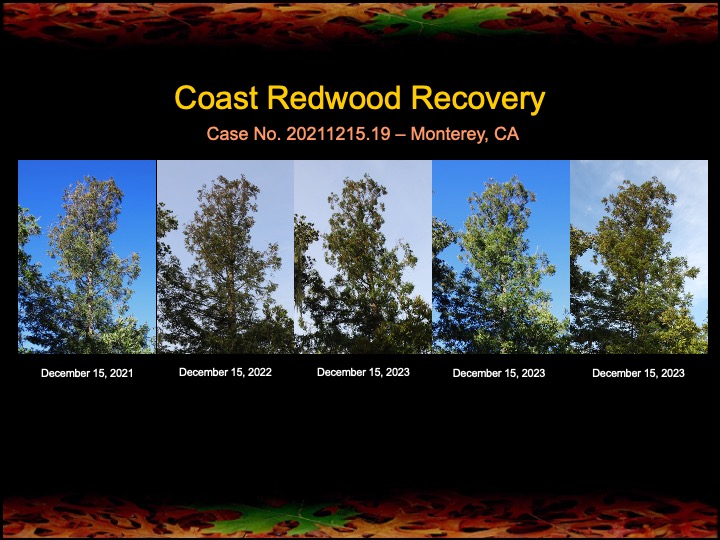
Tomorrow is winter solstice and I would like to celebrate by sharing with you a redwood tree that I’ve been tending with fire mimicry for the past four years. All images were taken on the same date and at the same time of day. Enjoy!
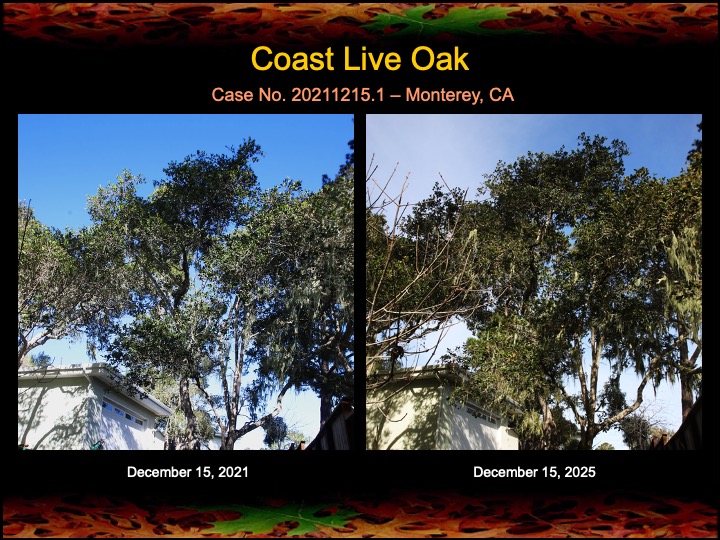
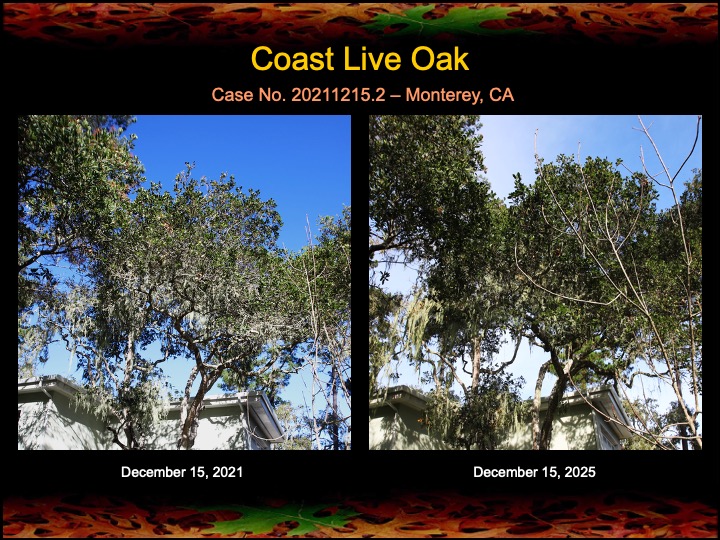
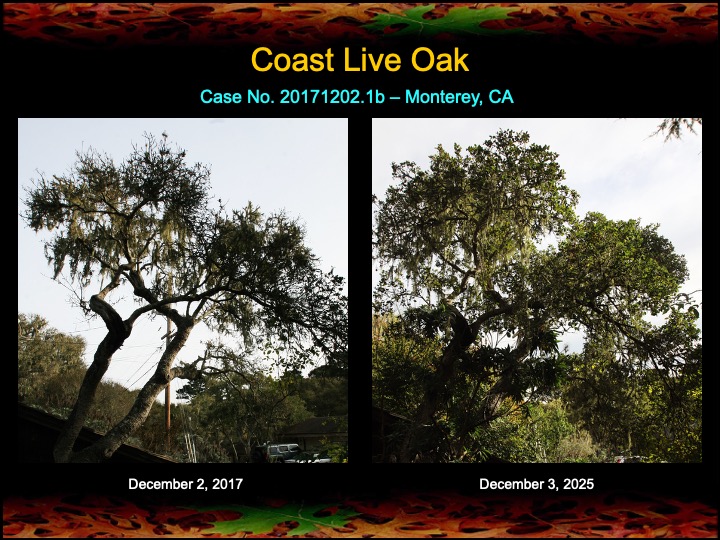
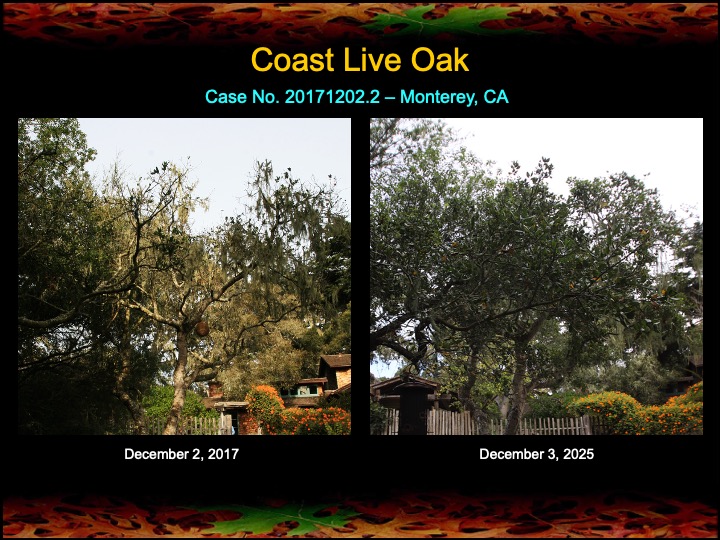
Four years ago I began fire mimicry treatments on a grove of coast live oaks overlooking Monterey, CA. I’m quite pleased with the results but I’ll let trees speak for themselves …
“In 2017 there was a severe oakworm infestation of coast live oaks in the Monterey region and elsewhere. I’m often contacted at these times by property owners concerned about their oaks. Many wish to spray the trees with insecticides to reduce the infestation. Upon my advice, I tell property owners that spraying chemical insecticides is not necessary for the oaks to recover from these infestations, provided they are given proper care. Since the oakworm infestations are related to a lack of cultural fires, which controlled their populations in the past, a way forward is to emulate fire effects on the forest ecosystem.
Thus, rather than using chemical sprays as is typically recommended by arborists, I prefer using fire mimicry treatments to oak trees infested with oakworm. In the present case study I recommended to the property owner to do fire mimicry treatments instead of spraying the oaks. Never knowing for sure, I explained to them that the oaks would likely recover from the infestation, and that they would show continued improvement in the following years. A second set of fire mimicry treatments were preformed the following year (2018).”
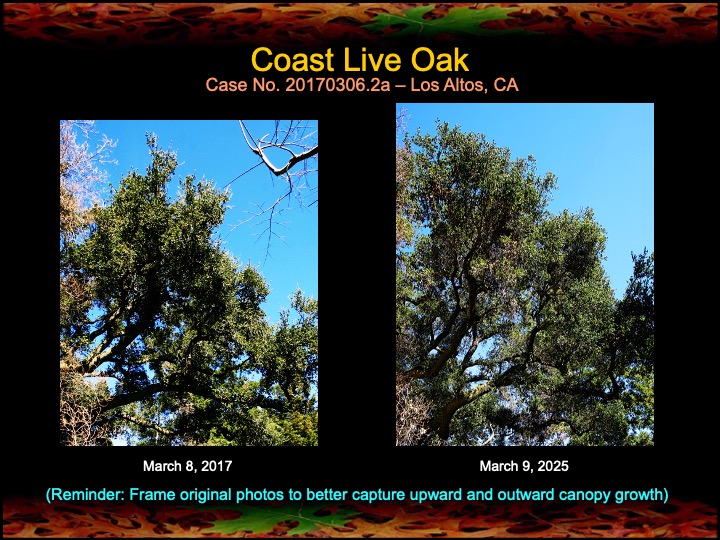
The repeat photo sets shown last year and the new ones from this year indicate that the oaks have continued to maintain healthy canopies following the 2017 oakworm infestation.
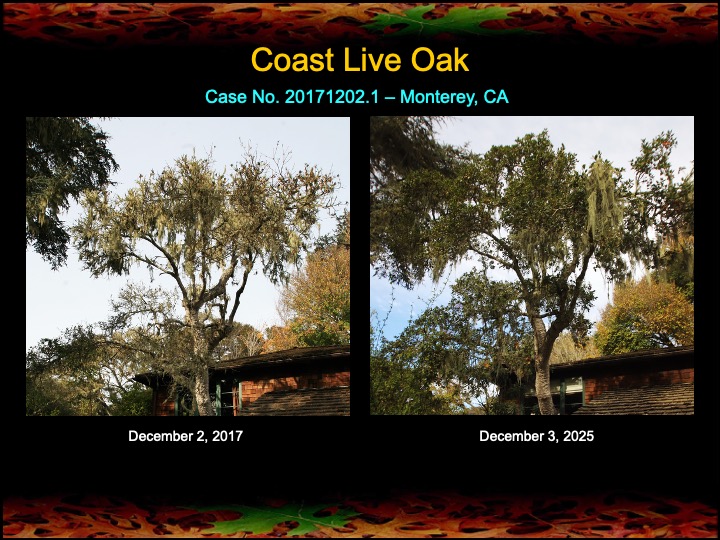
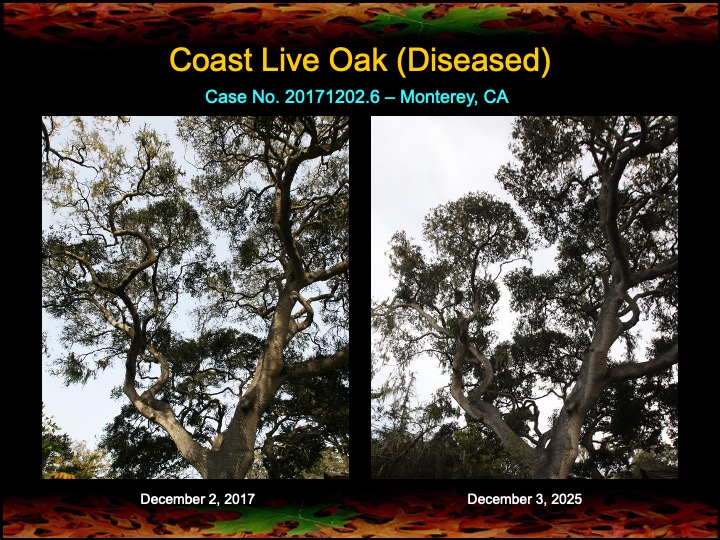
This is a 2017 image of an old-growth coast live oak in Monterey that I’ve been treating with fire mimicry for eight years. At that time it had bleeding stem canker infection, possibly Sudden Oak Death disease or Armillaria (oak root rot), at the base of the trunk. After the initial soil fertilization treatments I performed a surgery on December 2, 2018 to remove, cauterize, and poultice the canker infection.
Here are the results:
After seven years the surgical wound has shown continuous healing with no residual signs of infection! The oak’s canopy density has also increased during this time (see photo set below).
Yesterday I examined a grove of coast live oaks that have undergone fire mimicry treatments for the past five years. Some of these oaks are centuries old and show signs of being tended by the Native Awaswas People. Here are the latest before-and-after photos showing a significant increase in health of the canopy foliage in ALL of the treated oaks. Enjoy!
(The above photo set may appear to be of different locations, but they are both taken from nearly the same spot.)
Hey fellow tree-huggers, especially those in SoCal, how would you like to learn about the health and care of our old-growth oak forests and what we can do to mitigate wildfires using the knowledge of a broad community of stakeholders? Well next week Sudden Oak Life and the Santa Monica Mountains Fire Safe Council are giving you the opportunity to explore these issues together amid a mix of voices from the Indigenous Tribes of the LA basin, the National Park Service, California State Park Rangers, the local community fire safe council, and me, a western-trained ecologist. Please join us for a three-day (and night) learning and camping experience where you will not only up your skills, but, more importantly, you will help grow and strengthen the community of people that is necessary to better tend our forests.
This workshop will likely fill up so please consider registering soon and/or sharing this announcement with your community. Workshop registration: https://www.smmfsc.org/oakworkshop
Below are further workshop details and a schedule of activities:
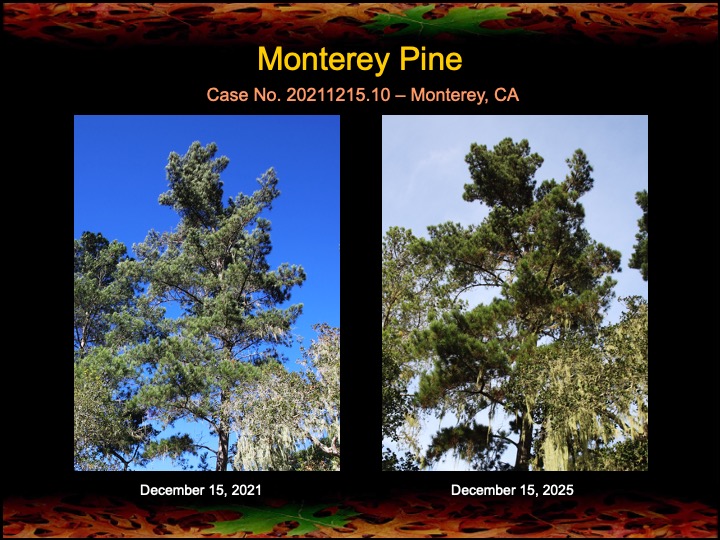
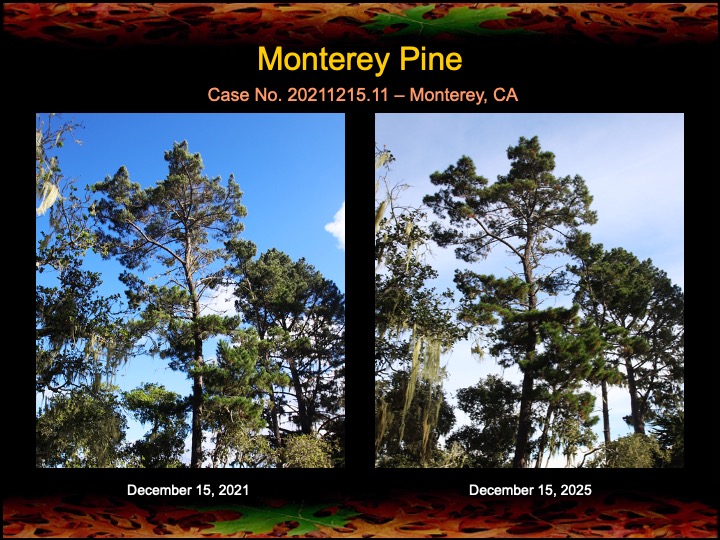
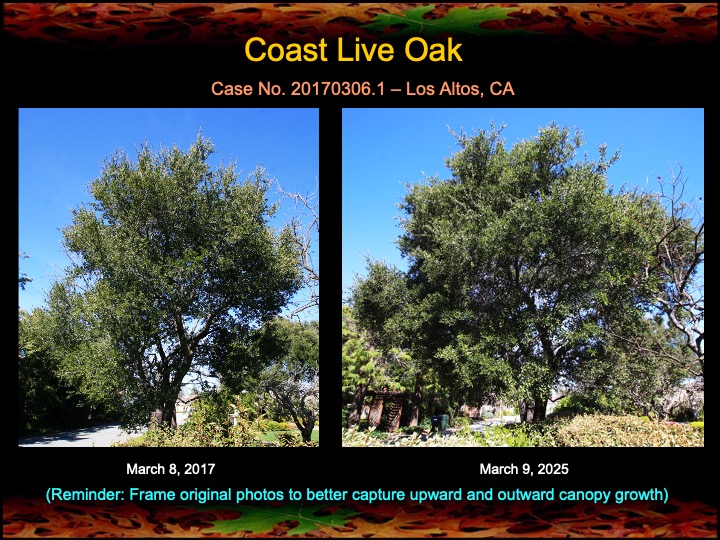
Eight years of tending these coast live oaks and coast redwoods with fire mimicry. (Note to self – widen frames of original photos to better capture future upward and outward canopy growth)









Recent Comments