Today’s KSQD show Talk of the Bay with host Christine Barrington features my work with the Esselen Tribe, and includes a few spoilers from my new book “Forged by Fire”.
I often tell people inquiring on how to best care for their oaks that doing nothing is not an option! It seems that most people see oaks as native trees of California that have adapted and endured here for thousands of years, so they should not need our care.
Missing from this understanding is that the great oak forests here are the result of thousands of years of care by the Native Peoples. That is why those of us who know this are tending the oaks with fire and/or fire mimicry and seeing clear improvement in their health. Indeed, most of the information on this blog addresses mainly the positive results of tending trees.
But what happens to oaks when we do nothing?
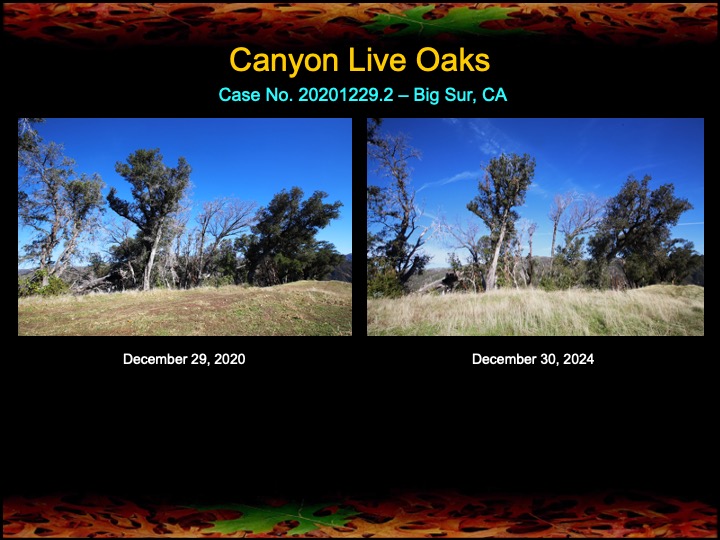
Here I present four-year photo sets of numerous canyon live (Valparaiso) oaks where nothing has been done, save for one oak that received a partial fire mimicry treatment in January of 2021. Most of the oaks are showing noticeable decline in canopy leaf density, a fair measure of the trees’ overall health. Several show no clear change in canopy density, and one or two seem to have improved over the past four years.
Can anyone guess which of these oaks received a partial fire mimicry treatment?
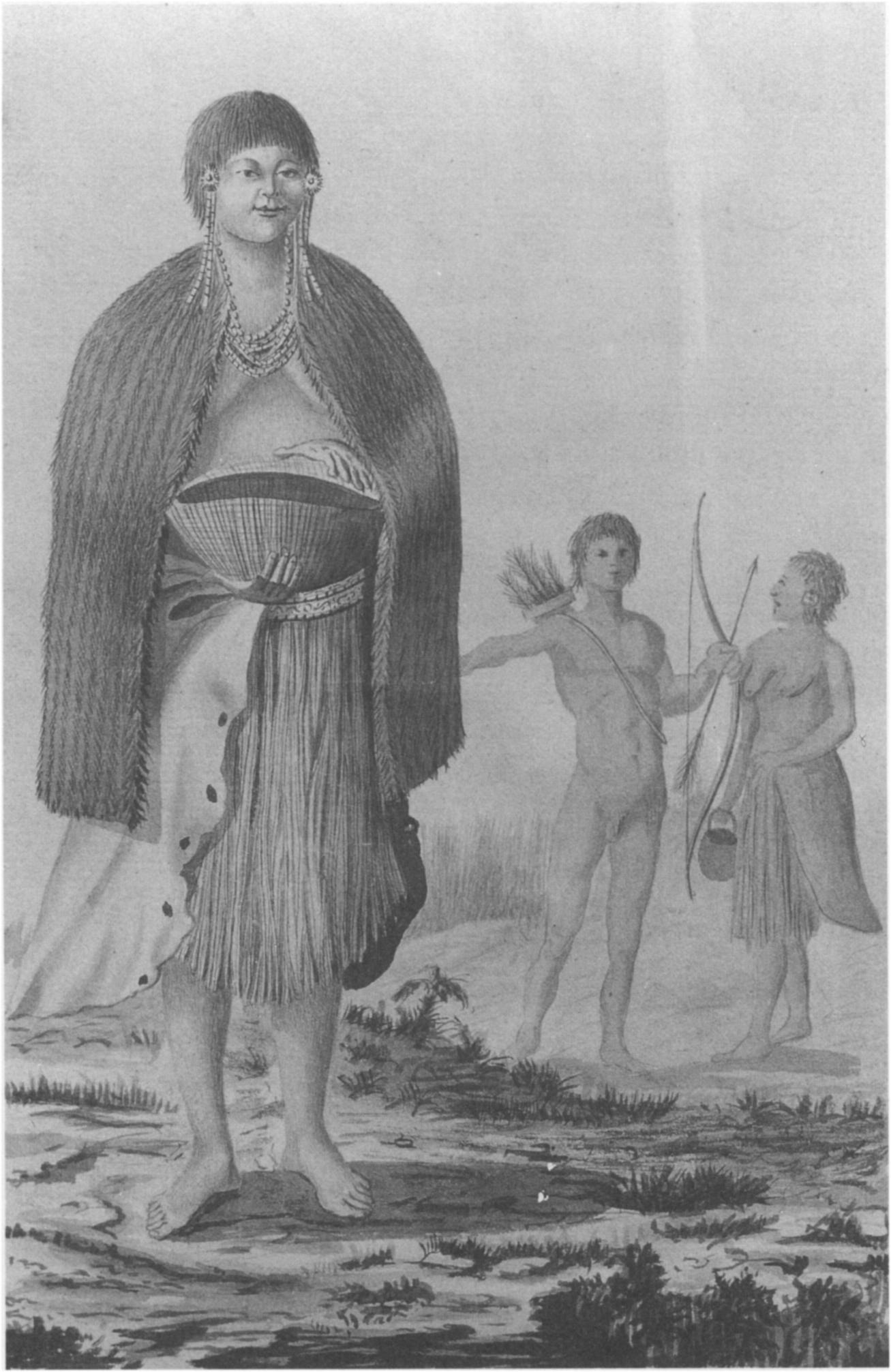
For thousands of years the Native Peoples living here along the central coast of California, the Esselen and the Rumsen (Figure 1), tended the lands with cultural fire and other management practices, creating mosaics of oak forests, redwood forests, savannas, chaparral, and scores of other land and marine ecosystems, which together helped sustain the People, the plants, and the wildlife. Over time, the lowlands and hillsides surrounding Monterey Bay, like in many other places in California, came to be dominated by old-growth oak forests and woodlands, as these provided rich sources of acorns and other important foods.
Figure 1. Native Indians of the Monterey, California area circa 1791 as drawn by José Cardero.
On the evening of December 16, 1602, this all began to change when the first western colonizers, the Spanish Vizcaino Expedition, sailed into Monterey Bay (Figure 2). They were, no doubt, noticed by the nearby Rumsen People, but it wasn’t until the next day that first contact was made. That morning, Ensign Alarcon arrived in a landing boat with orders from the admiral to “make a hut where a mass could be said and to see if there was water, and what the country was like.” He soon reported back that there was fresh water and “a great oak near the shore”, where a hut and arbor were prepared for mass. Upon hearing this news Sebastian Vizcaino and crew embarked to shore and a Catholic mass was said at the improvised altar under this “great oak.”
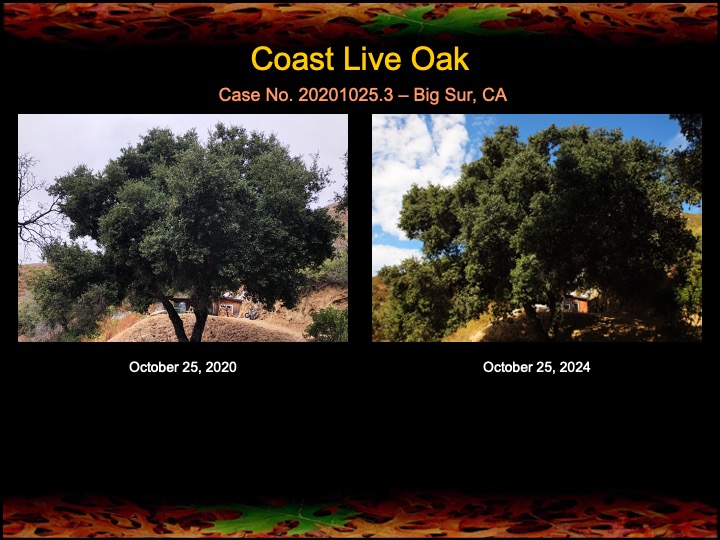
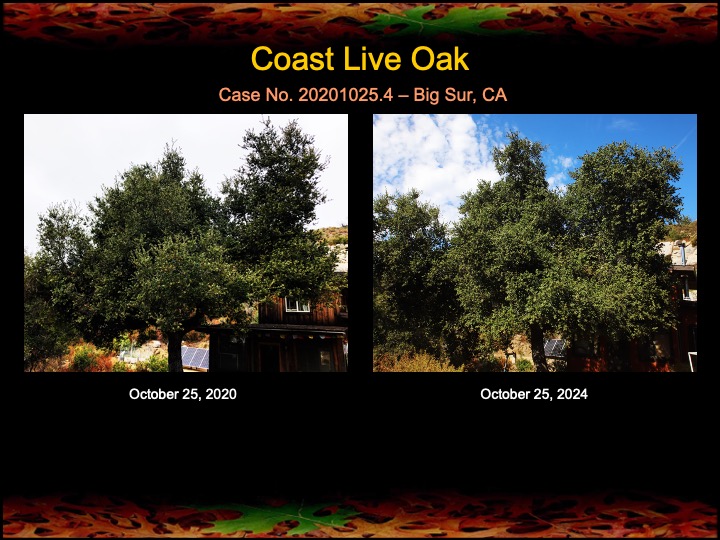
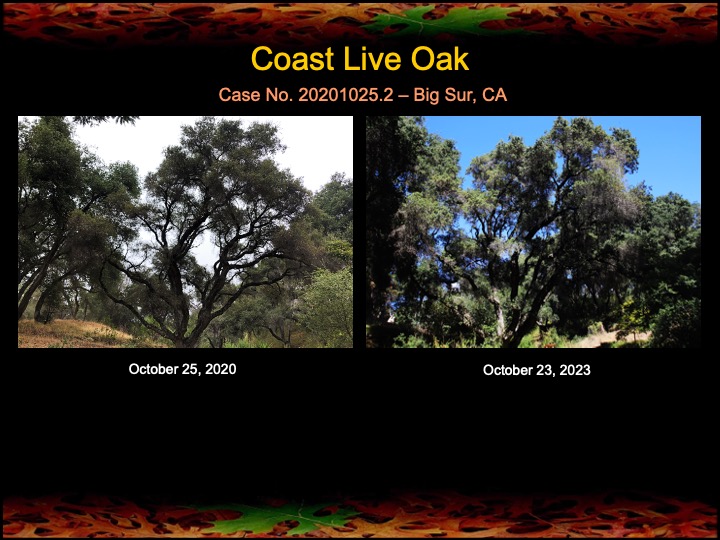
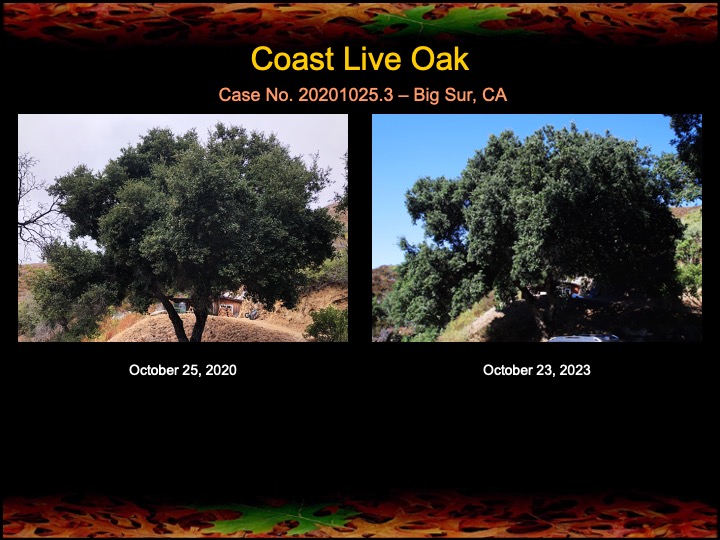
Here are four coast live oaks and a black oak we treated back in 2020. Some additional surgery was done in 2022 to remove lingering canker infections on the oak above. While the above ancestor oak (300+ years old) is still diseased, further surgery and fire mimicry treatments should keep it alive for decades.
Three years ago I began fire mimicry treatments on five oak trees here in Big Sur. I also performed a large canker surgery on one of the trees, an Ancestor oak that is about 350 years old. Here are the results captured with repeat photography. Enjoy!
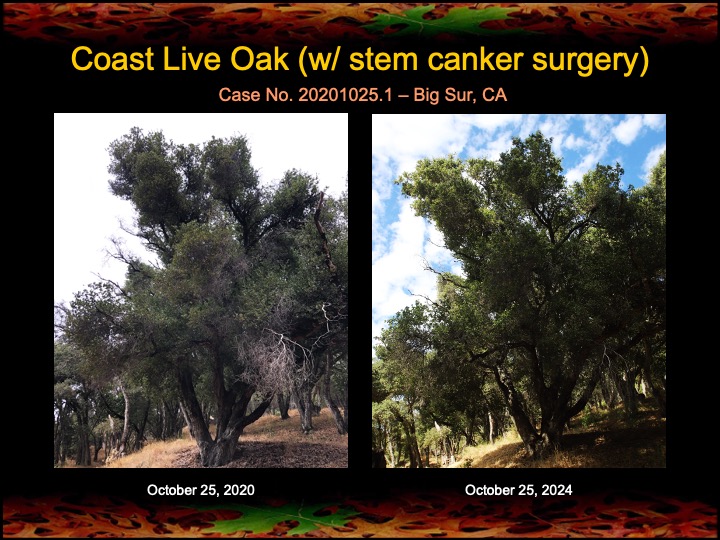
In October of 2020 I began fire mimicry treatments on 4 coast live oaks and one black oak here in Big Sur. The above oak also received a major stem canker surgery. Yesterday I checked on the progress of the oaks at the two year mark, nearly to the minute. I’ll never tire of seeing trees get healthier!
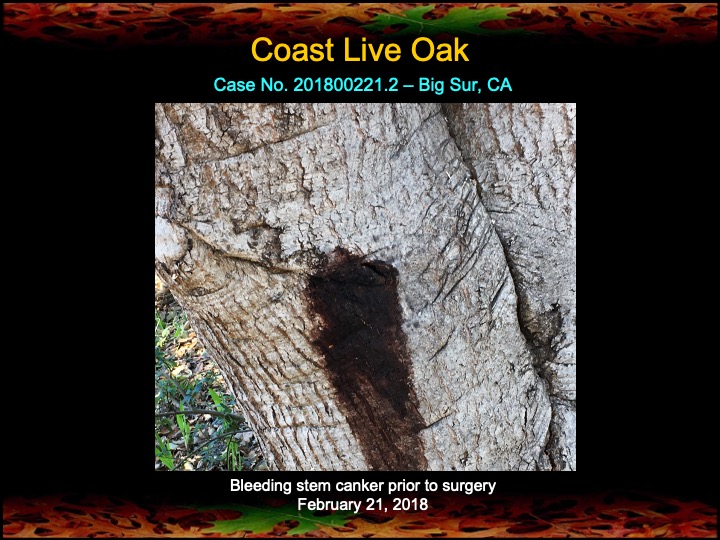
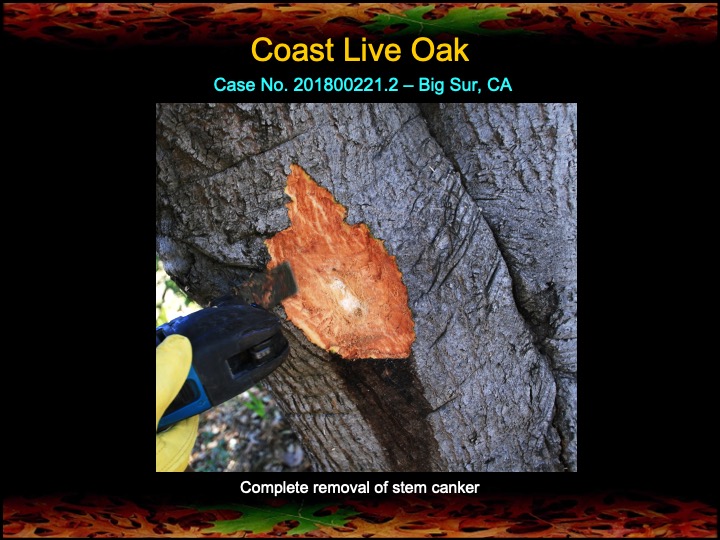
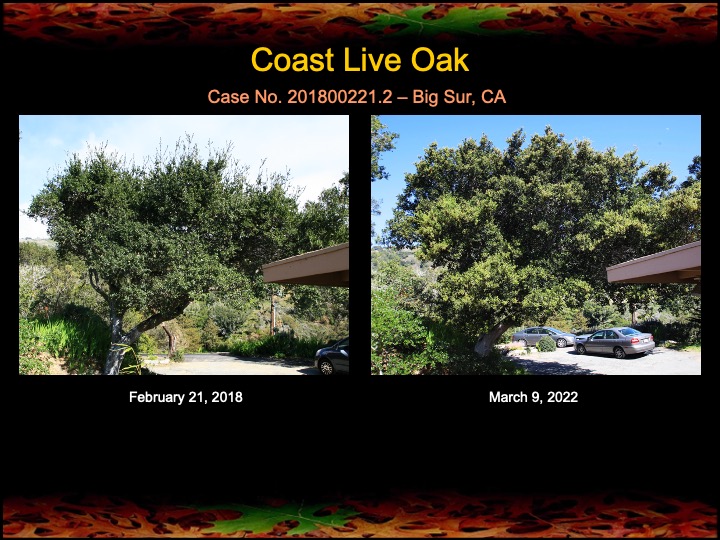
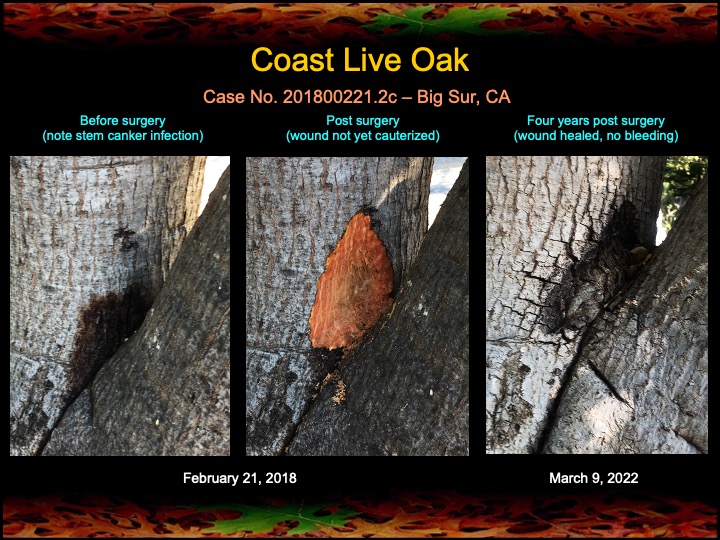
Several years ago I started fire mimicry treatments on a coast live oak in Big Sur, CA. The treatment included stem canker surgery, as well as soil fertilization and limewash application. Here is a set of photos showing both the surgical procedure and progress of recovery of the wound and the canopy health of the oak. Be sure to look at the final photo of this sequence!
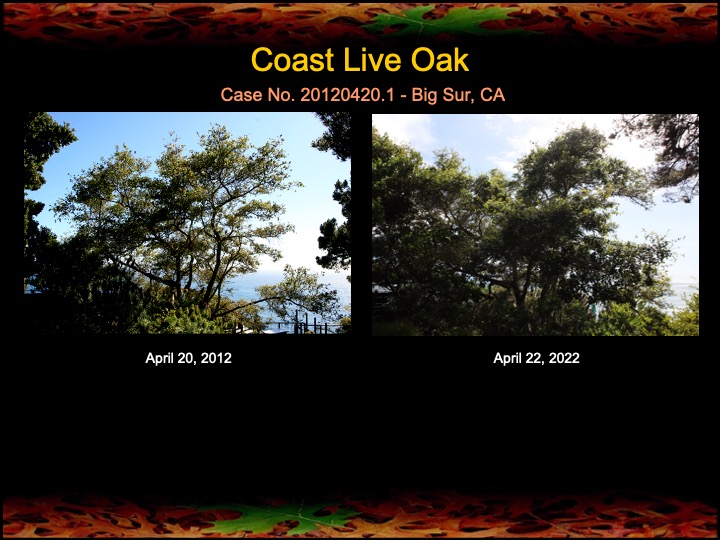
Four years ago I performed fire mimicry treatments and two canker surgeries on the above coast live oak in Big Sur. This oak was treated again two years ago. I checked on the oak yesterday and found it has completely transformed into a lush, vibrant tree. The bit of yellowing seen at the tips of the branches are thick clusters of male flowers. The two surgical wounds (below) have mostly healed shut will no remaining infection in one and a minor residual infection in the other.
Another nearby coast live oak was also treated twice with fire mimicry in the past 4 years, although did not require any surgery. Here are the results of that oak.
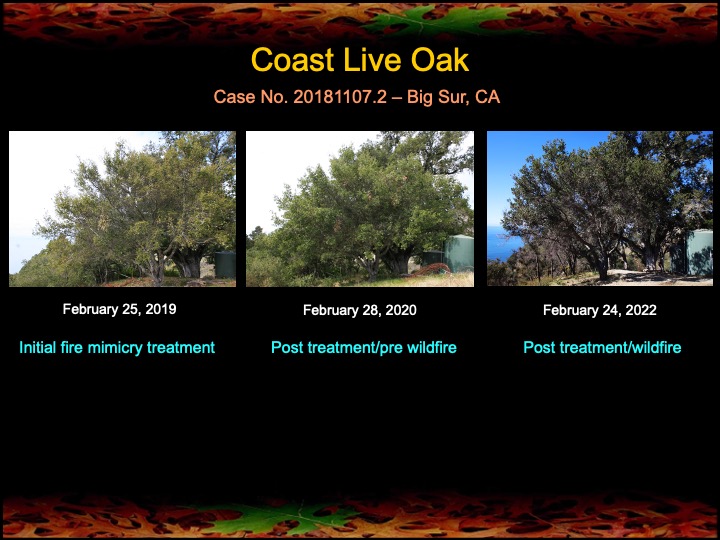
In February of 2019 I began photo documentation of 21 coast live oaks in Big Sur, CA. At least six of these appear to be “Ancestor” oaks, culturally-modified by the Esselen Indians via pollarding of their canopies. All oaks were initially treated with a fire mimicry protocol (clearing, pruning, moss/lichen removal, soil fertilization, & limewash), with the intention that this work would improve the survival rates of the oaks, whether or not a wildfire occurred. The first year results were About photo documented in February 2020. In August 2020 a severe wildfire was ignited in the area and burned through all the groves of the treated oaks.
Yesterday I was finally able to access the site to observe and photo document the findings. Both wooden structures on the property were lost, as were two treated oaks that grew adjacent to them. However, of the 21 oaks initially surveyed, 17 survived the fire, a survival rate of just over 80%. Four of the six “Ancestor” oaks also survived. More than 75% of the oaks showed noticeable signs of improvement in canopy lushness following fire mimicry. A year and a half after the wildfire, 6 of the surviving oaks continue to show signs of heavy fire damage in their canopies. However, 11 (or just over 50%) of the surviving oaks are showing significant improvement of their canopy health following the wildfire.
These are exciting results (see photos below) and show to me that fire mimicry treatments can provide considerable benefit to survivability and health of oaks and other trees in the event of a wildfire.










 Sudden Oak Life by Lee Klinger
Recent Comments