Ancient redwoods in decline

21 01 2010

A week or so ago a large redwood tree growing near my home here in Big Sur lost its top. The wind blew hard and broke off the upper part of the redwood as shown in Photo 1. In many places around Big Sur ancient redwood trees have lost their tops during the winter storms. Some of these tops are more than three feet in diameter and you don’t want to be around when they come crashing to the ground.
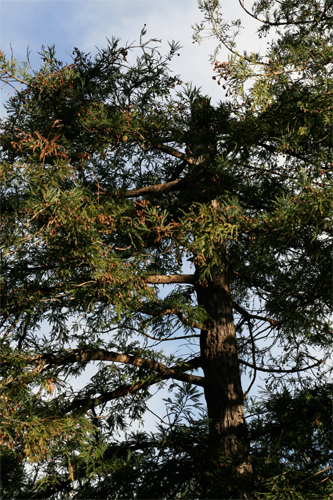
Photo 1 (photo by Lee Klinger)

I realize, of course, that it is not unusual for large trees to succumb to high winds, but what does seem unusual is that in some groves nearly half of the ancient trees have lost their tops within the past 20 years or so. By all appearances these redwoods have grown healthily together in these groves for three, four, five centuries or more, so why are they suddenly losing their tops?

The answer is not too hard to figure out. Yes, there is acid rain falling in Big Sur (see here, here, and here) and that no doubt has some effect on the redwood ecosystem. But recent changes in land practices, most notably fire suppression, are causing dramatic shifts in the successional status of the redwood forests. In the past the native people set fires that revitalized the soil and kept the young redwoods from crowding out the older ones. Read the rest of this entry »



Acid rain in Big Sur – Dec. 2009 update

5 01 2010

Acid rain continues to fall at my home here in Big Sur. During December 2009 there were seven measurable days of rain with the following values:

Date        Amount      Mean pH          N

Dec. 7         0.29″           4.74              3

Dec. 11       0.42″           4.53              3

Dec. 12       0.53″           4.31              3

Dec. 13       0.62″           4.71              4

Dec. 22       0.20″           4.52              2

Dec. 27       0.19″           4.36              2

Dec. 30       0.23″           4.60              2

The pH readings from Dec. 12 are some of the lowest (highest acidity) yet recorded here in Big Sur in over three years of measurements.

Meanwhile, oaks, pines, and bays are dying by the thousands. Don’t suppose there’s a connection, eh?


A holistic approach to mitigating pathogenic effects on trees

25 12 2009

For those of you who would like to read more about the details of the science and techniques involved in fire mimicry practices for oak restoration, here is a paper I wrote last year:

A holistic approach to mitigating pathogenic effects on trees

by Lee Klinger MA PhD

Presented at: Treework Environmental Practice Seminar XII
National Museum Cardiff, Cardiff, UK – 13th November 2008

Summary

The conventional ‘disease model’ approach to tree health focuses on identifying and controlling a specific pathogen (or pest) implicated as the causal agent of tree decline. Alternatively there are more holistic approaches in tree health that address a broader suite of processes occurring at the ecosystem level which may be predisposing the trees to infection by disease. Here I describe a holistic methodology that takes into account not only the proximal agents involved in tree decline, but also the age and structure of the forest, the abundance of cryptogams, the fire history, the acidity of the precipitation, the fertility of the soil, and the historical land care practices. This methodology is being implemented in the oak forests of coastal California which are experiencing high levels of mortality attributed, by most scientists, to the pathogen Phytophthora ramorum (aka sudden oak death). Evidence reported here of 1) acid rain, 2) acidifying effects of mosses and lichens, 3) the presence of acidic and nutrient deficient soils, and 4) a much lowered incidence of disease in recently burned areas, points to the likelihood that fire suppression has radically altered the structure and successional status of the forests, leading to enhanced competition and systemic acidification. Case study results of sick and diseased coast live oaks receiving holistic care, aimed not at treating P. ramorum but at reducing the environmental acidity, fertilizing the soils, and otherwise mimicking the effects of fire, show noticeable improvement in the health of the oaks after one year (78%, n=152), with further improvement in years two (84%, n=134) and three+ (81%, n=80). While the results do not indicate that the incidence of P. ramorum has changed significantly in the population of treated oaks, there is evidence that the sick, non-diseased trees are better able to resist infection.

Download the complete paper here.


Early season rainfall pH measurements in Big Sur

19 10 2009

Here is some news for those of you interested in following the story of acid rain in Big Sur. The first rains have arrived here in Big Sur in a big way, 8.45″ of rain fell between Oct. 12 and 14. The pH readings on the first 3 inches of rain averaged 5.41, the highest value (lowest acidity) yet recorded in over three years of measurements.

Another small storm brought some rain today (Oct. 19) which totaled just 0.14″, with a pH value of 4.79. This value is more in line with readings from the previous three years and represents a significant drop (increase in acidity) compared to the heavy rains last week.

What do you suppose is going on?


On the origins of fire scars in California redwoods

10 05 2009

UPDATE: For a more detailed discussion of the science and traditional knowledge on this subject please refer to Chapter 3 “The redwood giants” in my book Forged by Fire https://www.amazon.com/dp/B0D3ZVMB3P

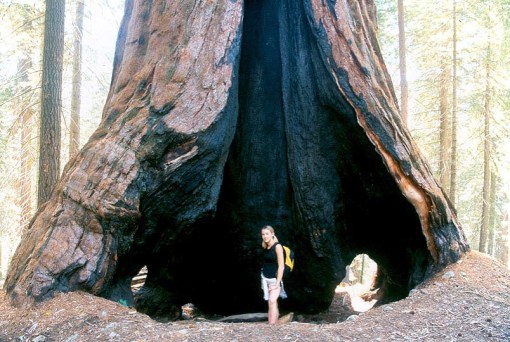
Anyone who has spent time with the redwoods has no doubt seen and even ventured inside the giant trees with fire-scarred trunks. Certain trees are so severely scarred that you wonder how they are even able to stand. Some trees contain cavernous fire-carved rooms in their base with multiple entrances and even window-like openings. I’ve marveled at these trees and looked carefully at the orientations and shapes of their scars, and in doing so have found some odd things.

Huge fire scar

Huge fire scar in giant sequoia (photo by Lee Klinger)

Having worked on fire lines in Alaska, Colorado, and California I’ve seen how fire scars are formed. A large quantity of fuel piled at the base of the tree is usually required to ignite a fire hot enough to penetrate the bark and scorch the cambium.

A characteristic burn pattern is seen on slopes where the vast majority of fire scars occur on the uphill face of the trunk (more than 90% in places)[1]. This is due to a couple of factors. First, hot air currents tend to drive ground fires upslope, especially during the day when fires burn hottest. (Keep in mind we’re talking about large ground fires, not large canopy fires which would more likely kill the tree.) The wind-driven fires tend to burn relatively quickly around the lower parts of the trunk, but eddy effects allow the fire to linger on the uphill side. Second, fallen leaves and branches tend to move downhill and accumulate on the uphill side of the trunk. Together these factors seem to account fairly well for the uphill side tendency of fire scars.

So imagine my confusion . . .  Read the rest of this entry »


Sudden Oak Death

3 05 2009

In recent years a whole lot of attention has been paid to Sudden Oak Death, a stem canker disease (Phytophthora ramorum) that has sickened countless oaks in California. I, too, believe that Sudden Oak Death is a particularly aggressive pathogen that requires our careful observation and study. To be sure, I often inspect the sick coast live oaks and tan oaks here in Big Sur and at least half have bleeding stem cankers.

Sudden Oak Death casaulty in Big Sur

Sudden Oak Death casaulty in Big Sur (photo by Lee Klinger)

Still, there are many other problems I am seeing in these forests that cannot be attributed to Sudden Oak Death. Pines are becoming infected with pitch pine canker, sycamores are sick with anthracnose, bays are toppling from a root collar fungus, and redwoods are losing their tops. It seems that something larger is going on . . . Read the rest of this entry »


Acid rain in Big Sur

28 04 2009

Having been in my progress so often misled by taking for granted the results of others, I have determined to write as little as possible but what I can attest by my own experience.” – John Dalton, Independent Scientist (1766-1844)

UPDATE (May 2, 2009): In the past 24 hours it has rained 0.93″ here in Big Sur with a pH of 4.56. I have amended the seasonal data accordingly.

UPDATE 2 (May 5, 2009): An additional 0.08″ was recorded, but the sample was too small to obtain an accurate pH reading. The seasonal data have been amended.

Anyone who thinks acid rain does not occur in pristine, unpolluted environments had better think again. Or better yet, go get some litmus paper and check it out for yourself.

Scientists studying Sudden Oak Death have dismissed acid rain as a relevant factor in oak mortality, pointing out that areas of severe decline are near the coast, upwind of the major sources of pollution, thus rainfall could not be acidic. Here along the coast of California storms blow in from the ocean where there are few sources of manmade pollutants. Rainfall pH, then, is not expected to be any more acidic than about 5.6, which is the theoretical pH of unpolluted rainwater in equilibrium with atmospheric CO2.

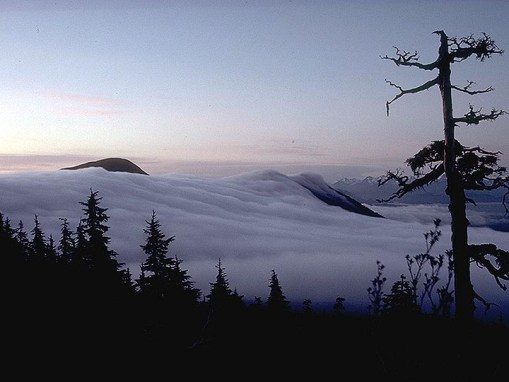
Acid precipitation in southeast Alaska

Acid precipitation in southeast Alaska (photo by Lee Klinger)

However, I have learned from past research that rainfall in pristine environments can sometimes be quite acidic[1]. So for the past three years I have been recording rainfall at my home in Big Sur using a Stratus RG202 rain gauge. Readings of rainfall pH have been made with a high-precision Beckman (Model Φ250) pH meter using a standard two-point (4.00 & 7.00) calibration. The rain station is located 1.2 miles from the coast at 36° 16’N; 121° 49’W, and 922’ (281 m) elevation.

Here are the results: Read the rest of this entry »