The Old Oaks Home

30 07 2024

There’s a special place near Monterey that is an oak lover’s dream – over 600 acres of undeveloped, intact old-growth oak forest and savanna, never burned, that I’ve been commissioned to tend. In 2022 I surveyed about 25% of the property and identified over 200 ancient, culturally-modified coast live oaks (“ancestor” oaks) that date from the time when the Rumsen-Ohlone Indians were the sole human occupants of the land (> 300 years old). Every one of these oaks is a living cultural artifact of the Rumsen-Ohlone People. I’m guessing there may be nearly 1000 “ancestor” oaks on the property, many of which are over 500 years old. Thus, I refer to this place as “The Old Oaks Home”.

These ancient oaks are in a precarious situation. Given that fires have not burned here in well over 100 years, the forests are now overcrowded with young oaks and the grassland savannas have been mostly replaced by chaparral. A single spark could end the lives of hundreds of these ancient beings in just a day or two. So far, luck has been on the side of these elders, but their luck is running out for every year we postpone care.

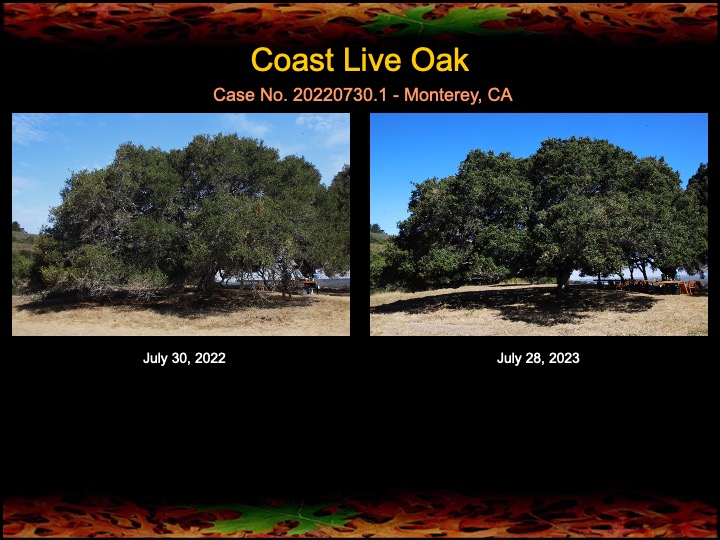
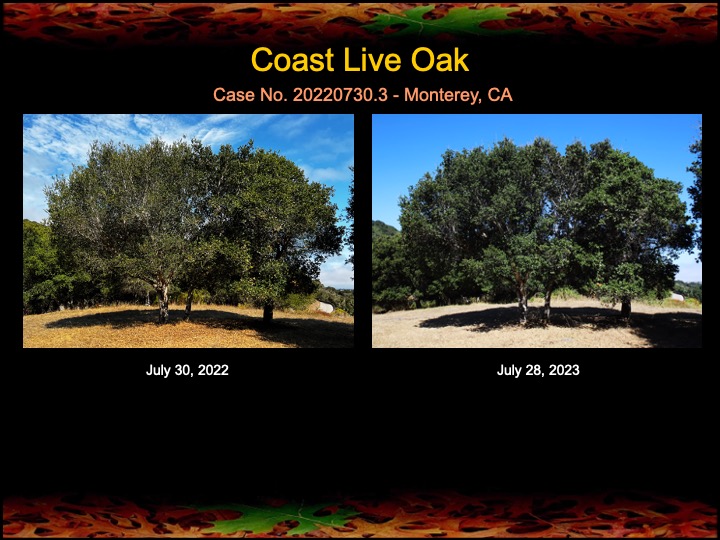
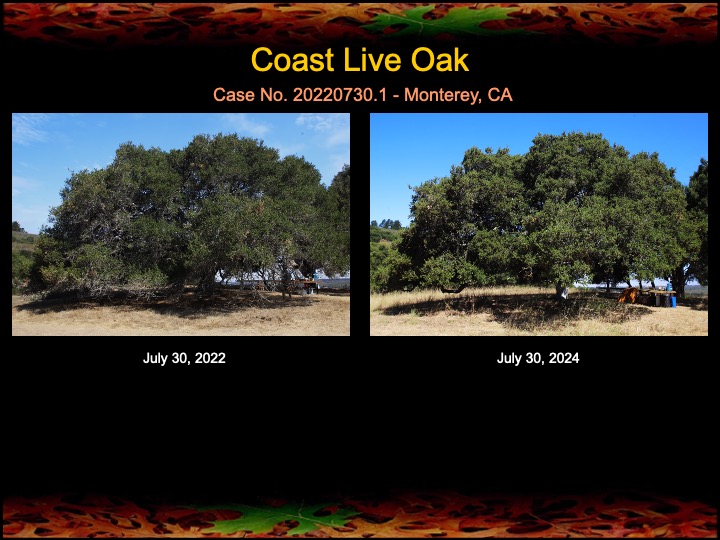
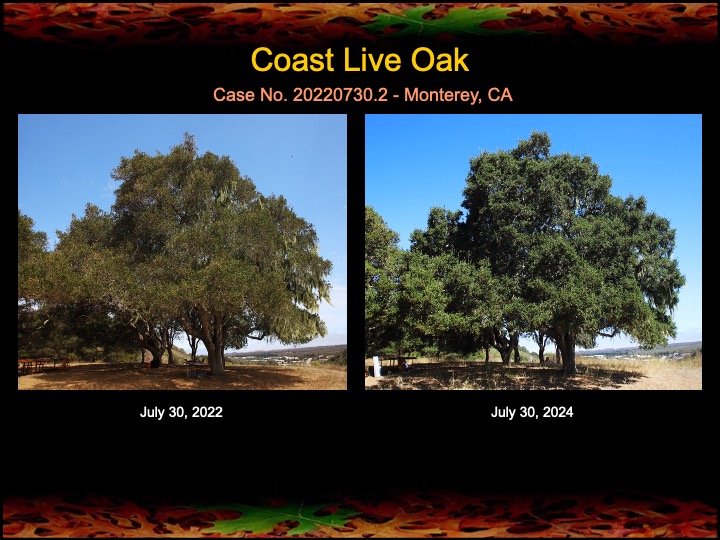
In lieu of fire, I have been applying fire mimicry treatments to several of the ancestor oaks over the past couple years and am seeing a significant improvement in the density and lushness of the canopies of these trees. The above and below photos show the treated oaks today, compared to their appearance two years ago. Enjoy!
Read the rest of this entry »


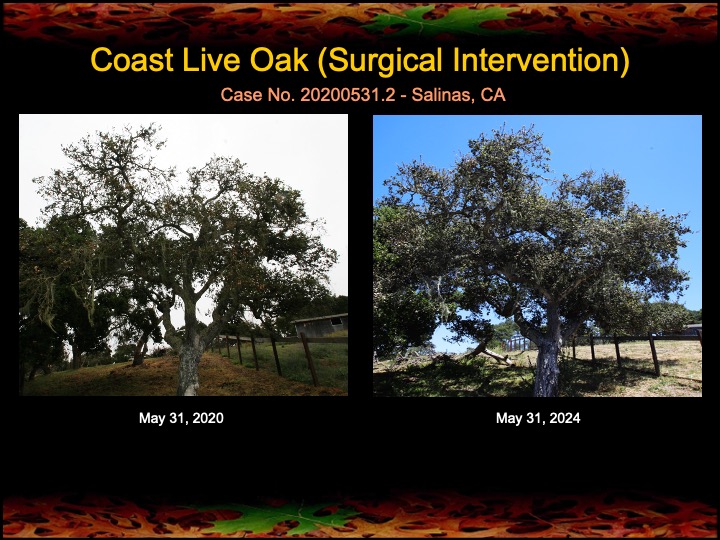
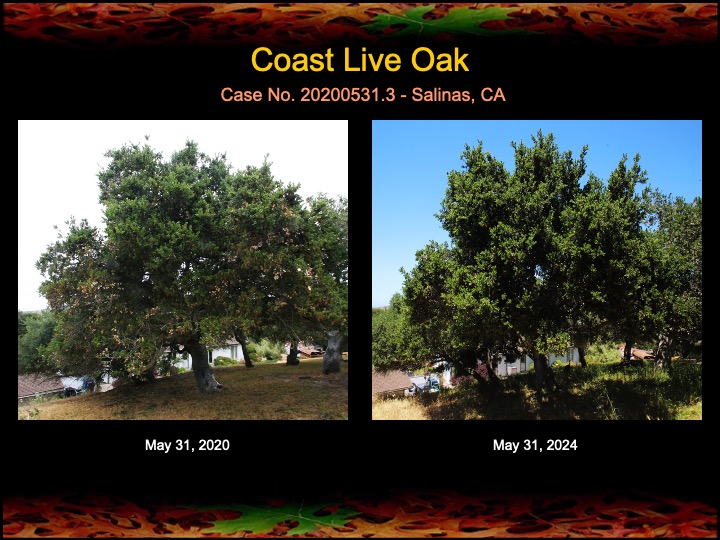
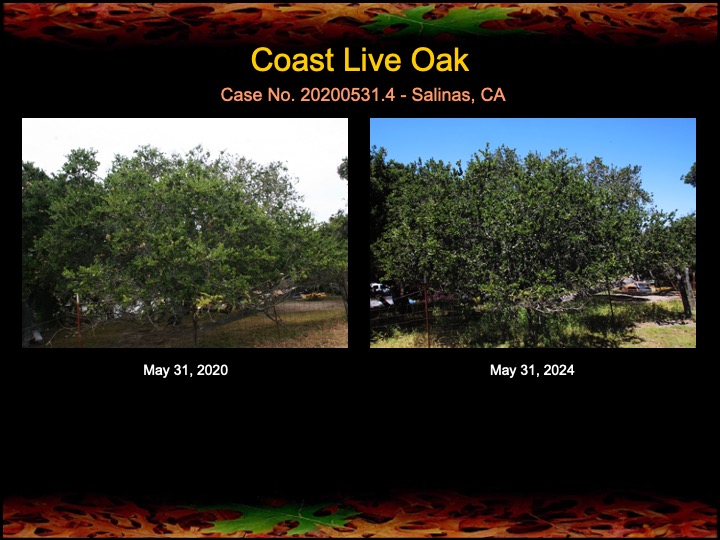
Coast live oaks in Salinas recovering after 4 years

31 05 2024

In 2020 a good friend contacted me about care for his sick oaks. I immediately responded and applied fire mimicry treatments on several of his oaks, including a control oak that I did not treat (see below). Here are the results after four years. Note below that one of the diseased oaks initially began to recover nicely in 2021, but ended up dying in 2022. The oak shown above had a stem canker infection (probably Sudden Oak Death) that was surgically removed in 2020, and now shows no sign of lingering infection.

Read the rest of this entry »


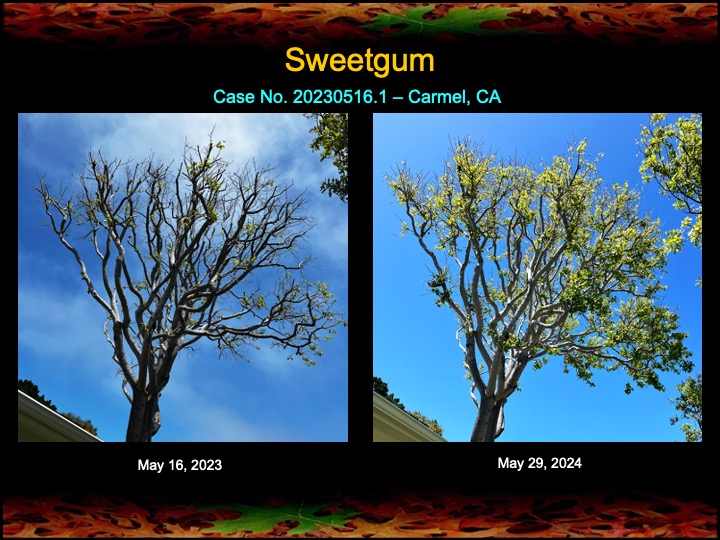
Who knew? Sweetgum too!

29 05 2024

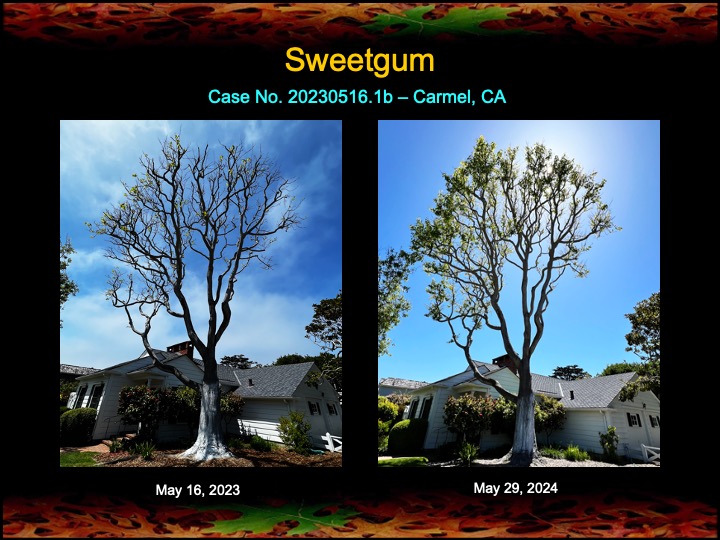
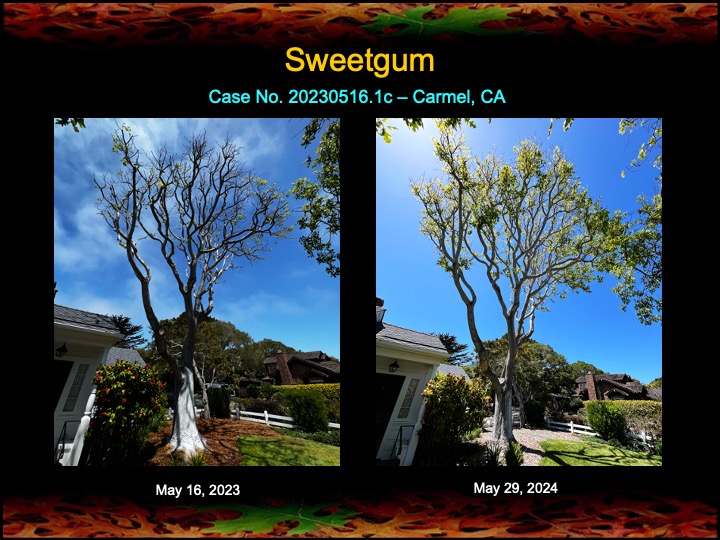
Last year a good friend’s mother contacted me about a sick sweetgum tree at her home in Carmel. I inspected the tree and saw that it was nearly dead. Although I had never treated a sweetgum tree before, as there seemed little likelihood that the tree would survive, I proposed we try a fire mimicry experiment. She agreed, so a major limb that was all but dead was removed, a surgery was done to remove a severe wood rot infection, the soils around the tree were amended with shells, ash, biochar, and compost tea, and a limewash was applied to the trunk. One year later …


Encouraging results with oaks and pines in Monterey, CA

17 12 2023

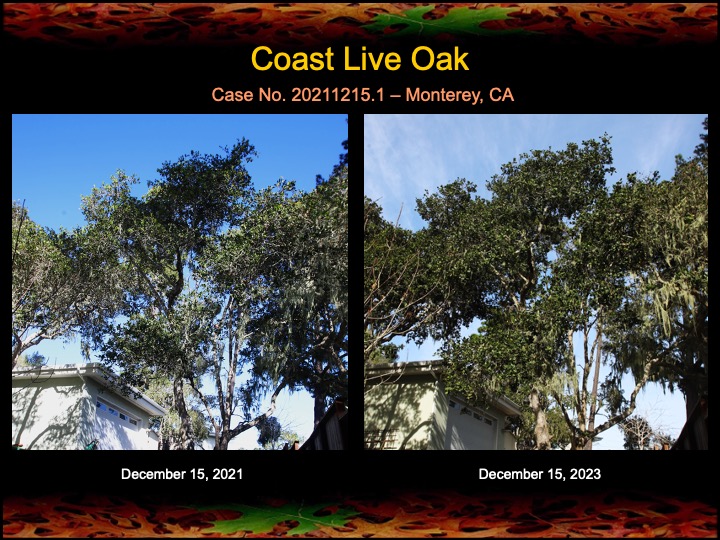
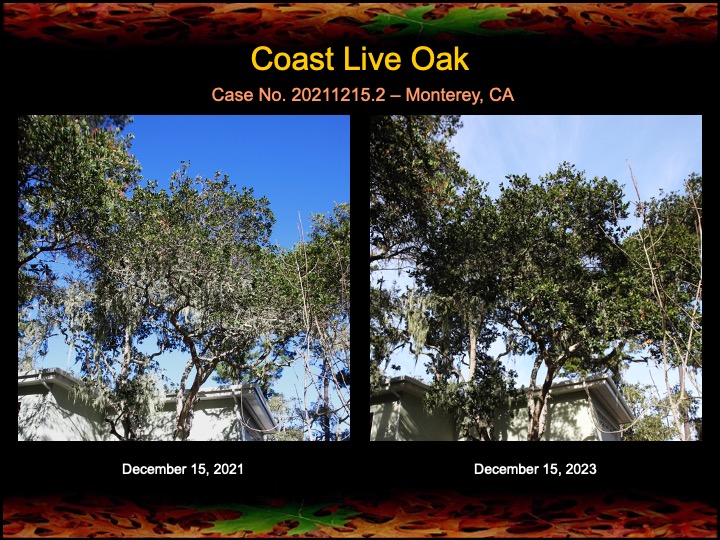
Two years ago I began fire mimicry treatments on several sick and declining coast live oaks and Monterey pines in Monterey, CA. Yesterday I checked on their progress and am generally pleased by the results, as is the homeowner!

Read the rest of this entry »


Ancestor oaks in Monterey, CA on the mend

30 07 2023

Last year I began fire mimicry treatments on several Ancestor oaks in Monterey, CA. Several of these oaks date from a time when the Ohlone Indians were the sole occupants of the land. As you can see the oaks are responding quite favorably to being tended. Note the change in greenness and lushness of the canopy leaves. It only took a few hours of work.

Read the rest of this entry »


Reducing ladder fuels and competition around an Ancestor coast live oak

4 10 2022

Here’s a clip of some fire mimicry work we did today around an ancient coast live oak in Carmel Valley, CA. The focus in this first stage of fire mimicry is to remove ladder fuels and reduce the competition from nearby woody shrubs. Afterwards, we will fertilize the soils with biochar (produced from burning the slash piles), along with compost tea and alkaline-rich minerals, then apply limewash to the trunks.


More ladder fuel removal from an oak grove in Carmel Valley

26 09 2022

Here’s a time-lapse video of the fire mimicry work we did today in Carmel Valley. Enjoy!


Removing ladder fuels from an ancient oak grove

21 09 2022

Yesterday our crew of fire mimicry practitioners began treatment of an ancient oak grove in Carmel Valley, CA. The videos here show the results of clearing ladder fuels to help prevent a healthy ground fire from becoming a destructive canopy fire. The video below was cut short by an unfriendly encounter with a wasp nest, an ever-present menace along with all the poison oak.


Restoration of oak woodland and native bunchgrass prairie in California’s central coast

17 09 2022

The latest efforts here at Sudden Oak Life have involved the restoration of about 20 acres of oak woodland and native prairie habitat in the Central Coast. I have pulled together a strong team of workers who are well trained in the principles and practices of fire mimicry.

On one particular hillside young coast live oaks have been invading an adjacent prairie of native bunchgrasses dominated by California fescue. Coastal prairie is one of the most endangered ecosystems in California due to fire suppression and conversion to agricultural uses. In places, the oak trees have shaded out and all but replaced the native prairie species. Our work here focused on removing many of the woody shrubs and young oaks along the prairie margin, and thinning and pruning oaks in nearby woodlands that still support substantial bunchgrass cover. Efforts were made to preserved many of the native understory species including toyon, currant, sage, and mountain mahogany. All the removed oaks were less than 6″ in diameter, per county regulations.

Young coast live oak invading native bunchgrass prairie, marked for removal
Read the rest of this entry »


How to prepare a grove of ancient oaks for cultural burning

10 08 2022

Here are several time-lapse videos from today showing our efforts to prepare a grove of ancient coast live oaks for reintroduction of cultural fire via fire mimicry. Notice that our focus is on removing ladder fuels in ensure that any cultural fires remain on the ground (good fire), rather than spreading into the canopies (bad fire).