Fire Mimicry: Treated vs. Untreated

8 12 2019

Slide1

Slide2

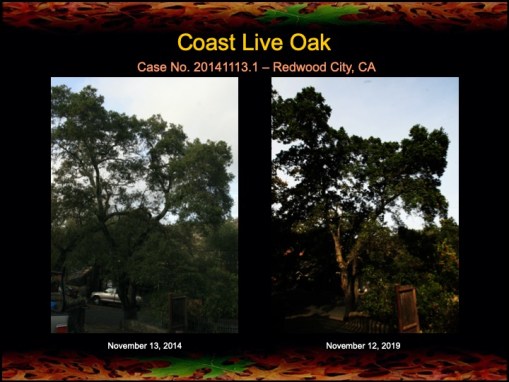
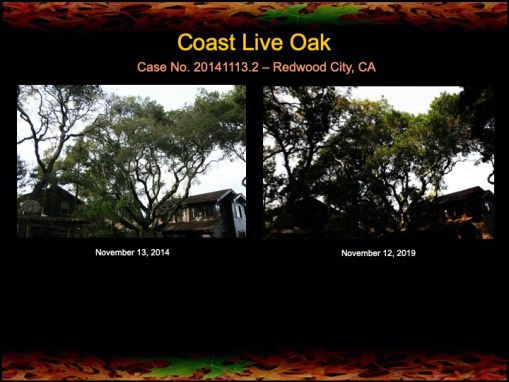
As most of my clients chose to have me treat all of their oaks with fire mimicry, I don’t often get the chance to compare treated vs. untreated oaks in the same landscape setting. However, last year a client had me treat come oaks, but not the others. Here are the before-and-after photos of two oaks that were treated (above), compared to another that was not treated (below). One of the above oaks (Case No. 20181203.2) was infected with a stem canker disease (probably Sudden Oak Death), which was surgically removed in 2018.

Slide3


Culturally-modified Indian-era oaks respond to fire mimicry

15 11 2019

Slide1

Five years ago I began fire mimicry treatments on a grove of ancient, Indian-era coast live oaks that have clear signs of being culturally modified (ie. pollarded). This past week I checked on the status of these oaks and the entire grove continues to show strong improvement in canopy density and greenness. And in an area of rapidly spreading Sudden Oak Death, none of these trees have contracted this disease.

Slide2 Read the rest of this entry »


Surgical procedure for removing stem canker infections (See year 1 update below)

30 10 2019

IMG_9930

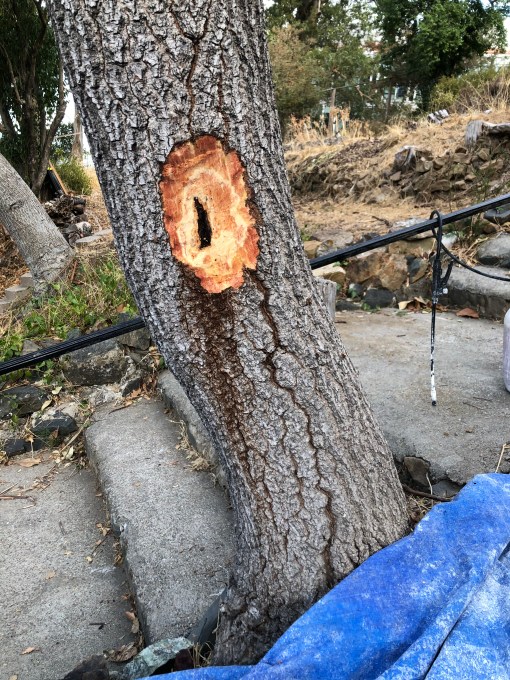
I’m seeing very encouraging results from the surgical procedures I have been performing on oaks with stem canker infections. Here is the sequence of steps. The above photo is of a recent (less than one year) stem canker infection, possibly Sudden Oak Death, of a young coast live oak. The next step is to remove the infected tissue using a hand axe. The photo below shows a partial state of canker removal.

IMG_9932

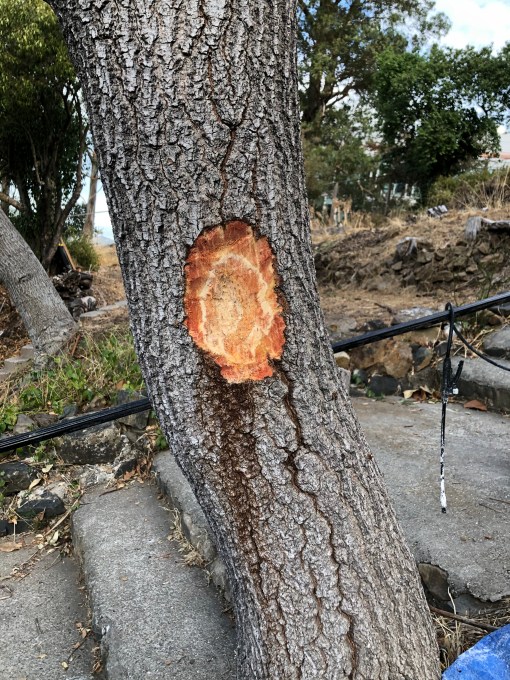
The next photo shows the infected canker tissue entirely removed.

IMG_9933 Read the rest of this entry »


Four years of fire mimicry on oaks in Piedmont, CA

21 10 2019

Slide1

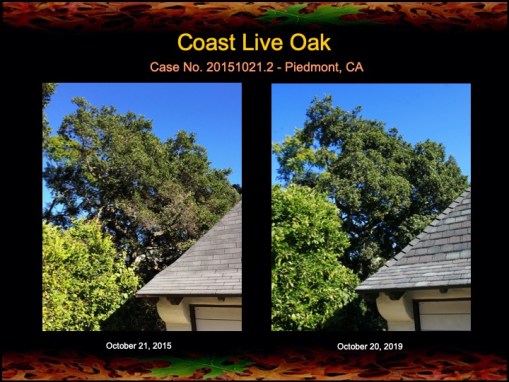
in 2015 I began applying fire mimicry treatments to a grove of sick coast live oaks. Yesterday I checked on their status. Here are the photographic comparisons showing that the density and greenness of the oak canopies has increased noticeably after four years of treatments. However, two severely diseased oaks did not respond to the treatments during this period and had to be removed. Fortunately, the remaining oaks appear healthier and the prognosis for recovery is good.

Slide2

Slide3 Read the rest of this entry »


One-year fire mimicry results from Kentfield, CA

5 10 2019

Slide1

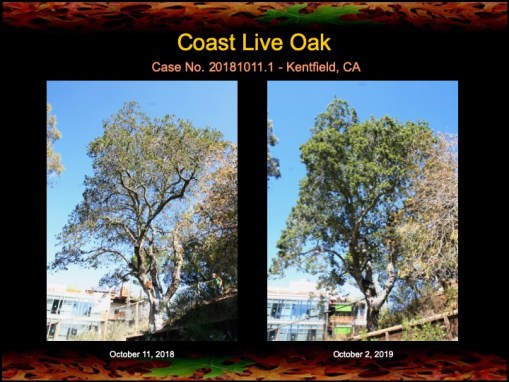
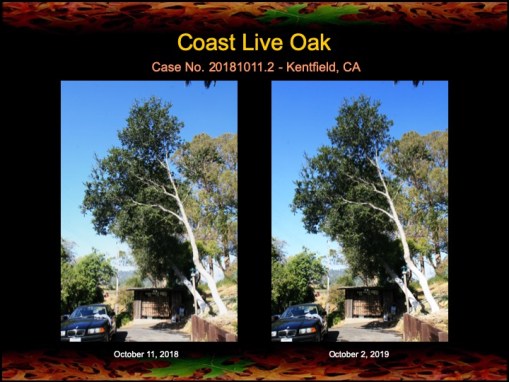
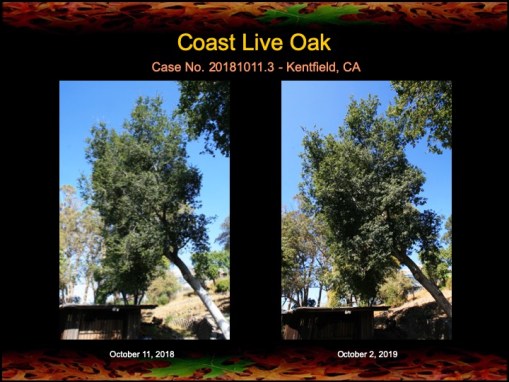
Last year I initiated fire mimicry treatments on a grove of coast live oaks in Kentfield, CA. Here are the resultsĀ  . . .

Enjoy!

Slide2

Slide3 Read the rest of this entry »


Five-year results of fire mimicry on oaks in Carmel, CA – Part 2

30 09 2019

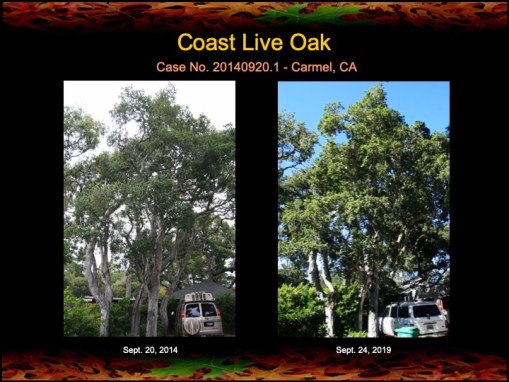
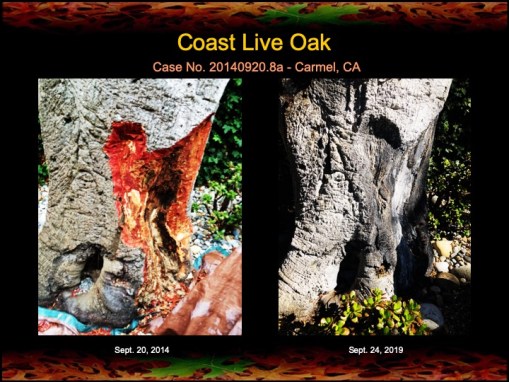
Part 2 of this post shows promising results in improving the health of an old coast live oak shown in the preceding post (Part 1) that was severely affected by a stem canker disease, possibly Sudden Oak Death, in 2014. Besides doing fire mimicry treatments I tried (experimentally, as I told the owner) a major surgical procedure that involved removing the infected tissue from the tree. The wound was then strongly cauterized and a mineral-based poultice was applied. One additional surgery to remove lingering infected tissue was done in May 2016. Here are before-and-after photos showing the initial surgical wound immediately after removal of infected tissue, but before cauterization and poultice, and the wound after 5 years.
Slide8

Slide9

While it may not be apparent in the photos, the large wound is showing no sign of lingering infection and it would appear that the disease is eradicated from this critical part of the tree.

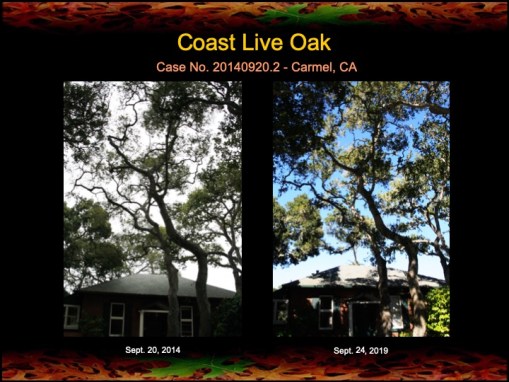
At the same time the general health of this oak, as indicated by the foliage density of its canopy, has clearly improved. The following photo shows the canopy density of the two main branches of this oak over the past 5 years. It is too soon to know whether or not this is an exceptional case. But it sure encourages me to try major surgeries on other severely diseased oaks!
Slide2


Five-year results of fire mimicry on oaks in Carmel, CA – Part 1

30 09 2019

Slide1

Last week I inspected a grove of oaks in Carmel, CA that have received several fire mimicry treatments. While the photos were taken under different light conditions, they do indicate a clear increase in foliage density over the years. However, one oak in this grove was lost earlier this year in a high wind event.

Part 2 of this post will show the results of fire mimicry treatments along with a major stem canker surgery on one of these oaks (see if you can guess which one).

These photos add to mounting evidence that oaks, and many other kinds of trees, need to be tended in order to flourish. As we are now aware, doing nothing is not a viable long-term treatment plan for oaks. See for yourself what can be achieved in just a few years …

Slide2

Slide3 Read the rest of this entry »


Fire Mimicry Results on Oaks in Pacific Grove, CA

24 09 2019

Slide1

Last year I began fire mimicry treatments on 21 oak trees in Pacific Grove, CA. Here are the results after just one year. The light conditions varied between the two years, but the photo comparisons still show a clear increase in canopy density. Enjoy! Read the rest of this entry »


Fire mimicry effects on oaks in Fairfax, CA

22 07 2019

Slide2

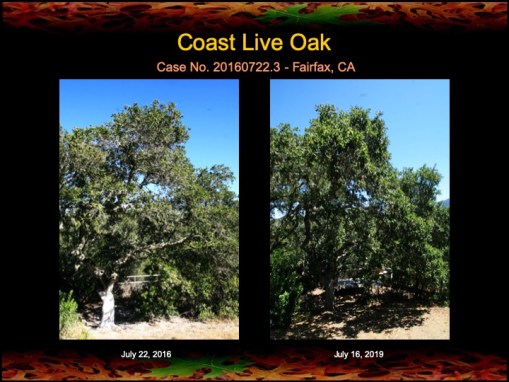
Last week I inspected several coast live oaks in Fairfax, CA that have been treated for the past three years with fire mimicry. The photos above and below show the results. The foliage of the oaks appears denser and greener following the treatments. Enjoy!

Slide3 Read the rest of this entry »


Oaks and other trees in Atherton, CA respond to fire mimicry

7 06 2019

Slide1

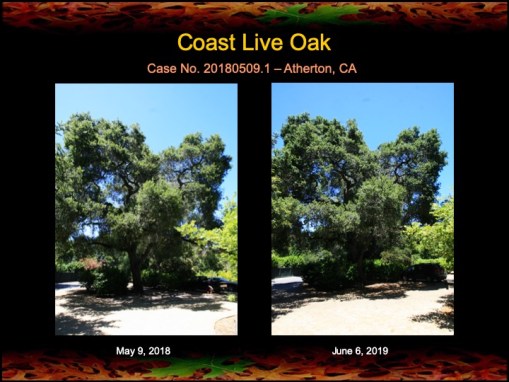
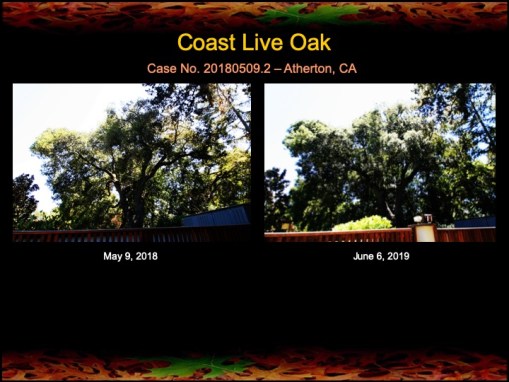
Last year I (and my dedicated crew) treated several coast live oaks along with a valley oak, a California buckeye, a jacaranda, and an ornamental pear with fire mimicry. Yesterday I inspected and re-photographed these trees. Here are the photos showing the results after just one year. I’m happy to report that most of the trees are showing a noticeable increase in canopy density and greenness. BTW, four of the coast live oaks are infected with a stem canker disease, probably Sudden Oak Death. Bet you can’t tell which oaks are infected!

Slide2 Read the rest of this entry »