Healing heritage oaks

1 11 2016

slide1

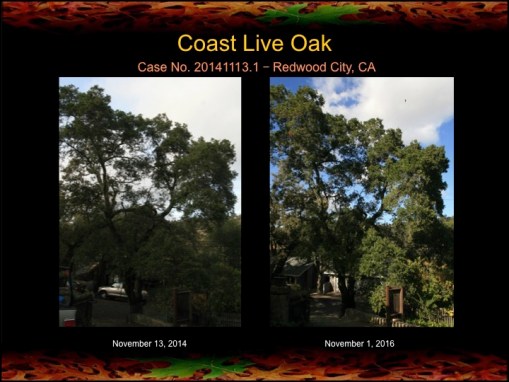
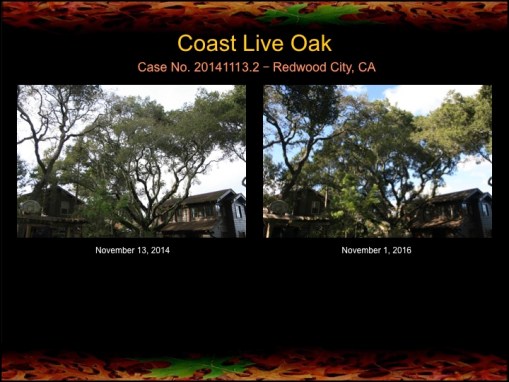
Two years ago I had the task of helping a grove of struggling heritage oaks in Redwood City. All of the mature oaks are centuries old and reveal signs of having been tended by native people. I’m happy to say that after two years of applying fire mimicry methods based on traditional ecological knowledge these oaks are making a strong recovery.

slide2 Read the rest of this entry »


News headline: “California Sudden Oak Death Reaches Catastrophic Levels”

29 10 2016

Yesterday I read a news report with the headline “California Sudden Oak Death reaches catastrophic levels“.

Yesterday I also read a news report “Standing Rock: militarized police from 5 states escalate violence . . .

Now it may seem obscure to most, but these two issues are intimately related. Let me explain how.

The first report states that California is experiencing a crisis in tree mortality with over 66 million dead trees, all attributed to a single disease (Sudden Oak Death) and a single insect pest (Pine Bark Beetle). The report features statements from two experts, a pathologist and an entomologist. Neither scientist mentions a single word about possible solutions.

And to make matters worse, regardless of which way the weather trends, they say that the death of the trees will be exacerbated. More drought will fuel Pine Bark Beetles, and wet weather will favor the spread of Sudden Oak Death. All appears hopeless in any direction.

Now I have no problem highlighting the serious forest health issues we are having in California. Trees are dying and it is affecting us all. The problem I have is that this issue is not reducible to two species of organisms. Even if we could find a cure for Sudden Oak Death and Pine Bark Beetles, the trees would still be dying. There are dozens of other diseases and insect pests that would fill their niches.

When one recognizes that the problems affecting our forests are not pathological or entomological, but are ecological and ethnographical in nature, then solutions become self-evident. California forests that were tended with fire by native people for thousands of years are now declining due to over-competition and soil acidification. Diseases and pests that are normally controlled by fire are now flourishing.

As the Standing Rock protest illustrates, we have lost our connections to the people and practices that gave us such magnificent lands and forests. Honoring our native people by tending to their legacies is one way of supporting all that they live and stand for.

This website is offered as testimony to the promise of traditional values and knowledge in forest health and restoration. Contained here are many hundreds of photos documenting the recovery of sick and diseased trees using solutions based on practices and materials used by native people for thousands of years.

In other news from yesterday – a sick oak that has been treated with traditional practices is making a steady comeback . . .

slide1

slide2


Carmel Valley heritage oak

21 10 2016

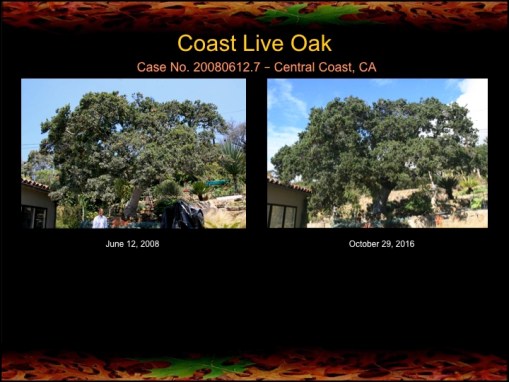
Every so often I get asked to provide some care for a single tree, usually a large heritage oak that dominates a particular property. Following a motto of “one tree at a time”, I never hesitate to help. So last year a Sudden Oak Life colleague, Shannon Boyle, and I had the honor of helping a massive, Indian-era coast live oak in Carmel Valley, CA. This ancient oak has clear signs of being pollarded and tended by the native people who lived in this valley hundreds of years ago. We applied fire mimicry methods to the trunk and the soils around the oak. One year later the canopy is showing a noticeable response in density, greenness, and size.

Deep gratitude to our ancestors for giving us these creatures. What better way to honor our Native American fore bearers than to extend the life and health of their legacies!

slide1


More Carmel oaks respond to fire mimicry

13 09 2016

slide2

slide3

slide4 Read the rest of this entry »


Carmel oaks respond to fire mimicry

13 09 2016

slide01

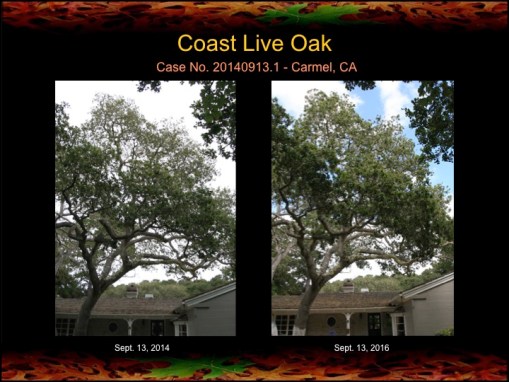
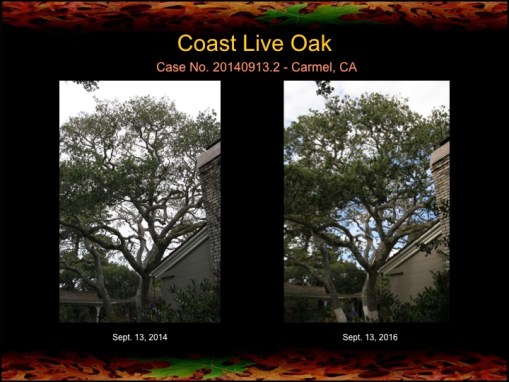
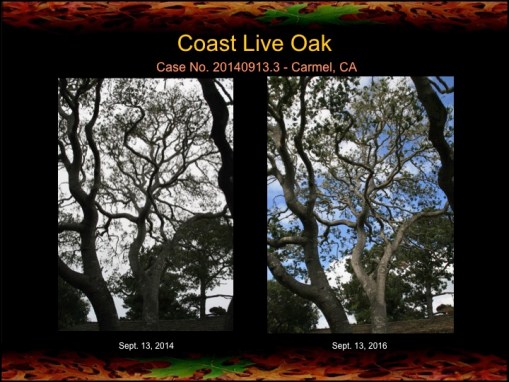
Two years ago a property owner in Carmel, CA approached me about helping improve the health of her sick oak trees. When I inspected her oaks I found them to be severely diseased and the canopies very thin. I told her that I wasn’t sure I could save her diseased oaks, but that I felt confident I could help her other oaks. She agreed to have all her oaks treated with fire mimicry.

Two years later, the diseased oaks (first three sets of photos) are recovering nicely and the remaining oaks on both properties are showing improved canopy health. The photos below show the results of all the oaks I’ve treated on her property over the past two years. The photos show a nice response in some oaks, others showing a limited response. Overall, I’m pretty happy with the results in just two years.

slide02

slide03 Read the rest of this entry »


Variable one-year responses of birch, apple, and pine trees to fire mimicry

28 07 2016

Slide1

Shown here are several birch, apple, and pine trees that were treated last year with fire mimicry. Telling from the photos it appears that the birch trees have response moderately, and the apple trees have responded significantly! The pine trees have yet to show much response. This seems to be typical of pines, which can take several years before showing visible responses (see  here and here).

Slide2

Slide3 Read the rest of this entry »


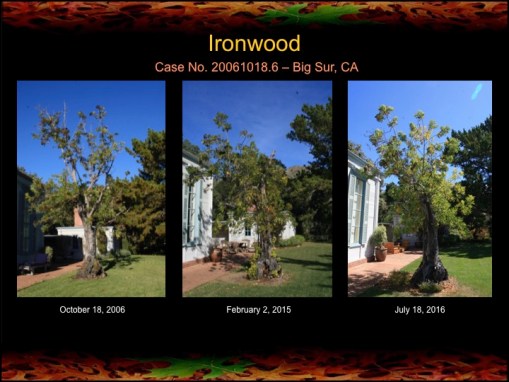
Pine, oak, and ironwood trees in Big Sur responding nicely after a decade of fire mimicry

20 07 2016

What is fire mimicry?

pine B

Slide03

Slide07


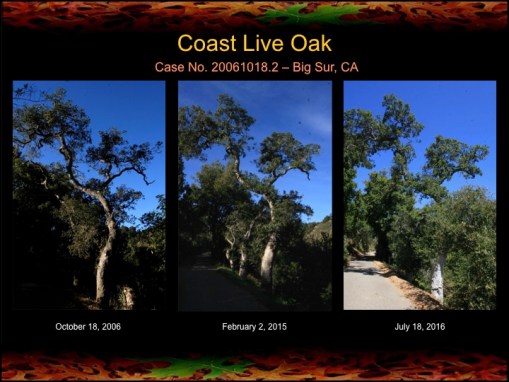
Coast live oak in Big Sur cured of stem canker infection using fire mimicry + surgery

18 07 2016

This is exciting news! A coast live oak in Big Sur appears to have been cured of two stem canker infections (possibly Sudden Oak Death) using fire mimicry and surgical methods. Furthermore, no new infections have occurred on this tree. While I’ve reported on the progress of other coast live oaks that have received fire mimicry and surgery (see here, here, and here), this is the first oak that I feel confident has been cured of a stem canker infection!

Slide10

There is also evidence at the same site that the deep cracks forming in other coast live oaks, cracks that allow infection by stem canker disease, are healing well. And, no new cracks are forming. Published studies have shown that “the presence of unweathered bark in bark furrows, (is) positively correlated with disease (Sudden Oak Death)”. Note in the photo below that the exposed unweathered bark is healing.

Slide08 Read the rest of this entry »


Rapid response of oak, mayten, bay laurel, and cedar trees to fire mimicry

2 07 2016

Slide01

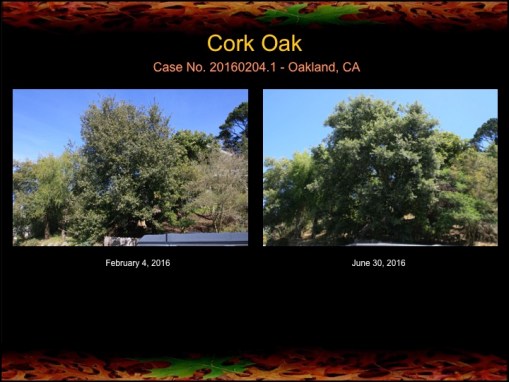
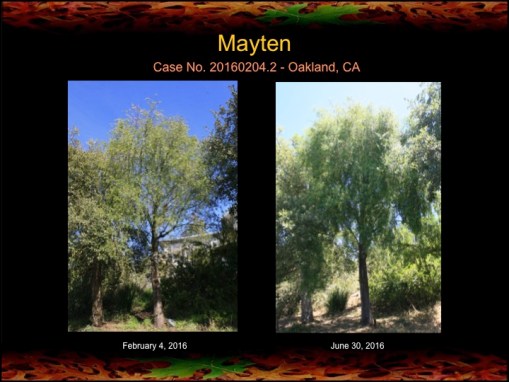
I recently inspected several cork oak, coast live oak, mayten, bay laurel, and cedar trees that I treated with fire mimicry methods in February of this year. The positive responses of these trees to the treatments after just six months are pleasantly surprising. The photos below tell the happy story . . .

Slide02 Read the rest of this entry »


Fairfax oaks treated with fire mimicry and canker surgery

23 05 2016

Slide2

Nearly two years ago I treated several coast live oaks with fire mimicry. On three of the oaks I performed a surgical procedure to remove the stem canker infections (possibly sudden oak death). The procedure involves surgically removing the infected tissue with an axe, followed by a chisel. Lately I’ve been using a multi tool which does an excellent job at cutting infected bark and wood. Following surgery I’ve been cauterizing the wound with a propane blow torch, then applying a lime wash to the entire trunk. Below are photos of two of the surgeries two years later and I am pleased to report that the wounds are healing up nicely and there is no sign of further infection in these oaks. I would say the procedure is still experimental at this point, but I am more confident to keep trying it after seeing these results. Also below are photos depicting the surgical methods and equipment, as well as other photos sets of the oaks response to a single treatment after two years.

IMG_4355

Surgical scar after nearly two years of healing. Note absence of any bleeding or other sign of infection. Read the rest of this entry »