Hillsborough oaks respond to fire mimicry

3 05 2013

20120417.3

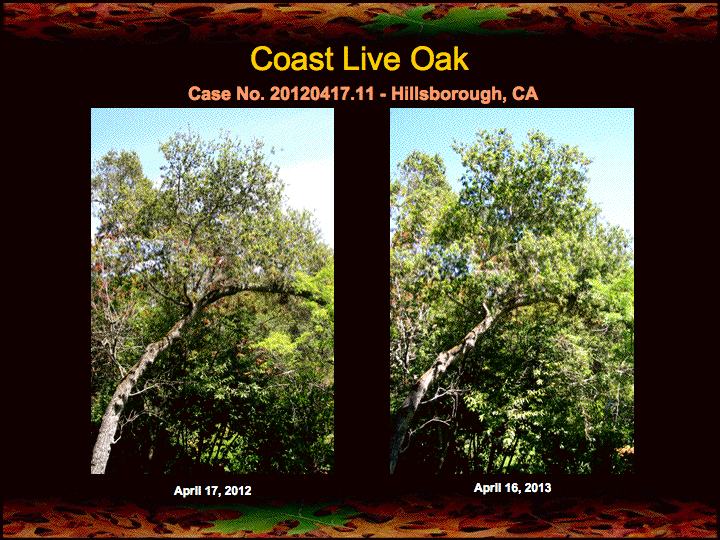
Last year I began restoration work using fire mimicry on a stand of oaks in Hillsborough, CA. I did some clearing of woody understory and moss removal from the trunks, and added alkaline-rich minerals and compost tea to the soils. I also applied a lime spray to the trunks.

Here are the results after just one year.

20120417.11

20120417.8 Read the rest of this entry »


Sick pines respond to fire mimicry

21 04 2013

20100415.24.3

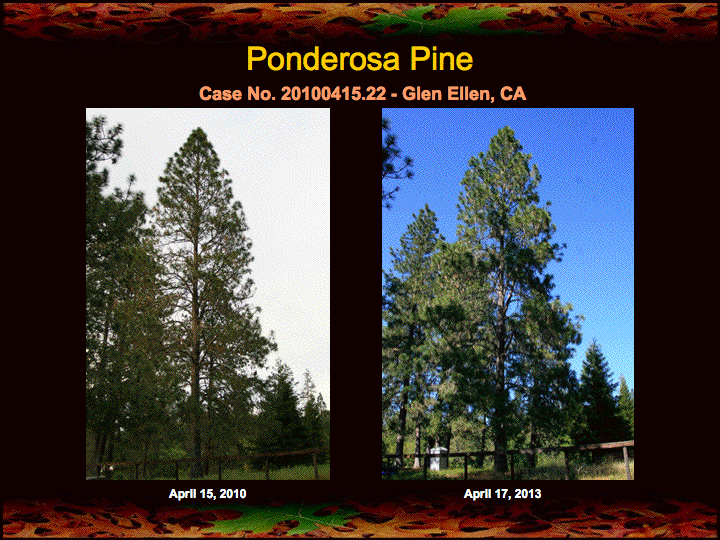
While the focus of work here at Sudden Oak Life is on oak health, there are lots of other kinds of trees that respond to fire mimicry treatments. Today I would like to share with you the results of some work being done on several ponderosa pine trees. These photo sets show how the pines have responded after three years of treatments. Note that the last photo set is of an adjacent UNTREATED pine.

20100415.22.3

20100415.23.3 Read the rest of this entry »


City of Piedmont oaks respond quickly to fire mimicry treatments

19 04 2013

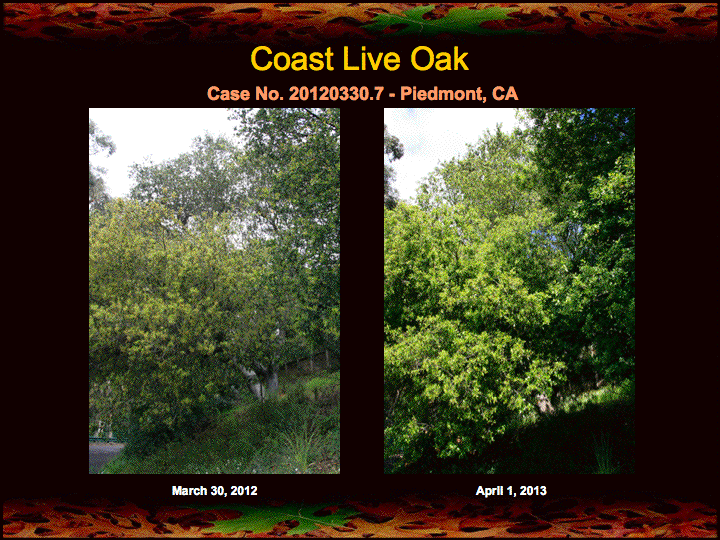
20120330.7

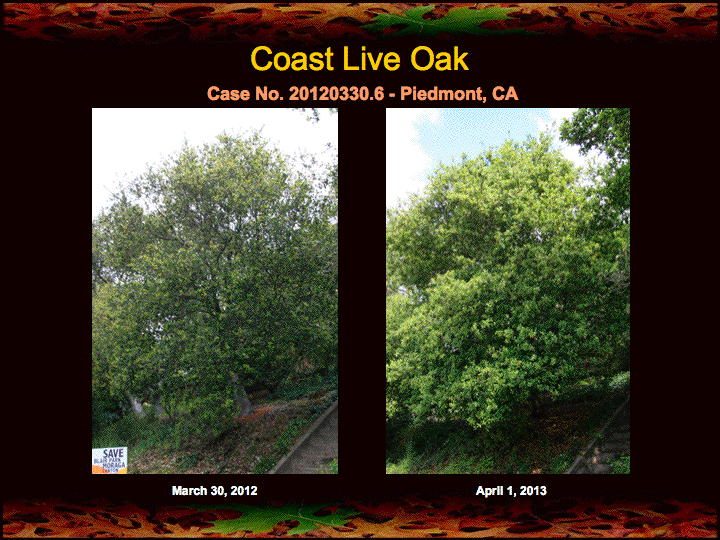
In April of 2012 I was asked by the City of Piedmont to treat several oaks along Moraga Ave. that were appearing unhealthy. Some of the oaks were on a cliff, so I set up a belay and worked spreading minerals and compost tea underneath the oak canopies and applying a lime spray to the trunks. In addition to the City of Piedmont oaks, I also treated several oaks on an adjacent private property at the same time.  Here are the results after just one year.

20120330.4


20120330.6 Read the rest of this entry »


Oaks in Santa Barbara thriving after 4 years of fire mimicry

7 02 2013

20090203.1.4

I’ve had several recent posts showing how oaks in Santa Barbara are flourishing after fire mimicry treatments. Here is another set of photos from a grove of oaks in Santa Barbara that have been receiving fire mimicry treatments for the past four years. Compare these results with the results in this same grove posted last year after three years of treatments.

Enjoy! Read the rest of this entry »


More results with Santa Barbara oaks

28 01 2013

20100107.1.3

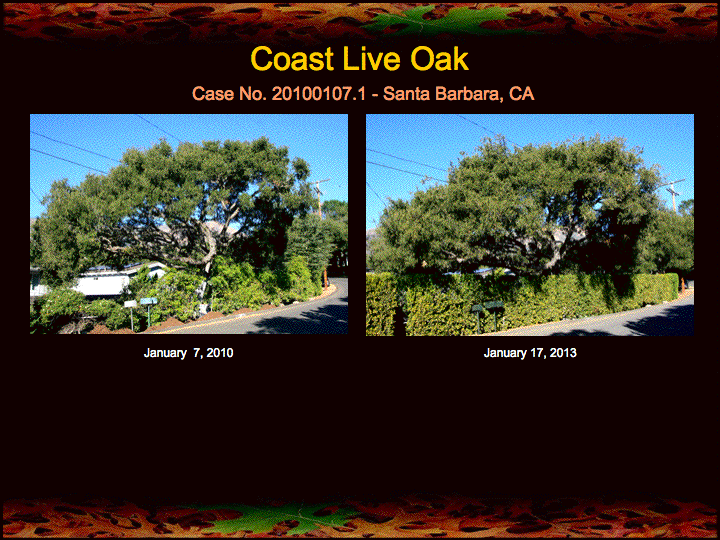
Yesterday I posted some very encouraging results from a grove of oaks in Santa Barbara. Today I would like to share some more results from another grove of oaks in Santa Barbara. These oaks have been treated with fire mimicry for three years, and all but one (case no. 20100107.5) are showing positive responses. The photos above and below show the results.

Be sure to examine the last photo set of this series (case no. 20100107.7), which shows the changes in an untreated control oak located in the same grove.

20100107.2.3 Read the rest of this entry »


Santa Barbara oaks flourishing after fire mimicry treatments

27 01 2013

20090119.16.4

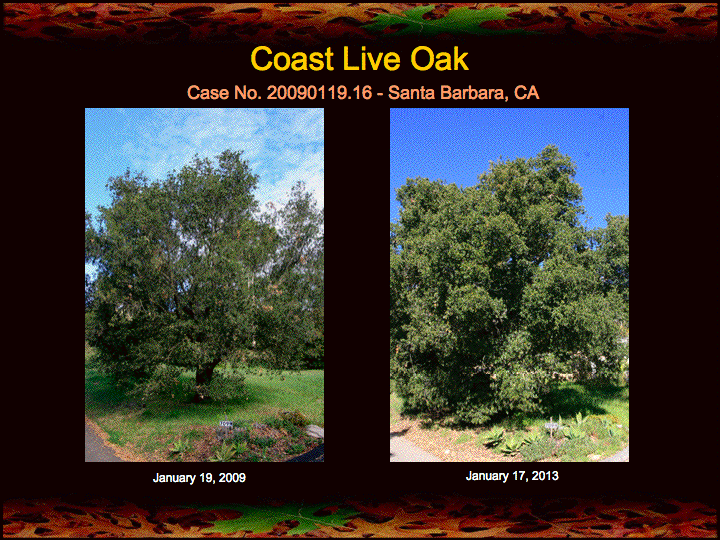
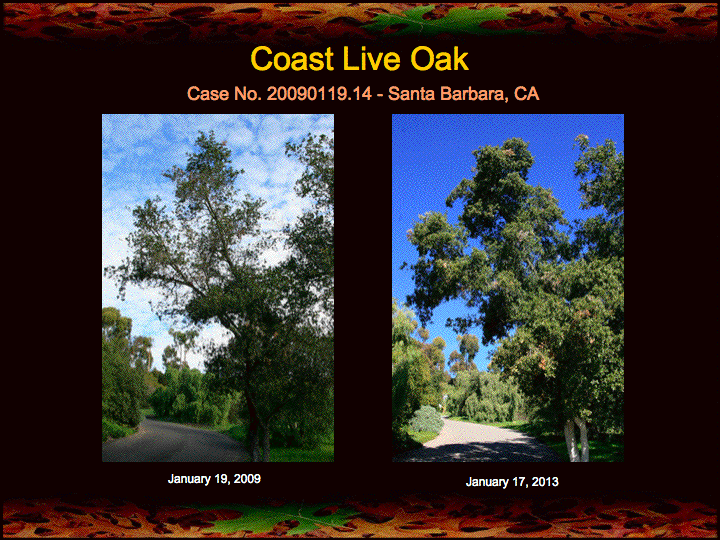
Last week I visited and re-photographed a number of oaks in Santa Barbara that first received fire mimicry treatments in January of 2009. I’ve previously reported on these oaks located in Toro Canyon here, here, and here. Several of these oaks are infected with a bleeding stem canker disease, possibly Sudden Oak Death. This past year the oaks were re-treated after a two-year pause in fire mimicry treatments, and the results are pretty remarkable. Examine the photos below and see for yourself.

20090119.15.4

20090119.14.4 Read the rest of this entry »


Hearst Castle oaks respond to fire mimicry – Part 3: A fortunate error

7 01 2013

When fire mimicry treatments began in 2006 on the oaks at Hearst Castle I had identified two control oaks, trees there were not to be treated in order to compare their response with the treated oaks. The yearly photos indicate that, indeed, these two oaks have shown no clear improvement in canopy density, compared to the treated oaks.

In 2012 a California State Park employee did a fire mimicry treatment on one of the two control oaks by mistake. The results were noticeable. The photos below show results for both the control oak that was accidentally treated, and the other control oak that has remained untreated. Note that the treated oak has shown noticeable improvement in canopy health in just one year! Note also that I have used the photos from Jan. 2011 rather than Jan. 2012. The canopy damage caused by the windstorm in Dec. 2011 would have biased the results.

20060104.3.7

20060104.4.7


Hearst Castle oaks respond to fire mimicry – Part 2: 17 years of change

7 01 2013

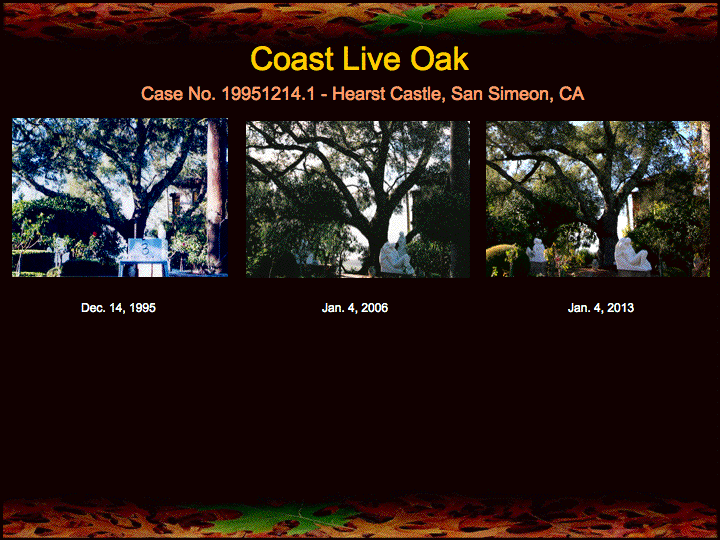
19951214.1

In 2006, when I first started consulting with Hearst Castle about treating their sick oaks using fire mimicry methods, I was provided a set of photos, scanned and printed on a color copier, of several oaks around the castle grounds. I relocated these photos and have re-photographed them every year since 2006.

Presented here are photo comparisons showing these oaks on Dec. 14, 1995, Jan.4, 2006, and Jan. 4, 2013. During the period between 1995 and 2006, the oaks did not receive any fire mimicry treatments. In 2006 fire mimicry treatments began and have continued to the present. Note that the oaks generally show little change or show a decrease in canopy density between 1995 and 2006, and that canopy density has improved between 2006 and 2013 when fire mimicry treatments were implemented.

I realize that the 1995 photos are of poor quality, but they are all I have to work with. Still, I believe they provide some useful information about the positive effects of fire mimicry for oaks. Read the rest of this entry »


Hearst Castle oaks respond to fire mimicry – Part 1: 7-year results

7 01 2013

20060104.1.7

Last Friday I visited Hearst Castle to check on several oaks that have been undergoing fire mimicry treatments for the past seven years. The California State Park employees, led by Chris Takahashi, have been implementing the fire mimicry treatments, more-or-less following my guidelines. Last year the oaks were partially damaged by a severe windstorm in December of 2011 (see the 2012 results here).

There are several interesting sets of results from Hearst Castle that I will present in three separate posts. Part 1 shows the seven-year results of fire mimicry treatments. Part 2 will examine several oaks that were photographed in December of 1995, which I have re-photographed in 2006 (at the time of their first treatment) and in 2013. Part 3, will examine the response of a control (untreated) oak to an accidental treatment in 2012.

The photos posted here show that the Hearst Castle oaks have generally made a strong recovery from the windstorm and most are sporting healthy canopies indicating that oak health is much improved since fire mimicry treatments began seven years ago. Some of the oaks have lost branches over the years, so the shape of the canopies has changed a bit. The main thing to observe is the canopy density, which is a measure of oak health.

A few of the oaks have had bleeding stem cankers, possibly sudden oak death, for the entire seven years of treatments. Most of these have continued to show positive responses (e.g. Case Nos. 20060104.1 & 20060104.16), but one (Case No. 20060104.2) is severely infected and is clearly in decline despite regular fire mimicry treatments. This is yet another case showing that oaks with severe infections of stem canker disease have little hope of recovery. The key is to treat the oaks BEFORE they are exposed to infection.

Be sure to compare these photo sets of treated oaks with the last photo set of a control oak (Case No. 20060104.4) that has not been treated.

20060104.6.7 Read the rest of this entry »


On Sudden Oak Death, fire mimicry, and canker surgery

22 10 2012

Coast live oak in Marin succumbing to Sudden Oak Death after 4 years (Photos by Lee Klinger)

Recently the California Oak Mortality Task Force issued a press release reporting on an explosive growth in Sudden Oak Death in the San Francisco and Monterey Bay areas. This is a sad situation, knowing that untold thousands of ancient heritage oaks will die while under our care, or rather our lack of care.

For thousands of years California Native Americans tended and cared for all these ancient oaks, and associated plants, animals, and fungi, in an effort to live sustainably. The concept of reciprocity permeated their spirituality and culture, the oaks provided them an abundance of food (acorn), and so in return they managed the land in ways that helped the oaks prosper.

Oaks we know, and as the native people knew, are early successional fire-adapted species, meaning that they need periodic understory (ground) fires to thrive. These fires alkalinize the soils, which is a good thing, and they remove encroaching shrubs and young trees which draw away water and nutrients from the mature oaks.

Without periodic fires the oaks begin to decline. Over many decades the soils gradually acidify and more shade-tolerant species such as bays, firs, pines, and redwoods invade the oaklands. Eventually these later successional species overtop the oaks and out-compete them for light, water, and nutrients. At this point fires, if they due occur, are usually large stand-devastating fires that burn the entire canopies of the trees, from which few oaks can recover.

The oak forests in California are experiencing a rapid shift in their ecology the likes of which has not been seen for thousands of years. The weakening oaks are succumbing to diseases like Sudden Oak Death, and it is likely to get worse.

Unless, we started start caring for the oaks under our care.

How many of us have befriended an oak, enjoyed its protective canopy and felt the nurturing presence of a stately being?

How many of us have tended an oak?

All the while the oaks are enriching the air and land, helping sustain us, along with so many birds, mammals, insects, plants, fungi, and much much more, they are running out of time. The current sad state of affairs is largely due to improper actions, or lack of actions by our parents, grandparents, and great grandparents in managing the oaks on our lands. They simply didn’t know what the native people knew, that oaks need tending.

So now many of us know, and I pray others will too, that the problems with our oaks, with some effort, are solvable. I and many others are using fire mimicry methods, which involve restoring oak forests using  clearing, pruning, and soil fertilization methods that mimic to a degree the normal effects of fire.

My purpose here, as is the purpose of my life, is to inform you and others that we can save our oaks and, more importantly, to do the work on the oaks and show you how it’s done.

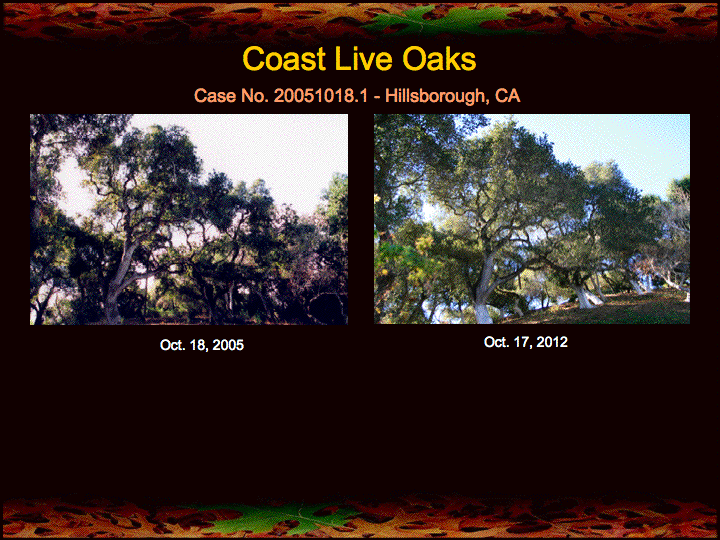
Here are several oaks that have received fire mimicry treatments beginning in 2005:

Note the improved canopy density and fullness. Fortunately these oaks are not infected with Sudden Oak Death, nor will they be (at least on my watch).

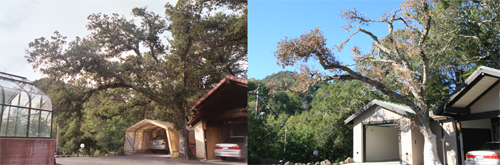
Here, however, is a nearby oak that is infected with Sudden Oak Death:

(Note the roof line has been altered by remodeling since the original photo)

While infected, this oak has some hope for a longer and healthier life as a result of the treatments. In addition to the fire mimicry treatments, I have done a surgical removal of the canker, which was still at an early phase of growth when discovered. For this I used an axe, then hammer and chisel to excavate the infected tissue, then I used a propane blow torch to cauterize the wound. This tree still has a small infection and will require some additional surgery, but the majority of the surgery appears to have worked to clear the tissue of the canker, and the tree is already healing over much of the wound. I predict that this oak will live for many decades, and if you hang around here I’ll keep showing you the photos of its recovery.

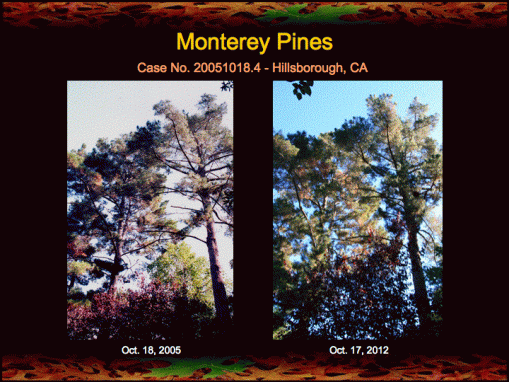
Finally, let me remind all you tree lovers that these techniques work on many kinds of trees. Here’s an example of what can be done for sick pines:
Interested? We’d love to hear from you!