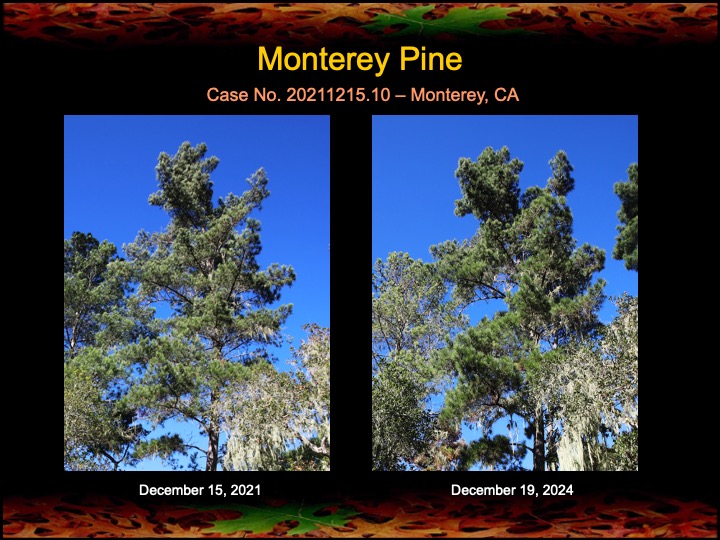
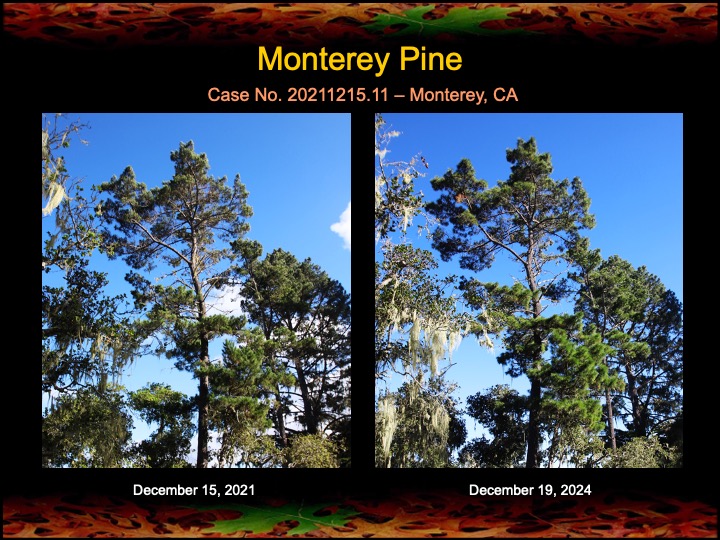
Monterey pines in Monterey showing off their new foliage

20 12 2024

Monterey pines (Pinus radiata) are fast-growing trees that produce abundant large cones and seeds. They are, as might be expected, quite common in Monterey, CA and are endemic to our region, having been here since the Tertiary. Lately, however, Monterey pines, like the coast live oaks, are in decline, essentially victims of colonization which has led to a lack of healing fires. Both pitch pine canker disease and bark beetles are taking a heavy toll on the pines, as well as overcrowding of the forests.

While my focus is on tending oaks, I’ve found that many other fire-adapted native trees respond well to fire mimicry. Thus, I began tending this grove of Monterey pines three years ago using the same fire mimicry protocol I use on the oaks. Yesterday I checked on these trees and am happy to report that most are showing noticeable improvement in the density and lushness of their foliage. Also, they bear no signs of disease or insect pests.
Read the rest of this entry »


Non-toxic approach to oakworm infestations along the Central Coast, CA

10 12 2024

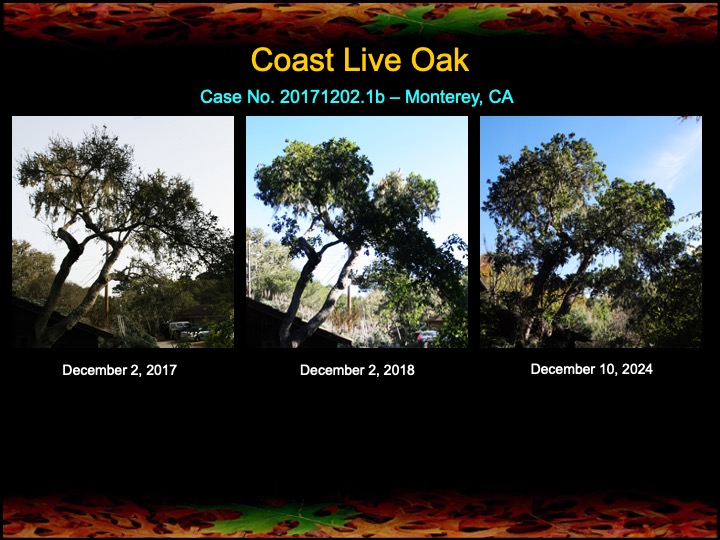
In 2017 there was a severe oakworm infestation of coast live oaks in the Monterey region and elsewhere. I’m often contacted at these times by property owners concerned about their oaks. Many wish to spray the trees with insecticides to reduce the infestation. Upon my advice, I tell property owners that spraying chemical insecticides is not necessary for the oaks to recover from these infestations, provided they are given proper care. Since the oakworm infestations are related to a lack of cultural fires, which controlled their populations in the past, a way forward is to emulate fire effects on the forest ecosystem.

Thus, rather than using chemical sprays as is typically recommended by arborists, I prefer using fire mimicry treatments to oak trees infested with oakworm. In the present case study I recommended to the property owner to do fire mimicry treatments instead of spraying the oaks. Never knowing for sure, I explained to them that the oaks would likely recover from the infestation, and that they would show continued improvement in the following years. A second set of fire mimicry treatments were preformed the following year (2018).

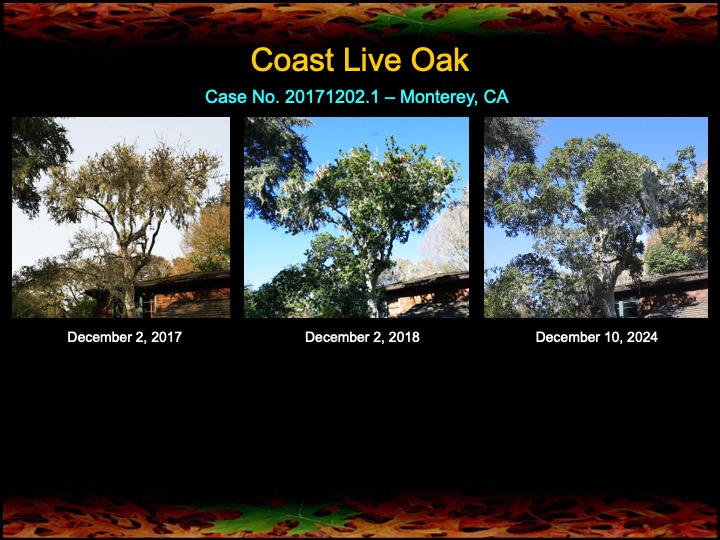
Shown here are repeat photographs of numerous coast live oaks taken upon initial treatments at the height of a severe oak worm infestation (2017), one year afterwards (2018), and seven years afterwards (2024).

Assessing the repeat photography results, the changes in canopy density of all the oaks on this property in Monterey, CA show that, in nearly all case studies, the canopy density increased as expected the year following the oakworm infection. However, the canopy density has continued to increase in nearly all of the oaks after only two years of fire mimicry treatments.

Read the rest of this entry »


Oak restoration project in Boulder Creek, CA – 2024 Update

6 12 2024

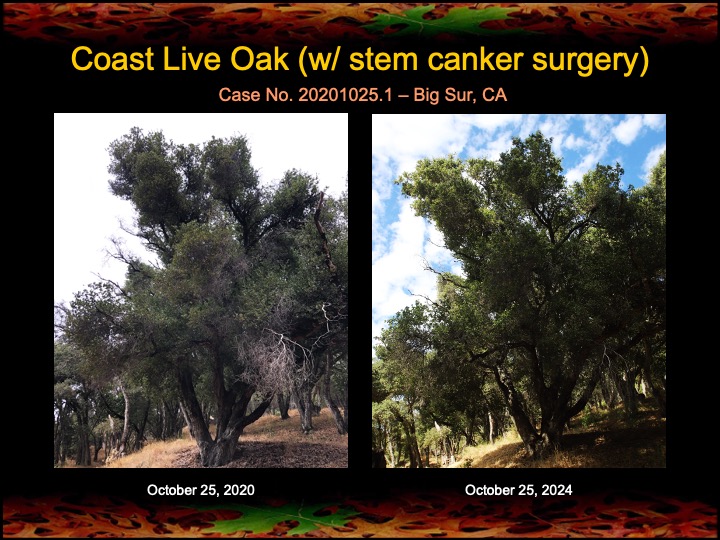
Six years ago I began a forest restoration project in Boulder Creek, CA using fire mimicry treatments to help improve the health of a grove of coast live oaks, some of which are likely more than 250 years old. Additionally, two of the oaks had bleeding stem cankers (probably Sudden Oak Death) that were surgically removed, cauterized, and poulticed.

In 2022 most of the oaks were pruned to help reduce the canopy size, which lowers the risk of both wind and fire damage to the trees. The pruning also allows for more light to reach the lower branches resulting in improved density and lushness of the inner canopy foliage.

Last Tuesday I made my annual pilgrimage to this grove to re-photograph the oaks and to assess their response to the fire mimicry treatments. Here are the case study results showing canopy conditions at the time of initial treatment (2018) and a few days ago (2024).

Note, also, the last two photo sets that show the rapid recovery of two surgical wounds (on the same old-growth oak). The absence of any residual bleeding from the wounds indicates that the surgeries were successful in removing the stem canker infections. I’m calling this a win!

Read the rest of this entry »


After 4 yrs of fire mimicry treatments, these oaks have something to say …

21 11 2024

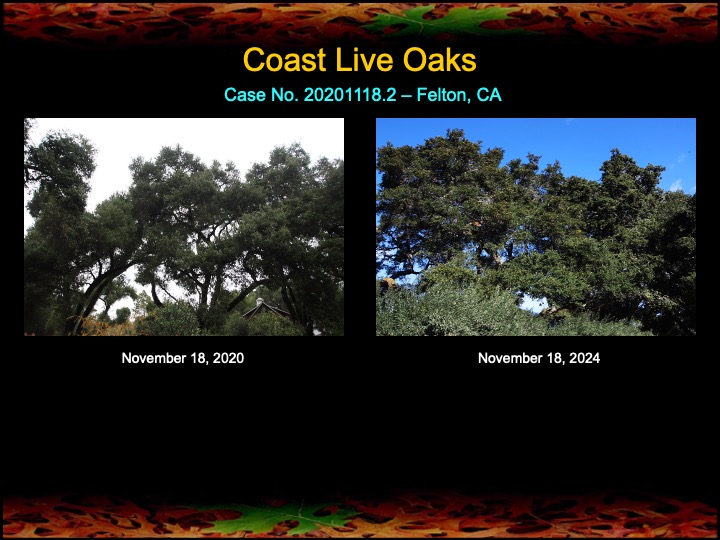
Four years ago I began fire mimicry treatments on several coast live oaks, some of them centuries old. A few days ago I checked on their responses. Enjoy!

Read the rest of this entry »


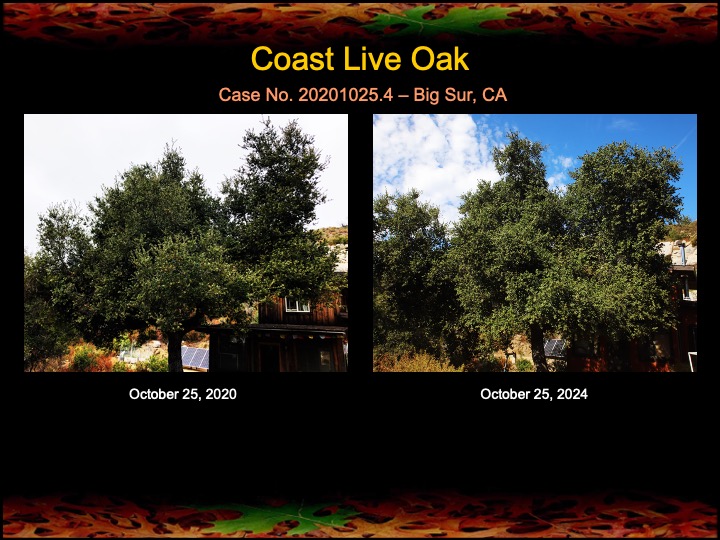
Big Sur oaks recovering from colonization

30 10 2024

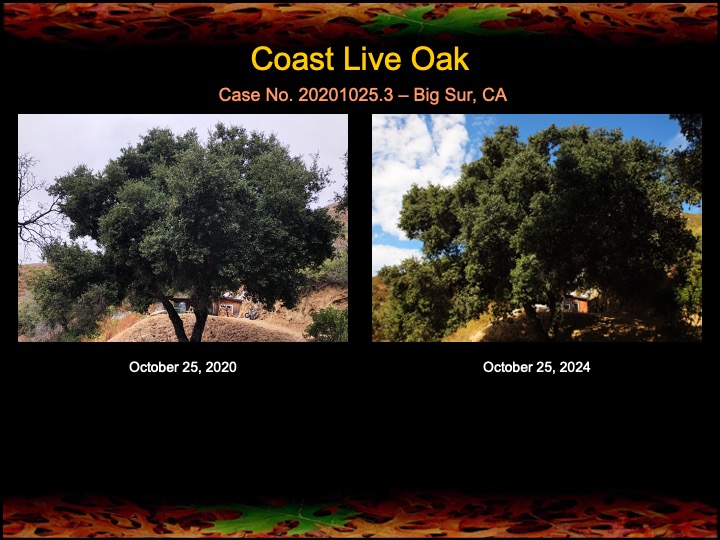
Here are four coast live oaks and a black oak we treated back in 2020. Some additional surgery was done in 2022 to remove lingering canker infections on the oak above. While the above ancestor oak (300+ years old) is still diseased, further surgery and fire mimicry treatments should keep it alive for decades.


The Old Oaks Home

30 07 2024

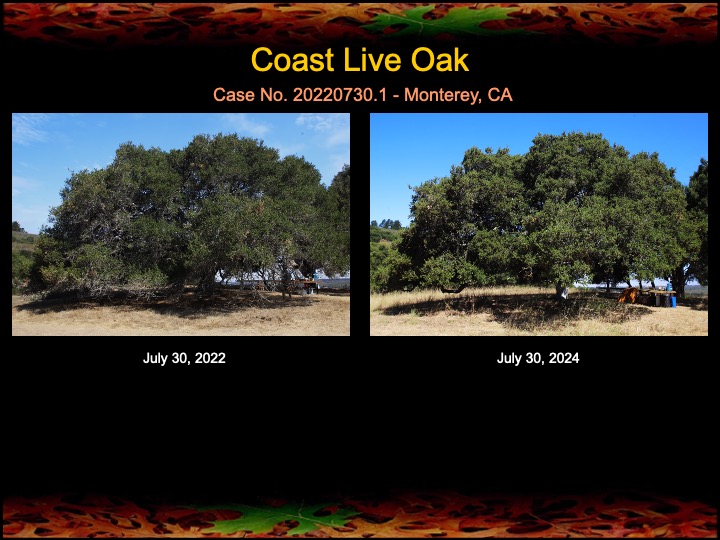
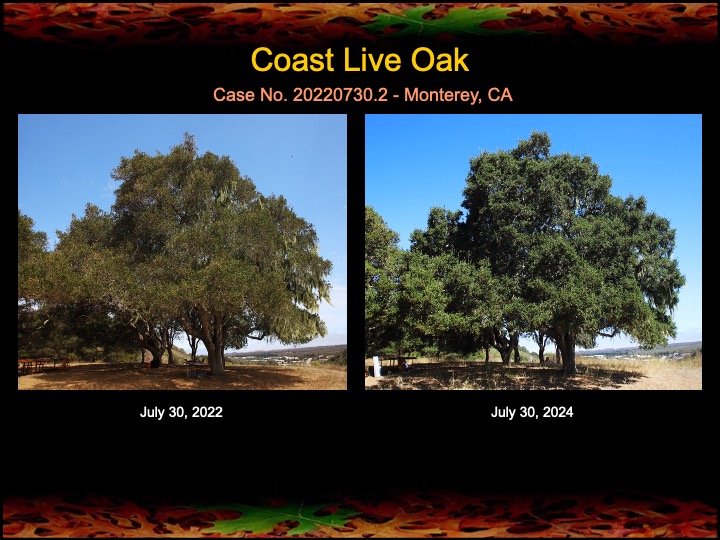
There’s a special place near Monterey that is an oak lover’s dream – over 600 acres of undeveloped, intact old-growth oak forest and savanna, never burned, that I’ve been commissioned to tend. In 2022 I surveyed about 25% of the property and identified over 200 ancient, culturally-modified coast live oaks (“ancestor” oaks) that date from the time when the Rumsen-Ohlone Indians were the sole human occupants of the land (> 300 years old). Every one of these oaks is a living cultural artifact of the Rumsen-Ohlone People. I’m guessing there may be nearly 1000 “ancestor” oaks on the property, many of which are over 500 years old. Thus, I refer to this place as “The Old Oaks Home”.

These ancient oaks are in a precarious situation. Given that fires have not burned here in well over 100 years, the forests are now overcrowded with young oaks and the grassland savannas have been mostly replaced by chaparral. A single spark could end the lives of hundreds of these ancient beings in just a day or two. So far, luck has been on the side of these elders, but their luck is running out for every year we postpone care.

In lieu of fire, I have been applying fire mimicry treatments to several of the ancestor oaks over the past couple years and am seeing a significant improvement in the density and lushness of the canopies of these trees. The above and below photos show the treated oaks today, compared to their appearance two years ago. Enjoy!

Read the rest of this entry »


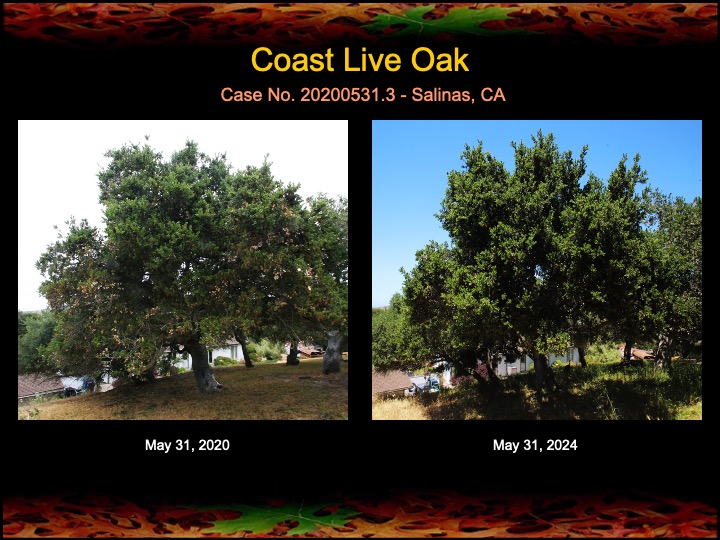
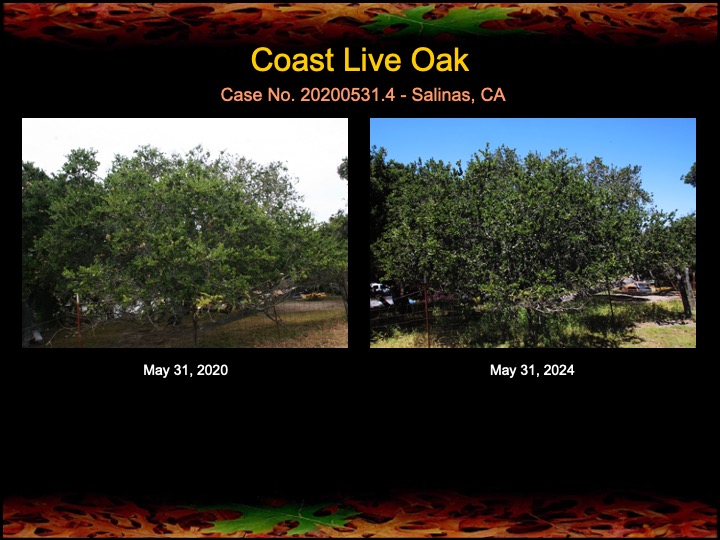
Coast live oaks in Salinas recovering after 4 years

31 05 2024

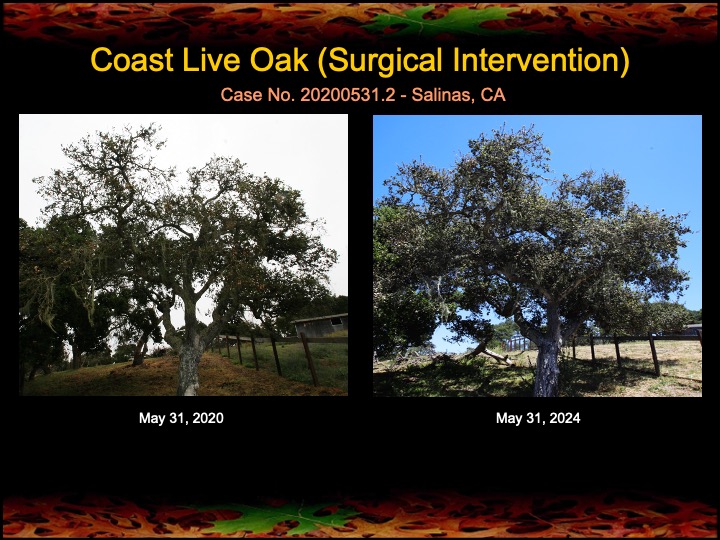
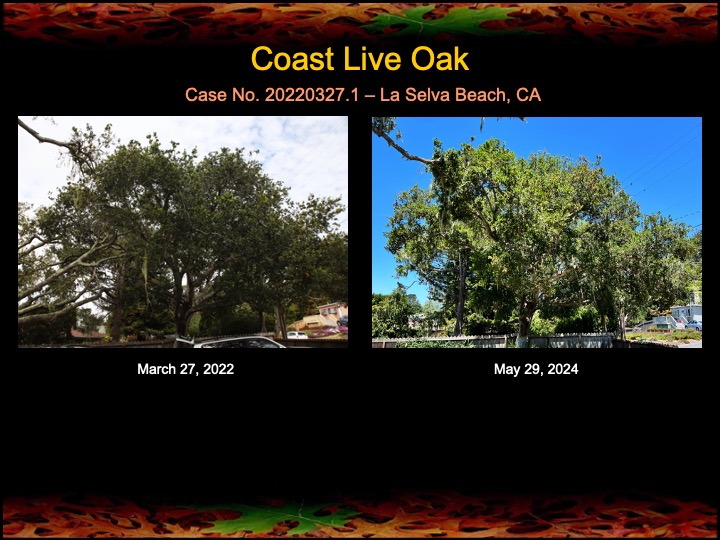
In 2020 a good friend contacted me about care for his sick oaks. I immediately responded and applied fire mimicry treatments on several of his oaks, including a control oak that I did not treat (see below). Here are the results after four years. Note below that one of the diseased oaks initially began to recover nicely in 2021, but ended up dying in 2022. The oak shown above had a stem canker infection (probably Sudden Oak Death) that was surgically removed in 2020, and now shows no sign of lingering infection.

Read the rest of this entry »


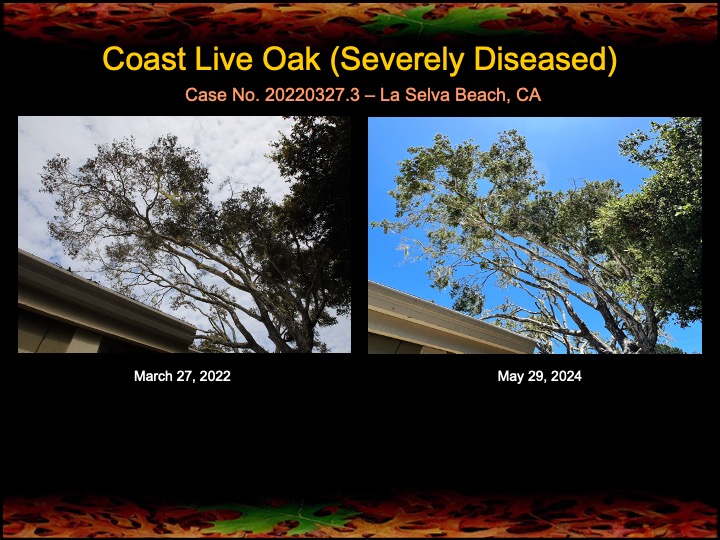
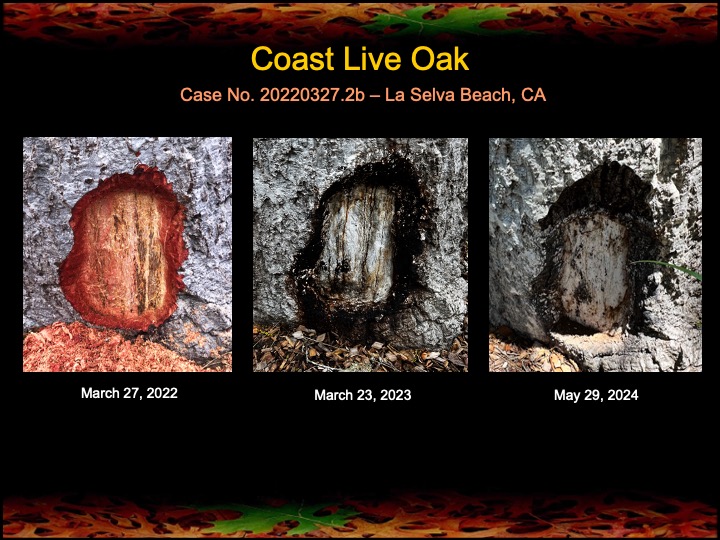
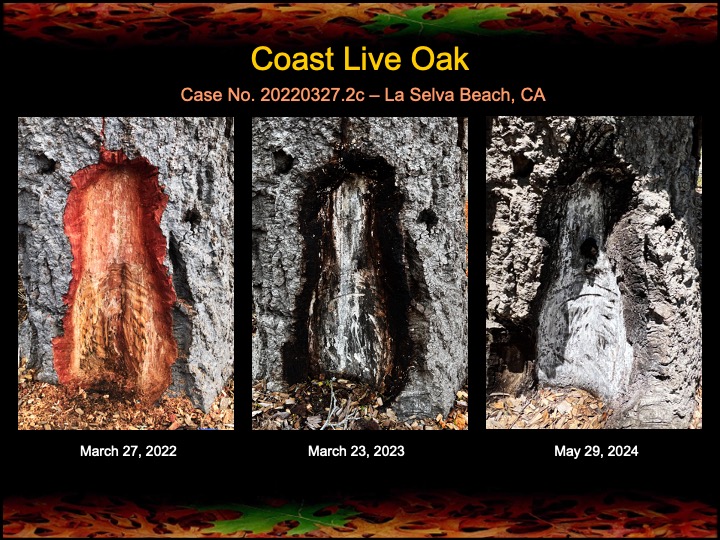
Coast live oaks, one requiring surgery, recovering after two years

30 05 2024

The coast live oak shown above was severely diseased with two large stem canker infections when I first arrived two years ago. Without promises of recover, I suggested two surgical procedures, as well as fire mimicry treatments to this and several non-diseased neighboring oaks. Below are the two surgical wounds depicting two years of healing. Note there is no residual bleeding or other signs of stem canker infection. Remaining photo sets below show the responses of the neighboring oaks to fire mimicry treatments. Happy to report that we’ll be returning soon to treat these oaks again.

Read the rest of this entry »


Who knew? Sweetgum too!

29 05 2024

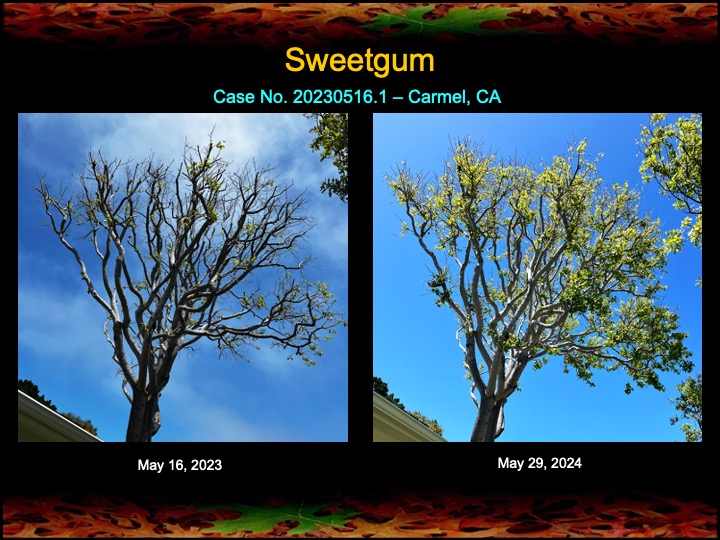
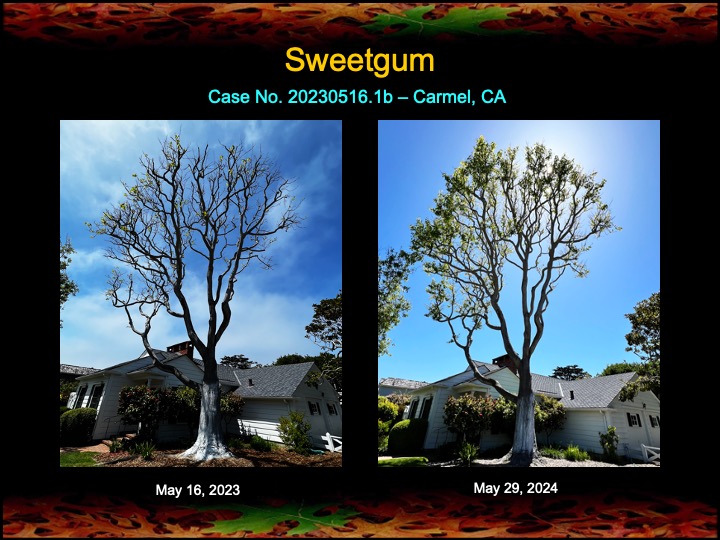
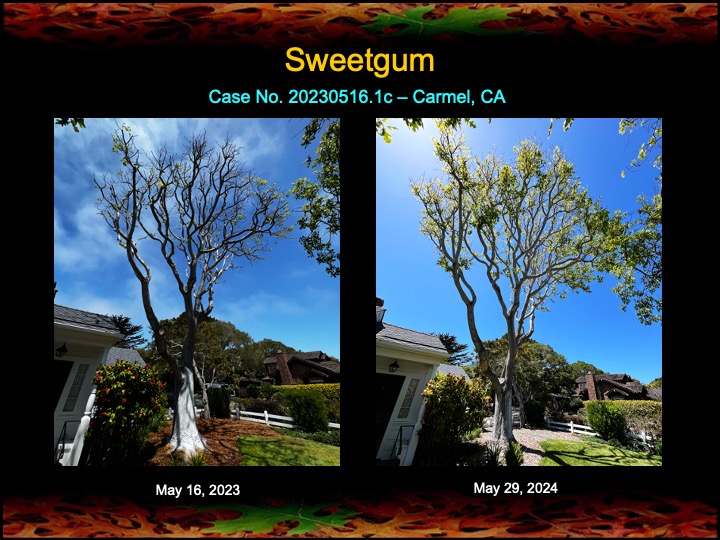
Last year a good friend’s mother contacted me about a sick sweetgum tree at her home in Carmel. I inspected the tree and saw that it was nearly dead. Although I had never treated a sweetgum tree before, as there seemed little likelihood that the tree would survive, I proposed we try a fire mimicry experiment. She agreed, so a major limb that was all but dead was removed, a surgery was done to remove a severe wood rot infection, the soils around the tree were amended with shells, ash, biochar, and compost tea, and a limewash was applied to the trunk. One year later …


Oaks after 3 years and 12 years

29 05 2024

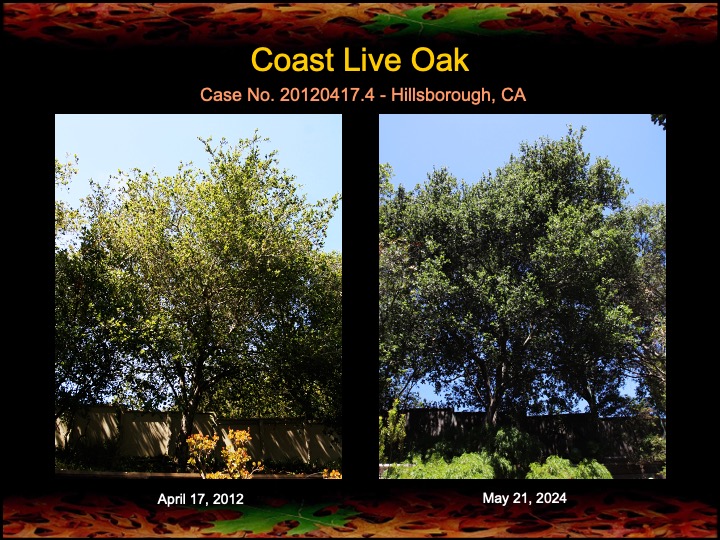
Here are some oaks that I’ve been treating with fire mimicry for 12 years, along with several oaks I’ve been treating for 3 years. Enjoy!

Read the rest of this entry »