Today I visited Hearst Castle and photographed several coast live oaks that have been under treatment with fire mimicry practices for four years. Some results from last year can be seen here. Below are the photos I took today showing changes in both treated and untreated oaks after four years. Be sure to examine the last two sets of photos which show results from some untreated oaks. Enjoy!
Hearst Castle 4-year results
4 01 2010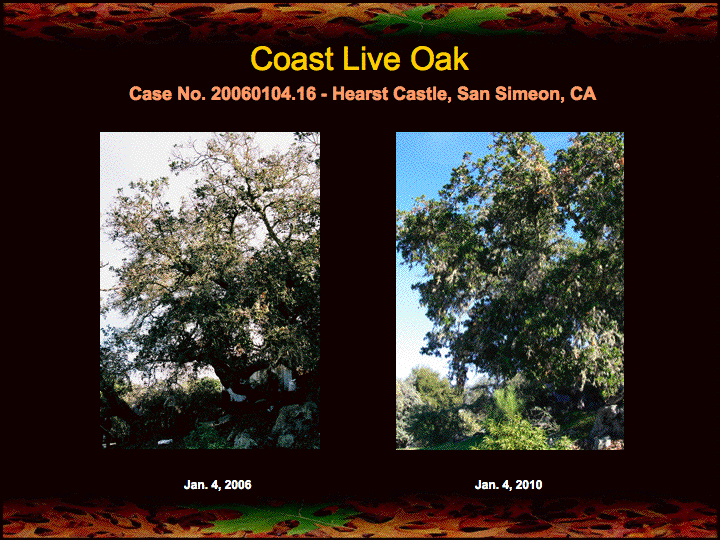
Comments : Leave a Comment »
Categories : Case studies, Fire mimicry, Oak health, Sudden Oak Death
A holistic approach to mitigating pathogenic effects on trees
25 12 2009For those of you who would like to read more about the details of the science and techniques involved in fire mimicry practices for oak restoration, here is a paper I wrote last year:
A holistic approach to mitigating pathogenic effects on trees
by Lee Klinger MA PhD
Presented at: Treework Environmental Practice Seminar XII
National Museum Cardiff, Cardiff, UK – 13th November 2008
Summary
The conventional ‘disease model’ approach to tree health focuses on identifying and controlling a specific pathogen (or pest) implicated as the causal agent of tree decline. Alternatively there are more holistic approaches in tree health that address a broader suite of processes occurring at the ecosystem level which may be predisposing the trees to infection by disease. Here I describe a holistic methodology that takes into account not only the proximal agents involved in tree decline, but also the age and structure of the forest, the abundance of cryptogams, the fire history, the acidity of the precipitation, the fertility of the soil, and the historical land care practices. This methodology is being implemented in the oak forests of coastal California which are experiencing high levels of mortality attributed, by most scientists, to the pathogen Phytophthora ramorum (aka sudden oak death). Evidence reported here of 1) acid rain, 2) acidifying effects of mosses and lichens, 3) the presence of acidic and nutrient deficient soils, and 4) a much lowered incidence of disease in recently burned areas, points to the likelihood that fire suppression has radically altered the structure and successional status of the forests, leading to enhanced competition and systemic acidification. Case study results of sick and diseased coast live oaks receiving holistic care, aimed not at treating P. ramorum but at reducing the environmental acidity, fertilizing the soils, and otherwise mimicking the effects of fire, show noticeable improvement in the health of the oaks after one year (78%, n=152), with further improvement in years two (84%, n=134) and three+ (81%, n=80). While the results do not indicate that the incidence of P. ramorum has changed significantly in the population of treated oaks, there is evidence that the sick, non-diseased trees are better able to resist infection.
Download the complete paper here.
Comments : 4 Comments »
Categories : Acid rain, Big Sur, Case studies, Fire ecology, Fire mimicry, Native people, Oak health, Soil science, Sudden Oak Death
Winter solstice oaks
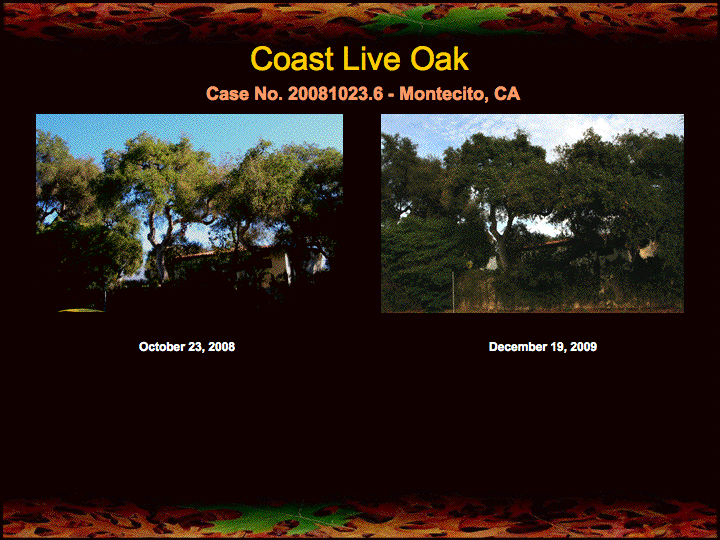
21 12 2009Winter solstice is upon us and I’m taking this day to rest my body after many days of hard work restoring oaks with fire mimicry practices in Santa Barbara. During my visit I re-photographed several oaks that I treated last year in Santa Barbara. I thought I would share the results as a winter solstice gift to readers.
Happy holidays. Enjoy!
Comments : Leave a Comment »
Categories : Case studies, Fire mimicry, Oak health
More good news . . .
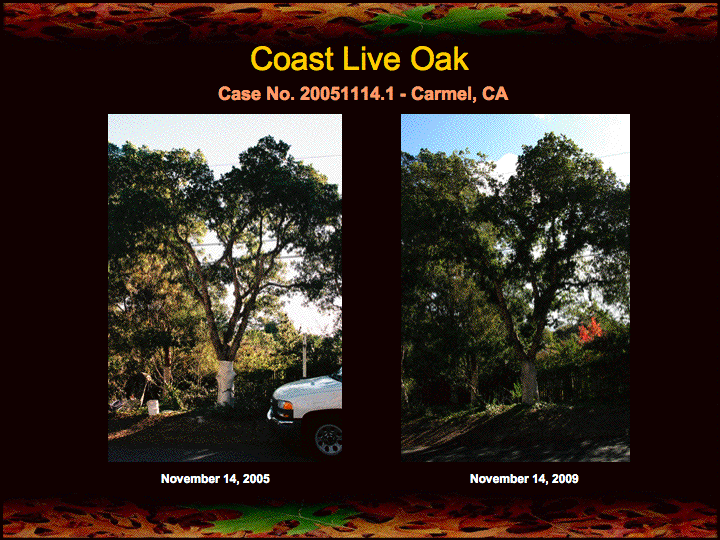
29 11 2009Fire mimicry effects after 4 years:
Comments : 2 Comments »
Categories : Case studies, Fire mimicry, Oak health
Five-year progress report on coast live oaks
16 11 2009I have been reporting for some time on the progress of seven ill coast live oaks in Fairfax, CA first treated with fire mimicry in November of 2004 (see here, here, and here). These oaks have been under the care of my friend and colleague Leith Carstarphen of Ecologic Landscaping. Alan Mart has also contributed his time and expertise in caring for these oaks.
After five years two of the oaks have succumb to sudden oak death, though not without a period of improved canopy health before their demise (see Sudden oak death). Today I would like to present repeat photographs of the five remaining oaks taken just a few days ago. I am pleased with the results. Readers can judge for themselves. (Please excuse my ill-fated attempt in some of the photos to match exposure levels).
There is one particular oak, case study no. 20041129.8, which tells an interesting story. I first chose this oak as a control tree since it was not initially treated. For two years the health of this untreated oak showed little if any change, as can be seen in the photographs below. Then as is so often the case the owner decided to treat all of the oaks, including this one, and after three years the oak is now showing modest improvement with fire mimicry.
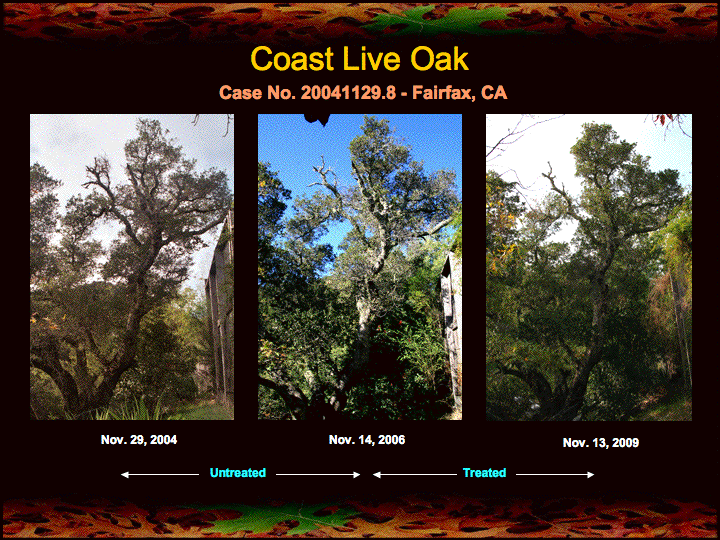
Another important point – while the originally diseased oaks remain infected with sudden oak death, the non-diseased oaks remain uninfected. This is consistent with many other case studies showing that fire mimicry treatments may be particularly effective at stopping the spread of sudden oak death. Read the rest of this entry »
Comments : Leave a Comment »
Categories : Case studies, Fire mimicry, Oak health, Sudden Oak Death
Encino heritage oak
3 11 2009I’ve often said that every tree tells a story. Well, there’s a heritage oak in Encino, California that has a story to tell.
As most of you may know the live oaks and tan oaks of California are dying off in large numbers as a result of stresses brought about by decades of fire suppression. Oaks are fire-adapted trees, meaning they benefit from periodic fires. The lack of fire has weakened the oaks and created conditions that encourage the spread of diseases such as sudden oak death.
The live oaks and tan oaks, however, are not the only species of oaks that are suffering. Valley oaks (Quercus lobata), blue oaks (Q. douglasii), Oregon white oak (Q. garryana), and other species in the white oak subgroup are, in places, experiencing heavy die-off, yet are showing no signs of sudden oak death or bark beetle infestation. As it turns out the white oaks, too, are suffering from the effects of fire suppression. The good news is that these oaks, like the live oaks and tan oaks, are showing positive responses to fire mimicry treatments.
One of the largest oaks in Encino, California is situated next to the home of Robert and Lelia Maltzman. This heritage valley oak is estimated to be about 500 years old. In 2006 I examined the oak and found the soils to be somewhat acidic and the canopy of the tree was rather thin. Fire mimicry treatments involving healthy doses of calcium-rich AZOMITE minerals were then implemented and, three years later, the oak is showing some nice improvement in canopy health.

Below are photos of the Encino heritage oak showing the changes in canopy health three years post-treatment. Note the removal of one large limb for stress reduction. I was not involved in this limb removal and may have done it differently from an aesthetic perspective. But the arborist certainly had his reasons and after three years the tree seems to be faring well.

Encino heritage oak before and after fire mimicry treatments
Here is an article describing this heritage oak that appeared in the Encino Sun in 2007. Read the rest of this entry »
Comments : 1 Comment »
Categories : Case studies, Fire mimicry, Native people, Oak health, Sudden Oak Death
Fire mimicry results with oaks, pines, and more . . .
28 10 2009As much as I would like to post more frequently on all the interesting work that is going on in land and tree stewardship, the fact is that I spend most of my time out working on the trees and soils, which leaves me limited time for blogging. There is so much I can do for a sick tree that I prefer to simply get on with doing the work rather than write about it.
Here is where my Canon Eos 30D comes in handy. I could measure and discuss percentage changes in crown density or leaf area index, but you’d be bored and the oaks would still be dying. With repeat photography I have more time to work on trees and it allows you to better view and judge for yourself the results of these efforts.

Comments : Leave a Comment »
Categories : Case studies, Fire mimicry, Oak health, Pine health
 Sudden Oak Life by Lee Klinger
Recent Comments