The potential role of peatland dynamics in ice-age initiation

10 01 2010

As I mentioned in a previous post I am putting up some of my earlier work on feedback mechanisms by which the planet cools itself. This background will be useful in an upcoming post on planetary temperature regulation.

The potential role of peatland dynamics in ice-age initiation

by Lee F. Klinger, John A. Taylor, & Lars G. Franzen

Quaternary Research 45: 89-92 (1996)

Summary – Physical and chemical coupling of peatland vegetation, soils and landforms and atmosphere creates feedbacks which may be important in ice-age initiation. A box diffusion CO2 exchange model shows that a transient forcing of 500Gt C (the amount proposed to have accumulated in peatlands during the last interglacial-glacial transition) over 5000 yr results in a lowering of atmospheric CO2 by about 40 ppm. Proxy data indicate that a decrease in atmospheric CO2 may have occurred over the last 5000 years up to pre-industrial times, and the amount (~22 ppm lowering in 5000 yrs) is similar to that calculated from Holocene peatland expansion. These results suggest that models should consider the role of peatlands in ice-age initiation.

View the entire paper here.

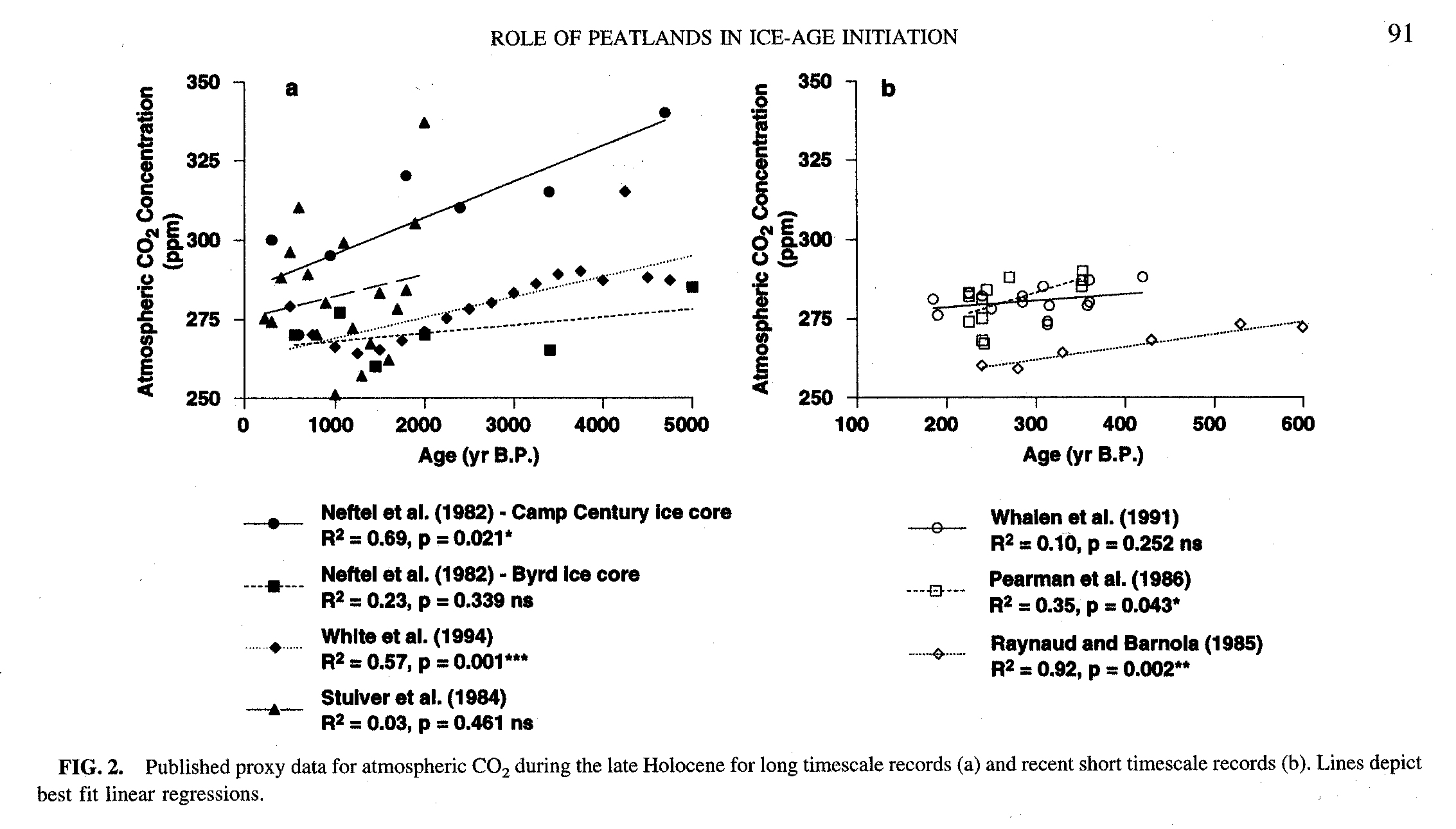
In Fig. 2 (see below) we present evidence that prior to the industrial era atmospheric CO2 was undergoing a decline. We attribute the decline to large-scale landscape transformation involving the replacement of forests by peatlands. Peatlands store immense amounts of carbon and, as described in an earlier publication, are potentially powerful organs that help cool the planet.


Peatland formation and ice ages: a possible Gaian mechanism related to vegetation succession

6 01 2010

To prepare readers for some upcoming posts on the implications of Gaia theory in climate change predictions I would like to provide some background literature of my earlier work in this area. Below is a paper I gave at the American Geophysical Union Chapman Conference on the Gaia Hypothesis held in San Diego, CA in 1988. This paper was published as a chapter in a 1991 book on the proceedings of the conference: Scientists on Gaia. Here is the summary of my paper:

Peatland formation and ice ages: a possible Gaian mechanism related to vegetation succession

by Lee F. Klinger

Summary – Terrestrial areas, which support over 99% of the earth’s biomass, have considerable potential for being involved in biosphere-atmosphere feedback loops as postulated by the Gaia hypothesis. This paper presents a model of a possible Gaian mechanism related to landscape-level successional changes during a glacial-interglacial cycle. The model is based on the view that terrestrial successions converge toward bogs, rather than toward old-growth forest, and that bogs represent structurally and compositionally stable (climax) communities. The model also assumes, as in classical successional theory, that during the course of succession the biota modifies the environment, both the soil and the atmosphere, to favor the progression of succession toward the climax state. Feedback mechanisms between peatlands (landscapes of bogs and bog forests) and the atmosphere are proposed which should favor the initiation and maintenance of relatively stable, ice age climates. These cooling mechanisms are related to increased albedo, increased evapotranspiration, and decreased atmospheric CO2 associated with the succession from woodlands to peatlands. Ice core and ocean core data for CO2, CH4, and delta 13C and delta 14C isotope ratios are consistent with the proposed terrestrial dynamics involving organic carbon.

Here is the full reference for my paper:

Klinger, L.F. 1991. Peatland formation and ice ages: a possible Gaian mechanism related to vegetation succession (Chap. 28). In: S.H. Schneider & P.J. Boston (eds.), Scientists on Gaia. The MIT Press, Cambridge, pp. 247-255.