An Op Ed on the Los Angeles Wildfires

13 01 2025

With regards to the recent catastrophic wildfires burning in LA, please consider what I have to say. I am a survivor of a wildfire that burned here in Big Sur several years ago which, despite my fire-fighting skills, took my home. As a PhD scientist my understanding of the ecology of the California forests and their decline runs deep, which has proven useful in consulting with landowners on how to prevent the decline of their trees and reduce the fire hazard on their properties. I served for many years as a volunteer and paid firefighter and, with respect to climate change, I worked as a staff scientist for 14 years at the National Center for Atmospheric Research (NCAR). Currently I serve as the Staff Ecologist with the Esselen Tribe of Monterey County.

Climate change is so often invoked as the “cause” of these wildfire disasters, that it is hard for most folks to parse the more nuanced explanations of what is really going on. In my opinion, the wildfire problem in California and elsewhere has been hijacked by climate activists, who wish to divert the attention of wildfires to climate change, despite knowing that climate is only part of the problem. This emphasis on climate change leaves people with few real-world solutions to the wildfire problem. Buy a Tesla perhaps?

But the LA fires were preventable, without changing the climate. How do I know? Because of the real world work I do which has not only saved homes, it has also saved entire forests – and I didn’t change the climate!

To put it simply, in my opinion, if climate change was not happening, or even if we were able to stop or reverse climate change right now, these wildfires would still happen. Present day climate change may be exacerbating the frequency of these events, but the wildfires would still happen. Suppose we were to develop better firefighting technologies and skills, the wildfires would still happen. Let’s rebuild with more fireproof homes, well then maybe not so many homes would be lost, but the wildfires would still happen!

The catastrophic wildfires in California and elsewhere are NOT the result of an altered climatology, they are the result of an altered ecology. For thousands of years the forests, chaparral, and prairies of California were managed by the Native Peoples, mainly with fire. Now that the Native People have been largely removed, the lands are no longer being tended. This has resulted in rapid shifts in the succession of ecosystems. Prairie ecosystems are being invaded by chaparral and oak savannas are quickly becoming overcrowded oak forests.

Thankfully, the Native Peoples have solutions, which they are willing to share. Maybe it’s time to listen and learn!

Respectfully,

Lee Klinger, Big Sur, CA

Author – “Forged by Fire: The Cultural Tending of Trees and Forests in Big Sur and Beyond” https://www.amazon.com/dp/B0D3ZVMB3P


Four years of doing nothing …

31 12 2024

I often tell people inquiring on how to best care for their oaks that doing nothing is not an option! It seems that most people see oaks as native trees of California that have adapted and endured here for thousands of years, so they should not need our care.

Missing from this understanding is that the great oak forests here are the result of thousands of years of care by the Native Peoples. That is why those of us who know this are tending the oaks with fire and/or fire mimicry and seeing clear improvement in their health. Indeed, most of the information on this blog addresses mainly the positive results of tending trees.

But what happens to oaks when we do nothing?

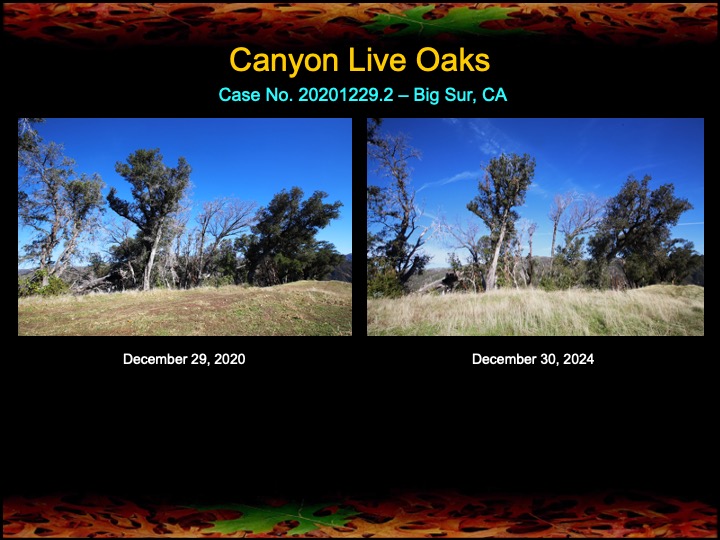
Here I present four-year photo sets of numerous canyon live (Valparaiso) oaks where nothing has been done, save for one oak that received a partial fire mimicry treatment in January of 2021. Most of the oaks are showing noticeable decline in canopy leaf density, a fair measure of the trees’ overall health. Several show no clear change in canopy density, and one or two seem to have improved over the past four years.

Can anyone guess which of these oaks received a partial fire mimicry treatment?

Read the rest of this entry »


California oak decline is reversible!

22 12 2024

For more than two decades the decline and death of California’s oaks has been a matter of serious concern. In 2000 the California Oak Mortality Task Force (COMTF) was formed and members of the task force have received over $50 million in funding to address this problem. I attempted to become a member of the COMTF in the early 2000’s and applied several times for funding, but to no avail. The problem was seen then, as it still is, as pathological (say the pathologists) not ecological (say me).

That cold shoulder turned out to be a fine move for the dying oaks, as it forced me to stop studying the problem and start trying to fix it. Hence “Sudden Oak Life” was born and ever since I have been showing the fruits of my labor. While the title of this post may be news to many, it is old news to the long-time followers of this work. In the archives of this blog that span two decades are photos of THOUSANDS of oaks showing that in most cases their decline can be reversed.

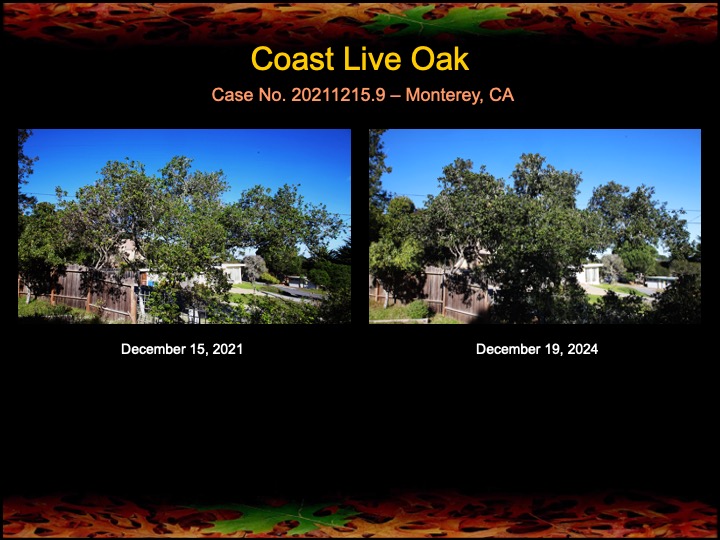
Shown here are photo sets of 16 ailing coast live oaks in Monterey CA treated with fire mimicry showing their progress after three years. Most of the oaks exhibit a notable increase in canopy density and many appear greener.

More evidence that California oak mortality is reversible! Enjoy …

Read the rest of this entry »


Images from the Spring 2022 Fire Mimicry and TEK workshop at Indian Canyon

16 05 2022
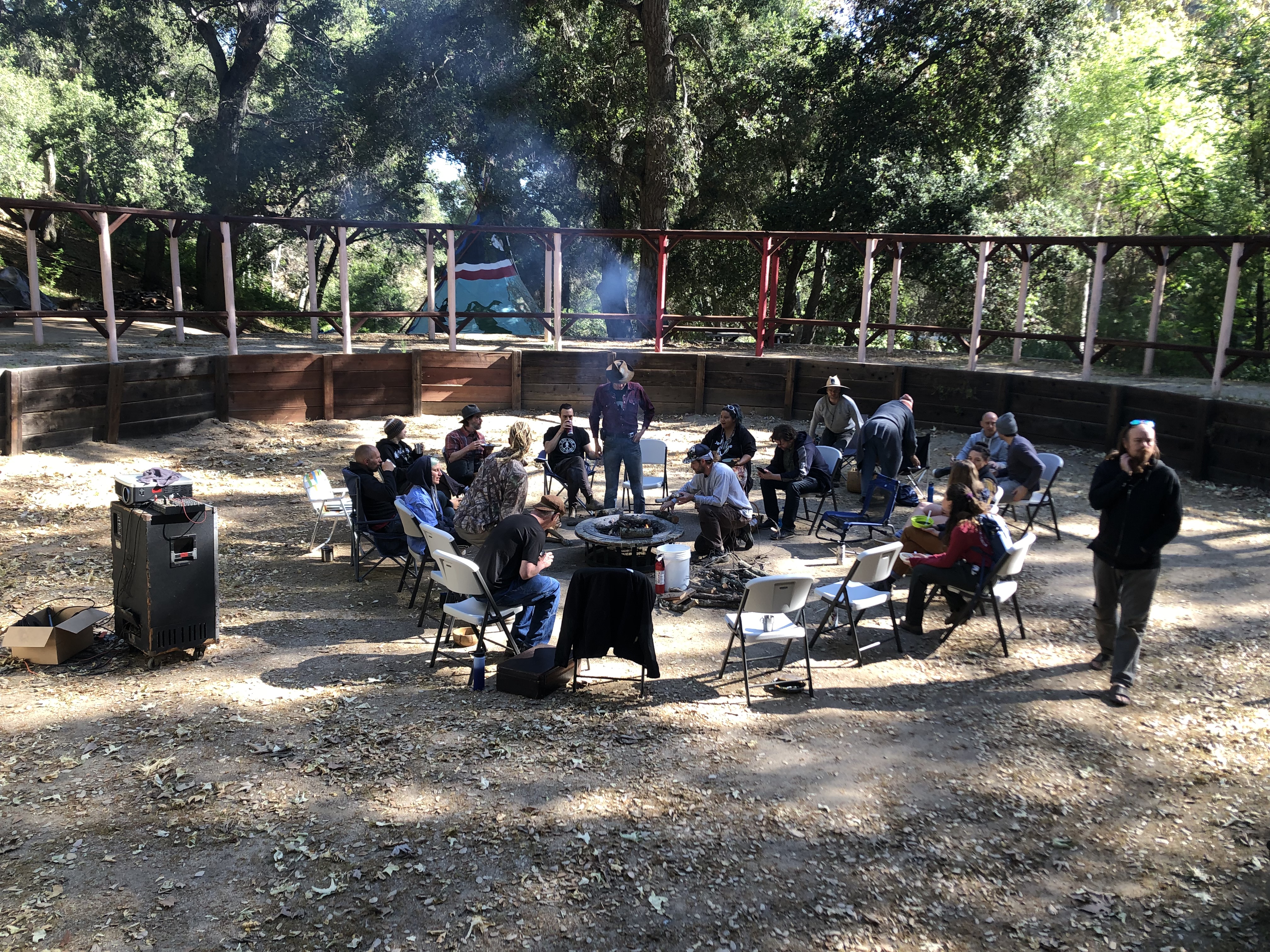
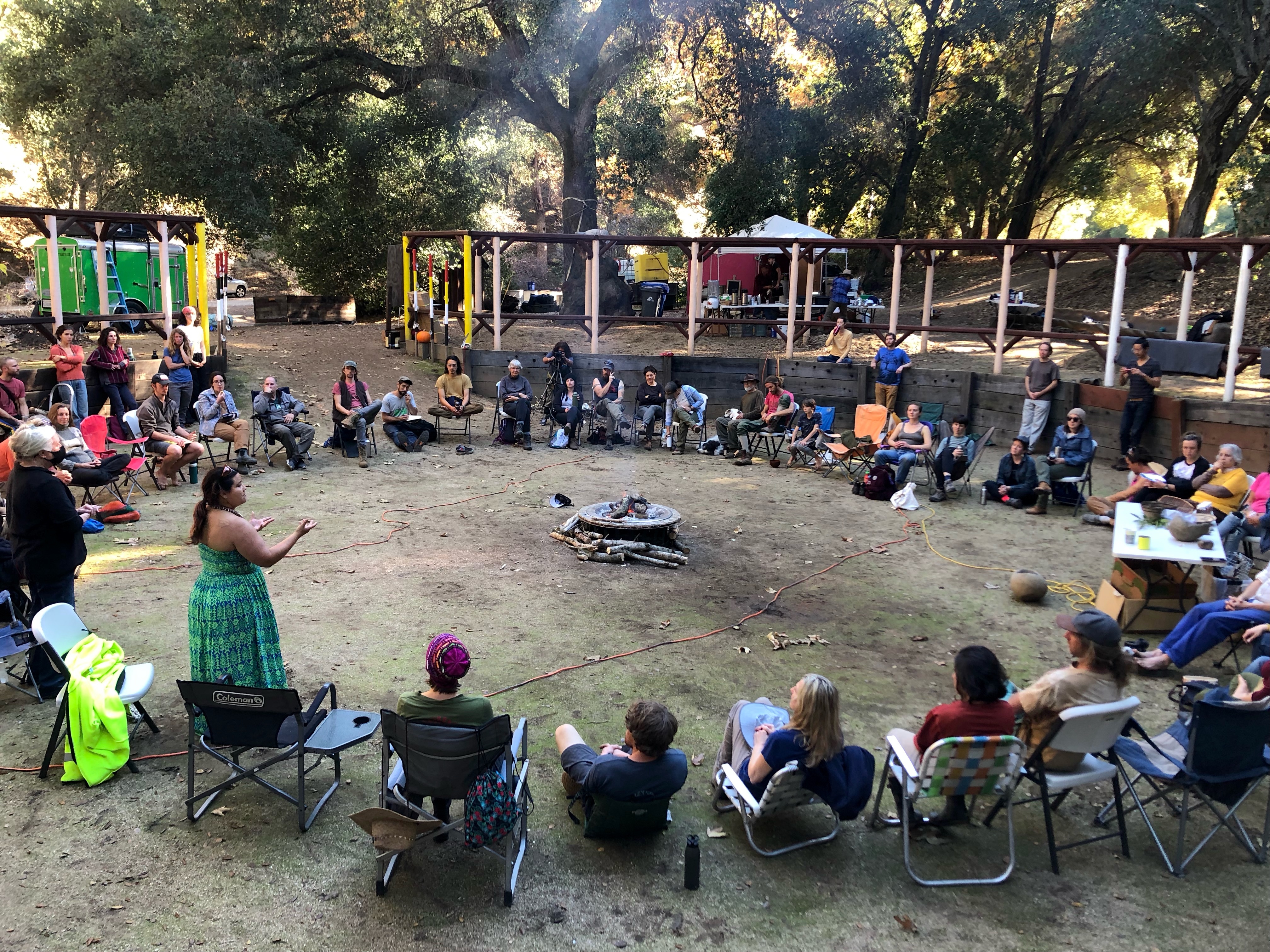
Opening circle

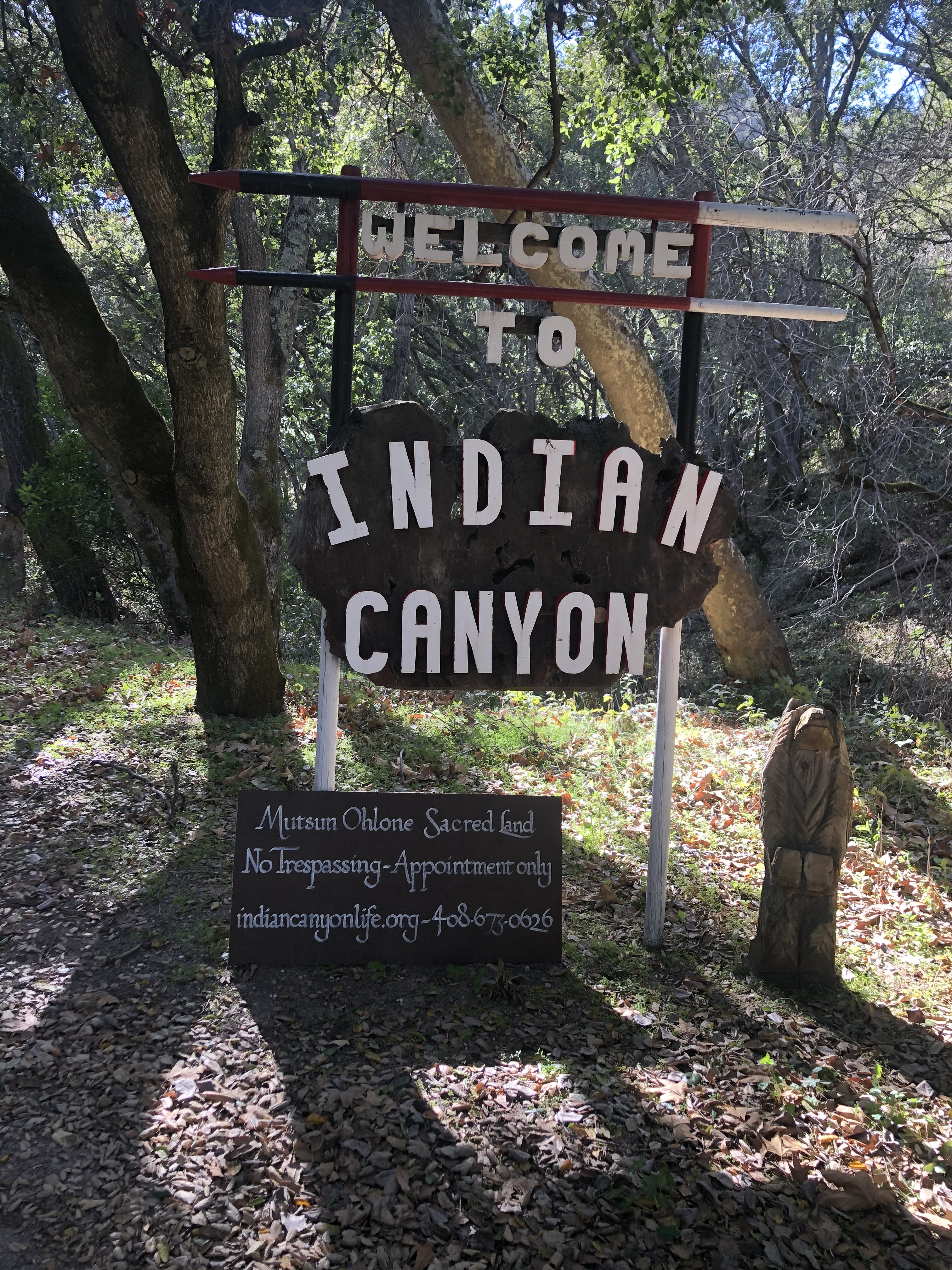
This past weekend Sudden Oak Life, EcoCamp Coyote, and Indian Canyon Nation joined efforts to choreograph the second FIre Mimicry and TEK workshop. This hands on 3-day event was attended by over 30 enthusiastic participants who took a deep dive into the ecology of fire and the practice of fire mimicry in the context of Traditional Ecological Knowledge (TEK). Our host and teacher of Indigenous knowledge was Kanyon Sayers-Roods (Mutsun Ohlone). Here are various images from the workshop. If you missed this event, please come to our Fall 2022 FIre Mimicry and TEK workshop at Indian Canyon in November.

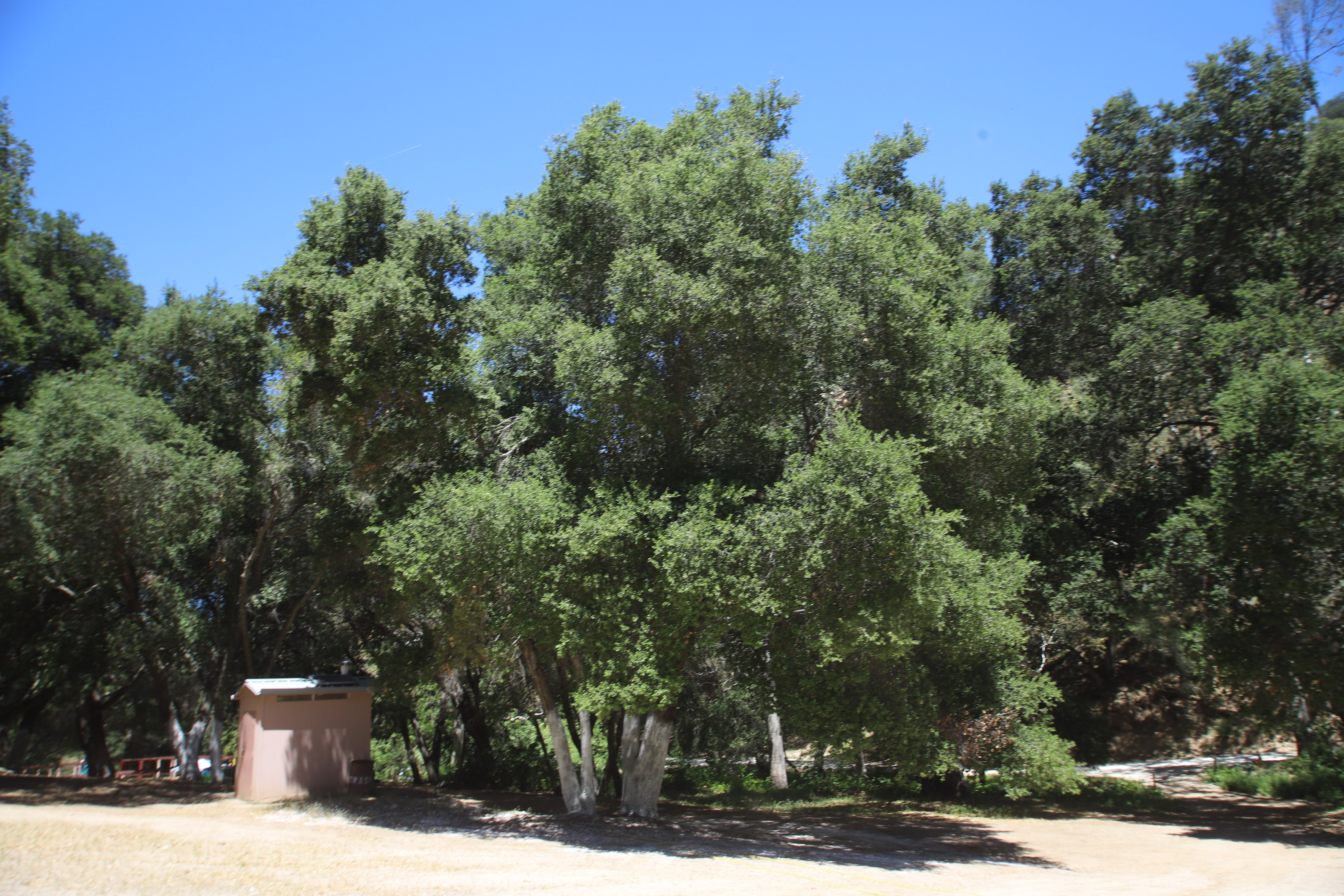
An Ancestor oak at Indian Canyon treated with fire mimicry at the workshop
Read the rest of this entry »


Sudden Oak Life event Spring 2022: Fire Mimicry and TEK at Indian Canyon (May 13-15)

11 03 2022

Indian Canyon Nation, EcoCamp Coyote, and Sudden Oak Life are collaborating again on an upcoming 3-day intensive workshop titled “Fire Mimicry and Traditional Ecological Knowledge” being held at Indian Canyon May 13-15, 2022. This event will feature Kanyon Sayers-Roods (Indian Canyon Nation, Mutsun Ohlone), Tom “Little Bear” Nason (Tribal Chairman of the Esselen Tribe of Monterey County), Leo Lauchere (EcoCamp Coyote), and Lee Klinger (Sudden Oak Life). Here are some of the topics we will cover:

• How this restoration work supports and is informed by indigenous cultures and traditions

• Explore right-relationship with the land and its people

• History and shared lineages of the Esselen and Mutsun Ohlone People

• Modern cultural tending and management of Central Coast forests

• Identifying culturally modified trees and landscapes

• The science and practice of fire mimicry

• Demonstration of stem canker surgical procedure

This is a rare event and should not be missed by anyone passionate about tending oaks and other native trees. More information and registration for the event are here.


Responses of Big Sur oaks to fire mimicry followed by wildfire

25 02 2022

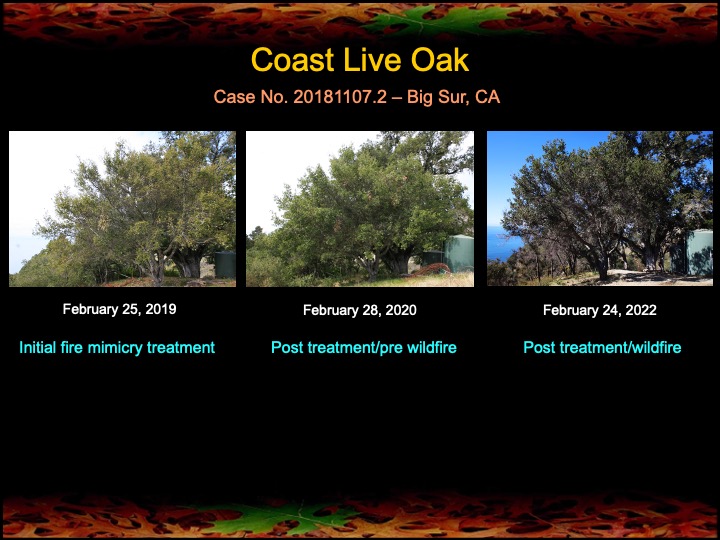
In February of 2019 I began photo documentation of 21 coast live oaks in Big Sur, CA. At least six of these appear to be “Ancestor” oaks, culturally-modified by the Esselen Indians via pollarding of their canopies. All oaks were initially treated with a fire mimicry protocol (clearing, pruning, moss/lichen removal, soil fertilization, & limewash), with the intention that this work would improve the survival rates of the oaks, whether or not a wildfire occurred. The first year results were About photo documented in February 2020. In August 2020 a severe wildfire was ignited in the area and burned through all the groves of the treated oaks.

Yesterday I was finally able to access the site to observe and photo document the findings. Both wooden structures on the property were lost, as were two treated oaks that grew adjacent to them. However, of the 21 oaks initially surveyed, 17 survived the fire, a survival rate of just over 80%. Four of the six “Ancestor” oaks also survived. More than 75% of the oaks showed noticeable signs of improvement in canopy lushness following fire mimicry. A year and a half after the wildfire, 6 of the surviving oaks continue to show signs of heavy fire damage in their canopies. However, 11 (or just over 50%) of the surviving oaks are showing significant improvement of their canopy health following the wildfire.

These are exciting results (see photos below) and show to me that fire mimicry treatments can provide considerable benefit to survivability and health of oaks and other trees in the event of a wildfire.

Read the rest of this entry »


Video recording of “Forest restoration theory and practice based on Indigenous cultural tending”

17 11 2020

Here a Youtube video of my recent lecture and discussion in the course FORESTS, hosted by the Humanities Center of Texas Tech University. Many thanks to Bruce Clarke and Michael Borshuk for facilitating this talk!


Upcoming zoom lecture (Thursday, Nov. 12) – “Forest restoration theory and practice based on Indigenous cultural tending”

7 11 2020

This Thursday, November 12, (5:30 pm Pacific Time) I will be conducting a zoom lecture and discussion for the online course FORESTS, hosted by Texas Tech University, on the topic of “Forest Restoration Theory and Practice Based on Indigenous Cultural Tending”. The points I will be addressing are: Gaia theory, ecological succession, fire ecology of California, evidence of cultural modification of trees and landscapes, and approaches to forest restoration. The lecture is open to all, just be sure to register beforehand. Follow the embedded link to register.


Tom “Little Bear” Nason, Esselen Elder, on the history of fire management in Big Sur

20 09 2020

(UPDATE: For a more detailed discussion of the history of fire management in Big Sur, please see my new book Forged by Fire: The Cultural Tending of Trees and Forests in Big Sur and Beyond with a foreword by Tom Little Bear Nason https://www.amazon.com/dp/B0D3ZVMB3P)

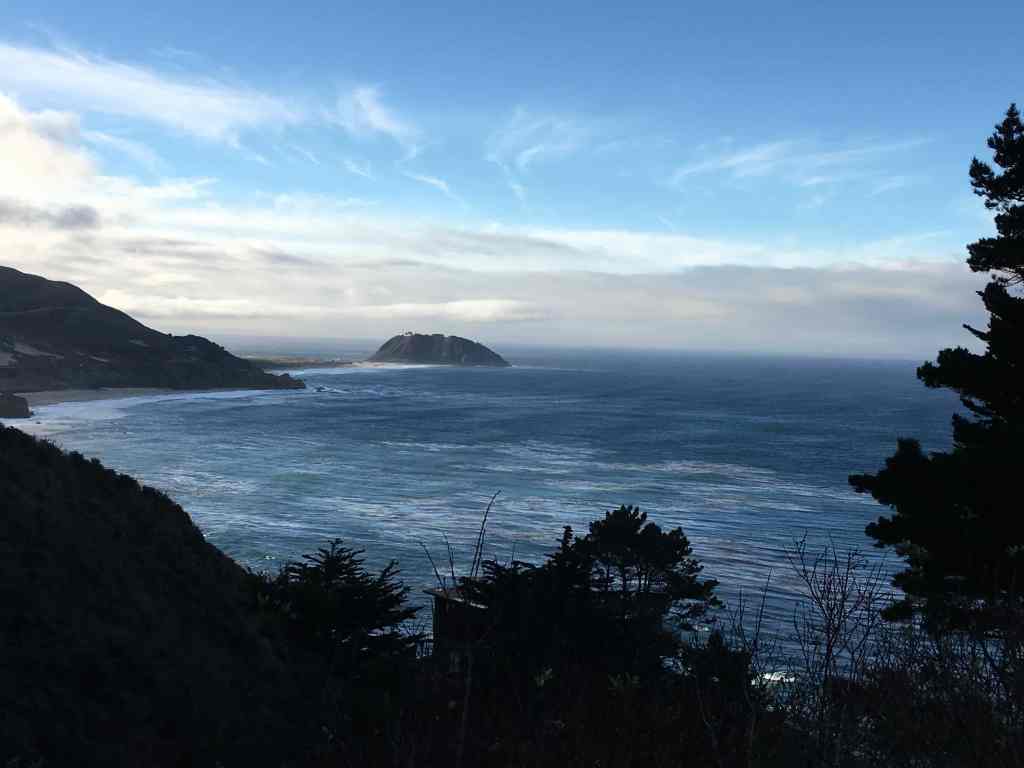
I live on Esselen tribal land. The name “Esselen” is derived from the word Ex’xien, or “the rock”, assumed by many to be Point Sur (pictured above). Several years ago I met an Esselen tribal elder named Little Bear at a meeting of the Four Winds Council in Big Sur, CA. I have since joined him in sweat lodge ceremonies and jaunts into sacred redwood groves. His perspectives have fascinated me over the years I have known him.

With his permission I am reposting below a recent series of photos and commentaries by Little Bear on the history of land management here in Big Sur. Please pay attention!

Tom “Little Bear” Nason, September 20, 2020:

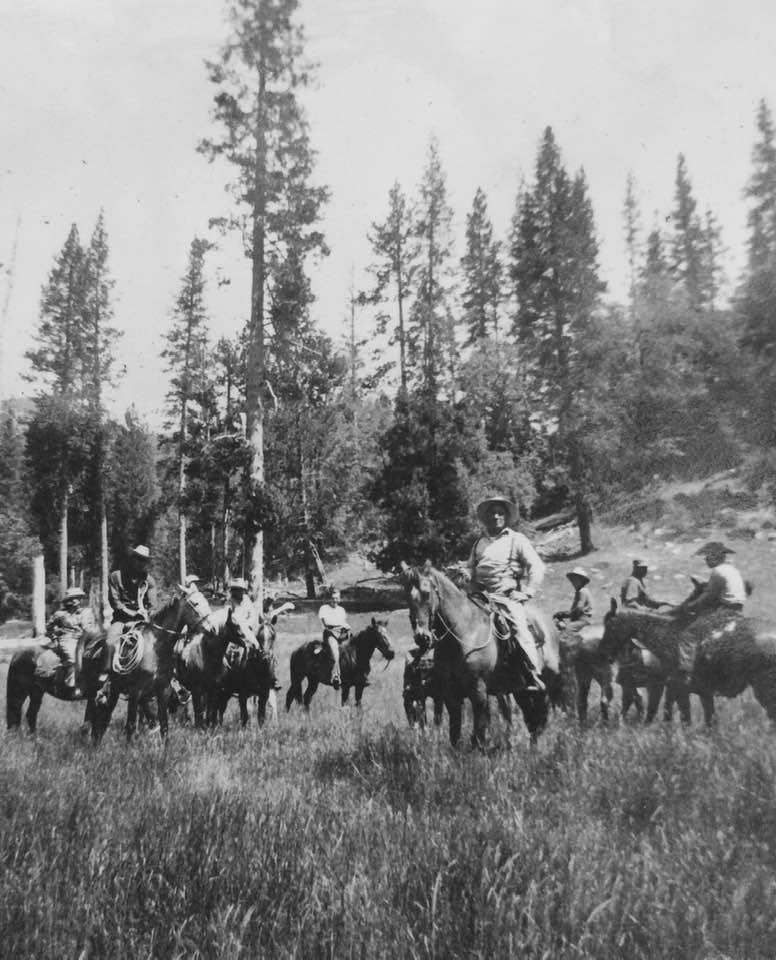
“My Great Grandfather Fred P Nason with guests in Pine Valley, Los Padres National Forest in 1940s. Our family has lived, loved and shared this sacred lands for over many generations and we always will forever.Our family has been practicing traditional native indigenous Esselen tribal burning of this valley up until 1970s. Government said STOP BURNING!! My Forefathers all told them that by ordering ceasing off these lands it would begin a dangerous situation by allowing the brush and scrub to grow out control and the forests would become choked off and when a natural force like lighting comes it would cause the lower brush to burn at high heat and kill the trees. In this photo you see many big ponderosa pine trees and open meadows surrounding them. As Natives of this lands we knew how to manage our lands and the forests. Since 1940s, we’ve had many wildfires come thru the Santa Lucia Mountains and some were good for the land and most have been extremely damaging. I will start posting more pictures and stories about how my family and tribe have seen our beloved and sacred places here in Big Sur changing so much due to imbalance and the deep sadness for losing so many of the old trees. We need change and it’s very challenging for all us to live with so many fires so frequently!! Prayers and Respect to all who listen to Mother Nature🙏🏽🌀🌏🌲🐻🙏🏽 Tom Little Bear Nason September 20th, 2020 Last Day of Summer🌞 Praying for Early Rains🌧

Read the rest of this entry »


California’s big trees tell a story of overcrowding …

17 08 2020

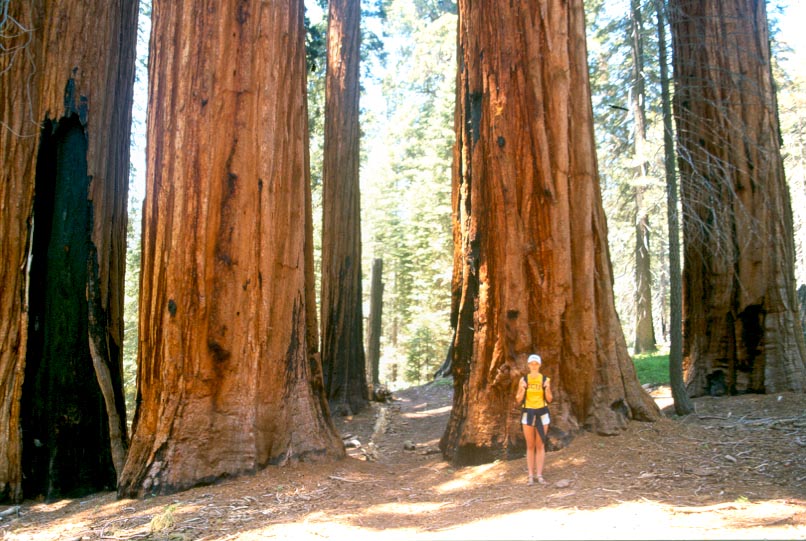
I recently went on a several week journey to further investigate the big trees of California. Within the past month I have visited Sequoia/Kings Canyon National Park, Sequoia National Forest, Sierra National Forest, Redwood National Park, and various northern California state parks. Simply put, there is an overcrowding problem, but not of tourists.

IMG_0933

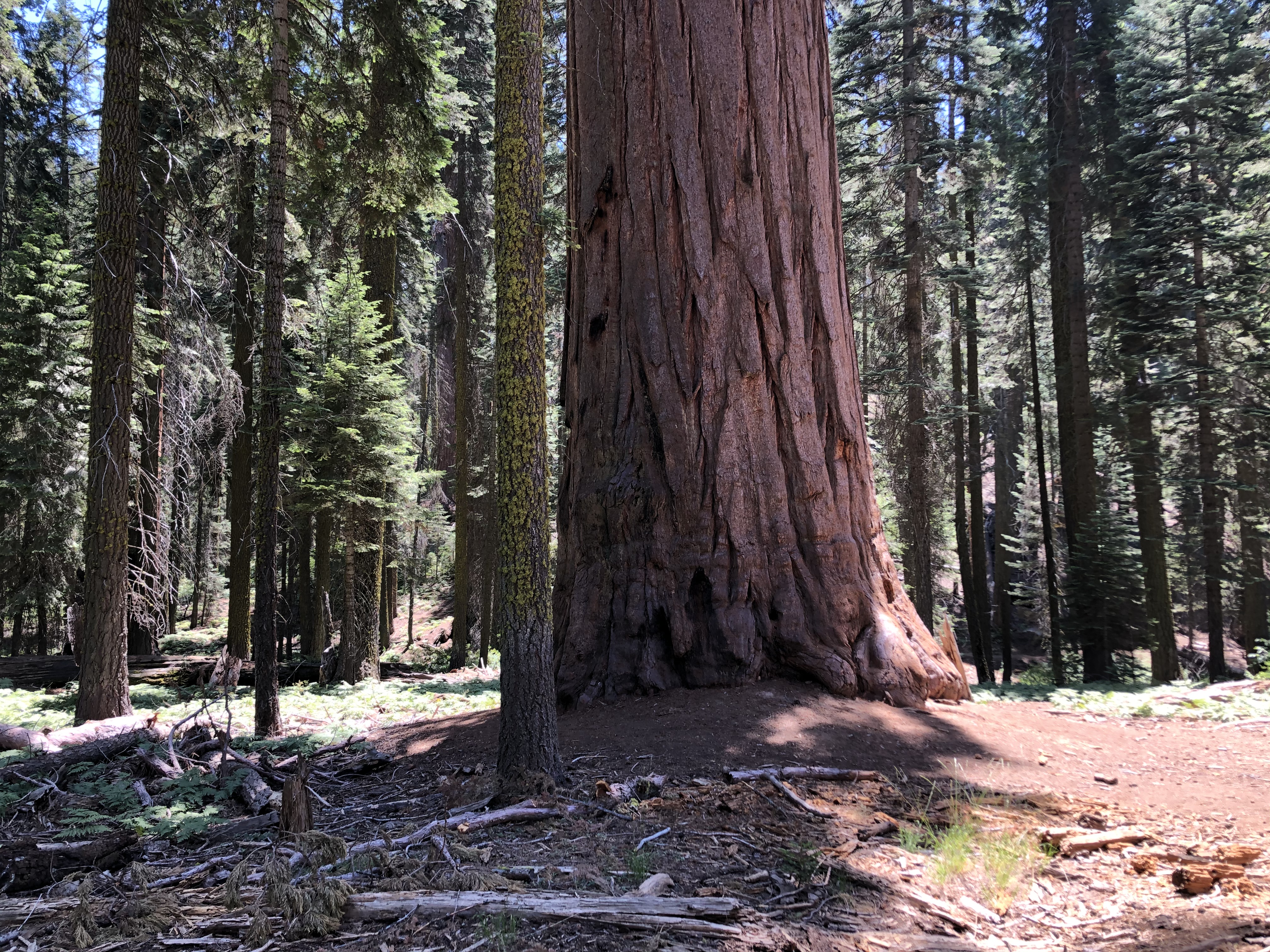
Above is a giant sequoia surrounded by dozens of younger trees, all of which are competing for the same resources as this ancient tree, In previous centuries, these younger trees would have been removed by fires set by the local California natives.

IMG_0881

Fallen giant sequoias from paludification, along with over competition.

IMG_0987 Read the rest of this entry »