Grandfather oak revisited

4 08 2015
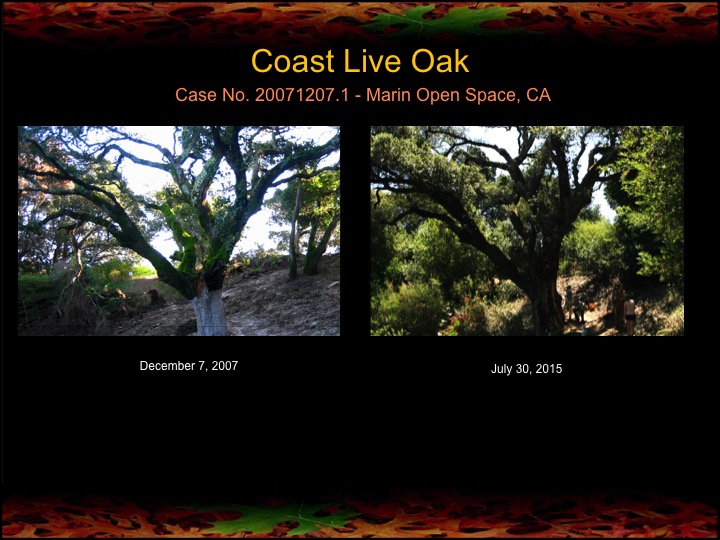
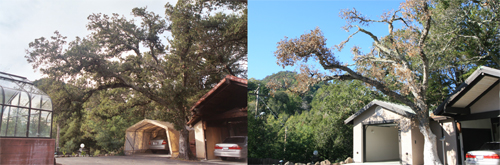
Grandfather oak before and after 7.5 years of healing.

Grandfather oak before and after 7.5 years of healing.

Last week a group of volunteers, assisted by Greg Laden of Marin County Open Space, visited a 400+ year-old coast live oak growing on King Mtn. I have reported on the progress of this oak in two previous posts: Grandfather oak and Grandfather oak – April 2011 update. This oak lies along the main trail up King Mountain and has captured the attention of many a hiker. Donna Shoemaker is one of those hikers. In the Fall of 2007 Donna contacted me about her concerns for the health of this oak. When I inspected it I found it was indeed in poor shape with signs of disease and insect infestation. I proposed a plan to her that could help the oak, but I was not optimistic that it would ever be cured. Donna organized a volunteer party to treat the oak and in December of 2007 we gave the oak its first of several fire mimicry treatments. There was an article by Richard Halstead in the Marin IJ (Sudden Oak Death Roars Back) that described the event, adding that “scientists studying the disease expect the (fire mimicry) treatments will prove futile”.

SAMSUNG CAMERA PICTURES

Volunteers assisting in the fire mimicry treatment of Grandfather oak, July 2015
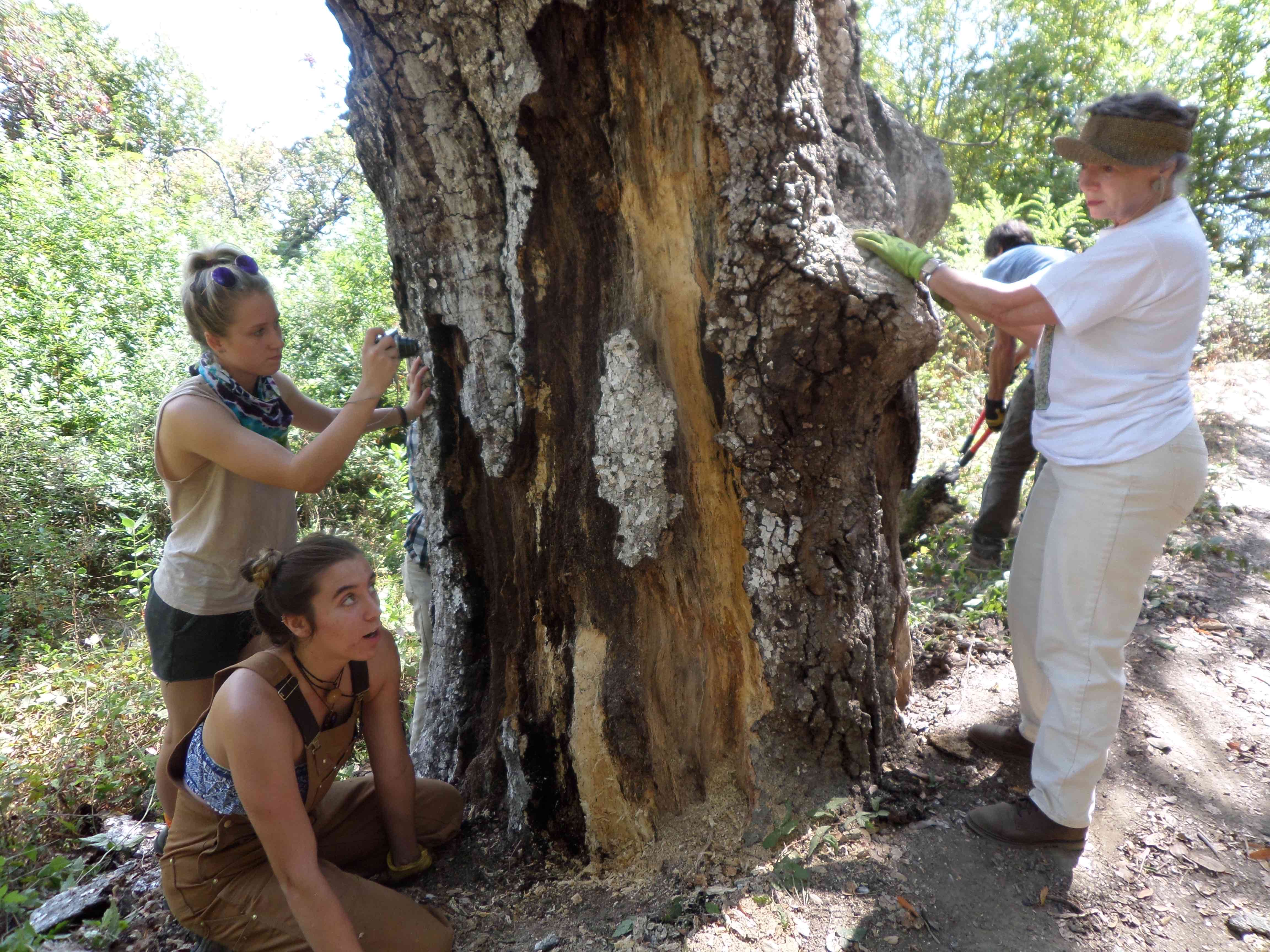
Grandfather oak volunteers - July 2015

Grandfather oak volunteers – July 2015

Well, I’m happy to report that 7.5 years later have NOT proved futile (UC scientists take note!). Grandfather oak is still alive and is noticeably healthier than before treatments began (see photos). The scientists studying sudden oak death have yet to come to terms with the success of fire mimicry. This is not surprising as their research is based on the disease model of forest health, whereas the fire mimicry approach is based on the ecological model of forest health. More than $100 million dollars has been spent studying one disease organism, Phytophthora ramorum, the pathogen that scientists claim “causes” sudden oak death. They are not about to disrupt that gravy train by expanding their scope of study to include ecological factors such as fire regime and soil pH. Their closed mindedness is our loss of so many oaks. Some day one oak too many will die and the mindshift will be inevitable . . . Read the rest of this entry »


A California oak stonehenge

3 07 2015

IMG_3317

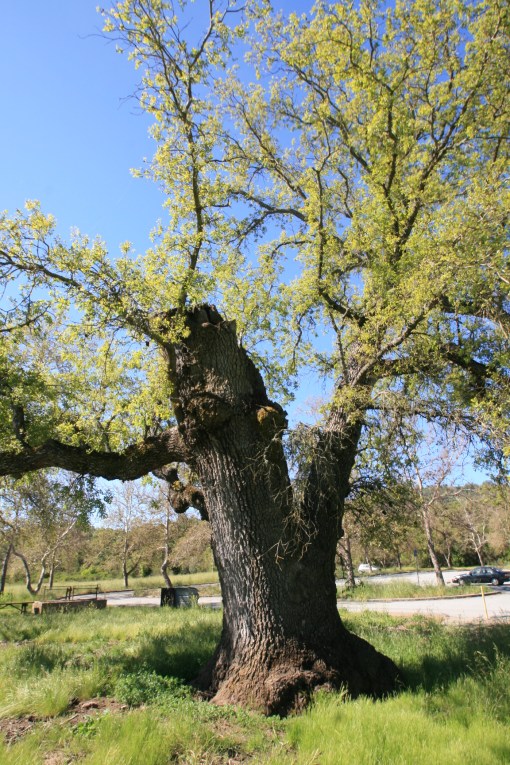
I met Ryan Masters at Tassajara a few months back while I was teaching a workshop on fire mimicry. He is a delightful person and impressed me as knowledgeable and sincere, so I shared some important Native American wisdom with him. He followed up diligently and the result is this fine article about an Ohlone oak stonehenge here in California.

http://hilltromper.com/article/summer-solstice-california-stonehenge

Ryan also wrote this wonderful article about his adventures in the Ventana Wilderness and the Native American “Hands” rock shelter.

http://hilltromper.com/article/tassajara-zen-center-ventana-wilderness

Enjoy!


On Sudden Oak Death, fire mimicry, and canker surgery

22 10 2012

Coast live oak in Marin succumbing to Sudden Oak Death after 4 years (Photos by Lee Klinger)

Recently the California Oak Mortality Task Force issued a press release reporting on an explosive growth in Sudden Oak Death in the San Francisco and Monterey Bay areas. This is a sad situation, knowing that untold thousands of ancient heritage oaks will die while under our care, or rather our lack of care.

For thousands of years California Native Americans tended and cared for all these ancient oaks, and associated plants, animals, and fungi, in an effort to live sustainably. The concept of reciprocity permeated their spirituality and culture, the oaks provided them an abundance of food (acorn), and so in return they managed the land in ways that helped the oaks prosper.

Oaks we know, and as the native people knew, are early successional fire-adapted species, meaning that they need periodic understory (ground) fires to thrive. These fires alkalinize the soils, which is a good thing, and they remove encroaching shrubs and young trees which draw away water and nutrients from the mature oaks.

Without periodic fires the oaks begin to decline. Over many decades the soils gradually acidify and more shade-tolerant species such as bays, firs, pines, and redwoods invade the oaklands. Eventually these later successional species overtop the oaks and out-compete them for light, water, and nutrients. At this point fires, if they due occur, are usually large stand-devastating fires that burn the entire canopies of the trees, from which few oaks can recover.

The oak forests in California are experiencing a rapid shift in their ecology the likes of which has not been seen for thousands of years. The weakening oaks are succumbing to diseases like Sudden Oak Death, and it is likely to get worse.

Unless, we started start caring for the oaks under our care.

How many of us have befriended an oak, enjoyed its protective canopy and felt the nurturing presence of a stately being?

How many of us have tended an oak?

All the while the oaks are enriching the air and land, helping sustain us, along with so many birds, mammals, insects, plants, fungi, and much much more, they are running out of time. The current sad state of affairs is largely due to improper actions, or lack of actions by our parents, grandparents, and great grandparents in managing the oaks on our lands. They simply didn’t know what the native people knew, that oaks need tending.

So now many of us know, and I pray others will too, that the problems with our oaks, with some effort, are solvable. I and many others are using fire mimicry methods, which involve restoring oak forests using  clearing, pruning, and soil fertilization methods that mimic to a degree the normal effects of fire.

My purpose here, as is the purpose of my life, is to inform you and others that we can save our oaks and, more importantly, to do the work on the oaks and show you how it’s done.

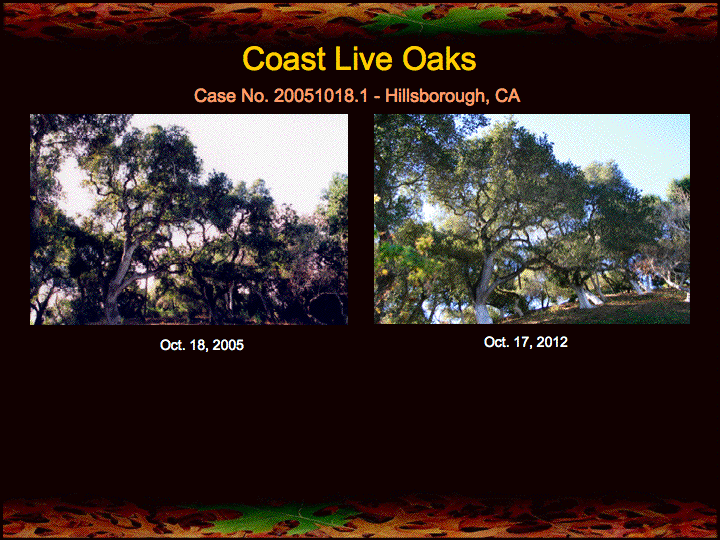
Here are several oaks that have received fire mimicry treatments beginning in 2005:

Note the improved canopy density and fullness. Fortunately these oaks are not infected with Sudden Oak Death, nor will they be (at least on my watch).

Here, however, is a nearby oak that is infected with Sudden Oak Death:

(Note the roof line has been altered by remodeling since the original photo)

While infected, this oak has some hope for a longer and healthier life as a result of the treatments. In addition to the fire mimicry treatments, I have done a surgical removal of the canker, which was still at an early phase of growth when discovered. For this I used an axe, then hammer and chisel to excavate the infected tissue, then I used a propane blow torch to cauterize the wound. This tree still has a small infection and will require some additional surgery, but the majority of the surgery appears to have worked to clear the tissue of the canker, and the tree is already healing over much of the wound. I predict that this oak will live for many decades, and if you hang around here I’ll keep showing you the photos of its recovery.

Finally, let me remind all you tree lovers that these techniques work on many kinds of trees. Here’s an example of what can be done for sick pines:

Interested? We’d love to hear from you!


New study of Appalachian forest fire history

9 09 2011

A new study of tree rings and fire scars by Charles Lafon, associate professor of geography at Texas A&M University, describes the fire history of forests of the southern and central Appalachian Mountains. His findings are consistent with and relevant to the forest dynamics in California, and provide support the use of fire mimicry methods in mitigating forest decline.

Fire-scarred oak in Santa Barbara. Photo by Lee Klinger.

Here are some excerpts from the Science Daily report:

“We know that Indians often set fires to clear areas”

“Many tree species that inhabit fire-prone areas have thick, protective bark,” he points out. “Some trees depend on fires for their own reproduction. One such tree is the Table Mountain Pine. Through a feature called serotiny, its cones often will not open to release the seeds unless they are heated by a fire, ensuring that the new seedlings emerge at an optimal time to survive and grow — right after a fire has cleared away the competing vegetation.”

“The decline in fire frequency during the 20th century, for example, permitted tree species like red maple to encroach into pine and oak forests. Now the pines, oaks and other fire-associated species like the Peters Mountain mallow are declining in abundance”

Read the entire article here.

Note the similarity of these results to those from the study of oak forests from the Upper Midwest reported here.


On managing California bay laurels to improve oak health

16 07 2011

UPDATE: For a more detailed discussion of the science and traditional knowledge on this subject please refer to my new book Forged by Fire: The Cultural Tending of Trees and Forests in Big Sur and Beyond” https://www.amazon.com/dp/B0D3ZVMB3P

Removing young bay laurels and burning the remains. Photo by Lee Klinger.

Several friends and tree professionals have contacted me about my thoughts on the following article by Peter Femrite that recently appeared in the San Francisco Chronicle:

Saving oak trees by chopping down bay trees

Workers began chopping down 250 California bay laurels this week in the Santa Cruz Mountains so that 49 signature oak trees might be saved from the infectious scourge known as sudden oak death.

The tree-removal project is an attempt by the Midpeninsula Regional Open Space District to prevent the spread of the tree-killing pathogen, which uses bay trees to scatter spores in the forest.

(h/t to R Zingaro for alerting me to this article)

First, there are important points here with which I agree. The bays are clearly major vectors for sudden oak death disease. I do believe that selective removal of bays will lower the incidence of sudden oak death (SOD). However, I am bothered by the singular focus on the disease. I would rather the focus of efforts be made toward promoting the overall health of the forest ecosystem. Read the rest of this entry »


New study with implications for fire management of oak woodlands

8 07 2011

Managed fire in a California oak woodland. Photo by Lee Klinger.

A recent study reported at Science Daily on the fire history of post oaks in Illinois reads like page from the history of California oak woodlands:

Old-Growth Tree Stumps Tell the Story of Fire in the Upper Midwest

The new study, in the journal Castanea, confirms that the people who lived in Illinois before European settlers arrived [Native Americans] were in the habit of setting fires in the region nearly every year, with fires in the Hamilton County woodland occurring at least every two or three years, McClain said. This repeated burning actually stabilized the prairies and open woodlands that dominated the region until the late 19th century, when the fire-suppression efforts of the new settlers allowed different plant species to take over, the researchers said.

The study was conducted by William McClain, a botanist with the Illinois State Museum along with researchers John Ebinger and Greg Spyreas, of the Illinois Natural History Survey at the University of Illinois. They also report:

“For hundreds, maybe thousands of years, this was a stable post oak woodland,” Spyreas said. “And then you have a gap of a couple of decades where there were no fires and suddenly the whole system is completely different. It’s amazing how, from Kansas to Ohio, these ecosystems completely depend on fire to be stable.”

See the full report here.

To all you Californian’s concerned about the oaks, this study is highly relevant.


Eucalyptus decline linked to fire suppression

7 05 2010

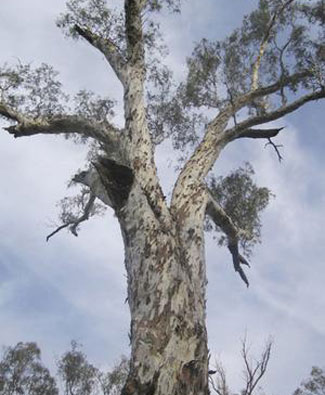
Earlier this year I was contacted by Vic Jurskis, a scientist with Forests NSW (Australia), alerting me to the work he has been doing on fire suppression and eucalyptus decline. He shared with me several of his scientific papers that document the pre-settlement burning of eucalyptus forests by the aboriginal people, and the critical effects that fire suppression is now having on those forests. (Reprints of these papers are available. Contact me about obtaining a reprint.)

In his most recent paper Jurskis writes –

“Exclusion of fire and/or grazing has contributed to shrub or sapling encroachment, weed invasion, loss of herbal diversity and tree decline compounded by pests, parasites and diseases. The ancient trees that were established before European settlement are especially vulnerable because they have become weaker competitors for water and nutrients, whilst they are more vulnerable to fires because they typically have exposed dry wood that is easily ignited and burns readily.”

(from Jurskis, V. 2009. River red gum and white cypress forests in south-western New South Wales, Australia: Ecological history and implications for conservation of grassy woodlands. Forest Ecology and Management 258: 2593–2601.)

In another paper Jurskis states – Read the rest of this entry »


Sudden Oak Death researchers acknowledge fire suppression link to disease

24 04 2010

There is an exciting new video out titled – “The Teakettle Experiment: Fire and Forest Health” released by The Video Project.  A summary of the film states:

“The film documents the Teakettle Experiment, a ten-year collaboration of forest managers and scientists from diverse disciplines that investigated the effects of prescribed fire and forest thinning on restoring forest health.

A century of fire suppression has significantly changed many western forests, leaving them overcrowded and susceptible to disease, pests, and catastrophic crown fires that endanger lives and property.”

Here is the trailer (YouTube):

Besides describing the science behind the use of fire and fire mimicry practices in restoring forests, there is something else remarkable about this film. Read the rest of this entry »


Mimicking fire in western US forests

24 04 2010

There is an important book on fire mimicry that was written several years ago that I just came across.  The authors are Stephen Arno and Carl Fiedler, both well-known experts in forest management, and book is titled “Mimicking Nature’s Fire: Restoring Fire-prone Forests in the West” (2005) Island Press.

From the Introduction –

“After decades of studying western forests, the authors recognized that the magnificent old-growth trees that survived and depended on periodic fires disappear when deprived of this essential disturbance process. When forests of these venerable trees are managed using traditional timber harvesting methods, the features that made them famous ultimately disappear. When these forests are protected in ‘natural areas’ that fail to restore the historical role of fire – as in the majority of parks, wilderness, and primitive areas – the big old fire-resistant trees gradually die and are replaced by thickets of small trees. Our experience revealed that long-lived trees and other important features of fire-prone forests can be restored through management that mimics the effects of historical fires. Although research studies and practical examples indicate how to restore forests and reduce potential damage from wildfires, insects, and disease, they get little play in the media. However, it is these topics – scientific findings and real-world management examples – that we bring together in this book.” (my bold – lk)

Also from the Introduction –

“When people learn that more than one hundred million acres of fire-prone western (US) forests harbor deteriorating conditions outside of the historical range of variability, they are struck by the staggering extent of this problem. Given the difficulties of applying restoration, some may judge the situation hopeless. However, our experience suggests that any strategically located restoration treatments can produce noticeable benefits in reducing wildfire hazard to homes and communities and return important features of historical forests.”

Leave it to the experts to explain in abundant detail the critical reasons for implementation of fire mimicry practices to restore our oaks in California.


Carbon storage augmentation in fire-managed forests

31 03 2010

Big Sur fire 2008 (photo by Lee Klinger)

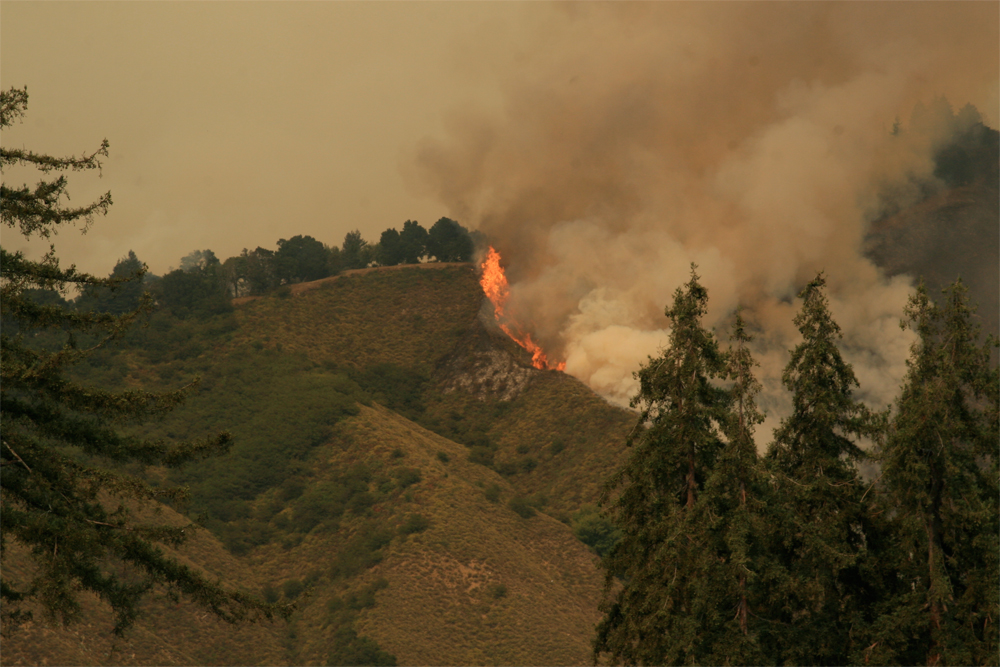
Science Daily reports on a recent study on the carbon storage in fire-managed forests published by a former colleague of mine at the National Center for Atmospheric Research. Christine Wiedinmyer, with whom I collaborated on a field study of oak forests in eastern Texas back in 1998, is the lead author on the study that examines the use of prescribed fires in the management of western US forests.

Christine states “It appears that prescribed burns can be an important piece of a climate change strategy”, adding “If we reintroduce fires into our ecosystems, we may be able to protect larger trees and significantly reduce the amount of carbon released into the atmosphere by major wildfires.” This is another bit of evidence that backs the fire mimicry approach in forest management. One word of caution, this study relies in part on mathematical models are not accurate representations of nature.

The Science Daily report “Prescribed burns may help reduce US carbon footprint” can be found here.