UPDATE: For a more detailed discussion of the science and traditional knowledge on this subject please refer to Chapter 3 “The redwood giants” in my book Forged by Fire https://www.amazon.com/dp/B0D3ZVMB3P
Anyone who has spent time with the redwoods has no doubt seen and even ventured inside the giant trees with fire-scarred trunks. Certain trees are so severely scarred that you wonder how they are even able to stand. Some trees contain cavernous fire-carved rooms in their base with multiple entrances and even window-like openings. I’ve marveled at these trees and looked carefully at the orientations and shapes of their scars, and in doing so have found some odd things.
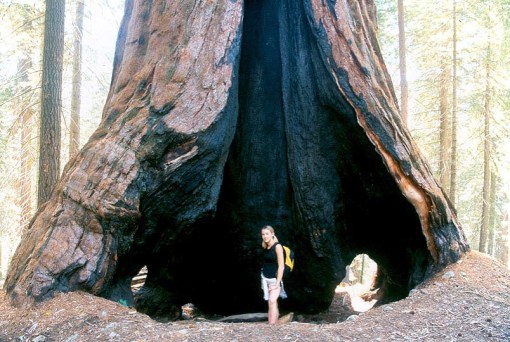
Huge fire scar in giant sequoia (photo by Lee Klinger)
Having worked on fire lines in Alaska, Colorado, and California I’ve seen how fire scars are formed. A large quantity of fuel piled at the base of the tree is usually required to ignite a fire hot enough to penetrate the bark and scorch the cambium.
A characteristic burn pattern is seen on slopes where the vast majority of fire scars occur on the uphill face of the trunk (more than 90% in places)[1]. This is due to a couple of factors. First, hot air currents tend to drive ground fires upslope, especially during the day when fires burn hottest. (Keep in mind we’re talking about large ground fires, not large canopy fires which would more likely kill the tree.) The wind-driven fires tend to burn relatively quickly around the lower parts of the trunk, but eddy effects allow the fire to linger on the uphill side. Second, fallen leaves and branches tend to move downhill and accumulate on the uphill side of the trunk. Together these factors seem to account fairly well for the uphill side tendency of fire scars.
So imagine my confusion . . . Read the rest of this entry »
 Sudden Oak Life by Lee Klinger
Recent Comments