Fire mimicry is improving the health of oaks in Redwood City, CA

22 11 2017

Slide1

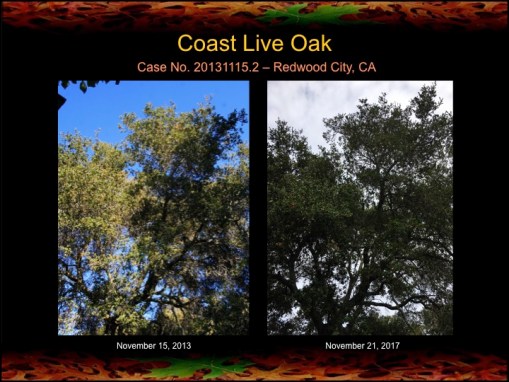
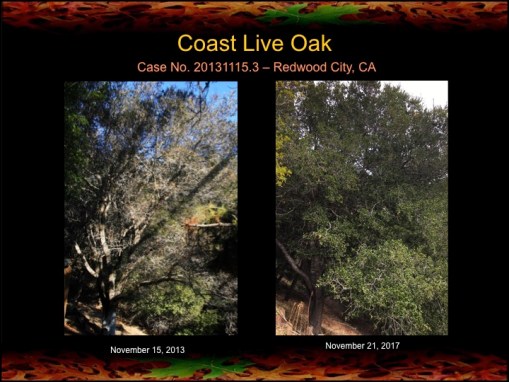
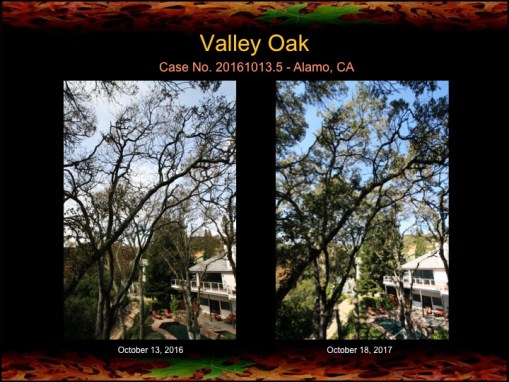
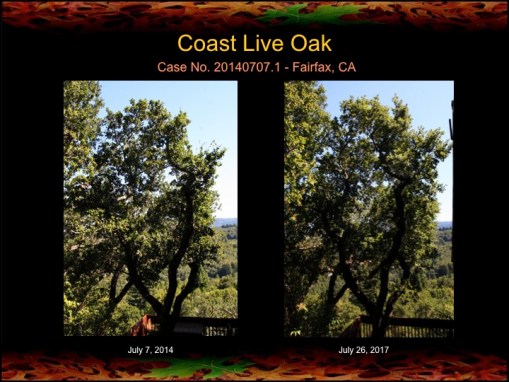
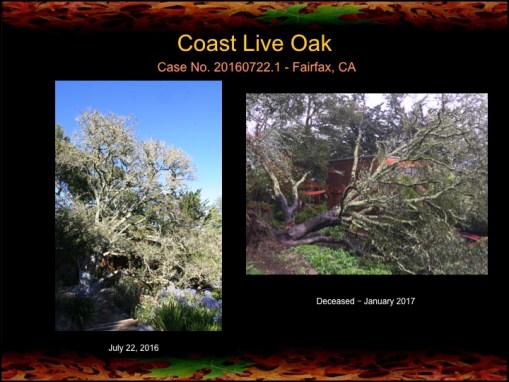
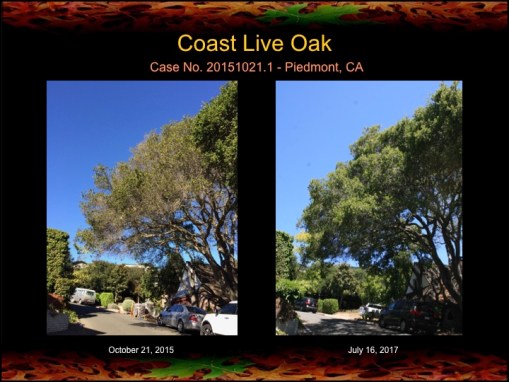
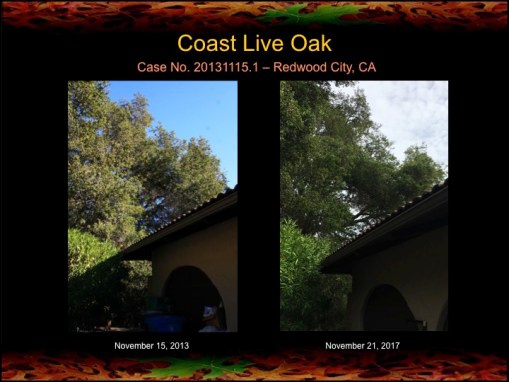
Today I would like to show you the progress of some oaks that were treated with fire mimicry starting in 2013. Previous years’ results with the same trees are shown here and here. As can be seen in these photos, most of the oaks are continuing to show a strong and in some cases a dramatic response to the treatments, including the last tree in the series which is a Native American era heritage oak. The photos speak for themselves. Enjoy!

Slide2

Slide3 Read the rest of this entry »


Fire mimicry treatments likely saved homes and oak groves from Sonoma wildfires

15 11 2017
Sonoma fire 3

Compare untreated oaks in the background (right) with oaks in the foreground (left) treated with fire mimicry.

In 2009 I was contacted by a property owner who had just purchased a home and several acres of oak forest near the town of Sonoma, CA. The forest had been neglected for many years and was in poor health. There was also a dense growth of underbrush around the trees and many dead limbs on the oaks. I provided him a fire mimicry treatment plan that involved clearing of the underbrush and pruning the oaks, focusing on removing the ladder fuels near the ground. I also proposed to fertilize the oaks with alkaline-rich soil minerals, removed mosses and lichens from the trunks, and applied limewash.

The owner agreed to this plan and during the next couple years I and several colleagues spent many weeks clearing brush, pruning limbs, burning brush piles, and fertilizing a large grove of more than 50 valley oak, blue oak, and coast live oak trees.

Afterwards, in 2015, another property owner in Glen Ellen, CA contracted with me to care for her oaks with fire mimicry. This grove of about 30 oaks was treated in the same manner as described above.

Both of these properties were impacted by the recent wildfires in Sonoma.  Yesterday I visited these properties and I’m pleased to report that they sustained very little permanent damage. No structures were lost and nearly all of the oak trees appear to have survived. I estimate that the survival rate of trees on both properties is about 98%, although it will be another year or so before we know the exact percentage.

With regards to the first property, the photos here show that the fire burned the adjacent forest severely, with a complete loss of the forest canopy in places. However, once the fires reached the areas treated with fire mimicry, the severity lessened and fire stayed on the ground. None of the trees in the treated areas experienced a canopy fire. The boundary between the treated and untreated trees, showing this difference in fire severity, can be seen in the above and below photos.

I should add that while this home did not burn, four nearby homes were completely destroyed.

The second property also had no loss of structures and only minor damage to the oaks (see last photo below). The fire did not spread into the canopies and all of the affected oaks will likely recover.

With regards to the “cause” of these severe wildfires, some focus on the source of the initial spark, such as a downed power line or arson. Others point the finger at climate change affecting the health of the forests.

My take, based on the results shown here and elsewhere in the scientific literature, is that the cause of the severe wildfires is due to the suppression of fires and lack of management of the forests. Historically, oak forests were regularly burned by the California native people to enhance the health of the oak savanna ecosystem. Under a frequent burning regime the fires tended to be ground fires, which rejuvenate the soils but do not damage the tree canopies. Without these traditional management practices, our oak forests have become overgrown and stressed. Now-a-days, when fires do burn, they tend to be destructive canopy fires, rather than rejuvenating ground fires.

The oak forests and homes on these properties were saved in spite of adjacent ignition sources from raging fires. Nor did we change the climate. We simply went in ahead of time and mimicked wildfire in these areas. It is clear to me from this and other studies that proper forest management is fundamental in solving the wildfire problem in California.

Sonoma fire 12

Fence line of property separating burned/untreated oak forests (right) and unburned/treated oak forests (left).

Read the rest of this entry »


Black oaks and coast live oaks in Glen Ellen, CA respond to fire mimicry

28 10 2017

Slide08

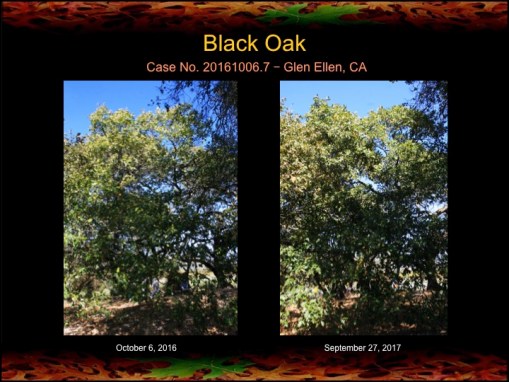
A grove of black oaks and coast live oaks in Glen Ellen, CA treated last year with fire mimicry are showing a nice positive response in canopy health, except for one black oak (see photo below) that has lost it’s leaves early and appears distressed. All of these trees survived the recent fires that burned through the area.

Slide03 Read the rest of this entry »


Positive response of valley oaks in Alamo, CA to fire mimicry

23 10 2017

Slide03

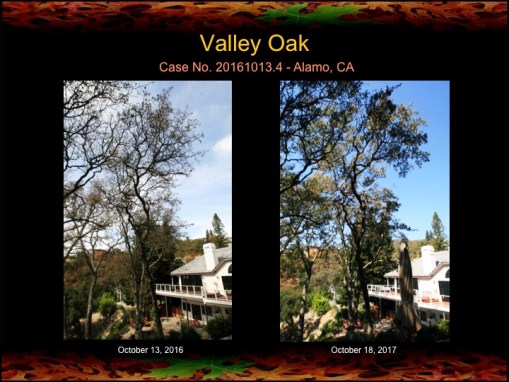
In the previous post I showed the improvement of several redwoods to fire mimicry treatments at a property in Alamo, CA. Today I would like to share the results with the valley oaks at the same location. In both years the oaks have already dropped some of their leaves with the onset of fall. However, this year the oaks, in all but one case, are holding onto their leaves longer, despite it being one of the driest summers on record.

While most of the results shown in this blog are for coast live oaks, it is important to recognize that many other native species, including valley oaks, redwoods, pines, and toyons are showing positive responses to fire mimicry.

Slide04

Slide05 Read the rest of this entry »


Oaks in Marin respond to fire mimicry

15 09 2017

Slide1

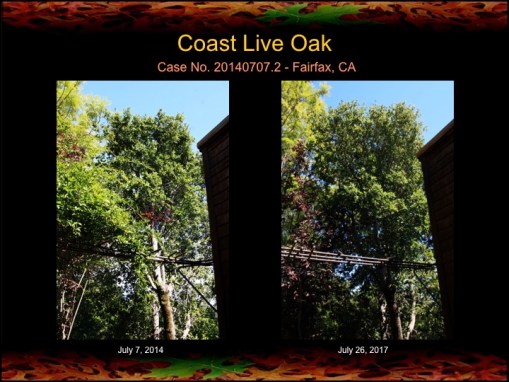
Here are the results of an oak grove in Fairfax, CA that has been treated with fire mimicry a couple of times over the past three years. Most of the oaks have responded nicely.

One tree at a time . . .

Slide2 Read the rest of this entry »
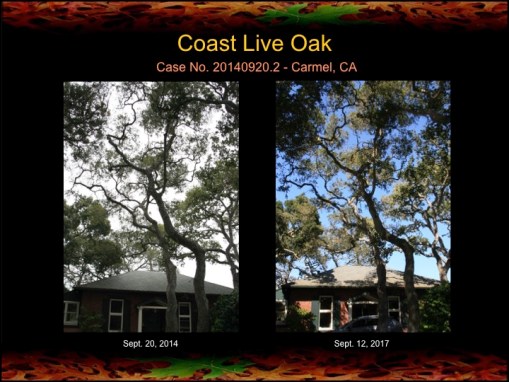


Carmel oaks respond to fire mimicry

13 09 2017

Slide1

Three years ago I began treating a grove of mature coast live oaks in Carmel, CA with fire mimicry. Yesterday I checked on their response. As the photos here reveal, most of the oaks show a clear improvement in the leaf density.of their canopies.

I haven’t done a tally on the total number of trees I’ve reported on in the nearly 10 years of hosting this website, but a fair estimate is that it is upwards of 1000 case studies, including oaks, pines, cedars, buckeyes, magnolias, fruit trees, and more. It has been immensely rewarding to witness and report these results, and to demonstrate to all concerned a clear way forward for tending our trees and forests.

Slide2

Slide3 Read the rest of this entry »


Oaks in Fairfax, CA respond to fire mimicry (Part 2)

27 07 2017

Slide01

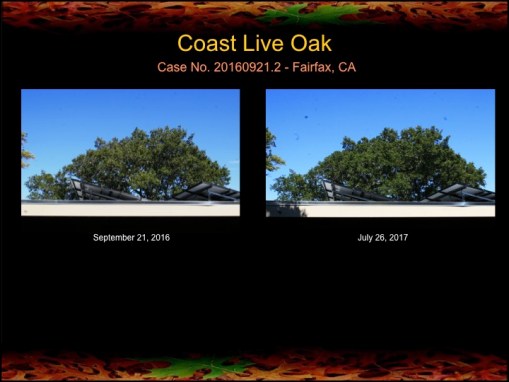
While on my way to check on the oaks in the previous post, I happened upon another client whose oaks I treated with fire mimicry last September. I stopped to say “Hi” and mentioned that I would return in September for the one-year checkup, but he was anxious to see how his oaks were doing yesterday, so I took the time to  re-photogrpah his oaks, Here are the results after 10 months . . .

Slide02

Slide04 Read the rest of this entry »
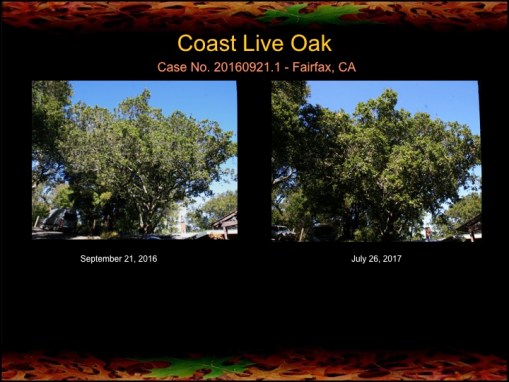


Oaks in Fairfax, CA respond to fire mimicry (Part 1)

27 07 2017

Slide1

Yesterday, in Fairfax, CA, I examined a number of coast live oaks that I treated with fire mimicry for the first time in July of last year. The first tree I examined was a a large oak that was severely diseased and near death last year. I told the owner that I did not think it could be saved, but he insisted I try. As you can see in the above photo my attempts to save the tree were unsuccessful. The oak came down in a storm this past January.

Fortunately, the owner had me treat his other oaks, some of which are infected with stem canker disease (probably Sudden Oak Death). As you can see in the following photos, all are showing noticeable improvement in just one year. I’m happy to attribute some of this success to the plentiful rains this past winter, however, considering I’ve gotten similar results at the height of the recent drought (see Archives 2013 – 2016), I’m certain that the fire mimicry treatments are assisting in the recovery of these oaks.

Slide2

Slide3 Read the rest of this entry »


Oaks in Piedmont, CA responding to fire mimicry

22 07 2017

Slide01

Two years ago a property owner in Piedmont, CA contacted me about the declining health of their oaks. When I inspected the trees I found a couple of them had stem canker infections (possibly Sudden Oak Death), including the oak pictured above. Most of the oaks were free of infections, but still showed signs of poor health. Now after two treatments using fire mimicry, the oaks, generally, are showing a noticeable improvement in canopy health and density. Note that the photos are not exactly two years apart, but when I re-photograph the oaks again in October I’m betting that the trees will not have lost much, if any, vigor.

Slide02 Read the rest of this entry »


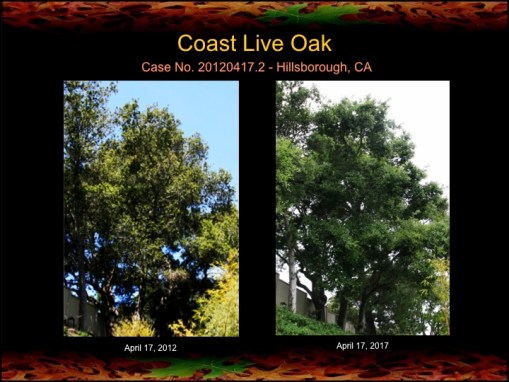
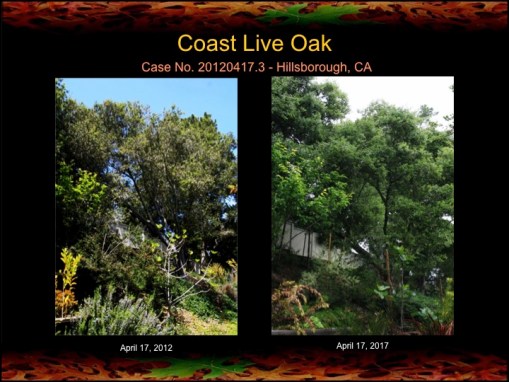
Five year results of fire mimicry on oaks in Hillsborough, CA

24 04 2017

Slide02

Last week I inspected several coast live oaks that have received three fire mimicry treatments over the past five years. A couple of these oaks have bleeding stem cankers (probably Sudden Oak Death) that have been treated surgically as well. It will be a few more years before I know if the diseased oaks have recovered, but in the meantime these and the other uninfected oaks appear to be doing fairly well.

A couple of the oaks have lost a few limbs in the storms this past year, but are otherwise healthy. I should add that the wet winter has played some role in the improved canopies, however, results from these same oaks in prior years (2013, 2015) indicate noticeable improvement even under severe drought conditions.

Slide03

Slide04 Read the rest of this entry »