Carmel oaks respond to fire mimicry

13 09 2016

slide01

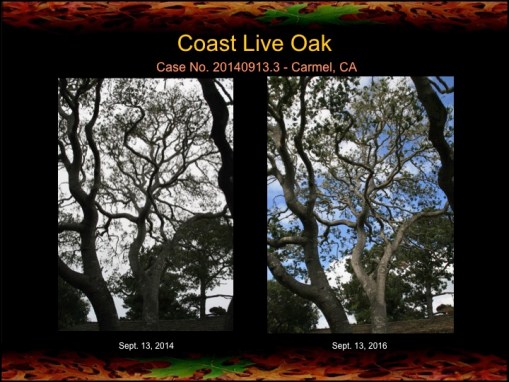
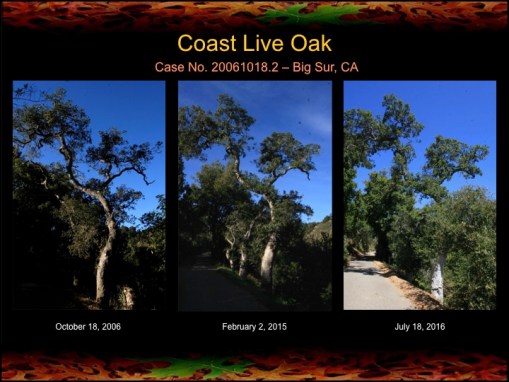
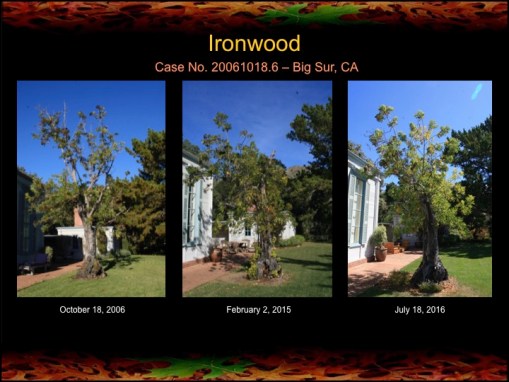
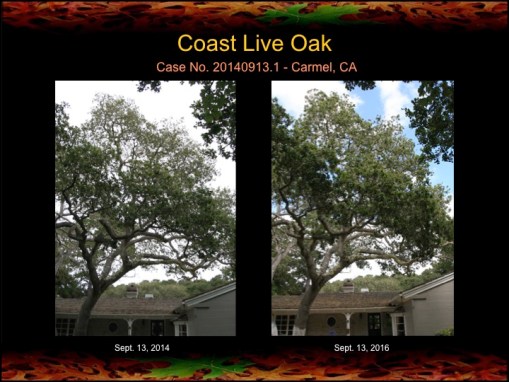
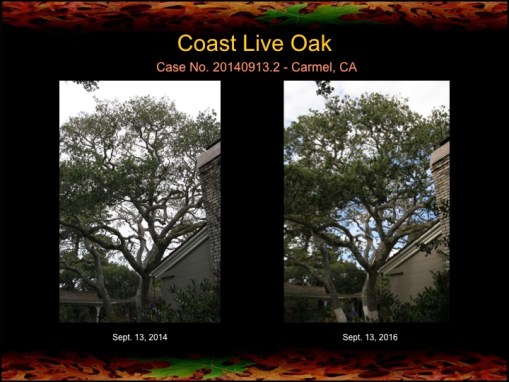
Two years ago a property owner in Carmel, CA approached me about helping improve the health of her sick oak trees. When I inspected her oaks I found them to be severely diseased and the canopies very thin. I told her that I wasn’t sure I could save her diseased oaks, but that I felt confident I could help her other oaks. She agreed to have all her oaks treated with fire mimicry.

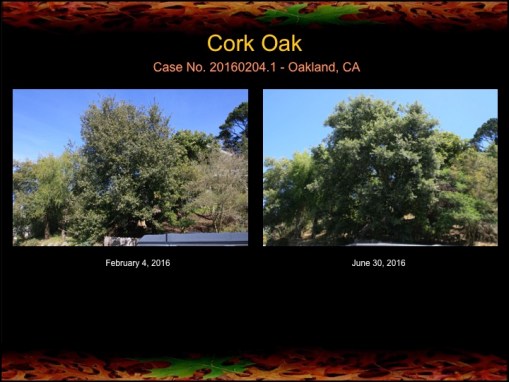
Two years later, the diseased oaks (first three sets of photos) are recovering nicely and the remaining oaks on both properties are showing improved canopy health. The photos below show the results of all the oaks I’ve treated on her property over the past two years. The photos show a nice response in some oaks, others showing a limited response. Overall, I’m pretty happy with the results in just two years.

slide02

slide03 Read the rest of this entry »


Shell midden and tree health hypothesis confirmed in Pacific Northwest forests

11 09 2016

cover-image

Indeed, it’s becoming clear that native people of North America knew how to grow big trees! In 2006 I published a peer-reviewed chapter titled “Ecological evidence of large-scale silviculture by California Indians” in the book Unlearning the Language of Conquest (Four Arrows, ed.). In that chapter I proposed the hypothesis that “the many types of refuse mounds and middens, including shell middens, bone middens, and rock middens originate not from the gradual accumulation of the waste products of daily living, but rather from the intentional stockpiling of gathered or recycled lime-rich materials for use as mineral fertilizers.” A careful review of the literature at the time indicated to me that this hypothesis was novel to modern science, though not at all novel to traditional ecological knowledge. Furthermore, I provided evidence for the fertilization effect of midden materials on trees that I collected from a giant sequoia grove in central California and from a grove of western hemlock and Sitka spruce trees in southeastern Alaska, which I attributed to intentional tending by native people.

Now, ten years later, comes a study published in Nature Communications detailing the positive effects of shell middens on the growth and health of western redcedar trees in coastal British Columbia. The paper, “Intertidal resource use over millennia enhances forest productivity” (by A.J. Trant et al. 2016. Nature Communications 7:12491) makes several key points that are relevant to my original hypothesis. These include:

“Pockets of enhanced forest productivity are associated with increased phosphorous availability resulting from higher soil pH from the slow leaching of calcium from shell middens along with the nutrient amendments of past fires.”

“Western redcedar (Thuja plicata) trees growing on the middens were found to be taller, have higher wood calcium, greater radial growth and exhibit less top die-back.”

“Coastal British Columbia is the first known example of long-term intertidal resource use enhancing forest productivity and we expect this pattern to occur at archaeological sites along coastlines globally.”

This last point I take some exception to, as Trant et al. fail to recognize that examples of the same phenomenon were reported ten years earlier in my peer-reviewed publication noted above. I might have given them a pass for unintentionally overlooking my work, except that when I do a google search on “shell middens and tree health” my 2006 publication shows up on the first page of results. Perhaps the authors were careless in their searches, or viewed the evidence I reported as somewhat scant, which I agree it was. But any peer-reviewed hypothesis with supportive evidence, scant or not, deserves to be cited and recognized as taking precedent to any later work.

I’m not asking for any personal recognition here, rather I’m hoping to point out that in the ten years since I first published the above findings I have used midden materials (crushed shells and rocks) in the treatment of thousands of oaks and other trees, with good to excellent results (see the many previous posts on fire mimicry). This, to me, is the real evidence supporting the shell midden hypothesis, and more importantly, demonstrates the immense ecological wisdom of the native peoples of the world who discovered this relationship millennia before modern science. Hopefully the authors of the recent paper will take the next step, as I did, and use their findings to make a difference in the health of trees and forests in British Columbia!


Variable one-year responses of birch, apple, and pine trees to fire mimicry

28 07 2016

Slide1

Shown here are several birch, apple, and pine trees that were treated last year with fire mimicry. Telling from the photos it appears that the birch trees have response moderately, and the apple trees have responded significantly! The pine trees have yet to show much response. This seems to be typical of pines, which can take several years before showing visible responses (see  here and here).

Slide2

Slide3 Read the rest of this entry »


Pine, oak, and ironwood trees in Big Sur responding nicely after a decade of fire mimicry

20 07 2016

What is fire mimicry?

pine B

Slide03

Slide07


Coast live oak in Big Sur cured of stem canker infection using fire mimicry + surgery

18 07 2016

This is exciting news! A coast live oak in Big Sur appears to have been cured of two stem canker infections (possibly Sudden Oak Death) using fire mimicry and surgical methods. Furthermore, no new infections have occurred on this tree. While I’ve reported on the progress of other coast live oaks that have received fire mimicry and surgery (see here, here, and here), this is the first oak that I feel confident has been cured of a stem canker infection!

Slide10

There is also evidence at the same site that the deep cracks forming in other coast live oaks, cracks that allow infection by stem canker disease, are healing well. And, no new cracks are forming. Published studies have shown that “the presence of unweathered bark in bark furrows, (is) positively correlated with disease (Sudden Oak Death)”. Note in the photo below that the exposed unweathered bark is healing.

Slide08 Read the rest of this entry »


Rapid response of oak, mayten, bay laurel, and cedar trees to fire mimicry

2 07 2016

Slide01

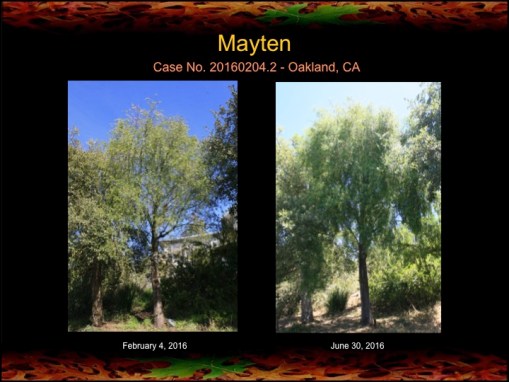
I recently inspected several cork oak, coast live oak, mayten, bay laurel, and cedar trees that I treated with fire mimicry methods in February of this year. The positive responses of these trees to the treatments after just six months are pleasantly surprising. The photos below tell the happy story . . .

Slide02 Read the rest of this entry »


Fairfax oaks treated with fire mimicry and canker surgery

23 05 2016

Slide2

Nearly two years ago I treated several coast live oaks with fire mimicry. On three of the oaks I performed a surgical procedure to remove the stem canker infections (possibly sudden oak death). The procedure involves surgically removing the infected tissue with an axe, followed by a chisel. Lately I’ve been using a multi tool which does an excellent job at cutting infected bark and wood. Following surgery I’ve been cauterizing the wound with a propane blow torch, then applying a lime wash to the entire trunk. Below are photos of two of the surgeries two years later and I am pleased to report that the wounds are healing up nicely and there is no sign of further infection in these oaks. I would say the procedure is still experimental at this point, but I am more confident to keep trying it after seeing these results. Also below are photos depicting the surgical methods and equipment, as well as other photos sets of the oaks response to a single treatment after two years.

IMG_4355

Surgical scar after nearly two years of healing. Note absence of any bleeding or other sign of infection. Read the rest of this entry »


A single fire mimicry treatment is not effective for longterm oak recovery

30 04 2016

Slide1

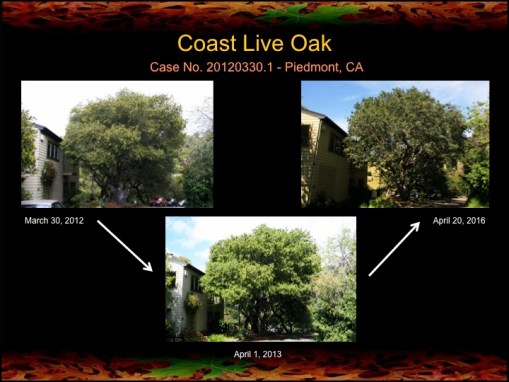
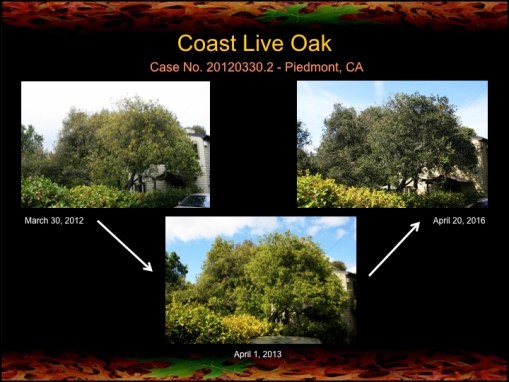
I recently inspected a grove of oaks that I treated with fire mimicry methods four years ago. Two of these oaks have stem canker infections, possibly Sudden Oak Death, that were present before the oaks were treated. As the photo sets show, the oaks responded dramatically after only one year. The property owners, pleased with the results, opted to not continue treatments of their oaks despite my recommendation that the oaks receive at least three annual treatments. While some of the oaks are still showing improvement four years after the 2012 treatment, these photos demonstrate that the oaks have undergone a clear decrease in canopy density after the initial response. I believe this decline is because they did not receive followup treatments.

Consider the huge volume of soil encompassed by the roots of an oak tree. These soils have been undergoing nutrient depletion for however long its been since a fire last burned, decades, perhaps centuries ago. Reconditioning this large volume of soil by replacing lost nutrients, especially alkaline-rich minerals, takes a significant effort that requires fertilization over several years.

These results further demonstrate the efficacy of the fire mimicry approach. Not only is there a positive response when we apply these methods, there is also a negative response when we forgo these methods.

Slide2 Read the rest of this entry »


Diseased oaks in Marin respond quickly to fire mimicry

25 04 2016

Slide1

Last April (2015) I was contacted by a home owner in Ross, CA (Marin County) regarding a very sick coast live oak tree (above) growing near his home. I promptly inspected the oak and found it was badly infected with a stem canker disease (probably Sudden Oak Death) and told him that I was not optimistic it could be helped. During my inspection I found few other oaks with SOD-like cankers. He asked that I try the fire mimicry techniques to see if they would help his sick oaks.

I visited the oaks last week to inspect and photograph their response. The photos show that the very sick oak has surprisingly responded with a nice flush of leaves in just one year. Several of the other sick oaks have also shown a good response (see below). The sick oak still has a severe stem canker infection and may not survive in the long run, but this is further evidence that we can improve the health and extend the lives of diseased oaks.

Slide2 Read the rest of this entry »


Oak restoration at Esalen Institute

24 04 2016

Slide4

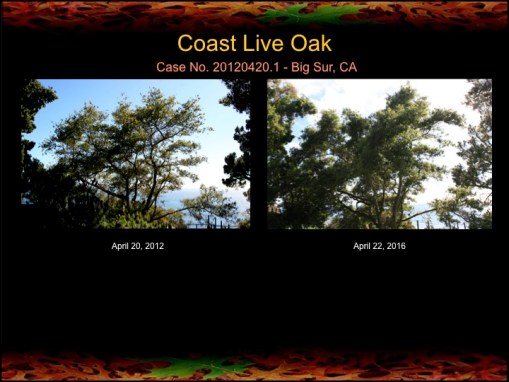
This past Earth Day (April 22) I visited Esalen Institute in Big Sur and spoke on results of forest restoration using fire mimicry in California to the farm and garden staff. I also had the occasion to inspect and photograph several oaks that were treated with fire mimicry at an Earth Day event in 2012. These photos show pretty remarkable improvement in the canopy size and density of the oaks over the past four years, with one exception. The last oak in the photo sets below is in a very windy location. It has shown slight improvement over the years, but this year is exhibiting some browning of the leaves. I suspect this browning is a result of the very dry conditions in 2015. All of these oaks will receive another round of care this spring. Many thanks to the Esalen community for their support of this oak restoration effort!

Slide1 Read the rest of this entry »