Last year we treated several coast live oaks, some of them ancestor oaks, with fire mimicry on a property in Felton, CA. They all received compost tea, soil minerals, and limewash, and some of them also had stem canker surgeries. Here are the results, a pretty decent recovery IMO after only one year, under drought conditions …
Last night I returned home to Big Sur full of hope and joy after a successful “Fire Mimicry and Insights of Traditional Ecological Knowledge” workshop held at Indian Canyon over the weekend. About 60 truly fine and stellar people showed up! Kanyon Sayers-Roods (Costanoan Ohlone, Chumash) welcomed us warmly to Indian Canyon and skillfully held us accountable for our sacred relations to the land and people. Ruth Orta (Ohlone, Bay Miwok, Plains Miwok) generously shared stories of her family history and instructed us on traditional methods of acorn processing. Leo Lauchere, Ero Gorski, Jill Kunishige, and the rest of the crew of Ecocamp Coyote did a fantastic job of organizing the schedule and providing the necessary infrastructure. And all the while, Red prepared and served us the tastiest vegan meals imaginable!. Many thanks, too, to my loyal colleagues Giovanna Piumarta, Sprout Weinberger, Siena King, and Jorge Espinosa for showing up and sharing their fire mimicry knowledge and insights. If you missed the event, don’t worry, we’ll definitely be doing this again!
Also, there will a followup event on Sunday, December 5, 2021 at Indian Canyon where we will be holding a burn pile workshop. Prescribed fire expert Jared Childress and several of his colleagues will be there to help lead and teach us about fire safety and management. I’ll also be there sharing about fire mimicry. Watch this page for further details.
Here are images of some of the event highlights this past weekend …
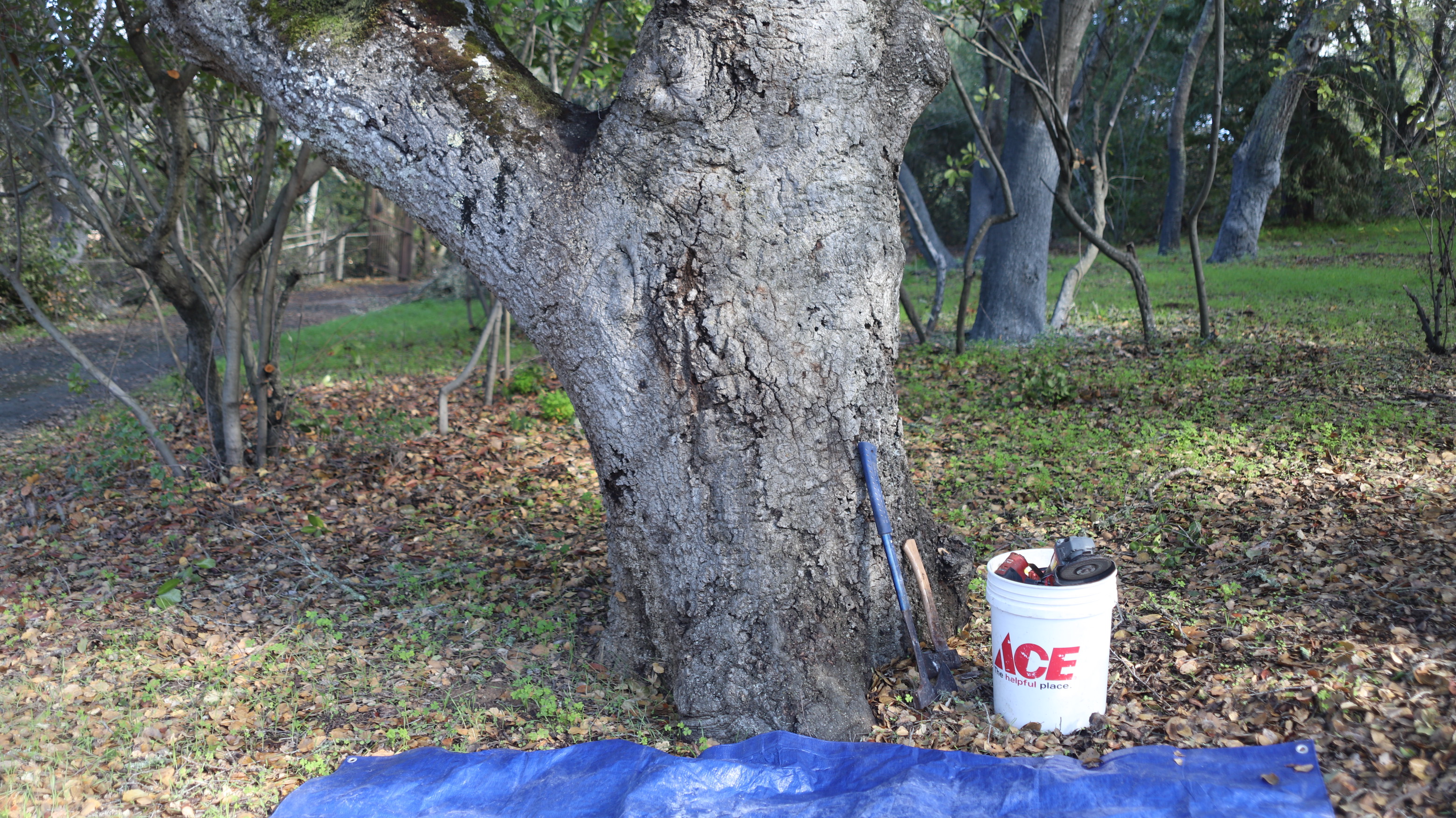
Below is a time-lapse video of a stem canker surgery we did today on a pollarded, Ohlone “ancestor” coast live oak in Portola Valley, CA. Note the removal of diseased tissue with axes and power multi-tools, cauterization, and poultice application. This was followed by a limewash application to the trunk, as well as compost tea and alkaline-rich mineral amendments to the soils. Enjoy!
Indian Canyon Nation, EcoCamp Coyote, and Sudden Oak Life are collaborating on an upcoming 3-day intensive workshop titled “Fire Mimicry and Insights of Traditional Ecological Knowledge” being held at Indian Canyon November 12-14, 2021. This event will feature Kanyon Sayers-Roods (Mutsun Ohlone), Ruth Orta (Him•re-n of Ohlone, Bay Miwok, and Plains Miwok), Ero Gorski and Leo Lauchere (EcoCamp Coyote), and Lee Klinger (Sudden Oak Life). Here are some of the topics we will cover:
• identifying culturally modified trees and landscapes
• the science and practice of fire mimicry
• demonstration of stem canker surgical procedure
• considerations for acorn harvesting
• methods of oak seedling propagation.
This is a rare event and should not be missed by anyone passionate about tending oaks and other native trees. More information and registration for the event are here.
Coast live oak at Indian Canyon tended with fire mimicry since 2019
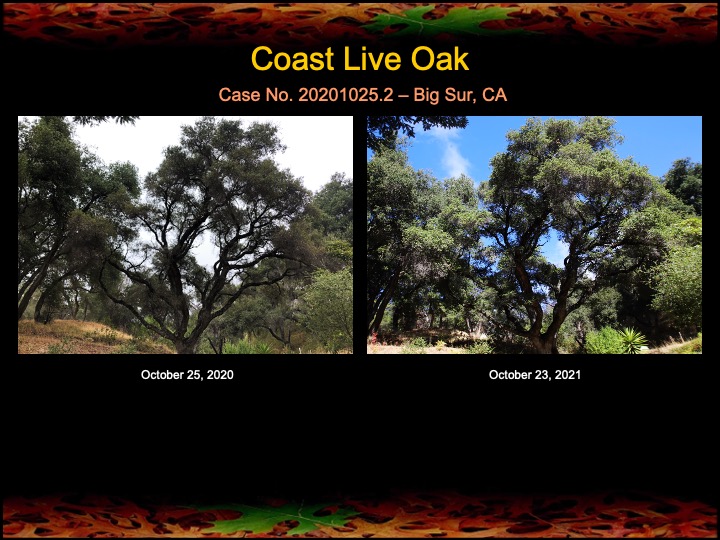
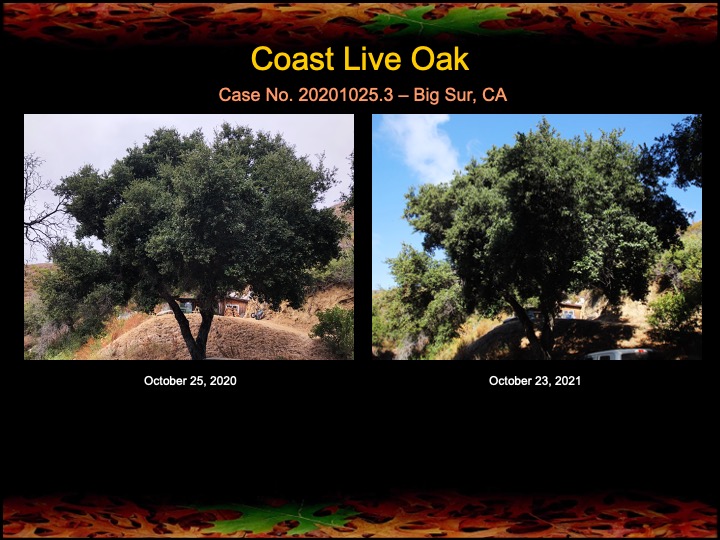
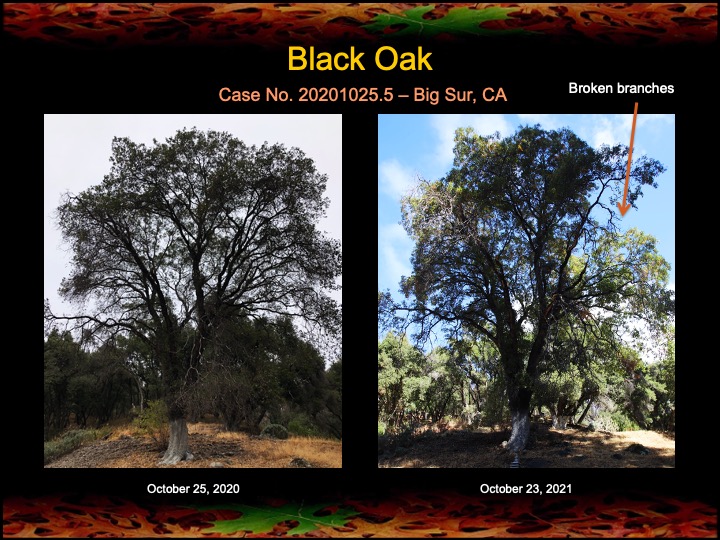
Last year we treated several coast live oaks and a black oak in Big Sur with a fire mimicry protocol. Here are the results after one year. While the light conditions varied between years, there is clear indication that these oaks are responding positively to the treatments, despite the drought conditions. There is a time-lapse video of the treatment of the black oak (below) on my youtube channel: https://youtu.be/BCK4iQQ6q-0.
See the following link to a youtube time-lapse video showing the treatment sequence of the above oak https://youtu.be/BCK4iQQ6q-0
Ancient Ohlone-tended coast live oak with a severe stem canker disease
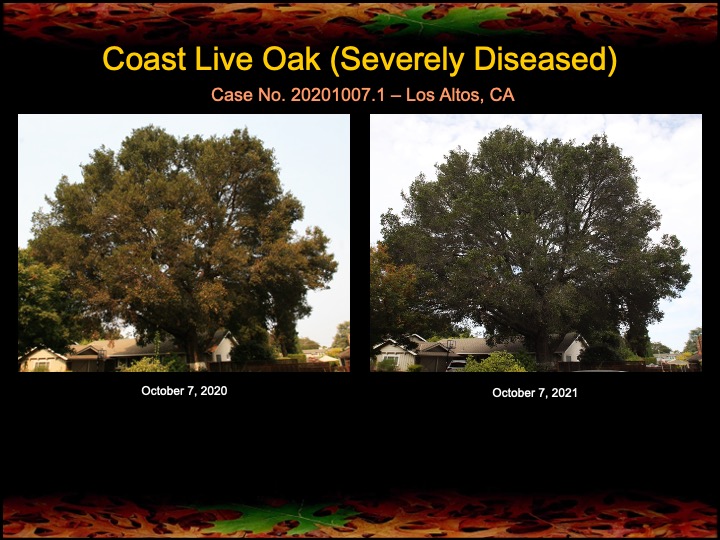
I recently inspected four mature coast live oaks in Los Altos, CA that I first treated last year with fire mimicry. All four have stem canker disease (probably Sudden Oak Death), and the largest, a 300+ yrs old Ohlone-tended (pollarded) oak, is severely diseased. Stem canker surgeries involving canker removal with an axe and multi-tool, cauterization of the wound, and poultice application were done on all four oaks.
All four oaks are showing noticeable improvement in canopy health (greenness), and the surgeries, for the most part were successful, although there are small residual infections in two of the oaks that need to be treated. Otherwise, I’m calling this a win after just one year! Of course, I will continue to treat and monitor these oaks in future years.
Here’s a short time-lapse video of a minor stem canker surgery we did on an ancient coast live oak here in Big Sur yesterday. The surgical protocol involves canker removal with an axe and multi-tool, cauterization of wound, and mineral poultice application. We also treated this oak with compost tea, alkaline-rich soil minerals, and limewash.
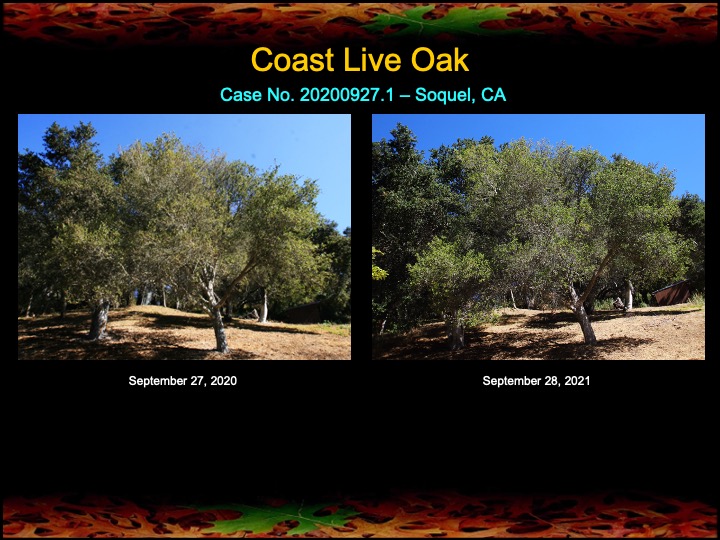
Last September (2020) I treated 8 mature coast live oaks in Soquel, CA, with fire mimicry. We first pruned and cleared around the oaks, which was documented at the time in this post “Initial stages of fire mimicry in Soquel, CA”. We then spread compost tea and alkaline-rich minerals to the surrounding soils, and applied limewash to the trunks of the oaks. After one (drought) year, all 8 of the oaks are showing improvement in canopy density and lushness. Note that in Case No. 20200927.6 (below), this oak is severely infected with a stem canker disease (probably Sudden Oak Death) but is still showing a slight improvement in canopy health.
Today I performed a major stem canker surgery in an effort to save an Esselen-era (400+ years old) coast live oak in Big Sur. The process involved large and small axe work, power multi-tools, cauterization, and poultice. This is part of a larger protocol called fire mimicry, which includes removal of woody understory, fertilization of soils with alkaline-rich minerals + compost tea, and application of limewash to the trunk. Here’s the link to a time-lapse video of today’s surgery: https://www.youtube.com/watch?v=pEISFdAErc4
Here is a sick coast live oak with a stem canker infection (probably Sudden Oak Death). At that time a surgical procedure was performed to remove and cauterize the canker (see original post here). After one and a half years this oak has made a significant recovery, both in the healing of the surgical wound and in the lushness of the canopy. Note that there is no further bleeding or other symptoms of stem canker infection. More evidence for the efficacy of fire mimicry.










 Sudden Oak Life by Lee Klinger
Recent Comments