
Today an article I wrote on Gaia and climate change was published in The Ecologist [link here]. The article summarizes my thoughts and concerns around the science of climate change. This is the comment and discussion thread for that article.
Today an article I wrote on Gaia and climate change was published in The Ecologist [link here]. The article summarizes my thoughts and concerns around the science of climate change. This is the comment and discussion thread for that article.

The Hockey Stick graph, presented in May 2011 by Dr Jan Zalasiewicz as evidence for unprecedented anthropogenic warming
The final talk of the meeting was by Jan Zalasiewicz titled ‘Looking back from the future at the Anthropocene’. It is clear from this talk that some geologists have already decided humans are having a dramatic effect on the earth, which reinforces efforts to give the current geological period of the earth a separate classification, the Anthropogene. I find this kind of science disturbingly self-serving. A few days after the talk after I wrote Dr. Zalasiewicz the following letter: Read the rest of this entry »
Lynn Margulis, who as Lovelock said earlier “put the flesh and bones” on Gaia, spoke on ‘Evolutionary novelty in the Proterozoic eon: Symbiogenesis in Gaia’. She described a sequence of evolutionary events involving eubacteria and thermobacteria coming together to form the first eukaryotes. This occurred not through random mutations but through symbiosis occurring over evolutionary time scales, or symbiogenesis. While Lynn is often credited with the theory of symbiogenesis she emphatically states that others preceded her in this idea, particular a Russian scientist, Boris Mikhaylovich Kozo-Polyansky, who in 1924 published a book “Symbiogenesis: A New Principle in Evolution”. Still, Lynn undoubtedly put the “flesh and bones” on the theory of Symbiogenesis as well.
Nicholas Butterfield spoke on ‘Multicellularity in deep time’ where he described the early fossil record of various multicellular life forms. He pointed out that by ~1 Ga ago there is evidence for clonal colonies of cyanobacteria, coenobial and filamentous green algae, and branched multicellular filaments of red algae. There is even a 850 Ma old fungus-like fossil with complex multicellular vesicles/hyphae. He states, however, that at this time there is “not a whisper of land plant fossils”. Doubting that this is a preservation issue, he left open the question of plant and animal life on land in the Proterozoic.
Speaking on ‘Neoproterozoic glaciation: Microbes at work in terrestrial oases’ Ian Fairchild acknowledged that even under the most extreme conditions of Snowball Earth life must have persisted and even flourished in places. He described stratigraphic sequences from northern Svalbard which bear units of sandstone, rhythmites, and carbonates which appear to owe their origin, in part, to microbial mats of cyanobacteria. He concludes that “extremophile” life flourished at this time and provided a geochemical record of the Cryogenian (Snowball Earth) period. Unfortunately, he offered no ideas on possible biological feedbacks on the climate. Read the rest of this entry »

Life and the Planet meeting at the Geological Society of London
I recently attended the Life and the Planet meeting (May 5-6) held at Burlington House, home of the Geological Society of London, of which I am a fellow. In attendance were many of my friends and colleagues from the Gaia in Oxford meetings, including Jim and Sandy Lovelock, Lynn Margulis, Susan Canney, Tim Lenton, Andrew Watson, David Wilkinson, Anne and Mark Primavesi, and Bill Chaloner.
While the meeting had a Gaia theme, the program consisted of a number of speakers mainly from the geological sciences who are new to the discussion of Gaia. In general the speakers did a fair job of characterizing many of the dramatic shifts in earth’s history, such as the great oxygenation event, snowball earth, and the effects of the first plants on the planet, but many avoided mention of feedbacks, regulation, chaos, and complexity.
The one exception, of course, was the opening talk by James Lovelock. His keynote address was masterful, starting with a concise historical overview of Gaia theory for the many newcomers to the debate. He pointed out that the “atmosphere is almost entirely a biological product”. In his unapologetically alarmist voice he warned of “massively harmful climate change”, and suggested that climate change should mobilize science to geoengineer a fix. He then brought Gaia into the discussion of snowball earth by proposing a set of phytoplankton-driven ocean/atmosphere feedbacks involving sulfur pathways that could help drive the onset and termination of ice age conditions. Acknowledging ocean scientist Brian von Herzen in helping formulate this biotic ice age feedback, he stated “We have no notion if it offers a correct explanation but I put it to you as an example of the need for a whole science approach when seeking explanations of planetary scale phenomenon on a live planet like the Earth” (my bold). He then added, “This is especially true of the next catastrophe, the climate change we are now causing by the excessive excretion of CO2.” Read the rest of this entry »

I’m off to England next week to attend this meeting on the science of Gaia at the Geological Society of London. The program includes many new voices offering (hopefully) some fresh perspectives on the biological and ecological feedbacks in the earth system. Veteran Gaian scientists James Lovelock and Lynn Margulis are the featured speakers. I plan to write up the notes and post them on my blog after my return.
On December 18 I will be speaking at the Ecoliteracy in Action course being held at Esalen Institute in Big Sur, CA at the invitation of Kat Steele, the course coordinator. The title of my talk is “Gaia theory and climate change”. Prior to my talk on the 18th my good friend Daniel Peterson will be presenting on “Primitive skills and the Esselen tribal ways”, a discussion and hands on workshop relating to living off the land and crafting tools from natural materials. See the flyer below:

During the 2009-2010 rainy season the precipitation gauge at my home here in Big Sur received a total of 36.24” of rain, which was more than the totals for any of the previous three years. It was a particularly long rainy season, lasting from October 13, 2009 to May 28, 2010.
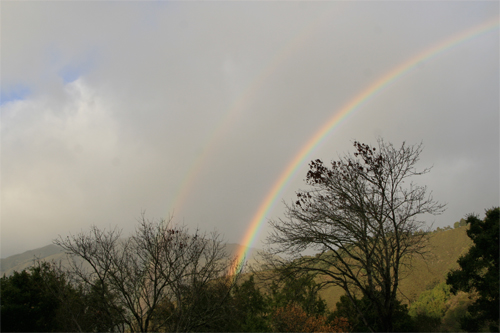
Double acid rainbow in Big Sur (photo by Lee Klinger)
With regards to rain pH there were 39 measurable events with a mean volume-weighted pH (± s.d.) of 4.80 ± 0.13. The lowest pH reading this past rain year was 4.37 recorded on December 27, 2009, and the highest pH reading was 5.65 recorded on May 18, 2010. Read the rest of this entry »
As I mentioned in a previous post I am putting up some of my earlier work on feedback mechanisms by which the planet cools itself. This background will be useful in an upcoming post on planetary temperature regulation.
The potential role of peatland dynamics in ice-age initiation
by Lee F. Klinger, John A. Taylor, & Lars G. Franzen
Quaternary Research 45: 89-92 (1996)
Summary – Physical and chemical coupling of peatland vegetation, soils and landforms and atmosphere creates feedbacks which may be important in ice-age initiation. A box diffusion CO2 exchange model shows that a transient forcing of 500Gt C (the amount proposed to have accumulated in peatlands during the last interglacial-glacial transition) over 5000 yr results in a lowering of atmospheric CO2 by about 40 ppm. Proxy data indicate that a decrease in atmospheric CO2 may have occurred over the last 5000 years up to pre-industrial times, and the amount (~22 ppm lowering in 5000 yrs) is similar to that calculated from Holocene peatland expansion. These results suggest that models should consider the role of peatlands in ice-age initiation.
View the entire paper here.
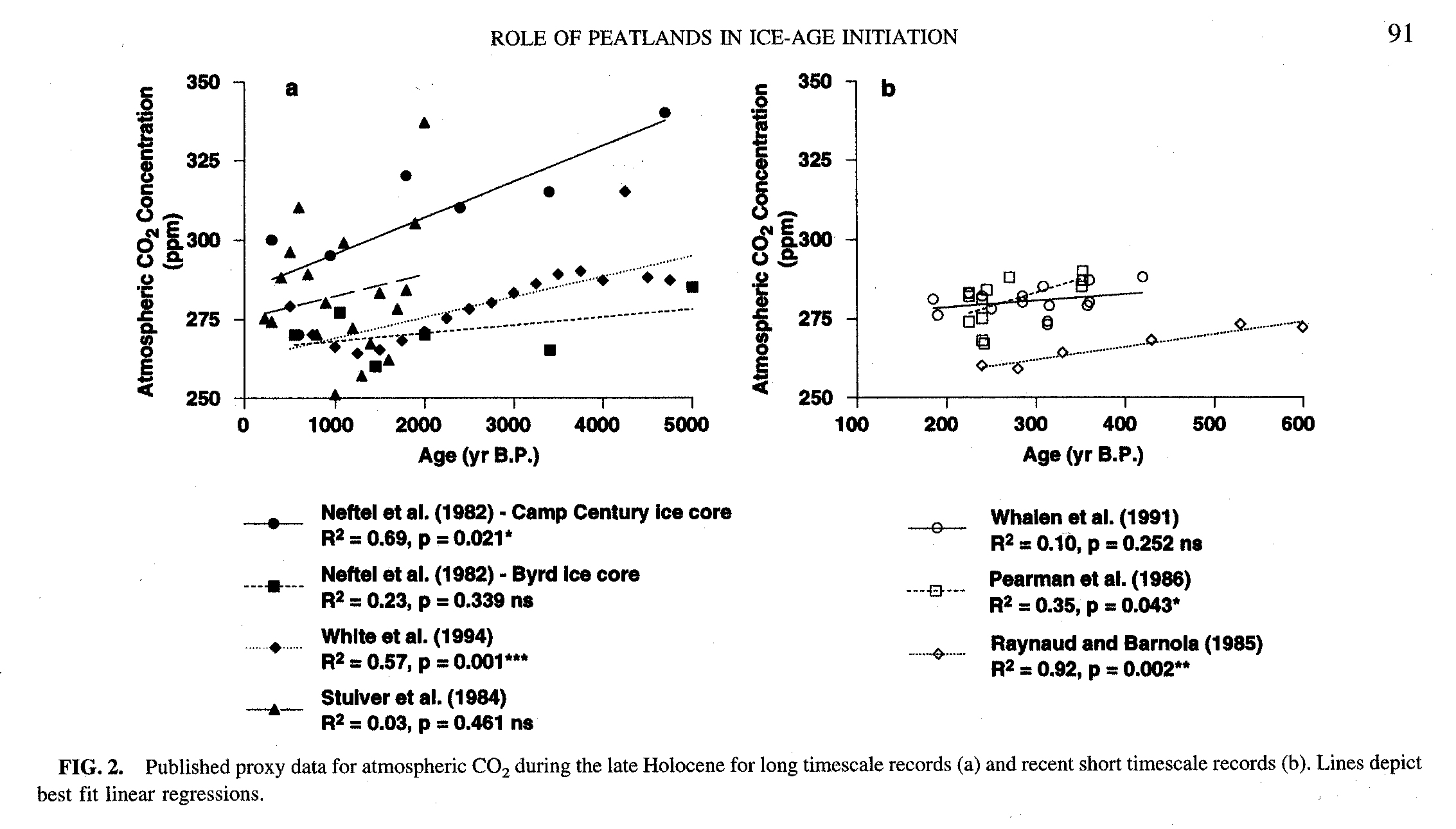
In Fig. 2 (see below) we present evidence that prior to the industrial era atmospheric CO2 was undergoing a decline. We attribute the decline to large-scale landscape transformation involving the replacement of forests by peatlands. Peatlands store immense amounts of carbon and, as described in an earlier publication, are potentially powerful organs that help cool the planet.
To prepare readers for some upcoming posts on the implications of Gaia theory in climate change predictions I would like to provide some background literature of my earlier work in this area. Below is a paper I gave at the American Geophysical Union Chapman Conference on the Gaia Hypothesis held in San Diego, CA in 1988. This paper was published as a chapter in a 1991 book on the proceedings of the conference: Scientists on Gaia. Here is the summary of my paper:
Peatland formation and ice ages: a possible Gaian mechanism related to vegetation succession
by Lee F. Klinger
Summary – Terrestrial areas, which support over 99% of the earth’s biomass, have considerable potential for being involved in biosphere-atmosphere feedback loops as postulated by the Gaia hypothesis. This paper presents a model of a possible Gaian mechanism related to landscape-level successional changes during a glacial-interglacial cycle. The model is based on the view that terrestrial successions converge toward bogs, rather than toward old-growth forest, and that bogs represent structurally and compositionally stable (climax) communities. The model also assumes, as in classical successional theory, that during the course of succession the biota modifies the environment, both the soil and the atmosphere, to favor the progression of succession toward the climax state. Feedback mechanisms between peatlands (landscapes of bogs and bog forests) and the atmosphere are proposed which should favor the initiation and maintenance of relatively stable, ice age climates. These cooling mechanisms are related to increased albedo, increased evapotranspiration, and decreased atmospheric CO2 associated with the succession from woodlands to peatlands. Ice core and ocean core data for CO2, CH4, and delta 13C and delta 14C isotope ratios are consistent with the proposed terrestrial dynamics involving organic carbon.
Here is the full reference for my paper:
Klinger, L.F. 1991. Peatland formation and ice ages: a possible Gaian mechanism related to vegetation succession (Chap. 28). In: S.H. Schneider & P.J. Boston (eds.), Scientists on Gaia. The MIT Press, Cambridge, pp. 247-255.
 Sudden Oak Life by Lee Klinger
Recent Comments