Indigenous-based tending of oaks: eleven year results

23 11 2016


slide2

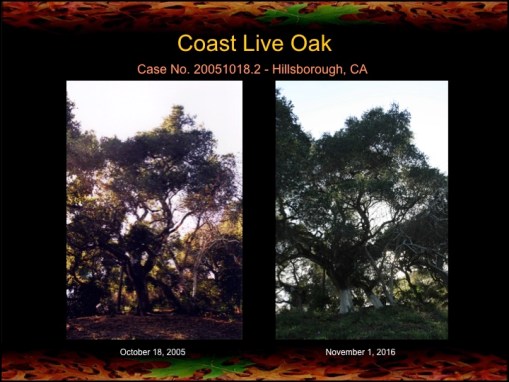
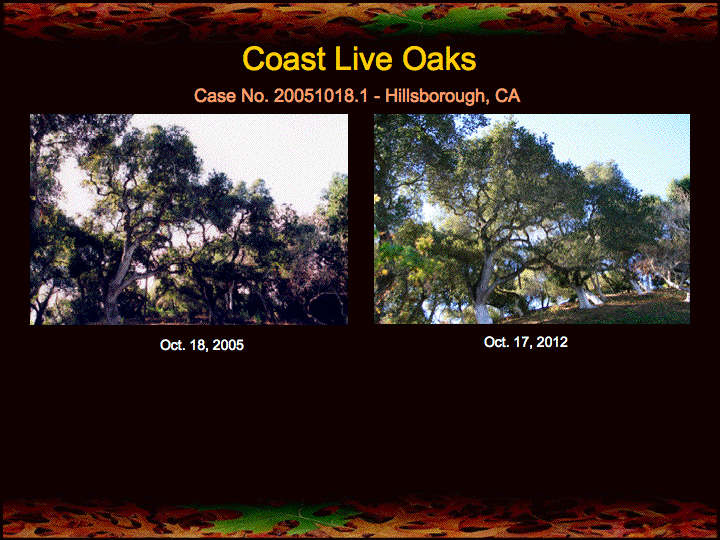
Eleven years ago I began treating this grove of oaks in Hillsborough, CA using indigenous-based methods (ie. fire mimicry). These sets of photos show their response after 11 years of care.

These are very significant results in that they show that these methods result in long-term (decade+) sustained recovery of oaks that were in decline.

Oak lovers and tree huggers, please take notice! And, please, thank the native ancestors for showing us the way!

slide3

slide4

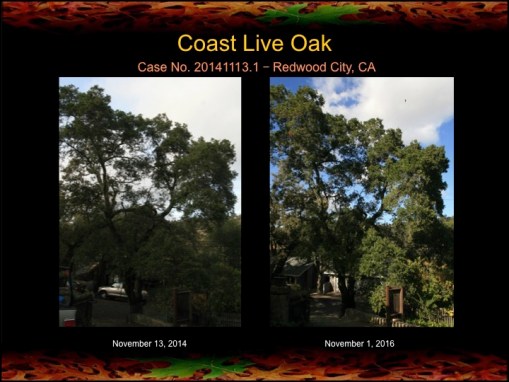
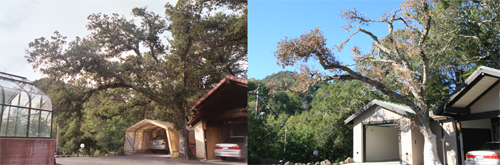
This last oak has been pruned since the initial photo. Note also that the roofline has been altered by construction, obscuring part of the tree. This oak has been infected with a stem canker disease (probably Sudden Oak Death) for the entire period. Despite the disease infection, which has been reduced via fertilization and surgery, this tree remains in relatively good health.


California oak mortality reversed!

23 11 2016

slide3

Here in California there’s been, rightfully, much attention paid to a recent report on the death of more than 100 million trees in the state. Sadly, there has been no talk of solutions, even in the face of clear evidence that prescribed fire and other indigenous-based tending practices (e.g. fire mimicry) improve forest health.

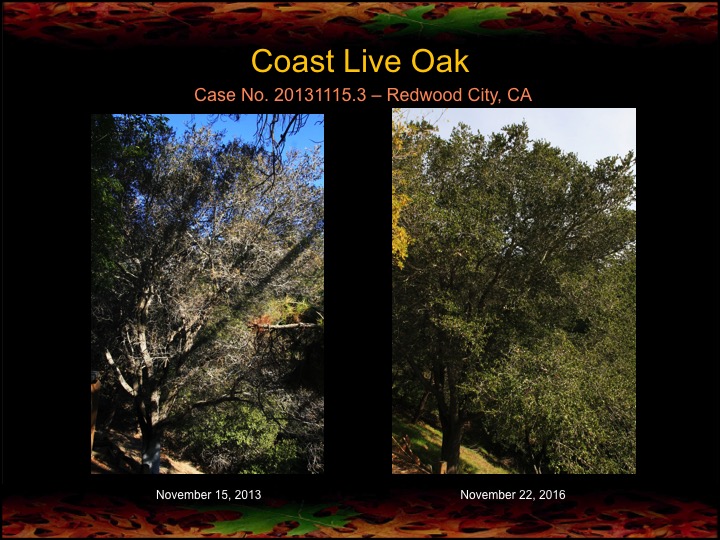
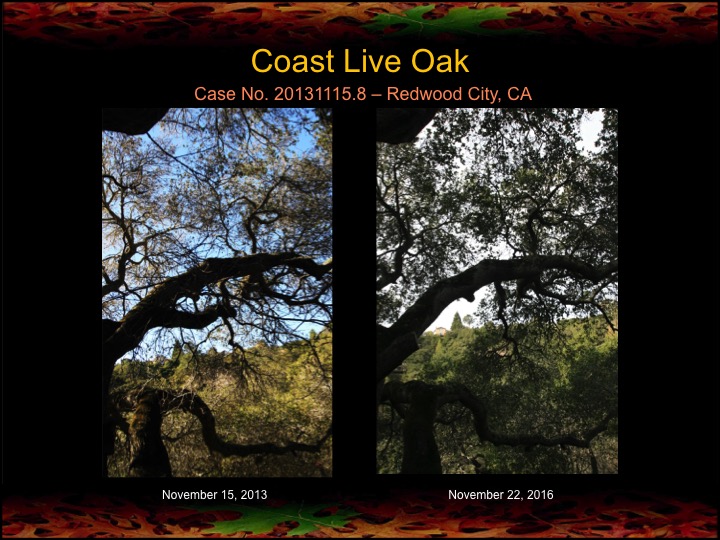
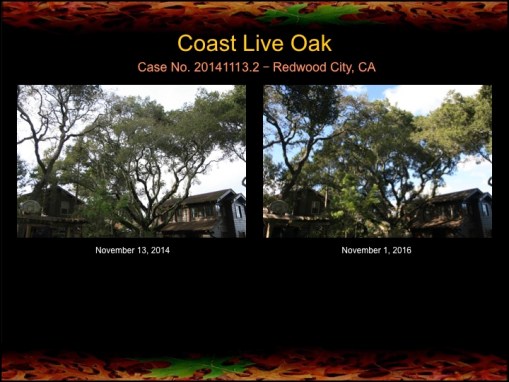
Today I offer, yet again, further evidence of our ability to address the death and decline of oak trees. The coast live oaks shown here are located in Redwood City, CA and were all treated with fire mimicry 3 years ago. Yesterday I revisited these oaks, some of them heritage oaks, and took photos to assess the changes in their canopies over that time. In my view, the decline of the oaks here has not only been abated, it has been reversed, as most of the oaks are showing a clear improvement in the fullness of their canopies.

How many more observations and studies of successful forest restoration efforts are required before more people start acting to save our trees?

slide7

slide8 Read the rest of this entry »


Healing heritage oaks

1 11 2016

slide1

Two years ago I had the task of helping a grove of struggling heritage oaks in Redwood City. All of the mature oaks are centuries old and reveal signs of having been tended by native people. I’m happy to say that after two years of applying fire mimicry methods based on traditional ecological knowledge these oaks are making a strong recovery.

slide2 Read the rest of this entry »


News headline: “California Sudden Oak Death Reaches Catastrophic Levels”

29 10 2016

Yesterday I read a news report with the headline “California Sudden Oak Death reaches catastrophic levels“.

Yesterday I also read a news report “Standing Rock: militarized police from 5 states escalate violence . . .

Now it may seem obscure to most, but these two issues are intimately related. Let me explain how.

The first report states that California is experiencing a crisis in tree mortality with over 66 million dead trees, all attributed to a single disease (Sudden Oak Death) and a single insect pest (Pine Bark Beetle). The report features statements from two experts, a pathologist and an entomologist. Neither scientist mentions a single word about possible solutions.

And to make matters worse, regardless of which way the weather trends, they say that the death of the trees will be exacerbated. More drought will fuel Pine Bark Beetles, and wet weather will favor the spread of Sudden Oak Death. All appears hopeless in any direction.

Now I have no problem highlighting the serious forest health issues we are having in California. Trees are dying and it is affecting us all. The problem I have is that this issue is not reducible to two species of organisms. Even if we could find a cure for Sudden Oak Death and Pine Bark Beetles, the trees would still be dying. There are dozens of other diseases and insect pests that would fill their niches.

When one recognizes that the problems affecting our forests are not pathological or entomological, but are ecological and ethnographical in nature, then solutions become self-evident. California forests that were tended with fire by native people for thousands of years are now declining due to over-competition and soil acidification. Diseases and pests that are normally controlled by fire are now flourishing.

As the Standing Rock protest illustrates, we have lost our connections to the people and practices that gave us such magnificent lands and forests. Honoring our native people by tending to their legacies is one way of supporting all that they live and stand for.

This website is offered as testimony to the promise of traditional values and knowledge in forest health and restoration. Contained here are many hundreds of photos documenting the recovery of sick and diseased trees using solutions based on practices and materials used by native people for thousands of years.

In other news from yesterday – a sick oak that has been treated with traditional practices is making a steady comeback . . .

slide1

slide2


Carmel Valley heritage oak

21 10 2016

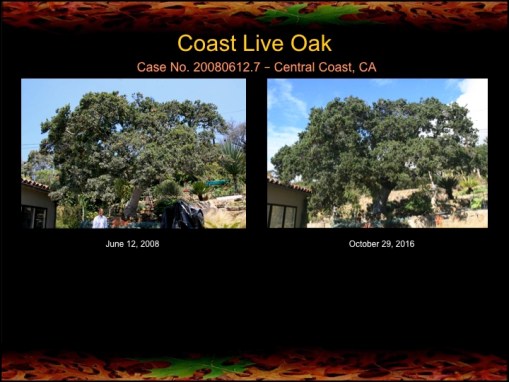
Every so often I get asked to provide some care for a single tree, usually a large heritage oak that dominates a particular property. Following a motto of “one tree at a time”, I never hesitate to help. So last year a Sudden Oak Life colleague, Shannon Boyle, and I had the honor of helping a massive, Indian-era coast live oak in Carmel Valley, CA. This ancient oak has clear signs of being pollarded and tended by the native people who lived in this valley hundreds of years ago. We applied fire mimicry methods to the trunk and the soils around the oak. One year later the canopy is showing a noticeable response in density, greenness, and size.

Deep gratitude to our ancestors for giving us these creatures. What better way to honor our Native American fore bearers than to extend the life and health of their legacies!

slide1


Shell midden and tree health hypothesis confirmed in Pacific Northwest forests

11 09 2016

cover-image

Indeed, it’s becoming clear that native people of North America knew how to grow big trees! In 2006 I published a peer-reviewed chapter titled “Ecological evidence of large-scale silviculture by California Indians” in the book Unlearning the Language of Conquest (Four Arrows, ed.). In that chapter I proposed the hypothesis that ā€œthe many types of refuse mounds and middens, including shell middens, bone middens, and rock middens originate not from the gradual accumulation of the waste products of daily living, but rather from the intentional stockpiling of gathered or recycled lime-rich materials for use as mineral fertilizers.” A careful review of the literature at the time indicated to me that this hypothesis was novel to modern science, though not at all novel to traditional ecological knowledge. Furthermore, I provided evidence for the fertilization effect of midden materials on trees that I collected from a giant sequoia grove in central California and from a grove of western hemlock and Sitka spruce trees in southeastern Alaska, which I attributed to intentional tending by native people.

Now, ten years later, comes a study published in Nature Communications detailing the positive effects of shell middens on the growth and health of western redcedar trees in coastal British Columbia. The paper, ā€œIntertidal resource use over millennia enhances forest productivityā€ (by A.J. Trant et al. 2016. Nature Communications 7:12491) makes several key points that are relevant to my original hypothesis. These include:

ā€œPockets of enhanced forest productivity are associated with increased phosphorous availability resulting from higher soil pH from the slow leaching of calcium from shell middens along with the nutrient amendments of past fires.ā€

ā€œWestern redcedar (Thuja plicata) trees growing on the middens were found to be taller, have higher wood calcium, greater radial growth and exhibit less top die-back.ā€

ā€œCoastal British Columbia is the first known example of long-term intertidal resource use enhancing forest productivity and we expect this pattern to occur at archaeological sites along coastlines globally.ā€

This last point I take some exception to, as Trant et al. fail to recognize that examples of the same phenomenon were reported ten years earlier in my peer-reviewed publication noted above. I might have given them a pass for unintentionally overlooking my work, except that when I do a google search on “shell middens and tree health” my 2006 publication shows up on the first page of results. Perhaps the authors were careless in their searches, or viewed the evidence I reported as somewhat scant, which I agree it was. But any peer-reviewed hypothesis with supportive evidence, scant or not, deserves to be cited and recognized as taking precedent to any later work.

I’m not asking for any personal recognition here, rather I’m hoping to point out that in the ten years since I first published the above findings I have used midden materials (crushed shells and rocks) in the treatment of thousands of oaks and other trees, with good to excellent results (see the many previous posts on fire mimicry). This, to me, is the real evidence supporting the shell midden hypothesis, and more importantly, demonstrates the immense ecological wisdom of the native peoples of the world who discovered this relationship millennia before modern science. Hopefully the authors of the recent paper will take the next step, as I did, and use their findings to make a difference in the health of trees and forests in British Columbia!


Talk on Gaia and trees for Gaia University

21 06 2016

A few weeks ago I gave a talk on “Applying Gaia theory to forest restoration”. The talk was arranged and recorded by my lovely daughter Ava Klinger, who works for Gaia University. I’m also proud to be involved with Gaia University as an external reviewer of students.

The link to talk is here. Enjoy!

AK Eklutna Clouds copy


A California oak stonehenge

3 07 2015

IMG_3317

I met Ryan Masters at Tassajara a few months back while I was teaching a workshop on fire mimicry. He is a delightful person and impressed me as knowledgeable and sincere, so I shared some important Native American wisdom with him. He followed up diligently and the result is this fine article about an Ohlone oak stonehenge here in California.

http://hilltromper.com/article/summer-solstice-california-stonehenge

Ryan also wrote this wonderful article about his adventures in the Ventana Wilderness and the Native American “Hands” rock shelter.

http://hilltromper.com/article/tassajara-zen-center-ventana-wilderness

Enjoy!


Reflections on “Tending the Wild” workshop at OAEC

8 07 2013
Acorn. Photo by Kat Steele.

Acorn. Photo by Kat Steele.

When people don’t use plants they get scarce. You must use them so they come up again. All plants are like that. If they’re not gathered from, or talked to, or cared about, they’ll die.

– Mabel McKay, Pomo Elder, quoted from News From Native California

Last week I attended a remarkable 3-day workshop at Occidental Arts and Ecology Center (OAEC) called “Tending the Wild”. It was organized by my friend and colleague Lindsay Dailey, who is the Associate Director of the Wildlands Program at OAEC. For the past few years Lindsay has been training and working with me in the use of fire mimicry techniques in oak woodland restoration. I have found her to be a serious student and practitioner of traditional ecological approaches in land care.

The workshop drew together an amazing group of teachers and elders speaking on the topic of wildland tending by the Californian native people. The first day was led by M. Kat Anderson, PhD, author of the book “Tending the Wild“. Her thesis is that the richness and abundance of the historical ecosystems in California were largely the result of thousands of years of tending by the native people, primarily through the wise use of fire in burning the land to improve soil fertility and promote plant production/regeneration. In answer to the question: “Why are plants and animals disappearing?”, her response is: “Because we no longer have a relationship with them.” Read the rest of this entry »


On Sudden Oak Death, fire mimicry, and canker surgery

22 10 2012

Coast live oak in Marin succumbing to Sudden Oak Death after 4 years (Photos by Lee Klinger)

Recently the California Oak Mortality Task Force issued a press release reporting on an explosive growth in Sudden Oak Death in the San Francisco and Monterey Bay areas. This is a sad situation, knowing that untold thousands of ancient heritage oaks will die while under our care, or rather our lack of care.

For thousands of years California Native Americans tended and cared for all these ancient oaks, and associated plants, animals, and fungi, in an effort to live sustainably. The concept of reciprocity permeated their spirituality and culture, the oaks provided them an abundance of food (acorn), and so in return they managed the land in ways that helped the oaks prosper.

Oaks we know, and as the native people knew, are early successional fire-adapted species, meaning that they need periodic understory (ground) fires to thrive. These fires alkalinize the soils, which is a good thing, and they remove encroaching shrubs and young trees which draw away water and nutrients from the mature oaks.

Without periodic fires the oaks begin to decline. Over many decades the soils gradually acidify and more shade-tolerant species such as bays, firs, pines, and redwoods invade the oaklands. Eventually these later successional species overtop the oaks and out-compete them for light, water, and nutrients. At this point fires, if they due occur, are usually large stand-devastating fires that burn the entire canopies of the trees, from which few oaks can recover.

The oak forests in California are experiencing a rapid shift in their ecology the likes of which has not been seen for thousands of years. The weakening oaks are succumbing to diseases like Sudden Oak Death, and it is likely to get worse.

Unless, we started start caring for the oaks under our care.

How many of us have befriended an oak, enjoyed its protective canopy and felt the nurturing presence of a stately being?

How many of us have tended an oak?

All the while the oaks are enriching the air and land, helping sustain us, along with so many birds, mammals, insects, plants, fungi, and much much more, they are running out of time. The current sad state of affairs is largely due to improper actions, or lack of actions by our parents, grandparents, and great grandparents in managing the oaks on our lands. They simply didn’t know what the native people knew, that oaks need tending.

So now many of us know, and I pray others will too, that the problems with our oaks, with some effort, are solvable. I and many others are using fire mimicry methods, which involve restoring oak forests usingĀ  clearing, pruning, and soil fertilization methods that mimic to a degree the normal effects of fire.

My purpose here, as is the purpose of my life, is to inform you and others that we can save our oaks and, more importantly, to do the work on the oaks and show you how it’s done.

Here are several oaks that have received fire mimicry treatments beginning in 2005:

Note the improved canopy density and fullness. Fortunately these oaks are not infected with Sudden Oak Death, nor will they be (at least on my watch).

Here, however, is a nearby oak that is infected with Sudden Oak Death:

(Note the roof line has been altered by remodeling since the original photo)

While infected, this oak has some hope for a longer and healthier life as a result of the treatments. In addition to the fire mimicry treatments, I have done a surgical removal of the canker, which was still at an early phase of growth when discovered. For this I used an axe, then hammer and chisel to excavate the infected tissue, then I used a propane blow torch to cauterize the wound. This tree still has a small infection and will require some additional surgery, but the majority of the surgery appears to have worked to clear the tissue of the canker, and the tree is already healing over much of the wound. I predict that this oak will live for many decades, and if you hang around here I’ll keep showing you the photos of its recovery.

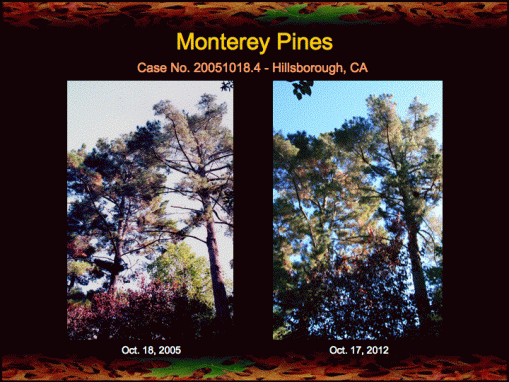
Finally, let me remind all you tree lovers that these techniques work on many kinds of trees. Here’s an example of what can be done for sick pines:
Interested? We’d love to hear from you!