Back in 2008 Kevin Feinstein over at FeralKevin blog interviewed me about Sudden Oak Death. I don’t know if he posted the interview, but reading over it I see that the information is still relevant. With permission from Kevin Feinstein, here is the transcript of that interview: Read the rest of this entry »
Sudden Oak Death: Interview with Dr Lee Klinger
15 11 2011Comments : Leave a Comment »
Categories : Native people, Oak health, Sudden Oak Death
New study of Appalachian forest fire history
9 09 2011A new study of tree rings and fire scars by Charles Lafon, associate professor of geography at Texas A&M University, describes the fire history of forests of the southern and central Appalachian Mountains. His findings are consistent with and relevant to the forest dynamics in California, and provide support the use of fire mimicry methods in mitigating forest decline.
Here are some excerpts from the Science Daily report:
“We know that Indians often set fires to clear areas”
“Many tree species that inhabit fire-prone areas have thick, protective bark,” he points out. “Some trees depend on fires for their own reproduction. One such tree is the Table Mountain Pine. Through a feature called serotiny, its cones often will not open to release the seeds unless they are heated by a fire, ensuring that the new seedlings emerge at an optimal time to survive and grow — right after a fire has cleared away the competing vegetation.”
“The decline in fire frequency during the 20th century, for example, permitted tree species like red maple to encroach into pine and oak forests. Now the pines, oaks and other fire-associated species like the Peters Mountain mallow are declining in abundance”
Read the entire article here.
Note the similarity of these results to those from the study of oak forests from the Upper Midwest reported here.
Comments : Leave a Comment »
Categories : Fire ecology, Fire mimicry, Native people, Oak health, Pine health
On managing California bay laurels to improve oak health
16 07 2011UPDATE: For a more detailed discussion of the science and traditional knowledge on this subject please refer to my new book Forged by Fire: The Cultural Tending of Trees and Forests in Big Sur and Beyond” https://www.amazon.com/dp/B0D3ZVMB3P
Several friends and tree professionals have contacted me about my thoughts on the following article by Peter Femrite that recently appeared in the San Francisco Chronicle:
Saving oak trees by chopping down bay trees
Workers began chopping down 250 California bay laurels this week in the Santa Cruz Mountains so that 49 signature oak trees might be saved from the infectious scourge known as sudden oak death.
The tree-removal project is an attempt by the Midpeninsula Regional Open Space District to prevent the spread of the tree-killing pathogen, which uses bay trees to scatter spores in the forest.
(h/t to R Zingaro for alerting me to this article)
First, there are important points here with which I agree. The bays are clearly major vectors for sudden oak death disease. I do believe that selective removal of bays will lower the incidence of sudden oak death (SOD). However, I am bothered by the singular focus on the disease. I would rather the focus of efforts be made toward promoting the overall health of the forest ecosystem. Read the rest of this entry »
Comments : 1 Comment »
Categories : Fire ecology, Fire mimicry, Native people, Oak health, Plant succession, Sudden Oak Death
New study with implications for fire management of oak woodlands
8 07 2011A recent study reported at Science Daily on the fire history of post oaks in Illinois reads like page from the history of California oak woodlands:
Old-Growth Tree Stumps Tell the Story of Fire in the Upper Midwest
The new study, in the journal Castanea, confirms that the people who lived in Illinois before European settlers arrived [Native Americans] were in the habit of setting fires in the region nearly every year, with fires in the Hamilton County woodland occurring at least every two or three years, McClain said. This repeated burning actually stabilized the prairies and open woodlands that dominated the region until the late 19th century, when the fire-suppression efforts of the new settlers allowed different plant species to take over, the researchers said.
The study was conducted by William McClain, a botanist with the Illinois State Museum along with researchers John Ebinger and Greg Spyreas, of the Illinois Natural History Survey at the University of Illinois. They also report:
“For hundreds, maybe thousands of years, this was a stable post oak woodland,” Spyreas said. “And then you have a gap of a couple of decades where there were no fires and suddenly the whole system is completely different. It’s amazing how, from Kansas to Ohio, these ecosystems completely depend on fire to be stable.”
See the full report here.
To all you Californian’s concerned about the oaks, this study is highly relevant.
Comments : 4 Comments »
Categories : Fire ecology, Native people, Oak health, Sudden Oak Death
Ecoliteracy in Action
29 11 2010On December 18 I will be speaking at the Ecoliteracy in Action course being held at Esalen Institute in Big Sur, CA at the invitation of Kat Steele, the course coordinator. The title of my talk is “Gaia theory and climate change”. Prior to my talk on the 18th my good friend Daniel Peterson will be presenting on “Primitive skills and the Esselen tribal ways”, a discussion and hands on workshop relating to living off the land and crafting tools from natural materials. See the flyer below:
Comments : Leave a Comment »
Categories : Announcements, Big Sur, Climate change, Gaia theory, Native people
Encino heritage oak – 2010 update
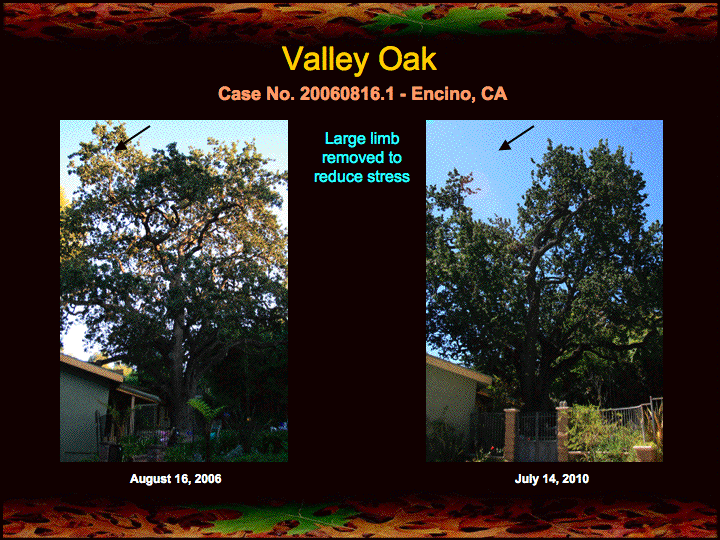
15 07 2010Yesterday I visited and tended a huge valley oak which, at about 500 years old, is possibly the oldest valley oak in Encino, CA. This oak appears to have been pollarded (pruned in a way that encourages broad, spreading branches) by the native people hundreds of years ago. Last year I posted a story about this Encino heritage oak, and presented photos that showed a significant improvement in the health of the tree in response to fire mimicry treatments.
We are now in the 4th year of fire mimicry treatments and the oak continues to show a very good response, as the photos below indicate:
Comments : Leave a Comment »
Categories : Case studies, Fire mimicry, Native people, Oak health, Repeat photography
Interview with SustainableWorld’s Channel
17 02 2010SustainableWorld’s Channel did a recent interview with me at La Casa de Maria (Santa Barbara, CA) about oak health, native people, and fire mimicry and has posted a portion of the interview on YouTube. Here is the video:
Comments : Leave a Comment »
Categories : Fire ecology, Fire mimicry, Native people, Oak health, Plant succession, Sudden Oak Death
What is fire mimicry?
8 02 2010People often ask me why the oaks and other trees in California need to be tended. Oaks have been growing in California for many thousands of years, so why would they need our help now?
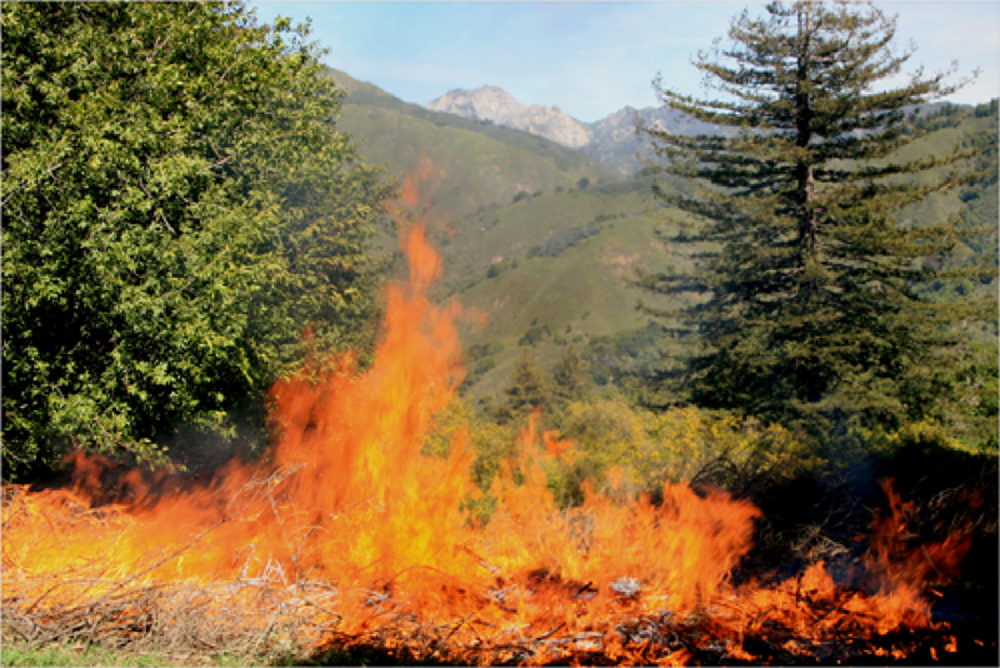
The answer is clear. The great oak woodlands and savannas of California are not the result of mother nature doing what she does best. The iconic oaks are largely the product of thousands of years of tending by Native Americans. It is well documented that the native people here managed the oaks with fire, keeping the ecosystem in an early successional state that is optimal for oaks. Acorns from the oaks were a primary food source for the native people of California.
Comments : 2 Comments »
Categories : Acid rain, Big Sur, Fire ecology, Fire mimicry, Native people, Oak health, Sudden Oak Death
Ancient redwoods in decline
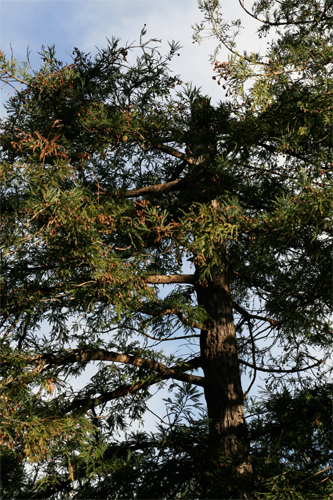
21 01 2010A week or so ago a large redwood tree growing near my home here in Big Sur lost its top. The wind blew hard and broke off the upper part of the redwood as shown in Photo 1. In many places around Big Sur ancient redwood trees have lost their tops during the winter storms. Some of these tops are more than three feet in diameter and you don’t want to be around when they come crashing to the ground.
I realize, of course, that it is not unusual for large trees to succumb to high winds, but what does seem unusual is that in some groves nearly half of the ancient trees have lost their tops within the past 20 years or so. By all appearances these redwoods have grown healthily together in these groves for three, four, five centuries or more, so why are they suddenly losing their tops?
The answer is not too hard to figure out. Yes, there is acid rain falling in Big Sur (see here, here, and here) and that no doubt has some effect on the redwood ecosystem. But recent changes in land practices, most notably fire suppression, are causing dramatic shifts in the successional status of the redwood forests. In the past the native people set fires that revitalized the soil and kept the young redwoods from crowding out the older ones. Read the rest of this entry »
Comments : 1 Comment »
Categories : Acid rain, Big Sur, Fire ecology, Fire mimicry, Native people, Redwoods
A holistic approach to mitigating pathogenic effects on trees
25 12 2009For those of you who would like to read more about the details of the science and techniques involved in fire mimicry practices for oak restoration, here is a paper I wrote last year:
A holistic approach to mitigating pathogenic effects on trees
by Lee Klinger MA PhD
Presented at: Treework Environmental Practice Seminar XII
National Museum Cardiff, Cardiff, UK – 13th November 2008
Summary
The conventional ‘disease model’ approach to tree health focuses on identifying and controlling a specific pathogen (or pest) implicated as the causal agent of tree decline. Alternatively there are more holistic approaches in tree health that address a broader suite of processes occurring at the ecosystem level which may be predisposing the trees to infection by disease. Here I describe a holistic methodology that takes into account not only the proximal agents involved in tree decline, but also the age and structure of the forest, the abundance of cryptogams, the fire history, the acidity of the precipitation, the fertility of the soil, and the historical land care practices. This methodology is being implemented in the oak forests of coastal California which are experiencing high levels of mortality attributed, by most scientists, to the pathogen Phytophthora ramorum (aka sudden oak death). Evidence reported here of 1) acid rain, 2) acidifying effects of mosses and lichens, 3) the presence of acidic and nutrient deficient soils, and 4) a much lowered incidence of disease in recently burned areas, points to the likelihood that fire suppression has radically altered the structure and successional status of the forests, leading to enhanced competition and systemic acidification. Case study results of sick and diseased coast live oaks receiving holistic care, aimed not at treating P. ramorum but at reducing the environmental acidity, fertilizing the soils, and otherwise mimicking the effects of fire, show noticeable improvement in the health of the oaks after one year (78%, n=152), with further improvement in years two (84%, n=134) and three+ (81%, n=80). While the results do not indicate that the incidence of P. ramorum has changed significantly in the population of treated oaks, there is evidence that the sick, non-diseased trees are better able to resist infection.
Download the complete paper here.
Comments : 4 Comments »
Categories : Acid rain, Big Sur, Case studies, Fire ecology, Fire mimicry, Native people, Oak health, Soil science, Sudden Oak Death


Recent Comments