Encino heritage oak

3 11 2009

I’ve often said that every tree tells a story. Well, there’s a heritage oak in Encino, California that has a story to tell.

As most of you may know the live oaks and tan oaks of California are dying off in large numbers as a result of stresses brought about by decades of fire suppression. Oaks are fire-adapted trees, meaning they benefit from periodic fires. The lack of fire has weakened the oaks and created conditions that encourage the spread of diseases such as sudden oak death.

The live oaks and tan oaks, however, are not the only species of oaks that are suffering. Valley oaks (Quercus lobata), blue oaks (Q. douglasii), Oregon white oak (Q. garryana), and other species in the white oak subgroup are, in places, experiencing heavy die-off, yet are showing no signs of sudden oak death or bark beetle infestation. As it turns out the white oaks, too, are suffering from the effects of fire suppression. The good news is that these oaks, like the live oaks and tan oaks, are showing positive responses to fire mimicry treatments.

One of the largest oaks in Encino, California is situated next to the home of Robert and Lelia Maltzman. This heritage valley oak is estimated to be about 500 years old. In 2006 I examined the oak and found the soils to be somewhat acidic and the canopy of the tree was rather thin. Fire mimicry treatments involving healthy doses of calcium-rich AZOMITE minerals were then implemented and, three years later, the oak is showing some nice improvement in canopy health.

Encino Sun photo

Below are photos of the Encino heritage oak showing the changes in canopy health three years post-treatment. Note the removal of one large limb for stress reduction. I was not involved in this limb removal and may have done it differently from an aesthetic perspective. But the arborist certainly had his reasons and after three years the tree seems to be faring well.

20060816.1a

Encino heritage oak before and after fire mimicry treatments

Here is an article describing this heritage oak that appeared in the Encino Sun in 2007. Read the rest of this entry »



Ecological research backs fire mimicry approach

31 10 2009

Science Daily is reporting on a new study that documents the importance of fire feedbacks in maintaining savanna woodlands. Fire feedbacks are the ecological basis for employing fire mimicry to restore the oak savannas here in California. While I don’t have much faith in the mathematical models that these scientists are using, it is interesting that they have come to the same conclusion I have reached based on my own, and others’, empirical studies.

From Science Daily (Oct. 29, 2009):

Trees Facilitate Wildfires As A Way To Protect Their Habitat

Fire is often thought of something that trees should be protected from, but a new study suggests that some trees may themselves contribute to the likelihood of wildfires in order to promote their own abundance at the expense of their competitors. Read the rest of this entry »


Upcoming workshop on tree and soil care at La Casa de Maria

15 09 2009

THE HISTORY AND PRACTICE OF NATIVE TREE CARE

Saturday, October 10, from 9:30 am to 3:00 pm
La Casa de Maria Retreat Center, 800 El Bosque Road, Santa Barbara, CA

For thousands of years the native Chumash people tended the oak forests in the Santa Barbara. Now California’s oaks are endangered. Come for a workshop that will include presentations, time in La Casa’s oak woodland and a hands-on demonstration of tree care.

The Chumash used prescribed fire and other methods of traditional land management. To them, living on a living earth meant that the trees and forests were essentially organs of the planet. Keeping the trees healthy was fundamental for maintaining their quality of life.

Now-a-days, oaks and other trees are experiencing accelerated rates of decline in many parts of California, including the Santa Barbara area. A holistic view of the problem reveals that many of our aging trees and their soils are undergoing a major ecological shift brought on by changes in land management, especially fire suppression.

By revisiting the practices of the native people we are provided with an effective means of intervening in the decline of trees without the use of synthetic chemicals. Details will be presented on how fires and fire mimicry methods act to improve the fertility of soils and the health of trees. Results will be shown of case studies involving a suite of techniques to restore oak trees, including fire, mineral fertilizers, limewashing, brush clearing and mulching.

There will also be a presentation on the practical applications of the theories of agroecology that are now used in ornamental horticulture. By shifting from conventional techniques that utilize synthetic chemicals and pesticides to non-toxic organic products focused on improving soil fertility and insect ecology plant health is significantly improved.

This workshop will include a demonstration on traditional tree care using all-natural materials.

Lee Klinger, MA, PhD is an independent scientist and ecological consultant from Big Sur, with over 25 years of professional experience in the fields of biogeochemistry, forest ecology and soil science. He has held scholarly appointments at the University of Colorado, the University of Oxford, and the Chinese Academy of Sciences.

Corey Welles is the Plant Health Care Coordinator at Lotusland. He has seen dramatic improvements in the health of their plant collections since using agroecology based practices.

For more information and to register online go to: www.lacasademaria.org


Using fire mimicry to treat early leaf senescence in California buckeyes

15 07 2009

The buckeye (Aesculus californica) is a deciduous tree, low and broad in stature, that is endemic to California. Every year these trees extend their gratitude by offering up a harvest of enormous size nuts. The species is a vital part of the California ecosystem and ever so worthy of our attention. Some even believe that tending the buckeyes is a responsibility passed on to us by the native people, who for the past few thousand years have been tending California’s buckeye groves.

Buckeyes do very well in open forests and savannas, especially in places where fires have been allowed to burn. However, on unburned lands buckeyes are often seen to be in poor health. Where forests are overgrown and acidified the buckeyes are experiencing serious health problems, including stem failure, canopy dieback, and any numbers of leaf blights including anthracnose and sudden oak death.

One of the first symptoms of ill health in buckeyes is the early seasonal onset of leaf senescence. Several years ago an astute friend of mine began noticing that for several years the buckeyes near her home had been losing their leaves earlier than usual. She contacted me about the problem and I suggested we try fire mimicry, the same treatments that I’ve been using on the oaks.

After four years of ongoing treatment here are the results . . .

20050711.8

Read the rest of this entry »


On the origins of fire scars in California redwoods

10 05 2009

UPDATE: For a more detailed discussion of the science and traditional knowledge on this subject please refer to Chapter 3 “The redwood giants” in my book Forged by Fire https://www.amazon.com/dp/B0D3ZVMB3P

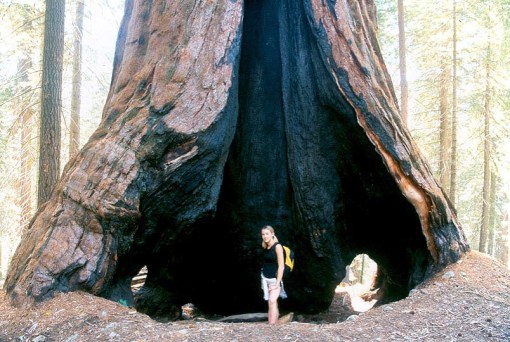
Anyone who has spent time with the redwoods has no doubt seen and even ventured inside the giant trees with fire-scarred trunks. Certain trees are so severely scarred that you wonder how they are even able to stand. Some trees contain cavernous fire-carved rooms in their base with multiple entrances and even window-like openings. I’ve marveled at these trees and looked carefully at the orientations and shapes of their scars, and in doing so have found some odd things.

Huge fire scar

Huge fire scar in giant sequoia (photo by Lee Klinger)

Having worked on fire lines in Alaska, Colorado, and California I’ve seen how fire scars are formed. A large quantity of fuel piled at the base of the tree is usually required to ignite a fire hot enough to penetrate the bark and scorch the cambium.

A characteristic burn pattern is seen on slopes where the vast majority of fire scars occur on the uphill face of the trunk (more than 90% in places)[1]. This is due to a couple of factors. First, hot air currents tend to drive ground fires upslope, especially during the day when fires burn hottest. (Keep in mind we’re talking about large ground fires, not large canopy fires which would more likely kill the tree.) The wind-driven fires tend to burn relatively quickly around the lower parts of the trunk, but eddy effects allow the fire to linger on the uphill side. Second, fallen leaves and branches tend to move downhill and accumulate on the uphill side of the trunk. Together these factors seem to account fairly well for the uphill side tendency of fire scars.

So imagine my confusion . . .  Read the rest of this entry »