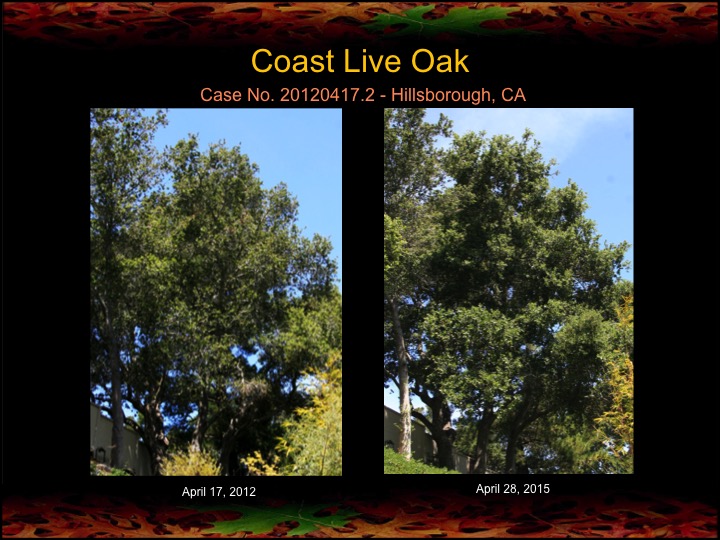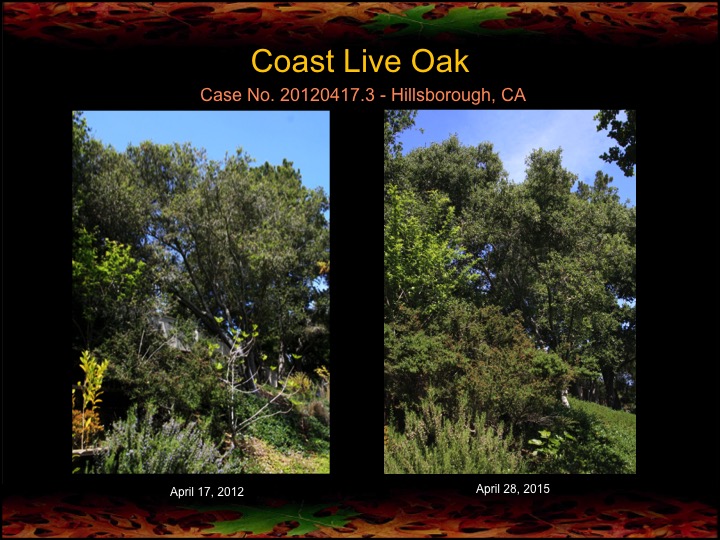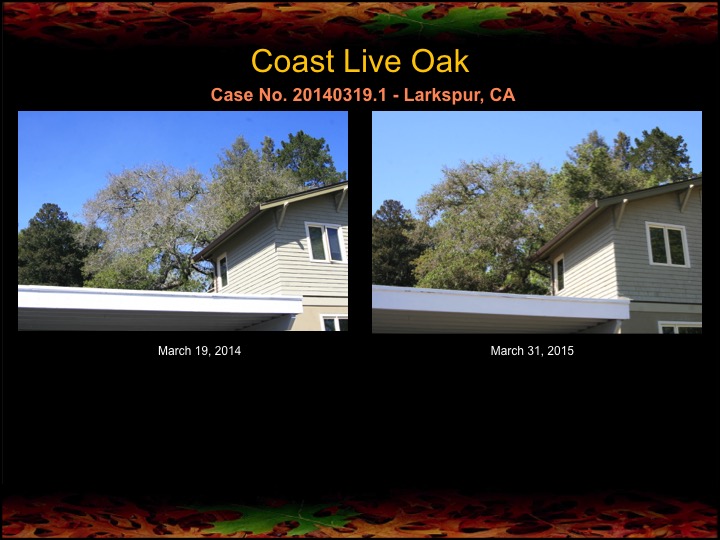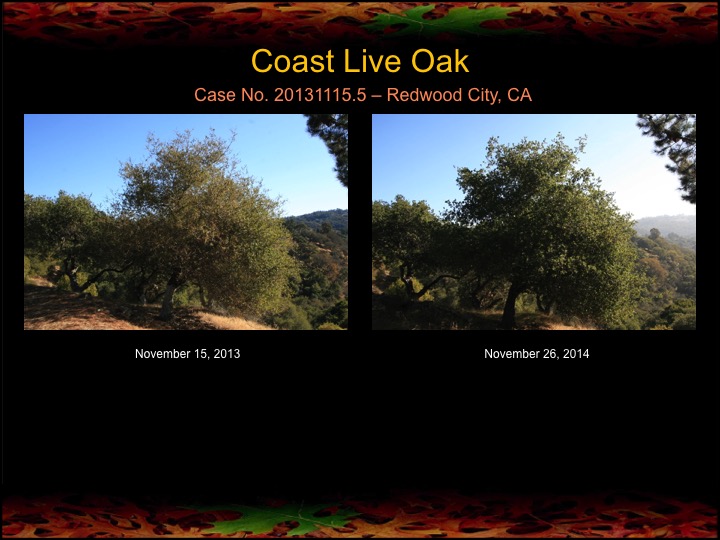
Here are some assorted results on oaks, pines, and one toyon tree that I collected over the past two weeks. All have been treated with fire mimicry. As you can see some trees are responding better than others. Some of the trees here are showing only a slight improvement in canopy size and density. But results are results, so here they are. Fortunately, I found no infections of sudden oak death disease in any of the oaks here.
California oak, pine, and toyon trees responding to fire mimicry
4 05 2015Comments : Leave a Comment »
Categories : Case studies, Fire mimicry, Oak health, Pine health, Repeat photography, Sudden Oak Death
Coast live oaks in Hillsborough responding to fire mimicry
1 05 2015A few days ago I checked up on some oaks treated with fire mimicry techniques twice in the past three years. Here are the results. I’m pleased to see that all the oaks are showing noticeable improvement in the health of their canopies. Also happy to report that none of these oaks have become infected with sudden oak death, despite this area being a hotspot for the disease.
Comments : Leave a Comment »
Tags: Sudden Oak Death
Categories : Case studies, Fire mimicry, Oak health, Repeat photography, Sudden Oak Death
Five-year results of fire mimicry on coast live oaks, valley oaks, and black oaks in Glen Ellen, CA
25 04 2015Last week I checked up on some oak trees in Glen Ellen, CA to see how they are faring after five years of fire mimicry treatments. I took photos of the oaks and compared them to photos taken five years ago at the same time of year. These are the results. I’m pleased to report that most of the oaks are responding noticeably in terms of canopy density and greenness, and some have improved dramatically. A few of the oaks have a stem canker disease, possibly sudden oak death. These oaks have not shown much response, though it is relevant to note that there are no clear indications of decline in canopy health of these diseased trees in five years. This may even be considered a positive result.
Comments : Leave a Comment »
Categories : Case studies, Fire mimicry, Oak health, Repeat photography, Sudden Oak Death
Marin oaks respond to fire mimicry
4 04 2015I’ve been away for the past 5 weeks, working on a project in Ireland. (Hint: the project made front page of the New York Times one week ago today.) While I was away I received messages from two clients concerned about the health of their oaks. In both cases they noticed a sudden browning of the oak canopy. The reports were definitely cause for alarm considering the prevalence of Sudden Oak Death, and other diseases and inspect pests that are afflicting the oaks in Marin.
Upon my return I promptly inspected the oaks and and am happy to report that in both cases the sudden “browning” was due to a heavy bloom of male flower clusters, which give the tree a brown appearance. I took photos of both trees, showing that they both are improving noticeably since their initial treatment with fire mimicry.
Ive
Comments : Leave a Comment »
Tags: Sudden Oak Death
Categories : Case studies, Fire mimicry, Oak health, Repeat photography, Sudden Oak Death
Fire mimicry shows promising results on oaks after just one year
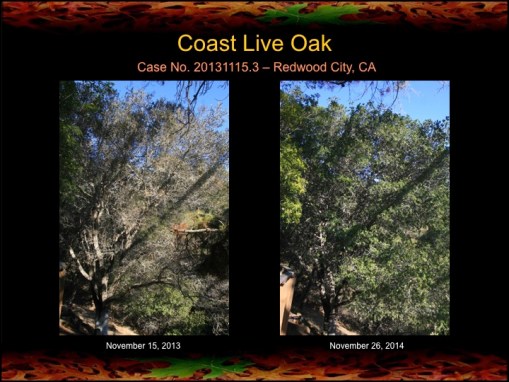
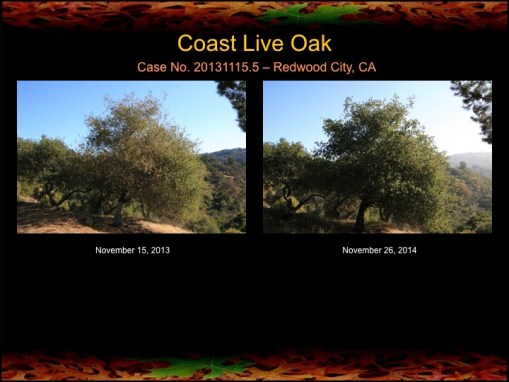
1 02 2015In November of 2013 I met with a property owner in Redwood City, CA who had some rather sick coast live oak trees. His wife had alerted him my work with fire mimicry and he was interested, though quite skeptical, of my approach to helping oaks. I provided a report of my findings and recommendations, and he responded with a number of good questions, showing me that he had done his homework on the subject. In the end he opted to try my approach, noting that his decision was swayed by the fact that the mineral and compost fertilizers I apply are all natural, non-toxic compounds typically used in organic agriculture.
One year later, in November of 2014, we met again as I did my annual inspection his treated oaks. Even before I had time to re-photograph the trees he admitted he had seen significant improvement in several oaks, and was no longer a skeptic of my work.
Bear in mind that these photos show the treated oaks after only one year’s time. A few oaks show no noticeable improvement in canopy density or greenness, nor do they show any noticeable decline. Other oaks have responded with clear improvement in canopy density and greenness.
Needless to say, the owner opted to treat his oaks again, and we’ll see their response again next year . . .
Comments : Leave a Comment »
Categories : Case studies, Fire mimicry, Oak health, Repeat photography, Sudden Oak Death
Oaks in Woodside, CA flourishing with fire mimicry
16 01 2015In 2010 I began fire mimicry treatments on a grove of coast live oaks in Woodside, CA, which are at risk of Sudden Oak Death. Here are the results after four years. None of the oaks has contracted disease, and their canopies are clearly showing an increase in size, greenness, and density. Some light pruning occurred in 2011.
Comments : Leave a Comment »
Categories : Case studies, Fire mimicry, Oak health, Repeat photography, Sudden Oak Death
Ten year milestone for Sudden Oak Life
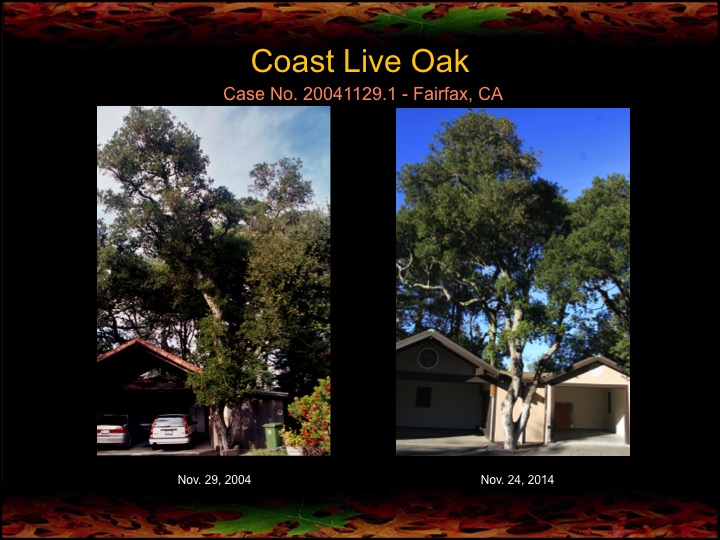
31 12 2014Thank you readers for your patience during the extended quiet time here on my blog in 2014. This year started off with the challenge of recovering from the loss of my home during the Big Sur fire in December 2013, where many of my friends and neighbors also lost their homes. Fortunately, with the generous help of the Big Sur community, family, and friends I’ve been able to set up a new home and am back doing my forest restoration work.
There are many results from the past year that I plan to show in coming posts in 2015. Let me start with a milestone, the first 10-year results of fire mimicry methods employed on oaks that I have documented. These results come from Fairfax, CA and much of the credit goes to Leith Carstarphen who has been applying the methods I showed him 10 years ago on the coast live oaks below.
Comments : Leave a Comment »
Categories : Case studies, Fire mimicry, Oak health, Repeat photography, Sudden Oak Death
Reflections on “Tending the Wild” workshop at OAEC
8 07 2013When people don’t use plants they get scarce. You must use them so they come up again. All plants are like that. If they’re not gathered from, or talked to, or cared about, they’ll die.
– Mabel McKay, Pomo Elder, quoted from News From Native California
Last week I attended a remarkable 3-day workshop at Occidental Arts and Ecology Center (OAEC) called “Tending the Wild”. It was organized by my friend and colleague Lindsay Dailey, who is the Associate Director of the Wildlands Program at OAEC. For the past few years Lindsay has been training and working with me in the use of fire mimicry techniques in oak woodland restoration. I have found her to be a serious student and practitioner of traditional ecological approaches in land care.
The workshop drew together an amazing group of teachers and elders speaking on the topic of wildland tending by the Californian native people. The first day was led by M. Kat Anderson, PhD, author of the book “Tending the Wild“. Her thesis is that the richness and abundance of the historical ecosystems in California were largely the result of thousands of years of tending by the native people, primarily through the wise use of fire in burning the land to improve soil fertility and promote plant production/regeneration. In answer to the question: “Why are plants and animals disappearing?”, her response is: “Because we no longer have a relationship with them.” Read the rest of this entry »
Comments : 2 Comments »
Categories : Buckeye health, Native people, Oak health, Pine health
Fire mimicry improving health of oaks, pines, and toyons
23 06 2013For thousands of years the native people of California used fire as a tool to manage the lands and maintain healthy trees. Now-a-days, faced with the fact that we can no longer set fire to the land because of heavy fuel buildup from years of fire suppression, we must use alternatives, such as fire mimicry methods, in our work to keep California’s trees healthy. Today I’m posting some recent results of fire mimicry treatments in restoring oak, pine, and toyon health.
Enjoy!
Comments : Leave a Comment »
Categories : Case studies, Fire mimicry, Oak health, Pine health, Repeat photography, Sudden Oak Death
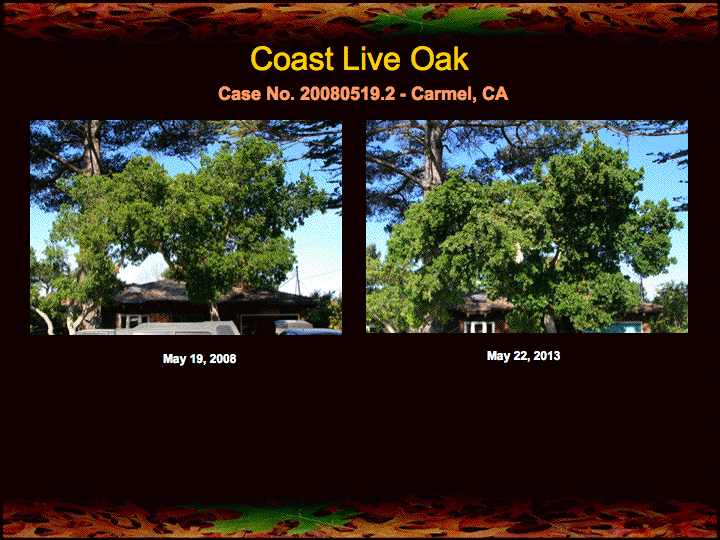
Oaks in Carmel respond with vigor to fire mimicry treatments
27 05 2013Five years ago I began fire mimicry treatments on these coast live oaks in Carmel, CA. Last week I checked on the oaks and re-photographed them. Here are the results:
Comments : Leave a Comment »
Categories : Case studies, Fire mimicry, Oak health, Repeat photography, Sudden Oak Death


Recent Comments