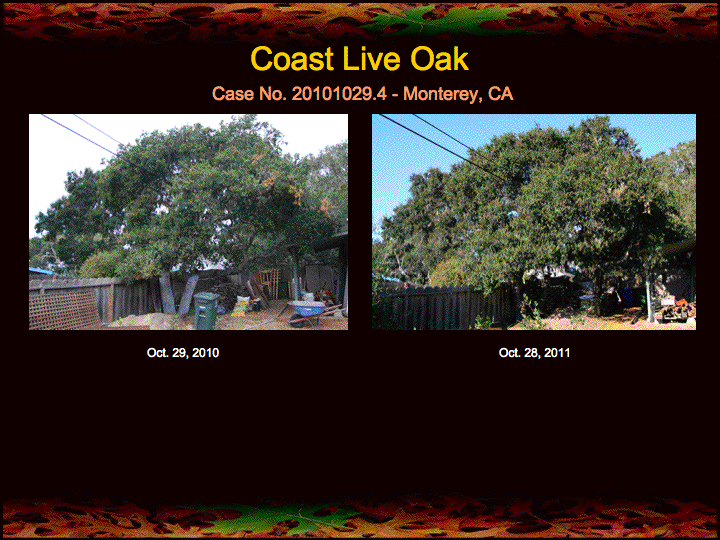
Last week I visited some oaks in Monterey that were first treated with fire mimicry last year at this time. This year there has been a heavy oak worm/moth infestation in the area with many oaks being nearly defoliated. However, most of the treated oaks shown here have not only survived the infestation, they are actually showing signs of improved health since last year. See the photo comparisons below:
Monterey oaks improving despite oak worm/moth infestation
4 11 2011Comments : Leave a Comment »
Categories : Case studies, Fire mimicry, Oak health, Repeat photography, Sudden Oak Death
Six years on . . . oaks and pines respond to fire mimicry
27 10 2011Not long ago I visited some oaks and pines in the Bay area that started receiving fire mimicry treatments six years ago. This particular client has done a remarkable job following my recommendations precisely. She’s quite happy for the results. Here are her coast live oaks and Monterey pines after six years.
Comments : Leave a Comment »
Categories : Case studies, Fire mimicry, Oak health, Pine health, Repeat photography, Sudden Oak Death
Sudden Oak Life workshop at Sienna Ranch on Oct. 23
28 09 2011Sudden Oak Life Workshop
Date: Sunday, October 23, 2011
Times: 11:30 am to 12:30 pm (free), 1 to 4 pm ($40)
Location: Sienna Ranch, 3232 Deer Hill Rd., Lafayette, CA
Contact: Lindsay Daley (707-889-3744)
Learn how to improve and restore the health of the oak ecosystem in this enlivening workshop with “Sudden Oak Life” oak tree expert and scientist, Dr. Lee Klinger.
For thousands of years the native California people tended oak forests and other food-producing ecosystems using prescribed fire and other methods of traditional land management. Now-a-days, with the suppression of fires, oaks and other trees are experiencing accelerated rates of decline in many parts of California, as witnessed by spread of epidemics such as sudden oak death.
Join Dr. Klinger as he demonstrates various “fire mimicry” methods to help the oak ecosystem flourish. Demonstrations will include a variety of practical, hands-on techniques, and we will treat several grandmother valley and live oaks on the ranch. All treatment methods are organic, and no synthetic chemicals are used. Details will be presented on how fires and fire mimicry methods act to improve the fertility of soils and the health of trees, and results will be shown of case studies involving a suite of techniques and natural products to restore oak trees.
Lee Klinger, MA PhD is an independent scientist and ecological consultant from Big Sur, CA with over 25 years of professional experience and over 50 peer-reviewed publications in the fields of biogeochemistry, forest ecology, and soil science. Dr. Klinger has worked as a staff scientist at the National Center for Atmospheric Research in Boulder, and has held scholarly appointments at the University of Colorado, the University of Oxford, and the Chinese Academy of Sciences.
Comments : Leave a Comment »
Categories : Announcements, Fire mimicry, Oak health, Soil science, Sudden Oak Death
Sudden Oak Life workshop at Lyngso on Oct. 15
27 09 2011Sudden Oak Life Workshop
Date: Saturday, October 15, 2011
Time: 10 to 11:30 am
Location: Lyngso Garden Materials, 19 Seaport Blvd., Redwood City, CA
Phone: 650-364-1730
Fee: $5
Register: Sudden Oak Life workshop at Lyngso
For thousands of years the native California people tended oak forests and other food-producing ecosystems using prescribed fire and other methods of traditional land management. Now-a-days, with the suppression of fires, oaks and other trees are experiencing accelerated rates of decline in many parts of California. By revisiting the practices of the native people we are provided an effective means of intervening in the decline of trees without the use of synthetic chemicals. Details will be presented on how fires and fire mimicry methods act to improve the fertility of soils and the health of trees. Results will be shown of case studies involving a suite of techniques and natural products to restore oak trees.
Lee Klinger, MA PhD is an independent scientist and ecological consultant from Big Sur, CA with over 25 years of professional experience and over 50 peer-reviewed publications in the fields of biogeochemistry, forest ecology, and soil science. Dr. Klinger has worked as a staff scientist at the National Center for Atmospheric Research in Boulder, and has held scholarly appointments at the University of Colorado, the University of Oxford, and the Chinese Academy of Sciences.
Comments : Leave a Comment »
Categories : Announcements, Fire mimicry, Oak health, Sudden Oak Death
Restoration of oaks in Sonoma using fire mimicry
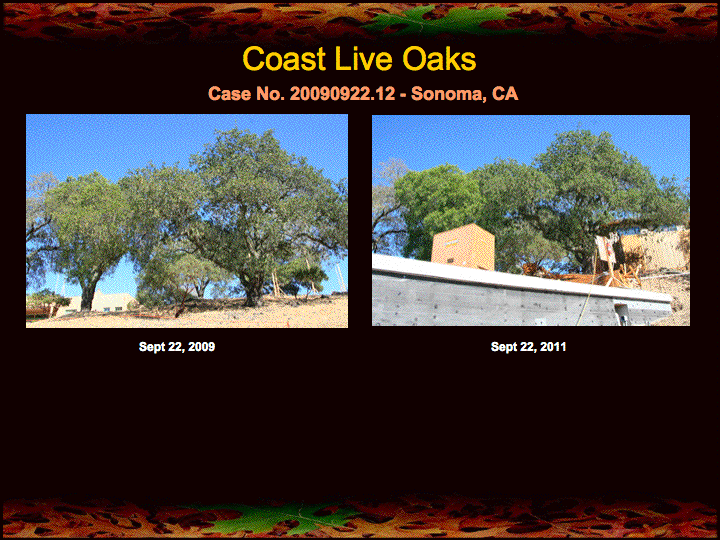
26 09 2011Last week I visited an oak grove in Sonoma where restoration efforts using fire mimicry began in 2009. Several of the coast live oaks had symptoms of Sudden Oak Death, and many other oaks were in rather poor health. Underbrush was cleared, dead branches were pruned, mosses and lichens were removed from the trunks, minerals were applied to the soil along with compost and mulch, and the trunks sprayed with a mineral-rich lime spray.
After this work began several of the oaks have since been heavily impacted by some new home construction. Despite this, most of the impacted oaks have shown a noticeable improvement in their health over the two year period. The photos below show the results.
Comments : Leave a Comment »
Categories : Case studies, Fire mimicry, Oak health, Repeat photography, Sudden Oak Death
Stewarding oaks with fire mimicry
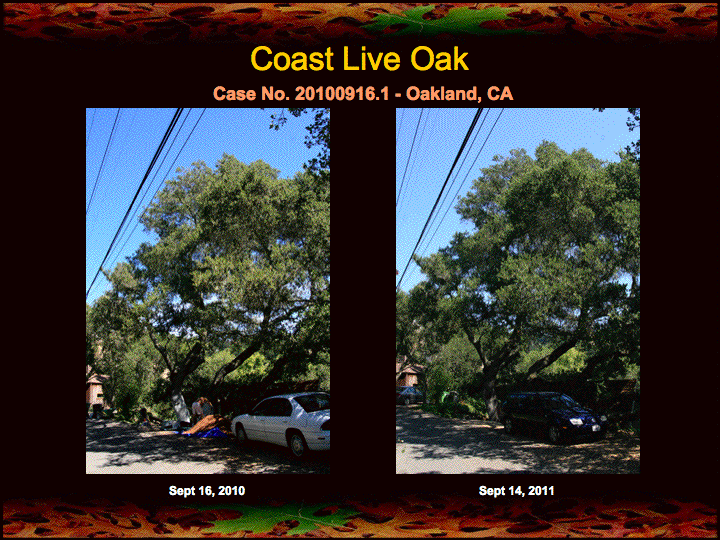
19 09 2011Last week I visited several groves of coast live oaks in the Bay area (Los Altos Hills, Woodside, and Oakland) that were treated one year ago for the first time using fire mimicry protocols. This post shows the results so far.
While Sudden Oak Death was (and still is) present in the nearby oaks, all of the oaks in the photos were uninfected with Sudden Oak Death at the time of treatment and remain uninfected after one year. As you can see most of the oaks are showing improvement in canopy density, some more than others, although a few are showing no noticeable change. The no change condition is not a poor result as it indicates that the canopy health of the oaks has not deteriorated. Also, it is not unusual for oaks to take three to five years to respond fully to the fire mimicry treatments. Still, it is encouraging to see that most of the treated oaks are experienced a noticeable flush of new growth in just the first year.
Comments : Leave a Comment »
Categories : Case studies, Fire mimicry, Oak health, Repeat photography, Sudden Oak Death
New study of Appalachian forest fire history
9 09 2011A new study of tree rings and fire scars by Charles Lafon, associate professor of geography at Texas A&M University, describes the fire history of forests of the southern and central Appalachian Mountains. His findings are consistent with and relevant to the forest dynamics in California, and provide support the use of fire mimicry methods in mitigating forest decline.
Here are some excerpts from the Science Daily report:
“We know that Indians often set fires to clear areas”
“Many tree species that inhabit fire-prone areas have thick, protective bark,” he points out. “Some trees depend on fires for their own reproduction. One such tree is the Table Mountain Pine. Through a feature called serotiny, its cones often will not open to release the seeds unless they are heated by a fire, ensuring that the new seedlings emerge at an optimal time to survive and grow — right after a fire has cleared away the competing vegetation.”
“The decline in fire frequency during the 20th century, for example, permitted tree species like red maple to encroach into pine and oak forests. Now the pines, oaks and other fire-associated species like the Peters Mountain mallow are declining in abundance”
Read the entire article here.
Note the similarity of these results to those from the study of oak forests from the Upper Midwest reported here.
Comments : Leave a Comment »
Categories : Fire ecology, Fire mimicry, Native people, Oak health, Pine health
How many photos do I need to show?
14 08 2011Here are a couple of oaks near Buellton, CA that I treated last July with fire mimicry methods (including soil minerals, compost, lime spray). Note that both are showing a noticeable improvement in just one year. While it is not always the case that results are seen in one year, it is not unusual.
This ecologically-based, fire mimicry approach to tree care and forest restoration is repeatedly showing very good results in most cases. As evidence, there are hundreds of before-and-after photos of oaks and other trees posted on this website. How many of these photos do I need to show before more people take action in restoring their trees and soils back to health? Read the rest of this entry »
Comments : Leave a Comment »
Categories : Case studies, Fire mimicry, Oak health, Repeat photography
On managing California bay laurels to improve oak health
16 07 2011UPDATE: For a more detailed discussion of the science and traditional knowledge on this subject please refer to my new book Forged by Fire: The Cultural Tending of Trees and Forests in Big Sur and Beyond” https://www.amazon.com/dp/B0D3ZVMB3P
Several friends and tree professionals have contacted me about my thoughts on the following article by Peter Femrite that recently appeared in the San Francisco Chronicle:
Saving oak trees by chopping down bay trees
Workers began chopping down 250 California bay laurels this week in the Santa Cruz Mountains so that 49 signature oak trees might be saved from the infectious scourge known as sudden oak death.
The tree-removal project is an attempt by the Midpeninsula Regional Open Space District to prevent the spread of the tree-killing pathogen, which uses bay trees to scatter spores in the forest.
(h/t to R Zingaro for alerting me to this article)
First, there are important points here with which I agree. The bays are clearly major vectors for sudden oak death disease. I do believe that selective removal of bays will lower the incidence of sudden oak death (SOD). However, I am bothered by the singular focus on the disease. I would rather the focus of efforts be made toward promoting the overall health of the forest ecosystem. Read the rest of this entry »
Comments : 1 Comment »
Categories : Fire ecology, Fire mimicry, Native people, Oak health, Plant succession, Sudden Oak Death
New study with implications for fire management of oak woodlands
8 07 2011A recent study reported at Science Daily on the fire history of post oaks in Illinois reads like page from the history of California oak woodlands:
Old-Growth Tree Stumps Tell the Story of Fire in the Upper Midwest
The new study, in the journal Castanea, confirms that the people who lived in Illinois before European settlers arrived [Native Americans] were in the habit of setting fires in the region nearly every year, with fires in the Hamilton County woodland occurring at least every two or three years, McClain said. This repeated burning actually stabilized the prairies and open woodlands that dominated the region until the late 19th century, when the fire-suppression efforts of the new settlers allowed different plant species to take over, the researchers said.
The study was conducted by William McClain, a botanist with the Illinois State Museum along with researchers John Ebinger and Greg Spyreas, of the Illinois Natural History Survey at the University of Illinois. They also report:
“For hundreds, maybe thousands of years, this was a stable post oak woodland,” Spyreas said. “And then you have a gap of a couple of decades where there were no fires and suddenly the whole system is completely different. It’s amazing how, from Kansas to Ohio, these ecosystems completely depend on fire to be stable.”
See the full report here.
To all you Californian’s concerned about the oaks, this study is highly relevant.
Comments : 4 Comments »
Categories : Fire ecology, Native people, Oak health, Sudden Oak Death


Recent Comments