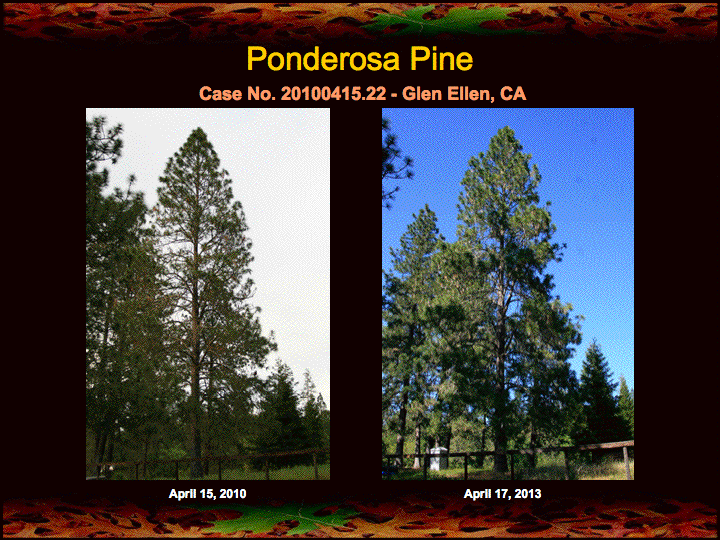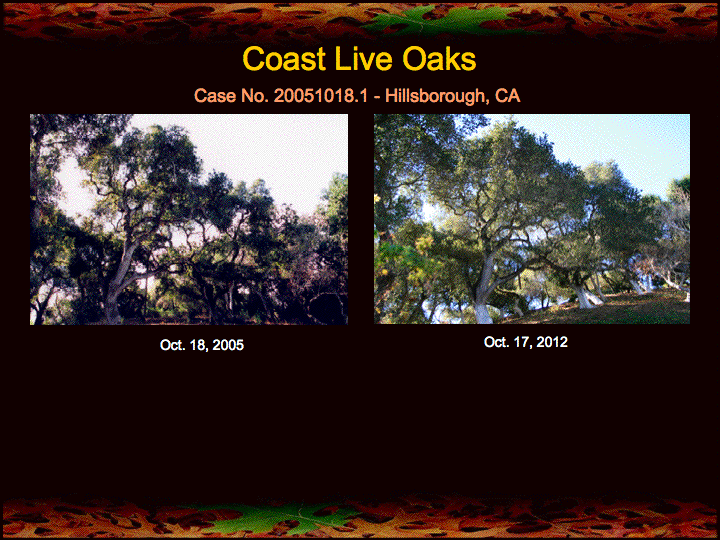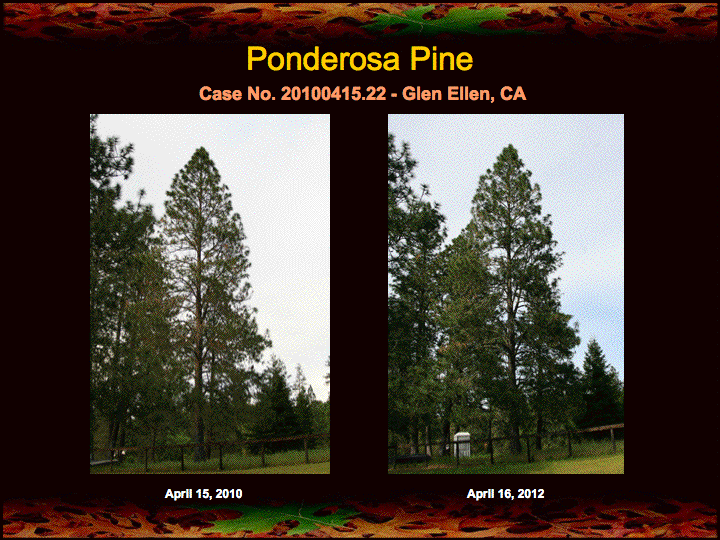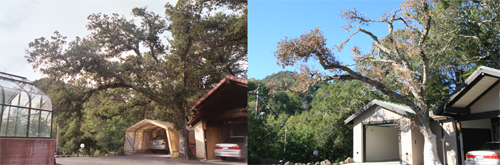
Here are some assorted results on oaks, pines, and one toyon tree that I collected over the past two weeks. All have been treated with fire mimicry. As you can see some trees are responding better than others. Some of the trees here are showing only a slight improvement in canopy size and density. But results are results, so here they are. Fortunately, I found no infections of sudden oak death disease in any of the oaks here.
California oak, pine, and toyon trees responding to fire mimicry
4 05 2015Comments : Leave a Comment »
Categories : Case studies, Fire mimicry, Oak health, Pine health, Repeat photography, Sudden Oak Death
Reflections on “Tending the Wild” workshop at OAEC
8 07 2013When people don’t use plants they get scarce. You must use them so they come up again. All plants are like that. If they’re not gathered from, or talked to, or cared about, they’ll die.
– Mabel McKay, Pomo Elder, quoted from News From Native California
Last week I attended a remarkable 3-day workshop at Occidental Arts and Ecology Center (OAEC) called “Tending the Wild”. It was organized by my friend and colleague Lindsay Dailey, who is the Associate Director of the Wildlands Program at OAEC. For the past few years Lindsay has been training and working with me in the use of fire mimicry techniques in oak woodland restoration. I have found her to be a serious student and practitioner of traditional ecological approaches in land care.
The workshop drew together an amazing group of teachers and elders speaking on the topic of wildland tending by the Californian native people. The first day was led by M. Kat Anderson, PhD, author of the book “Tending the Wild“. Her thesis is that the richness and abundance of the historical ecosystems in California were largely the result of thousands of years of tending by the native people, primarily through the wise use of fire in burning the land to improve soil fertility and promote plant production/regeneration. In answer to the question: “Why are plants and animals disappearing?”, her response is: “Because we no longer have a relationship with them.” Read the rest of this entry »
Comments : 2 Comments »
Categories : Buckeye health, Native people, Oak health, Pine health
Fire mimicry improving health of oaks, pines, and toyons
23 06 2013For thousands of years the native people of California used fire as a tool to manage the lands and maintain healthy trees. Now-a-days, faced with the fact that we can no longer set fire to the land because of heavy fuel buildup from years of fire suppression, we must use alternatives, such as fire mimicry methods, in our work to keep California’s trees healthy. Today I’m posting some recent results of fire mimicry treatments in restoring oak, pine, and toyon health.
Enjoy!
Comments : Leave a Comment »
Categories : Case studies, Fire mimicry, Oak health, Pine health, Repeat photography, Sudden Oak Death
Sick pines respond to fire mimicry
21 04 2013While the focus of work here at Sudden Oak Life is on oak health, there are lots of other kinds of trees that respond to fire mimicry treatments. Today I would like to share with you the results of some work being done on several ponderosa pine trees. These photo sets show how the pines have responded after three years of treatments. Note that the last photo set is of an adjacent UNTREATED pine.
Comments : Leave a Comment »
Categories : Case studies, Fire mimicry, Pine health, Repeat photography
On Sudden Oak Death, fire mimicry, and canker surgery
22 10 2012Recently the California Oak Mortality Task Force issued a press release reporting on an explosive growth in Sudden Oak Death in the San Francisco and Monterey Bay areas. This is a sad situation, knowing that untold thousands of ancient heritage oaks will die while under our care, or rather our lack of care.
For thousands of years California Native Americans tended and cared for all these ancient oaks, and associated plants, animals, and fungi, in an effort to live sustainably. The concept of reciprocity permeated their spirituality and culture, the oaks provided them an abundance of food (acorn), and so in return they managed the land in ways that helped the oaks prosper.
Oaks we know, and as the native people knew, are early successional fire-adapted species, meaning that they need periodic understory (ground) fires to thrive. These fires alkalinize the soils, which is a good thing, and they remove encroaching shrubs and young trees which draw away water and nutrients from the mature oaks.
Without periodic fires the oaks begin to decline. Over many decades the soils gradually acidify and more shade-tolerant species such as bays, firs, pines, and redwoods invade the oaklands. Eventually these later successional species overtop the oaks and out-compete them for light, water, and nutrients. At this point fires, if they due occur, are usually large stand-devastating fires that burn the entire canopies of the trees, from which few oaks can recover.
The oak forests in California are experiencing a rapid shift in their ecology the likes of which has not been seen for thousands of years. The weakening oaks are succumbing to diseases like Sudden Oak Death, and it is likely to get worse.
Unless, we started start caring for the oaks under our care.
How many of us have befriended an oak, enjoyed its protective canopy and felt the nurturing presence of a stately being?
How many of us have tended an oak?
All the while the oaks are enriching the air and land, helping sustain us, along with so many birds, mammals, insects, plants, fungi, and much much more, they are running out of time. The current sad state of affairs is largely due to improper actions, or lack of actions by our parents, grandparents, and great grandparents in managing the oaks on our lands. They simply didn’t know what the native people knew, that oaks need tending.
So now many of us know, and I pray others will too, that the problems with our oaks, with some effort, are solvable. I and many others are using fire mimicry methods, which involve restoring oak forests using clearing, pruning, and soil fertilization methods that mimic to a degree the normal effects of fire.
My purpose here, as is the purpose of my life, is to inform you and others that we can save our oaks and, more importantly, to do the work on the oaks and show you how it’s done.
Here are several oaks that have received fire mimicry treatments beginning in 2005:
Note the improved canopy density and fullness. Fortunately these oaks are not infected with Sudden Oak Death, nor will they be (at least on my watch).
Here, however, is a nearby oak that is infected with Sudden Oak Death:
While infected, this oak has some hope for a longer and healthier life as a result of the treatments. In addition to the fire mimicry treatments, I have done a surgical removal of the canker, which was still at an early phase of growth when discovered. For this I used an axe, then hammer and chisel to excavate the infected tissue, then I used a propane blow torch to cauterize the wound. This tree still has a small infection and will require some additional surgery, but the majority of the surgery appears to have worked to clear the tissue of the canker, and the tree is already healing over much of the wound. I predict that this oak will live for many decades, and if you hang around here I’ll keep showing you the photos of its recovery.
Finally, let me remind all you tree lovers that these techniques work on many kinds of trees. Here’s an example of what can be done for sick pines:
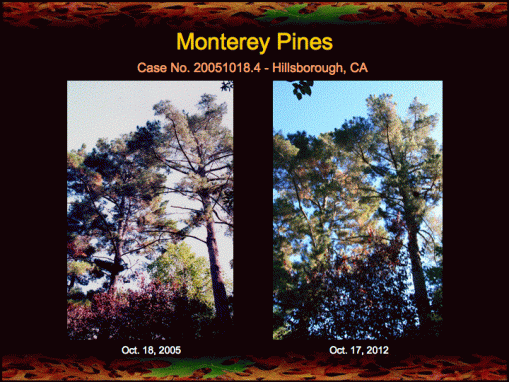
Interested? We’d love to hear from you!
Comments : 2 Comments »
Categories : Case studies, Fire ecology, Fire mimicry, Native people, Oak health, Pine health, Plant succession, Repeat photography, Sudden Oak Death
Improvement seen in pine health with fire mimicry
16 05 2012I’m often asked whether the fire mimicry techniques that have been so successful in oak restoration work on other trees. Given that many California native tree species are fire-adapted there is every reason to believe that fire mimicry could help them too. Indeed, I have several previous posts showing positive responses of a variety of non-oak species to fire mimicry treatments, including buckeyes, redwoods, and Douglas firs.
Today I would like to share some recent results with pine trees. California pines are also fire-adapted, and with the suppression of forest fires, are becoming ill and infected with bark beetles and pitch pine canker. Thus, fire mimicry treatments seem to be critical in helping sick pines and in keeping healthy pines from deteriorating.
The four-year results shown below are of a sick Monterey pine in Carmel, the two-year results are of mostly healthy ponderosa pines in Glen Ellen, and the one-year results are of mostly healthy Monterey pines in Mill Valley.
A word about the four-year results. I first treated this Monterey pine in 2008 when the owners observed some decline in the tree. On my return the following year I found the pine to have deteriorated slightly. By the second year it had deteriorated significantly. I was mystified since the nearby oaks I had treated were responding nicely. Pines have an extensive root system, so I decided to peek over the neighbor’s fence and was surprised to find the entire yard was a Japanese garden with a mat of mosses forming a solid carpet on the ground. While mosses serve a purpose in a Japanese garden by stunting growth, creating twisted forms, and stimulating unusual foliage coloration in the small trees and acid-tolerant shrubs, a heavy moss cover is not compatible with a nearby large, fast-growing pine.
I was able to get permission from the neighbor to treat the soils, but I could not spread minerals on the soils as that would likely damage much of the moss cover, thus, ruining the aesthetics of their garden. So, instead, I did a deep root feeding by drilling small holes through the moss mat and injecting the minerals into the subsoil. These treatments were done in 2010 and again in 2011. The photos below show that after two years the pine has made a nice recovery. Read the rest of this entry »
Comments : Leave a Comment »
Categories : Case studies, Fire mimicry, Moss ecology, Pine health, Repeat photography
Six years on . . . oaks and pines respond to fire mimicry
27 10 2011Not long ago I visited some oaks and pines in the Bay area that started receiving fire mimicry treatments six years ago. This particular client has done a remarkable job following my recommendations precisely. She’s quite happy for the results. Here are her coast live oaks and Monterey pines after six years.
Comments : Leave a Comment »
Categories : Case studies, Fire mimicry, Oak health, Pine health, Repeat photography, Sudden Oak Death
New study of Appalachian forest fire history
9 09 2011A new study of tree rings and fire scars by Charles Lafon, associate professor of geography at Texas A&M University, describes the fire history of forests of the southern and central Appalachian Mountains. His findings are consistent with and relevant to the forest dynamics in California, and provide support the use of fire mimicry methods in mitigating forest decline.
Here are some excerpts from the Science Daily report:
“We know that Indians often set fires to clear areas”
“Many tree species that inhabit fire-prone areas have thick, protective bark,” he points out. “Some trees depend on fires for their own reproduction. One such tree is the Table Mountain Pine. Through a feature called serotiny, its cones often will not open to release the seeds unless they are heated by a fire, ensuring that the new seedlings emerge at an optimal time to survive and grow — right after a fire has cleared away the competing vegetation.”
“The decline in fire frequency during the 20th century, for example, permitted tree species like red maple to encroach into pine and oak forests. Now the pines, oaks and other fire-associated species like the Peters Mountain mallow are declining in abundance”
Read the entire article here.
Note the similarity of these results to those from the study of oak forests from the Upper Midwest reported here.
Comments : Leave a Comment »
Categories : Fire ecology, Fire mimicry, Native people, Oak health, Pine health
Sea shells to help sick pine trees
11 08 2010From the Daily Yomiuri Online (h/t Ralph):
Scallop shells may help save pine trees
The Yomiuri Shimbun
A fishing town in northeastern Miyagi Prefecture has turned to the lowly scallop to save its pine trees from a weevil blight.
Minami-Sanrikucho is experimentally grinding the shells of scallops, the town’s speciality, into nutrient-rich powdered fertilizer that it hopes will make the pines resistant to weevils.
The town has about 1,924 hectares of pine woods, but since around 1970 weevils have been badly damaging the trees, mainly in a coastal area of the town. About 20,000 damaged trees have been cut down.
Local residents fear not only that the blight may ruin one of the town’s scenic attractions, but that loss of the trees may result in landslides. Pine trees also absorb carbon dioxide, thus helping reduce global warming.
Since the blight began, the town office has spent about 10 million yen a year on such measures as spraying pesticide and cutting down withered trees, to little effect.
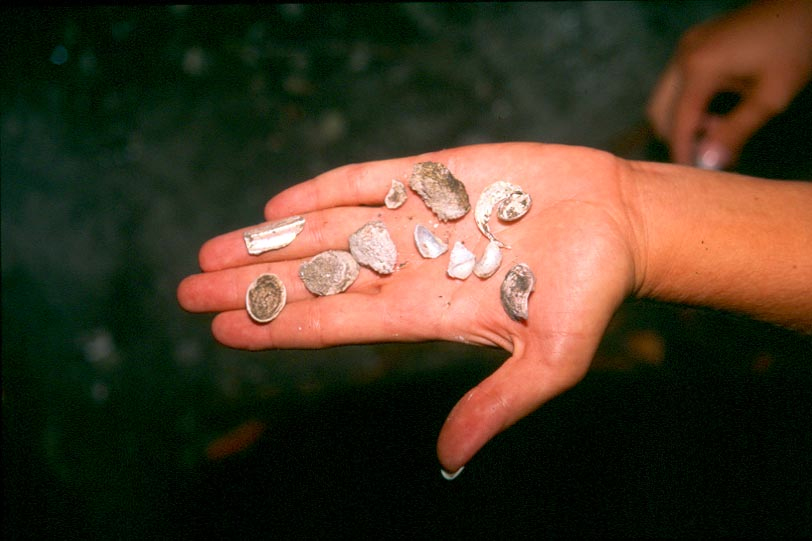
A town official heard that another municipality suffering from the same problem had found it effective to spread oyster shells as fertilizer on the soil in pine woods. Calcium and minerals contained in the shells promoted growth of the trees and made them strong enough to withstand the weevils.
Scallops are farmed in Minami-Sanrikucho, producing from three to five tons of shells that are thrown out every day. A marine products processing company in the town developed a technology to grind the shells into powder.
As powder made from scallop shells is finer than that from oyster shells, it can more easily permeate soil. Also, as the powder contains strongly alkaline calcium, it is expected to more effectively protect pine trees against the weevils.
On July 7, the town started the experiment using the new fertilizer. Town officials and local residents spread a total of 60 kilograms of the fertilizer around 22 dying red pine trees that are 57 years old. The town will check the condition of these trees every three months and spend two years monitoring the fertilizer’s effectiveness.
“I hope the pine woods will be revived and help curb global warming,” a 74-year-old resident in the town who helped spread the fertilizer said.
Comments : 5 Comments »
Categories : Fire mimicry, Pine health, Soil science
Fire mimicry results with oaks, pines, and more . . .
28 10 2009As much as I would like to post more frequently on all the interesting work that is going on in land and tree stewardship, the fact is that I spend most of my time out working on the trees and soils, which leaves me limited time for blogging. There is so much I can do for a sick tree that I prefer to simply get on with doing the work rather than write about it.
Here is where my Canon Eos 30D comes in handy. I could measure and discuss percentage changes in crown density or leaf area index, but you’d be bored and the oaks would still be dying. With repeat photography I have more time to work on trees and it allows you to better view and judge for yourself the results of these efforts.

Comments : Leave a Comment »
Categories : Case studies, Fire mimicry, Oak health, Pine health


Recent Comments