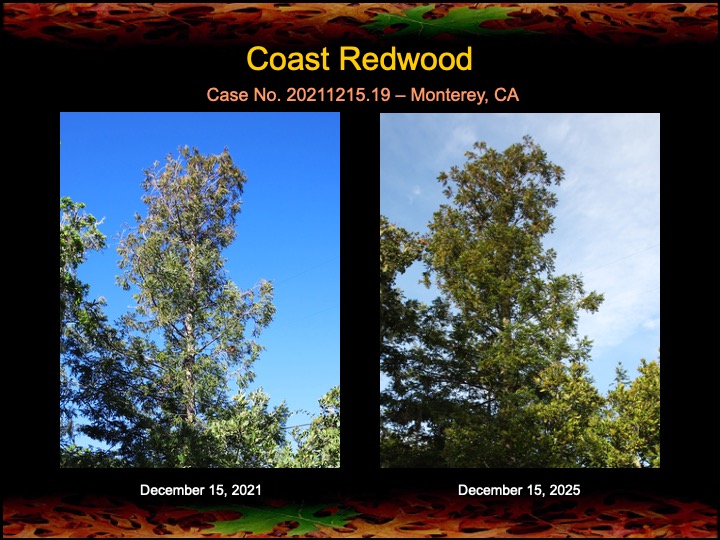
Tomorrow is winter solstice and I would like to celebrate by sharing with you a redwood tree that I’ve been tending with fire mimicry for the past four years. All images were taken on the same date and at the same time of day. Enjoy!
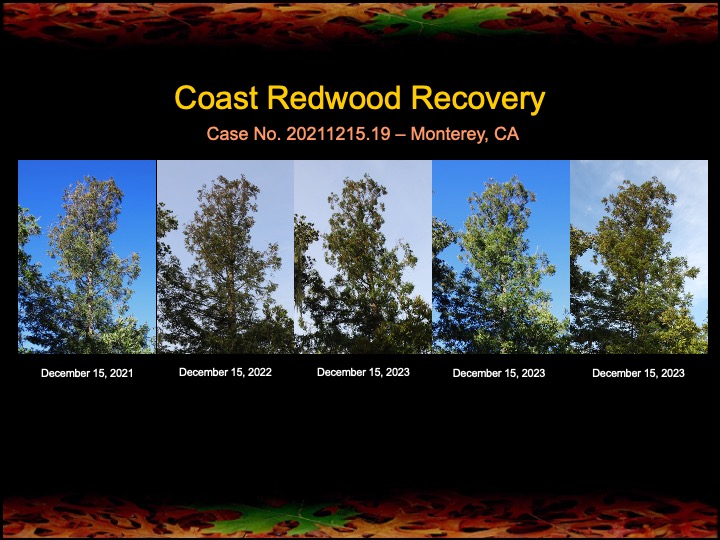
Tomorrow is winter solstice and I would like to celebrate by sharing with you a redwood tree that I’ve been tending with fire mimicry for the past four years. All images were taken on the same date and at the same time of day. Enjoy!
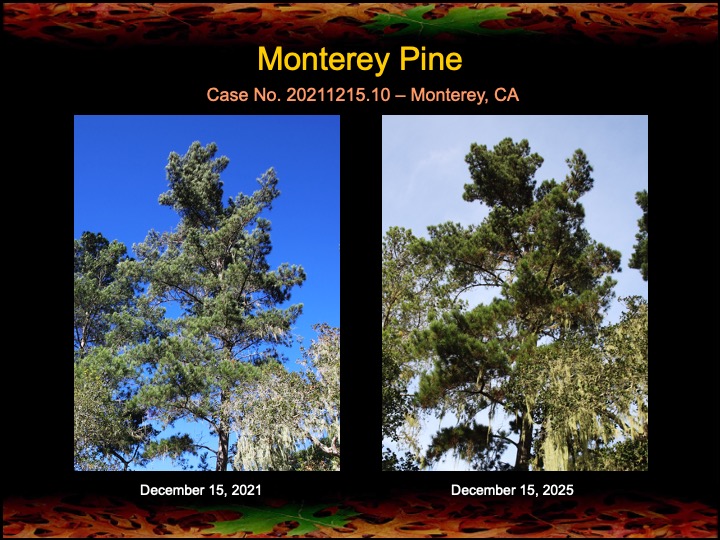
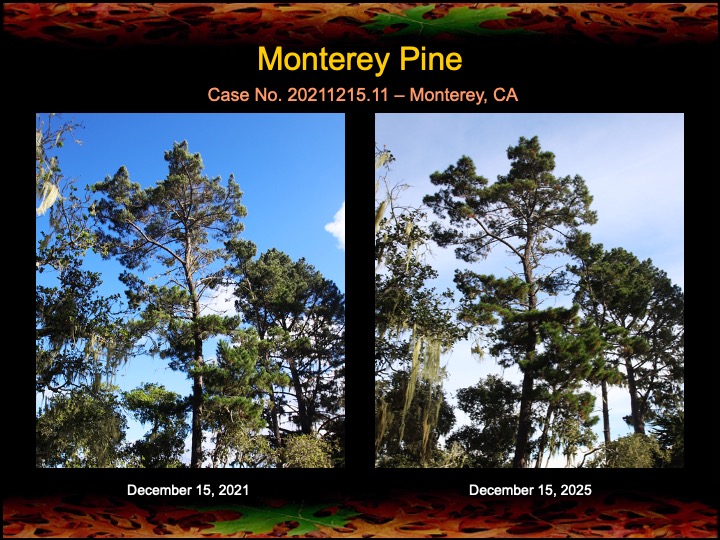
Yesterday I checked up on a grove of Monterey pines that have had a couple of fire mimicry treatments …

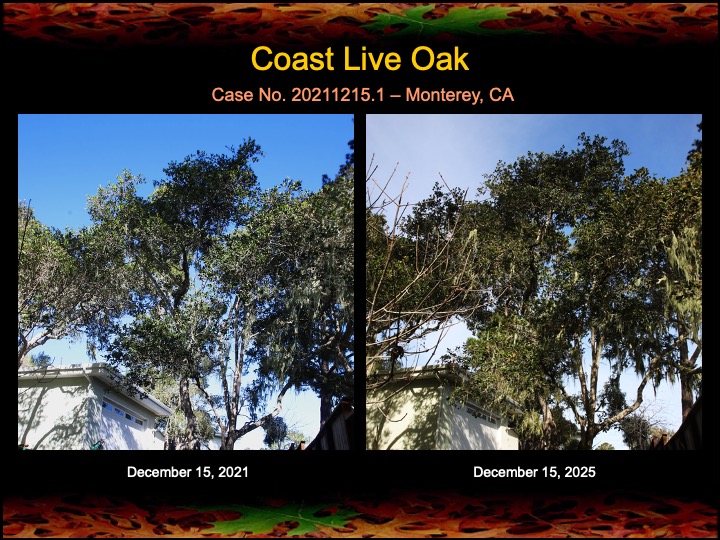
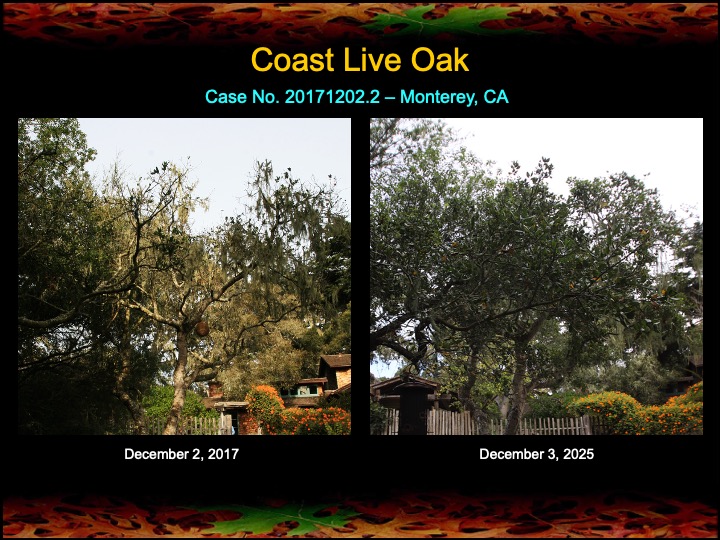
Four years ago I began fire mimicry treatments on a grove of coast live oaks overlooking Monterey, CA. I’m quite pleased with the results but I’ll let trees speak for themselves …
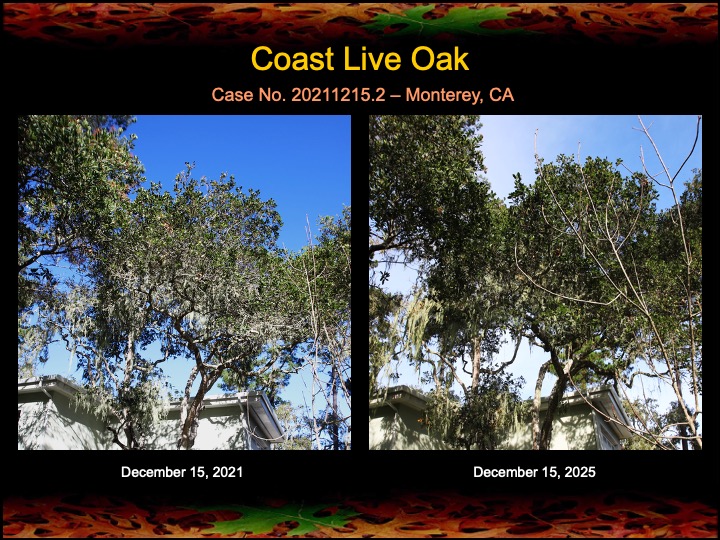

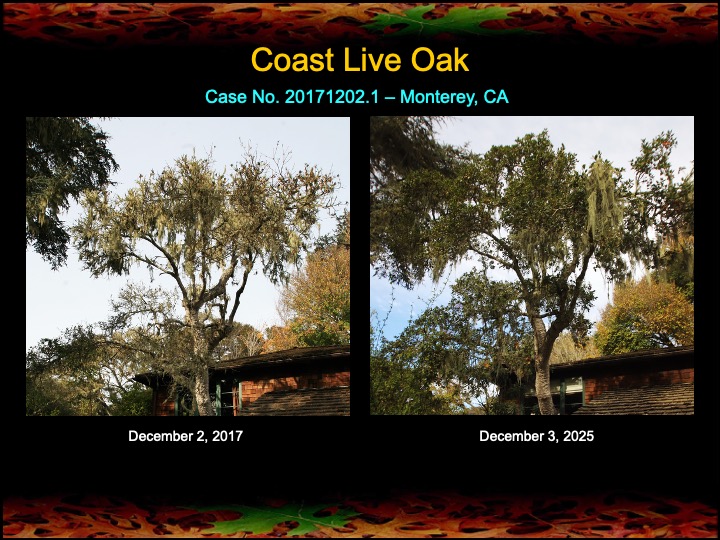
Last year I shared a post on a non-toxic treatment for oakworm infestations here on the Central Coast of California. In that post I stated:
“In 2017 there was a severe oakworm infestation of coast live oaks in the Monterey region and elsewhere. I’m often contacted at these times by property owners concerned about their oaks. Many wish to spray the trees with insecticides to reduce the infestation. Upon my advice, I tell property owners that spraying chemical insecticides is not necessary for the oaks to recover from these infestations, provided they are given proper care. Since the oakworm infestations are related to a lack of cultural fires, which controlled their populations in the past, a way forward is to emulate fire effects on the forest ecosystem.
Thus, rather than using chemical sprays as is typically recommended by arborists, I prefer using fire mimicry treatments to oak trees infested with oakworm. In the present case study I recommended to the property owner to do fire mimicry treatments instead of spraying the oaks. Never knowing for sure, I explained to them that the oaks would likely recover from the infestation, and that they would show continued improvement in the following years. A second set of fire mimicry treatments were preformed the following year (2018).”
The repeat photo sets shown last year and the new ones from this year indicate that the oaks have continued to maintain healthy canopies following the 2017 oakworm infestation.
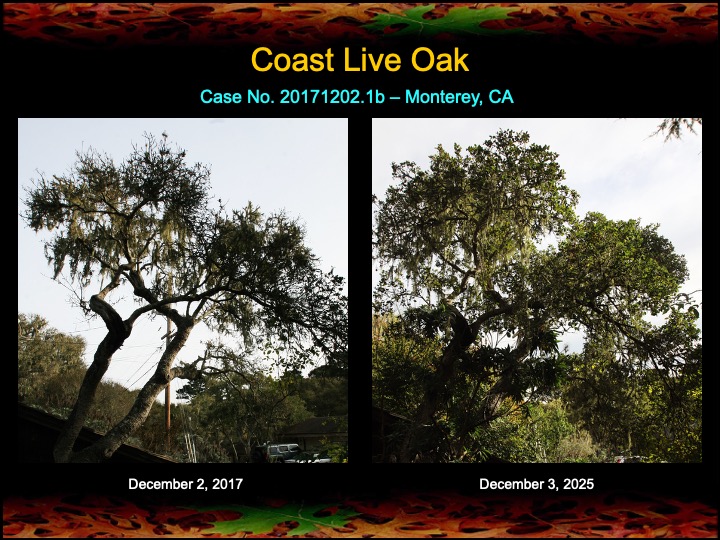

This is a 2017 image of an old-growth coast live oak in Monterey that I’ve been treating with fire mimicry for eight years. At that time it had bleeding stem canker infection, possibly Sudden Oak Death disease or Armillaria (oak root rot), at the base of the trunk. After the initial soil fertilization treatments I performed a surgery on December 2, 2018 to remove, cauterize, and poultice the canker infection.
Here are the results:

After seven years the surgical wound has shown continuous healing with no residual signs of infection! The oak’s canopy density has also increased during this time (see photo set below).
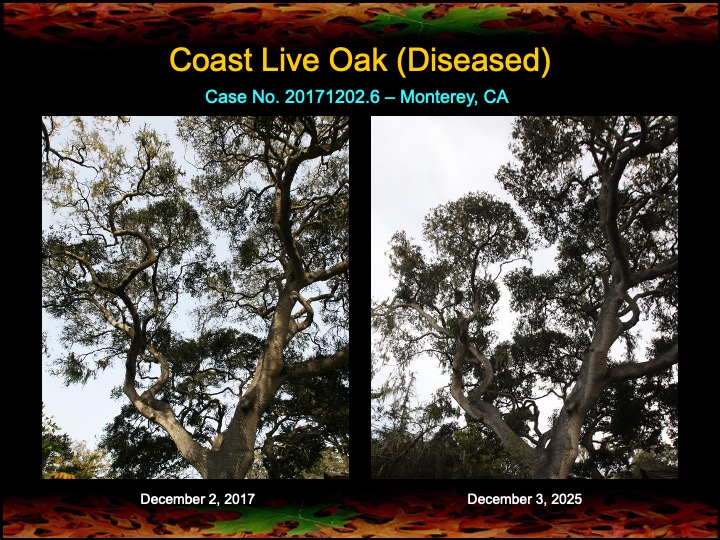
I’m calling this a win against oak disease!

Yesterday I examined a grove of coast live oaks that have undergone fire mimicry treatments for the past five years. Some of these oaks are centuries old and show signs of being tended by the Native Awaswas People. Here are the latest before-and-after photos showing a significant increase in health of the canopy foliage in ALL of the treated oaks. Enjoy!


(The above photo set may appear to be of different locations, but they are both taken from nearly the same spot.)
Read the rest of this entry »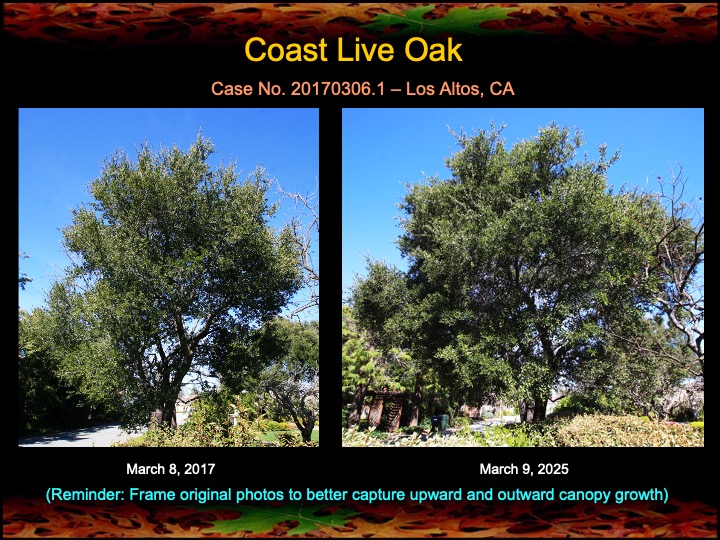
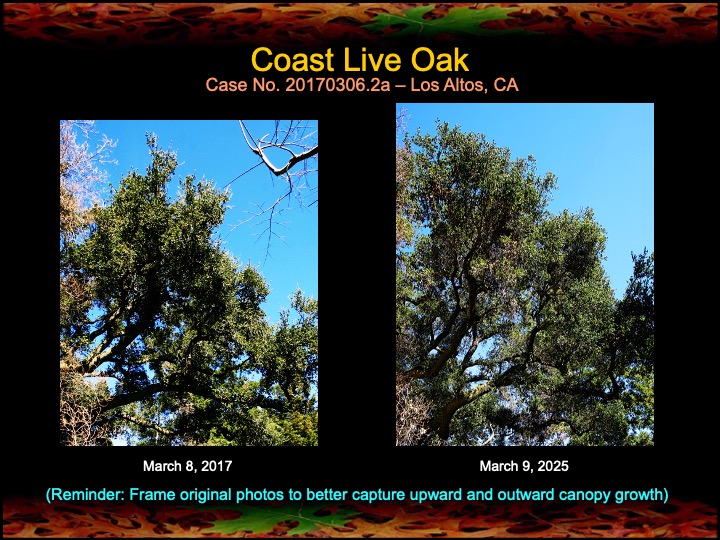
Eight years of tending these coast live oaks and coast redwoods with fire mimicry. (Note to self – widen frames of original photos to better capture future upward and outward canopy growth)


Many are asking about my thoughts on the LA fires. I plan to eventually share these once the scope of the tragedy is better known. For now let me show some images depicting the transformation of the land of my youth. Even though this place is in Ohio, the ecological changes happening here are dramatic and relevant to the devastating fires currently burning in Los Angeles.
Historically, grasslands in Ohio were maintained by a combination of cultural burning by the Native Peoples and grazing by the native herbivores. After colonization, although there were fewer fires, the grasslands in many areas persisted mainly due to cattle grazing.
When I first arrived at my Uncle Huck and Aunt Joan’s southern Ohio farmhouse in the late 1950s it was surrounded by cattle pasture as far as I could see. I remember how my cousin Scooter and I would climb the fence and throw stones at the Brahma bull, who then charged at us until we safely retreated behind the fence. I will never forget being reprimanded by Aunt Joan after she eventually caught us. We never did THAT again.
Anyway the point of this post, besides allowing me to wax nostalgic, is the transformation I’ve observed on this land over my lifetime. Below are two photos of the Huck’s farmhouse, one from 1956 and the other from 2014 taken from nearly the same spot. Farmhouse is still there, but mostly hidden by trees. The photo from 2014 was taken after cattle grazing had ended in the early 1970s. All of the previously grazed areas are now either mowed to maintain the grasses or are covered in dense deciduous forests. That may be OK (for now) in the midwest, but here in California the SAME THING is happening, and that is not OK! Our lands need more tending!


I often tell people inquiring on how to best care for their oaks that doing nothing is not an option! It seems that most people see oaks as native trees of California that have adapted and endured here for thousands of years, so they should not need our care.
Missing from this understanding is that the great oak forests here are the result of thousands of years of care by the Native Peoples. That is why those of us who know this are tending the oaks with fire and/or fire mimicry and seeing clear improvement in their health. Indeed, most of the information on this blog addresses mainly the positive results of tending trees.
But what happens to oaks when we do nothing?
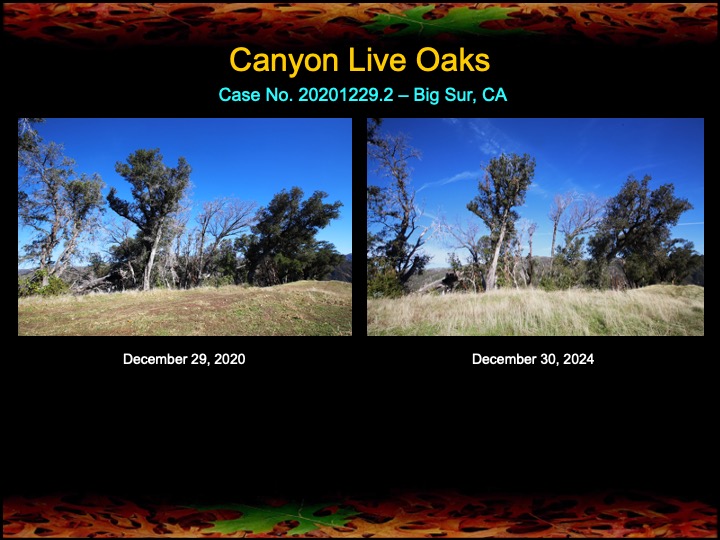
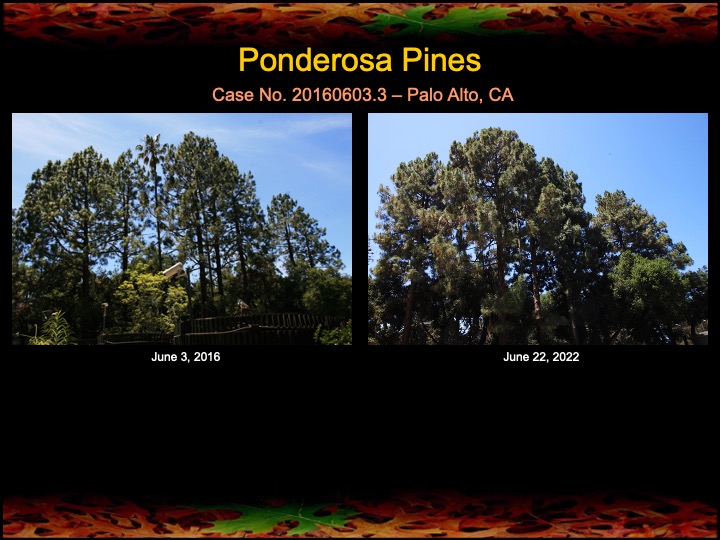
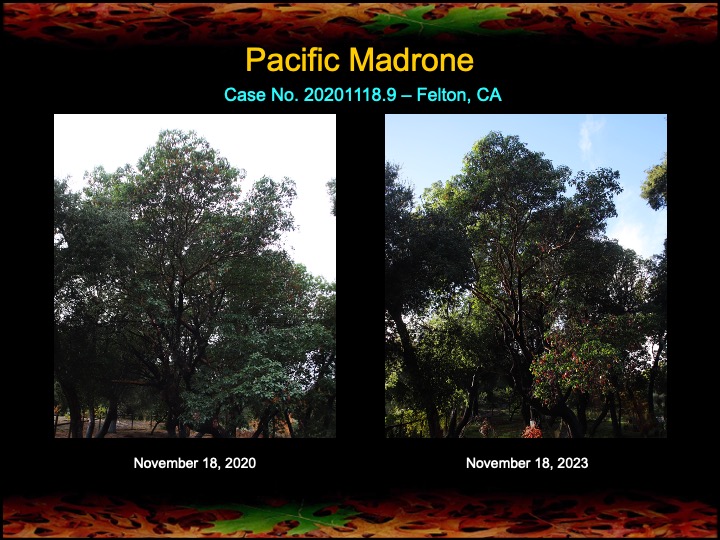
Here I present four-year photo sets of numerous canyon live (Valparaiso) oaks where nothing has been done, save for one oak that received a partial fire mimicry treatment in January of 2021. Most of the oaks are showing noticeable decline in canopy leaf density, a fair measure of the trees’ overall health. Several show no clear change in canopy density, and one or two seem to have improved over the past four years.
Can anyone guess which of these oaks received a partial fire mimicry treatment?

 Sudden Oak Life by Lee Klinger
Recent Comments