Fire Mimicry: Treated vs. Untreated

8 12 2019

Slide1

Slide2

As most of my clients chose to have me treat all of their oaks with fire mimicry, I don’t often get the chance to compare treated vs. untreated oaks in the same landscape setting. However, last year a client had me treat come oaks, but not the others. Here are the before-and-after photos of two oaks that were treated (above), compared to another that was not treated (below). One of the above oaks (Case No. 20181203.2) was infected with a stem canker disease (probably Sudden Oak Death), which was surgically removed in 2018.

Slide3


Oaks treated with fire mimicry fully recover from heavy wind damage in <1 yr

15 11 2019

Slide2

Slide10

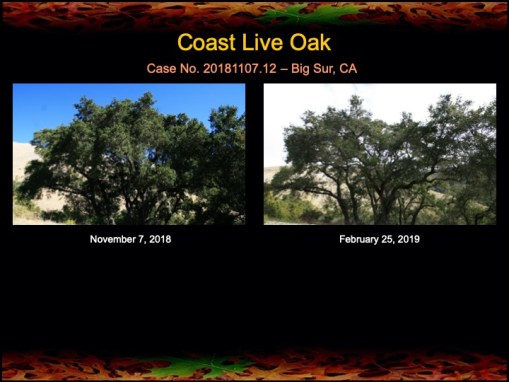
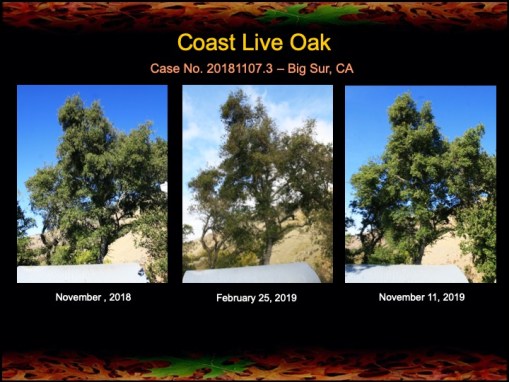
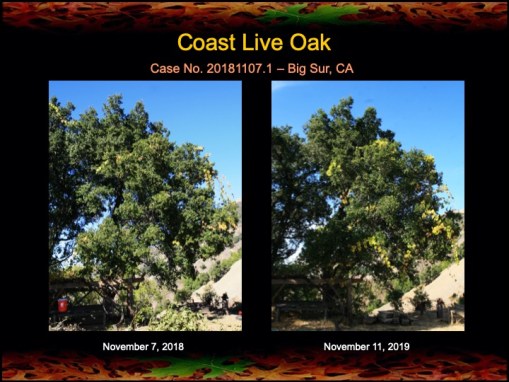
In late February of this year a severe wind storm hit the coast of Big Sur and damaged many trees, including a large grove of coast live oaks I began treating with fire mimicry last year. I re-photographed many of the oaks at the time and could clearly see the loss of leaves in the oak canopies, compared to last fall. The photo sets above show how heavily some of the oaks were damaged.

The photos below show how these and many other oaks that sustained damage in the February storm recovered in just 8 months! Most are looking even healthier than they appeared last fall. It may well be that fire mimicry treatments have aided in the recovery of these oaks.

Slide1

Slide9 Read the rest of this entry »


Culturally-modified Indian-era oaks respond to fire mimicry

15 11 2019

Slide1

Five years ago I began fire mimicry treatments on a grove of ancient, Indian-era coast live oaks that have clear signs of being culturally modified (ie. pollarded). This past week I checked on the status of these oaks and the entire grove continues to show strong improvement in canopy density and greenness. And in an area of rapidly spreading Sudden Oak Death, none of these trees have contracted this disease.

Slide2 Read the rest of this entry »


Ancient oaks in Big Sur respond to fire mimicry

12 11 2019

Slide1

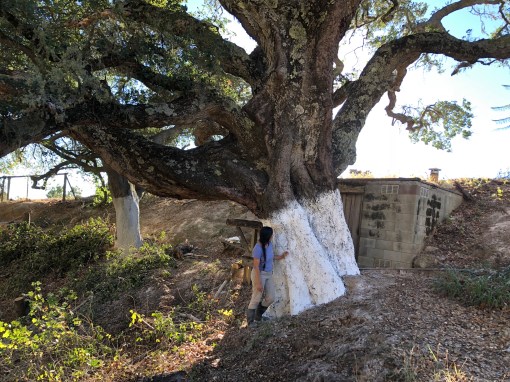
Last year I began fire mimicry treatments on a large grove of ancient coast live oaks in Big Sur. Many of these oaks were culturally modified several hundred years ago by the Esselen Indians. Several of the largest oaks have clear signs of being pollarded, as shown in the photo below.

IMG_8210

Culturally modified coast live oak in Big Sur, CA.

Read the rest of this entry »


Four years of fire mimicry on oaks in Piedmont, CA

21 10 2019

Slide1

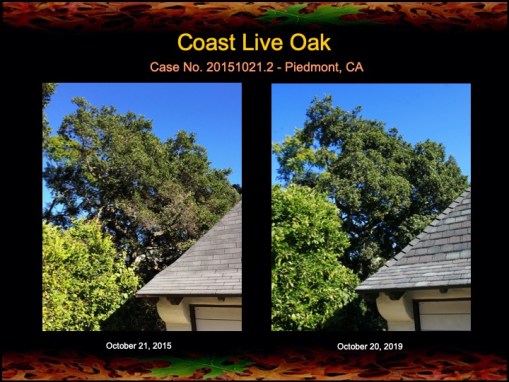
in 2015 I began applying fire mimicry treatments to a grove of sick coast live oaks. Yesterday I checked on their status. Here are the photographic comparisons showing that the density and greenness of the oak canopies has increased noticeably after four years of treatments. However, two severely diseased oaks did not respond to the treatments during this period and had to be removed. Fortunately, the remaining oaks appear healthier and the prognosis for recovery is good.

Slide2

Slide3 Read the rest of this entry »


One-year fire mimicry results from Kentfield, CA

5 10 2019

Slide1

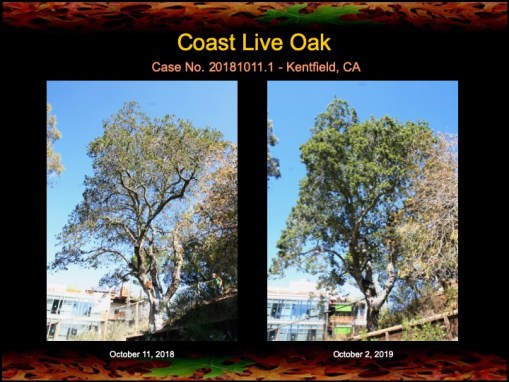
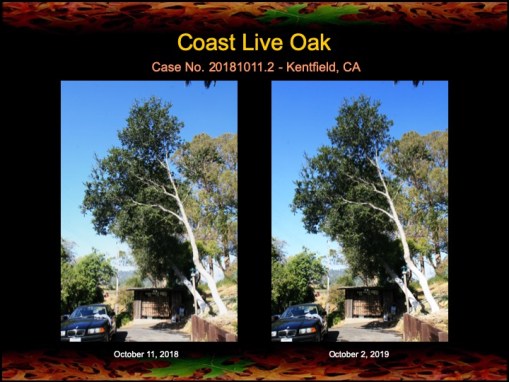
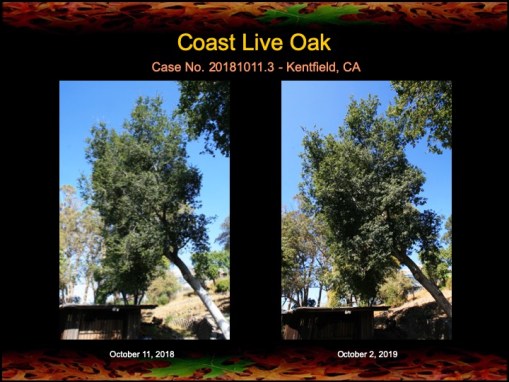
Last year I initiated fire mimicry treatments on a grove of coast live oaks in Kentfield, CA. Here are the results  . . .

Enjoy!

Slide2

Slide3 Read the rest of this entry »


Five-year results of fire mimicry on oaks in Carmel, CA – Part 2

30 09 2019

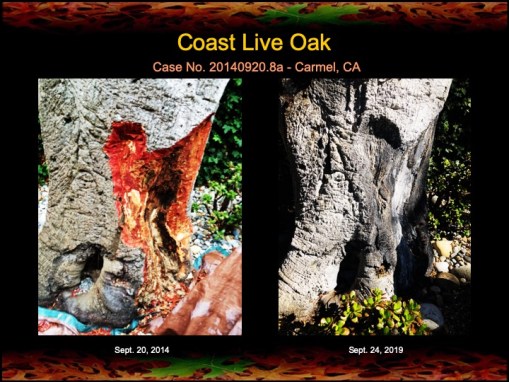
Part 2 of this post shows promising results in improving the health of an old coast live oak shown in the preceding post (Part 1) that was severely affected by a stem canker disease, possibly Sudden Oak Death, in 2014. Besides doing fire mimicry treatments I tried (experimentally, as I told the owner) a major surgical procedure that involved removing the infected tissue from the tree. The wound was then strongly cauterized and a mineral-based poultice was applied. One additional surgery to remove lingering infected tissue was done in May 2016. Here are before-and-after photos showing the initial surgical wound immediately after removal of infected tissue, but before cauterization and poultice, and the wound after 5 years.
Slide8

Slide9

While it may not be apparent in the photos, the large wound is showing no sign of lingering infection and it would appear that the disease is eradicated from this critical part of the tree.

At the same time the general health of this oak, as indicated by the foliage density of its canopy, has clearly improved. The following photo shows the canopy density of the two main branches of this oak over the past 5 years. It is too soon to know whether or not this is an exceptional case. But it sure encourages me to try major surgeries on other severely diseased oaks!
Slide2


Five-year results of fire mimicry on oaks in Carmel, CA – Part 1

30 09 2019

Slide1

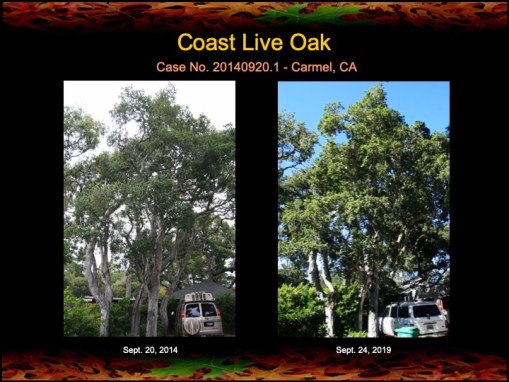
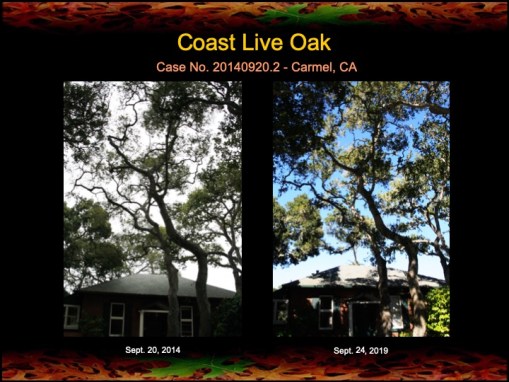
Last week I inspected a grove of oaks in Carmel, CA that have received several fire mimicry treatments. While the photos were taken under different light conditions, they do indicate a clear increase in foliage density over the years. However, one oak in this grove was lost earlier this year in a high wind event.

Part 2 of this post will show the results of fire mimicry treatments along with a major stem canker surgery on one of these oaks (see if you can guess which one).

These photos add to mounting evidence that oaks, and many other kinds of trees, need to be tended in order to flourish. As we are now aware, doing nothing is not a viable long-term treatment plan for oaks. See for yourself what can be achieved in just a few years …

Slide2

Slide3 Read the rest of this entry »


Fire Mimicry Results on Oaks in Pacific Grove, CA

24 09 2019

Slide1

Last year I began fire mimicry treatments on 21 oak trees in Pacific Grove, CA. Here are the results after just one year. The light conditions varied between the two years, but the photo comparisons still show a clear increase in canopy density. Enjoy! Read the rest of this entry »


Lovelock Centenary talk by Lee Klinger recorded on July 31, 2019

7 09 2019

Here is my presentation “Indigenous-based forest management: Looking to the past for a way forward” at the recent Lovelock Centenary conference at the University of Exeter, UK

My talk begins at 59:38 and ends at 117:00. Enjoy!