Eleven years ago I began fire mimicry treatments on two Lebanese cedar trees in Los Altos, CA. At the time the owner had been advised by a local arborist that the cedar tree shown in the above photo was diseased and should be removed. Fortunately the owner resisted cutting down the tree and contacted me. I proposed treating this cedar (above) and another nearby cedar (below) with fire mimicry. At the time I had mainly been treating oaks and did not know if the cedars would respond in the same way. I’m happy to say that, after 11 years, the cedars are thriving!
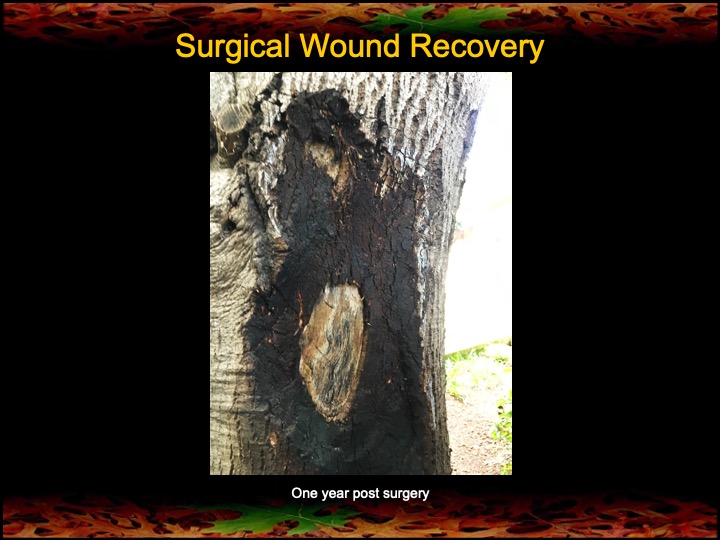
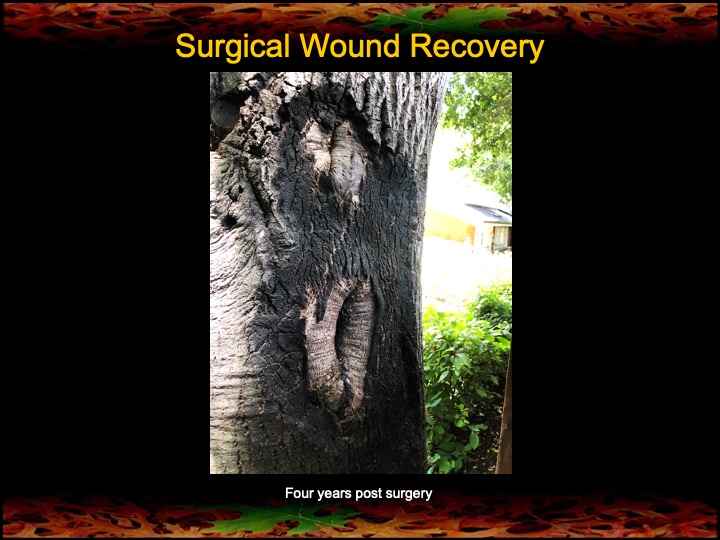
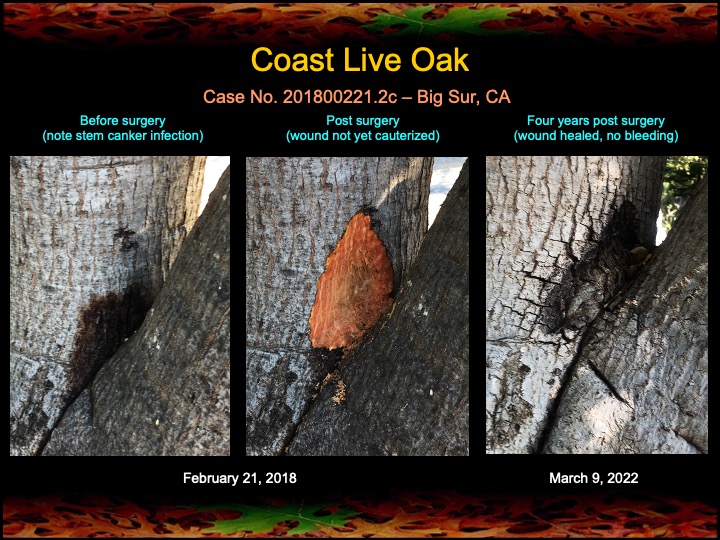
As I’ve shown in several recent posts (here and here), results are starting to accumulate regarding the efficacy of surgeries to remove stem canker infections (including Sudden Oak Death disease) in oaks. Five years ago I performed fire mimicry treatments and a stem canker surgery on a coast live oak in Los Altos, CA. I have returned every year since to track the progress of the wound recovery, and whether any infection remained. The set of photos presented here indicate that after only 5 years the surgical wound has healed closed with no sign of further infection. I’m calling this one a win!
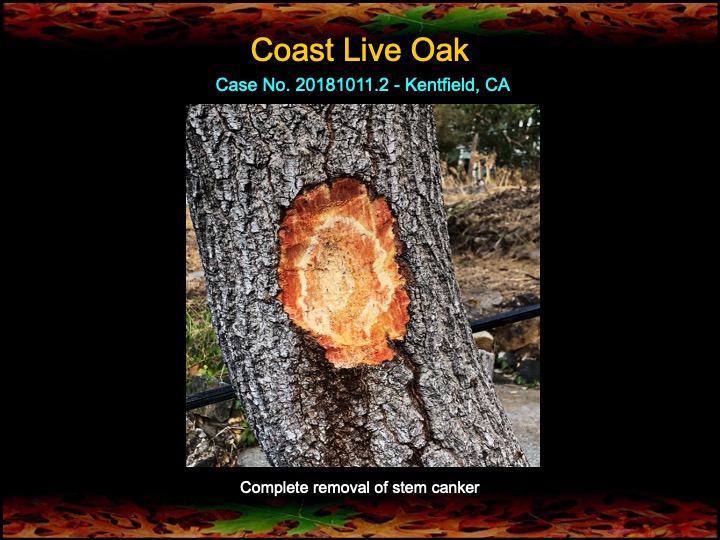
In 2018 I began fire mimicry treatments on a grove of coast live oaks in Kentfield, CA. One of the oaks started showing signs of a stem canker infection (probably Sudden Oak Death disease) in 2019. So I performed a surgical procedure to remove the canker, and have continued to treat this oak with compost tea, mineral-rich soil fertilizers, and limewash. Here are photos of the surgery and recovery of the wound and canopy. Be sure to look at the last picture of this series …
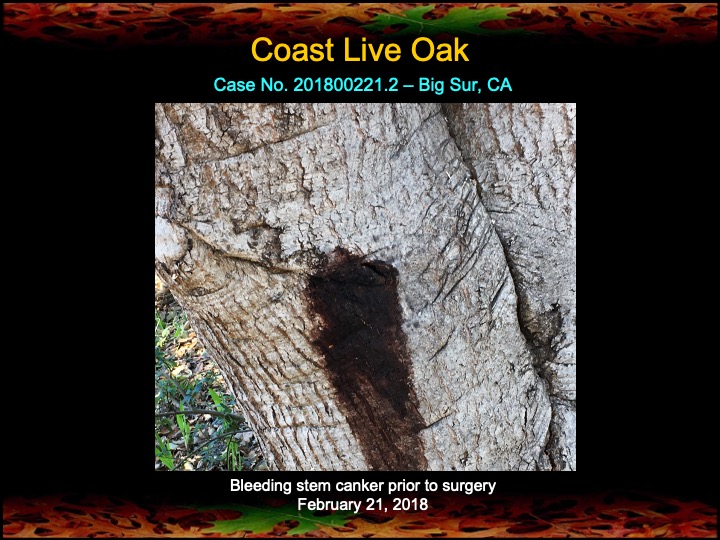
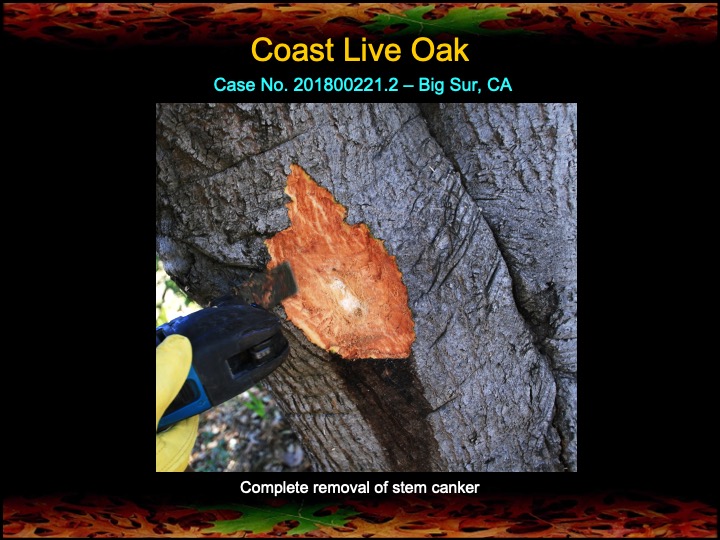
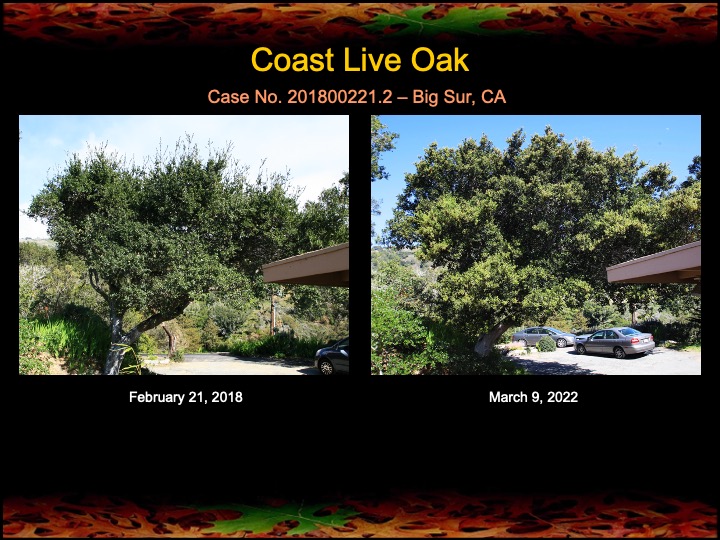
Several years ago I started fire mimicry treatments on a coast live oak in Big Sur, CA. The treatment included stem canker surgery, as well as soil fertilization and limewash application. Here is a set of photos showing both the surgical procedure and progress of recovery of the wound and the canopy health of the oak. Be sure to look at the final photo of this sequence!
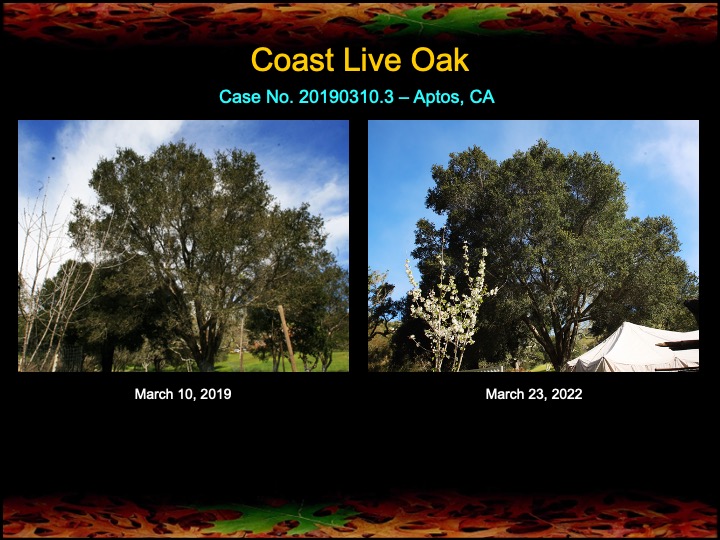
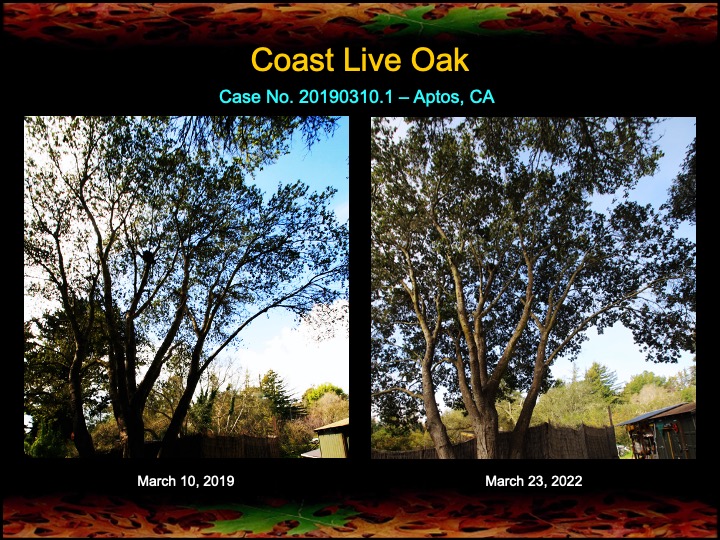
Here are various coast live oaks that have continued to respond to fire mimicry treatments over the course of 5, 8, and 10 years. Several have been affected by stem canker disease, probably Sudden Oak Death, but all have survived and most have improved in canopy density and lushness.
In 2019 I began fire mimicry treatments on a grove of 20 coast live oaks in Soquel, CA, including several “Ancestor” oaks (ancient oaks that were pollarded and otherwise tended by the Ohlone people). Today, I inspected and re-photographed the oaks, with the results shown here. While most of the oaks show noticeable increase in canopy density (leaf area), a few of the oaks have shown little improvement, and one oak died in 2021. Still, I continue to be encouraged by these and other results. Enjoy!
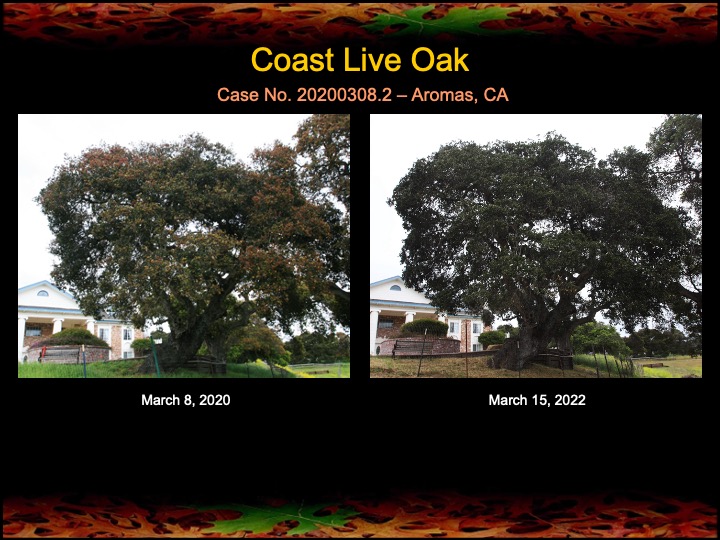
Two years ago the crew and I performed fire mimicry treatments, including a few surgeries for stem canker infections (probably Sudden Oak Death), on a grove of ancient coast live oaks in Aromas, CA. Several of these were pollarded “Ancestor” oaks, remnants of a vast Ohlone acorn orchard. Today I inspected the oaks and found that most of them have responded favorably to the treatments with denser and greener canopies. Here are the before-and-after photos so you can judge for yourself.
Four years ago I performed fire mimicry treatments and two canker surgeries on the above coast live oak in Big Sur. This oak was treated again two years ago. I checked on the oak yesterday and found it has completely transformed into a lush, vibrant tree. The bit of yellowing seen at the tips of the branches are thick clusters of male flowers. The two surgical wounds (below) have mostly healed shut will no remaining infection in one and a minor residual infection in the other.
Another nearby coast live oak was also treated twice with fire mimicry in the past 4 years, although did not require any surgery. Here are the results of that oak.
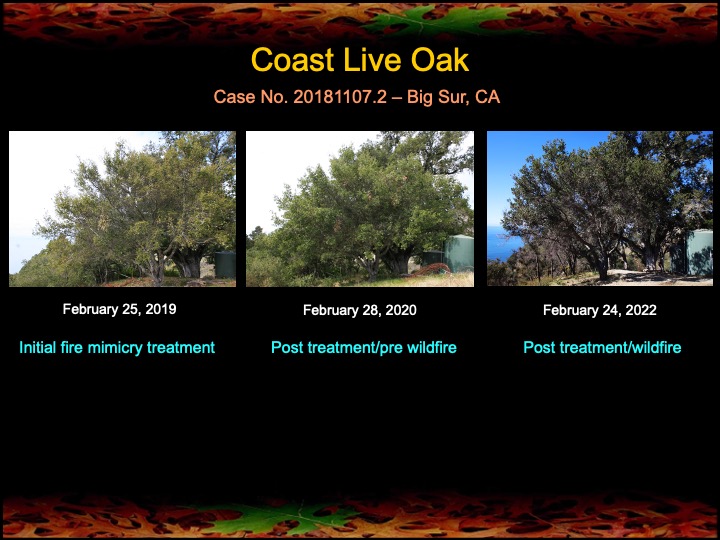
In February of 2019 I began photo documentation of 21 coast live oaks in Big Sur, CA. At least six of these appear to be “Ancestor” oaks, culturally-modified by the Esselen Indians via pollarding of their canopies. All oaks were initially treated with a fire mimicry protocol (clearing, pruning, moss/lichen removal, soil fertilization, & limewash), with the intention that this work would improve the survival rates of the oaks, whether or not a wildfire occurred. The first year results were About photo documented in February 2020. In August 2020 a severe wildfire was ignited in the area and burned through all the groves of the treated oaks.
Yesterday I was finally able to access the site to observe and photo document the findings. Both wooden structures on the property were lost, as were two treated oaks that grew adjacent to them. However, of the 21 oaks initially surveyed, 17 survived the fire, a survival rate of just over 80%. Four of the six “Ancestor” oaks also survived. More than 75% of the oaks showed noticeable signs of improvement in canopy lushness following fire mimicry. A year and a half after the wildfire, 6 of the surviving oaks continue to show signs of heavy fire damage in their canopies. However, 11 (or just over 50%) of the surviving oaks are showing significant improvement of their canopy health following the wildfire.
These are exciting results (see photos below) and show to me that fire mimicry treatments can provide considerable benefit to survivability and health of oaks and other trees in the event of a wildfire.













 Sudden Oak Life by Lee Klinger
Recent Comments