Diseased oaks flourishing after 12 years

29 11 2016

slide1

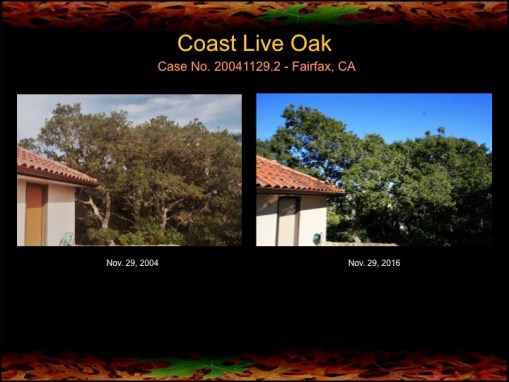
Twelve years ago today I initiated fire mimicry treatments on a grove of diseased coast live oaks in Marin County, CA. Since then Leith Carstarphen has been doing the followup work on these trees. Several of these oaks have stem canker infections, probably Sudden Oak Death disease. Two of the oaks in this grove have since died from stem canker infections, but the remainder of the oaks are clearly flourishing.

I should note that, for the above oak, the yellow appearance of the foliage in the recent (right) photo is due to dense clusters of yellowish male flowers.

These thriving oaks stand as testimony to the long-term efficacy of indigenous-based tending techniques (e.g., fire mimicry) in restoring the health of oak forests.

slide2

slide3

slide4


Indigenous-based tending of oaks: eleven year results

23 11 2016


slide2

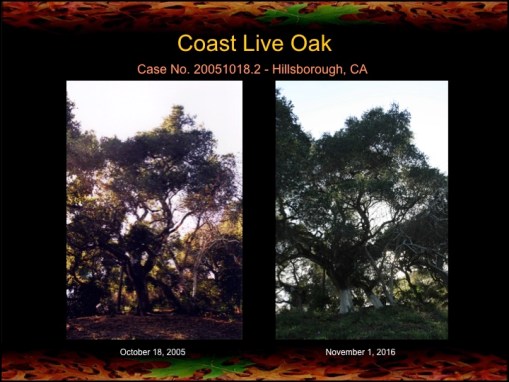
Eleven years ago I began treating this grove of oaks in Hillsborough, CA using indigenous-based methods (ie. fire mimicry). These sets of photos show their response after 11 years of care.

These are very significant results in that they show that these methods result in long-term (decade+) sustained recovery of oaks that were in decline.

Oak lovers and tree huggers, please take notice! And, please, thank the native ancestors for showing us the way!

slide3

slide4

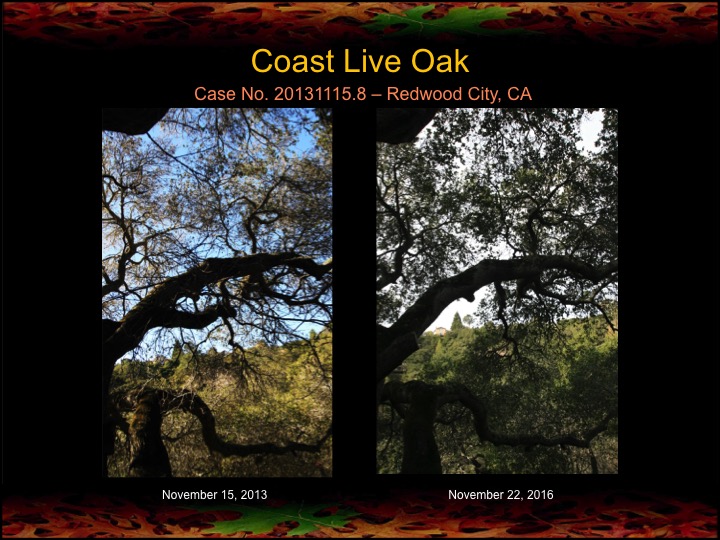
This last oak has been pruned since the initial photo. Note also that the roofline has been altered by construction, obscuring part of the tree. This oak has been infected with a stem canker disease (probably Sudden Oak Death) for the entire period. Despite the disease infection, which has been reduced via fertilization and surgery, this tree remains in relatively good health.


California oak mortality reversed!

23 11 2016

slide3

Here in California there’s been, rightfully, much attention paid to a recent report on the death of more than 100 million trees in the state. Sadly, there has been no talk of solutions, even in the face of clear evidence that prescribed fire and other indigenous-based tending practices (e.g. fire mimicry) improve forest health.

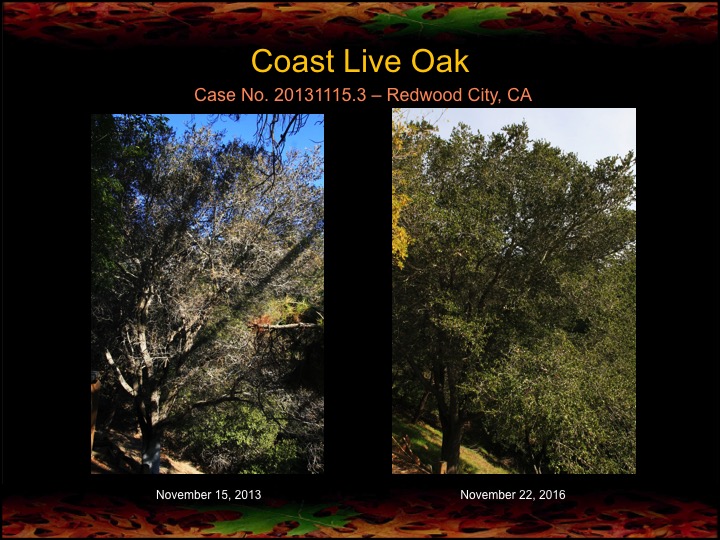
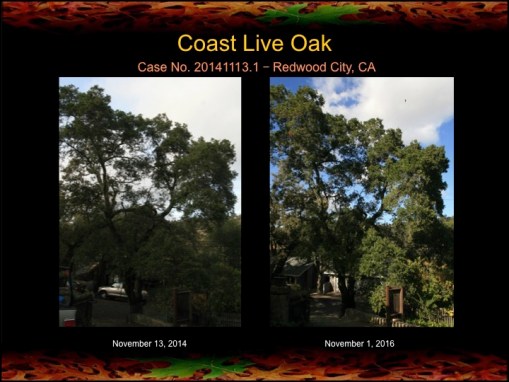
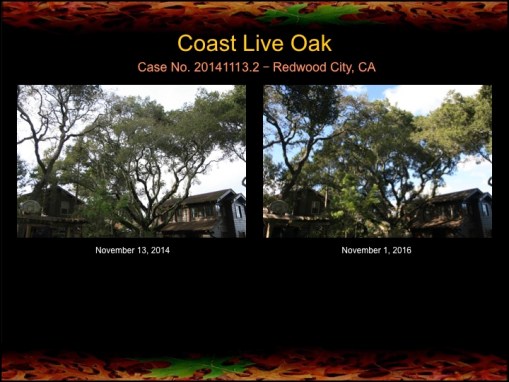
Today I offer, yet again, further evidence of our ability to address the death and decline of oak trees. The coast live oaks shown here are located in Redwood City, CA and were all treated with fire mimicry 3 years ago. Yesterday I revisited these oaks, some of them heritage oaks, and took photos to assess the changes in their canopies over that time. In my view, the decline of the oaks here has not only been abated, it has been reversed, as most of the oaks are showing a clear improvement in the fullness of their canopies.

How many more observations and studies of successful forest restoration efforts are required before more people start acting to save our trees?

slide7

slide8 Read the rest of this entry »


Healing heritage oaks

1 11 2016

slide1

Two years ago I had the task of helping a grove of struggling heritage oaks in Redwood City. All of the mature oaks are centuries old and reveal signs of having been tended by native people. I’m happy to say that after two years of applying fire mimicry methods based on traditional ecological knowledge these oaks are making a strong recovery.

slide2 Read the rest of this entry »


Carmel Valley heritage oak

21 10 2016

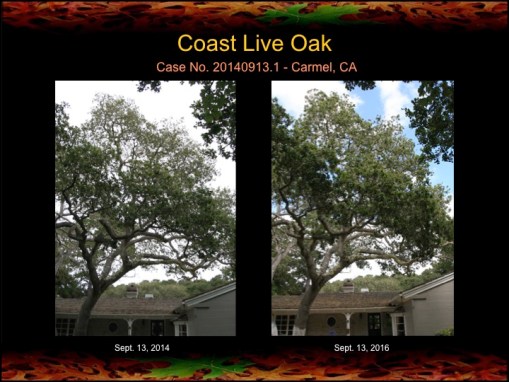
Every so often I get asked to provide some care for a single tree, usually a large heritage oak that dominates a particular property. Following a motto of “one tree at a time”, I never hesitate to help. So last year a Sudden Oak Life colleague, Shannon Boyle, and I had the honor of helping a massive, Indian-era coast live oak in Carmel Valley, CA. This ancient oak has clear signs of being pollarded and tended by the native people who lived in this valley hundreds of years ago. We applied fire mimicry methods to the trunk and the soils around the oak. One year later the canopy is showing a noticeable response in density, greenness, and size.

Deep gratitude to our ancestors for giving us these creatures. What better way to honor our Native American fore bearers than to extend the life and health of their legacies!

slide1


More Carmel oaks respond to fire mimicry

13 09 2016

slide2

slide3

slide4 Read the rest of this entry »


Carmel oaks respond to fire mimicry

13 09 2016

slide01

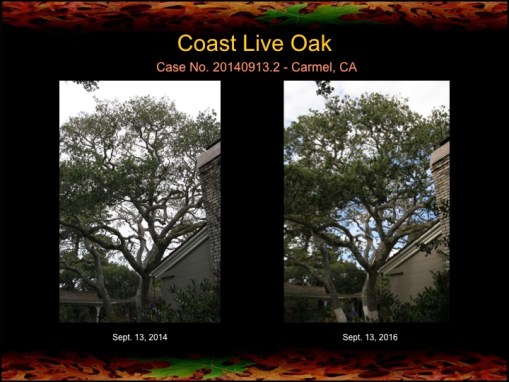
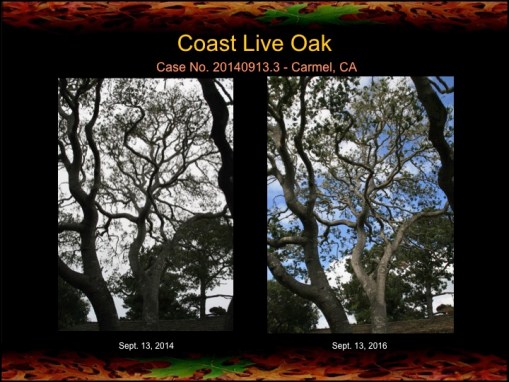
Two years ago a property owner in Carmel, CA approached me about helping improve the health of her sick oak trees. When I inspected her oaks I found them to be severely diseased and the canopies very thin. I told her that I wasn’t sure I could save her diseased oaks, but that I felt confident I could help her other oaks. She agreed to have all her oaks treated with fire mimicry.

Two years later, the diseased oaks (first three sets of photos) are recovering nicely and the remaining oaks on both properties are showing improved canopy health. The photos below show the results of all the oaks I’ve treated on her property over the past two years. The photos show a nice response in some oaks, others showing a limited response. Overall, I’m pretty happy with the results in just two years.

slide02

slide03 Read the rest of this entry »


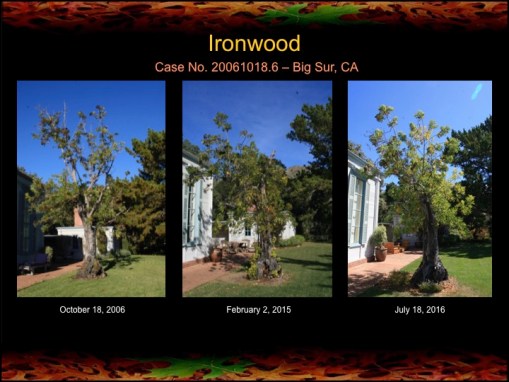
Pine, oak, and ironwood trees in Big Sur responding nicely after a decade of fire mimicry

20 07 2016

What is fire mimicry?

pine B

Slide03

Slide07


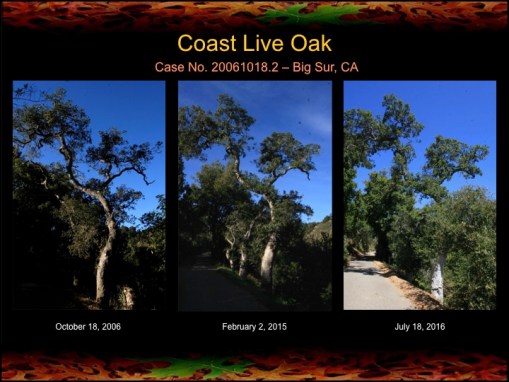
Coast live oak in Big Sur cured of stem canker infection using fire mimicry + surgery

18 07 2016

This is exciting news! A coast live oak in Big Sur appears to have been cured of two stem canker infections (possibly Sudden Oak Death) using fire mimicry and surgical methods. Furthermore, no new infections have occurred on this tree. While I’ve reported on the progress of other coast live oaks that have received fire mimicry and surgery (see here, here, and here), this is the first oak that I feel confident has been cured of a stem canker infection!

Slide10

There is also evidence at the same site that the deep cracks forming in other coast live oaks, cracks that allow infection by stem canker disease, are healing well. And, no new cracks are forming. Published studies have shown that “the presence of unweathered bark in bark furrows, (is) positively correlated with disease (Sudden Oak Death)”. Note in the photo below that the exposed unweathered bark is healing.

Slide08 Read the rest of this entry »


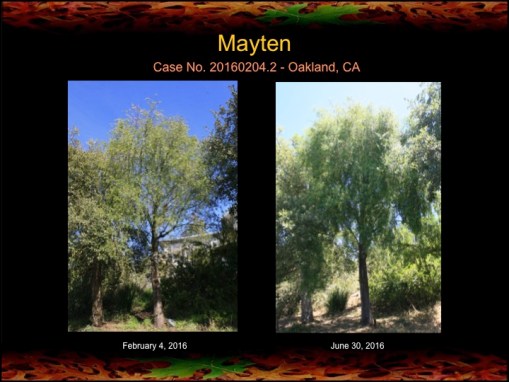
Rapid response of oak, mayten, bay laurel, and cedar trees to fire mimicry

2 07 2016

Slide01

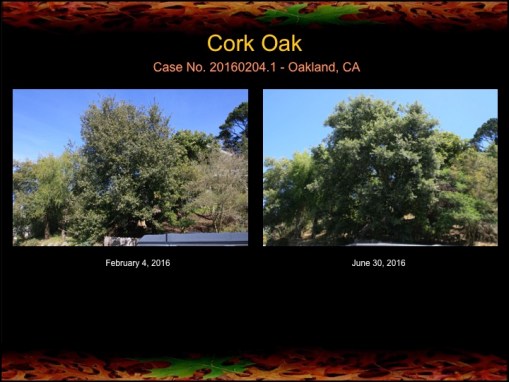
I recently inspected several cork oak, coast live oak, mayten, bay laurel, and cedar trees that I treated with fire mimicry methods in February of this year. The positive responses of these trees to the treatments after just six months are pleasantly surprising. The photos below tell the happy story . . .

Slide02 Read the rest of this entry »