Coast live oaks in Novato, CA respond to fire mimicry

19 02 2020

Slide1

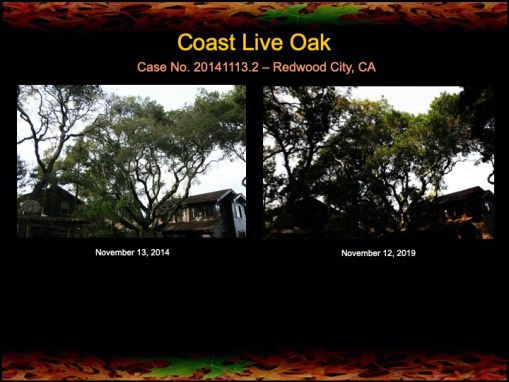
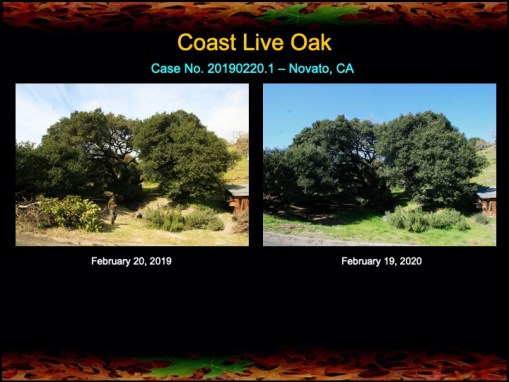
Last year I began fire mimicry treatments on three coast live oaks in Novato, CA. The first oak, shown in the images above and below (Case Nos. 20190220.1 & 20190220.1b), is an ancient Miwok-era oak with an estimated age of more than 300 years. It was in fairly good health when I treated it and is now showing an even denser canopy than before. Also, note that the last photo set in this series shows two oaks, one treated and the other untreated. The untreated oak is showing some increased browning of the canopy, while the treated oak is showing a clear increase in canopy density.

Slide2

Slide3 Read the rest of this entry »


Ailing oaks in Big Sur respond to fire mimicry

5 02 2020

Slide12

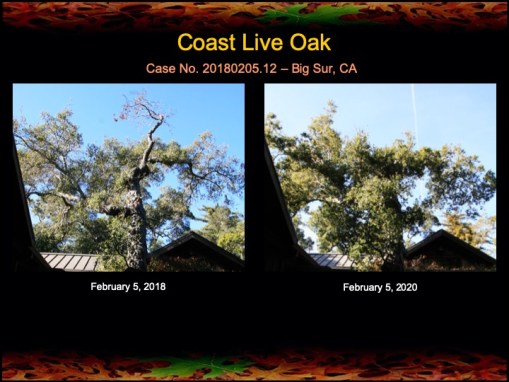
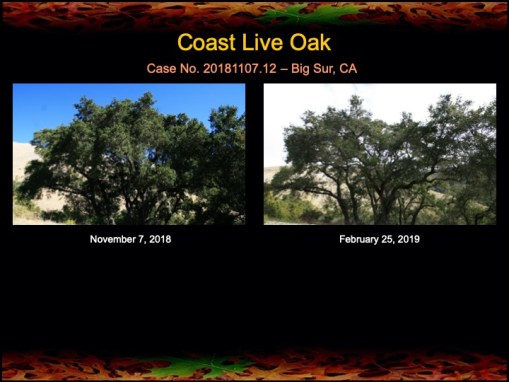
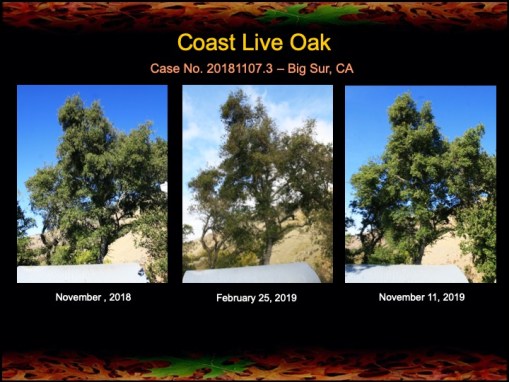
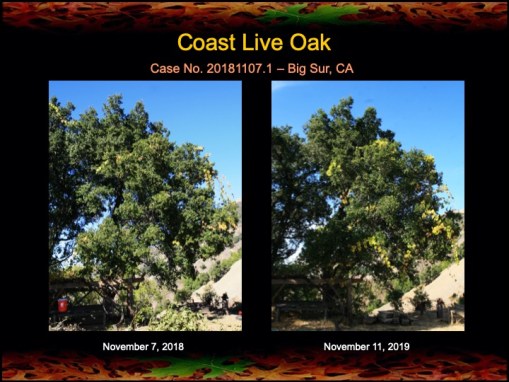
Two years ago I began fire mimicry treatments on a grove of sick coast live oaks in Big Sur, CA. Most of the oaks have responded well, including several that underwent surgical removal of bleeding stem cankers (probably Sudden Oak Death). Here are the before-and-after photos of the treated oaks. Note the photos are the same date, time of day, and light conditions as original photos.

Slide1 Read the rest of this entry »


A Decade of Fire Mimicry

30 12 2019
Oak dieback

Dead an dying coast live oak trees in Big Sur, CA

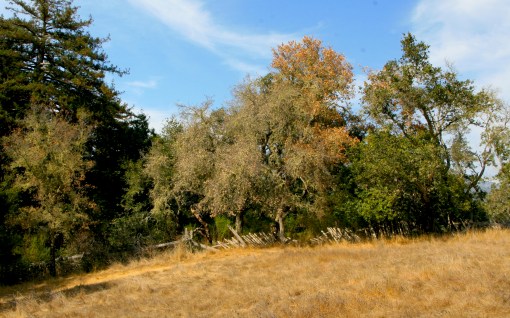
The past decade has been a tough one on California oaks. Tens of thousands of oaks have died and many more are in distress, simply because they are no longer being tended. For millennia the Indigenous People of California used, and still use, fire to improve the health of the native trees and forests.

Also over the past decade I and others have been tasked with restoring to health many of these oaks. During this time we have tended well over 1,000 oaks and other trees, with mostly positive, if not remarkable, results. Due to the severely overgrown nature of fire-suppressed forests, applying fire is not an immediate option. Therefore, we have been developing tending practices that mimic fire in ways that benefit the oaks.

Below are a selection of oaks, one per year of this past decade, that have inspired me to stay committed to tending our oaks. Many of these are legacies of the indigenous past and will, with our help, continue to be legacies in our future.

A decade of healing oaks . . .

20060104-1-4

Hearst Castle oak – 2010

20041129-1

Fairfax oak – 2011

Read the rest of this entry »


Fire mimicry results from Boulder Creek, CA

15 12 2019

Slide1

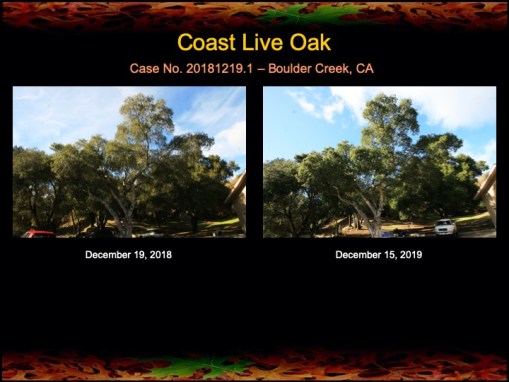
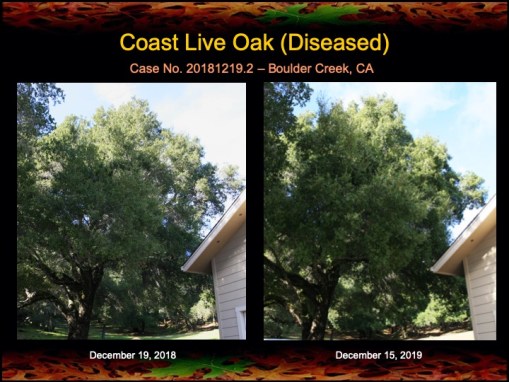
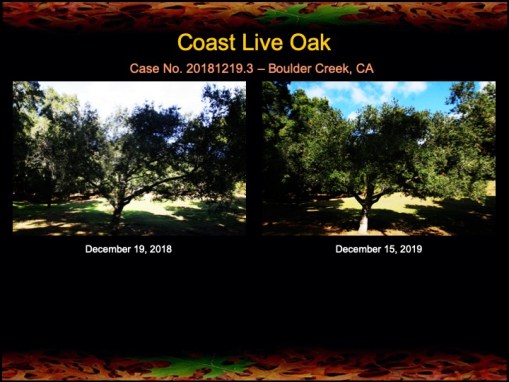
Last December I gave a talk at the Santa Cruz Public Library on “Living With Fire”. One of the participants asked me to apply the fire mimicry treatments I described on their oaks in Boulder Creek, CA. Here are the results after one year. Note that some of the oaks were diseased, including one that did not survive. Otherwise, most of the oaks are showing a positive response to the treatments.

Slide2

Slide3 Read the rest of this entry »


Fire Mimicry: Treated vs. Untreated

8 12 2019

Slide1

Slide2

As most of my clients chose to have me treat all of their oaks with fire mimicry, I don’t often get the chance to compare treated vs. untreated oaks in the same landscape setting. However, last year a client had me treat come oaks, but not the others. Here are the before-and-after photos of two oaks that were treated (above), compared to another that was not treated (below). One of the above oaks (Case No. 20181203.2) was infected with a stem canker disease (probably Sudden Oak Death), which was surgically removed in 2018.

Slide3


Oaks treated with fire mimicry fully recover from heavy wind damage in <1 yr

15 11 2019

Slide2

Slide10

In late February of this year a severe wind storm hit the coast of Big Sur and damaged many trees, including a large grove of coast live oaks I began treating with fire mimicry last year. I re-photographed many of the oaks at the time and could clearly see the loss of leaves in the oak canopies, compared to last fall. The photo sets above show how heavily some of the oaks were damaged.

The photos below show how these and many other oaks that sustained damage in the February storm recovered in just 8 months! Most are looking even healthier than they appeared last fall. It may well be that fire mimicry treatments have aided in the recovery of these oaks.

Slide1

Slide9 Read the rest of this entry »


Culturally-modified Indian-era oaks respond to fire mimicry

15 11 2019

Slide1

Five years ago I began fire mimicry treatments on a grove of ancient, Indian-era coast live oaks that have clear signs of being culturally modified (ie. pollarded). This past week I checked on the status of these oaks and the entire grove continues to show strong improvement in canopy density and greenness. And in an area of rapidly spreading Sudden Oak Death, none of these trees have contracted this disease.

Slide2 Read the rest of this entry »


Ancient oaks in Big Sur respond to fire mimicry

12 11 2019

Slide1

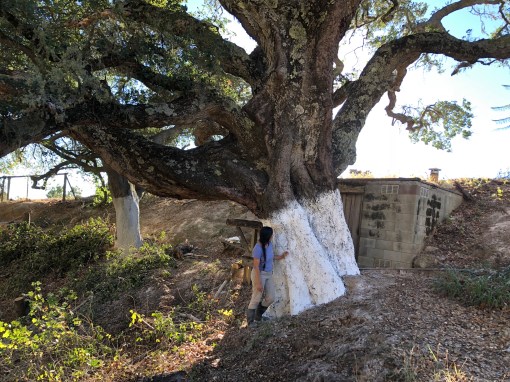
Last year I began fire mimicry treatments on a large grove of ancient coast live oaks in Big Sur. Many of these oaks were culturally modified several hundred years ago by the Esselen Indians. Several of the largest oaks have clear signs of being pollarded, as shown in the photo below.

IMG_8210

Culturally modified coast live oak in Big Sur, CA.

Read the rest of this entry »


Surgical procedure for removing stem canker infections (See year 1 update below)

30 10 2019

IMG_9930

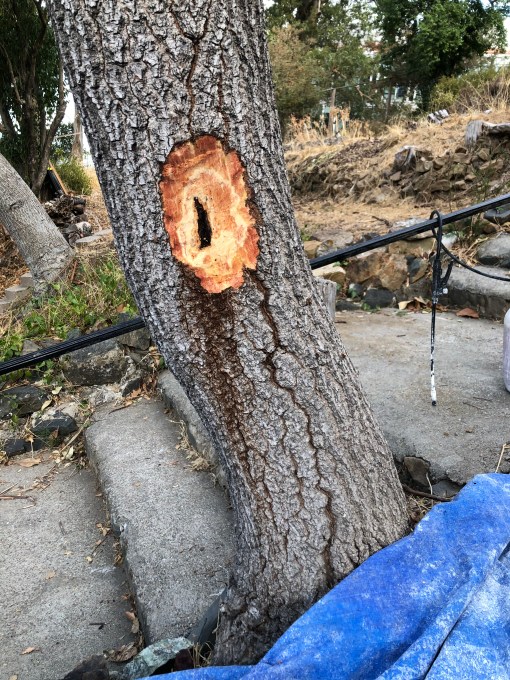
I’m seeing very encouraging results from the surgical procedures I have been performing on oaks with stem canker infections. Here is the sequence of steps. The above photo is of a recent (less than one year) stem canker infection, possibly Sudden Oak Death, of a young coast live oak. The next step is to remove the infected tissue using a hand axe. The photo below shows a partial state of canker removal.

IMG_9932

The next photo shows the infected canker tissue entirely removed.

IMG_9933 Read the rest of this entry »


Four years of fire mimicry on oaks in Piedmont, CA

21 10 2019

Slide1

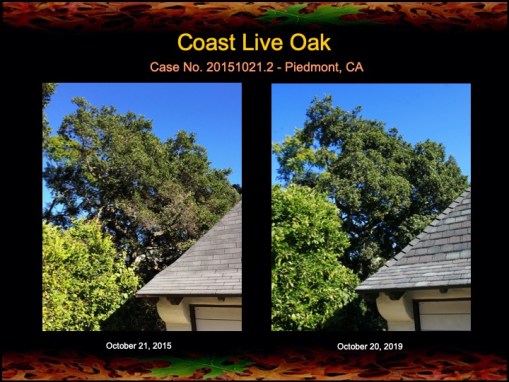
in 2015 I began applying fire mimicry treatments to a grove of sick coast live oaks. Yesterday I checked on their status. Here are the photographic comparisons showing that the density and greenness of the oak canopies has increased noticeably after four years of treatments. However, two severely diseased oaks did not respond to the treatments during this period and had to be removed. Fortunately, the remaining oaks appear healthier and the prognosis for recovery is good.

Slide2

Slide3 Read the rest of this entry »