Decline in redwood trees abated with fire mimicry

7 09 2013

20120912.1

Last year I was contacted by the owners of a property in Fremont, CA with numerous redwoods that had been in decline for several years. Previous to my involvement, various conventional tree service companies and experts had tried helping the trees, but to no avail. Their recommendation was to remove the sick redwoods. Fortunately, the owners were reluctant to cut down the redwood trees and decided to ask for my help.

Upon my inspection of the redwoods I found evidence of soil acidification and nutrient depletion. The owners followed my recommendations for fire mimicry treatments involving moss removal, soil mineral amendments, and compost tea.

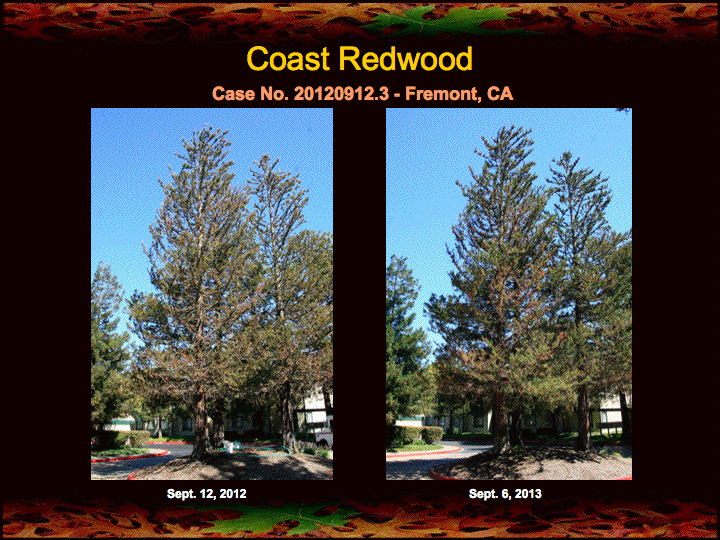
Here are the results after just one year. Most, although not all, of the sick redwood trees are showing noticeable improvement in canopy density. None of the redwoods appear to be exhibiting further decline. Note that in photo set 20120912.2 below, the redwood tree on the left was removed during the past year. It was the one redwood I felt could not be revived with treatments.
20120912.3 Read the rest of this entry »


Reflections on “Tending the Wild” workshop at OAEC

8 07 2013
Acorn. Photo by Kat Steele.

Acorn. Photo by Kat Steele.

When people don’t use plants they get scarce. You must use them so they come up again. All plants are like that. If they’re not gathered from, or talked to, or cared about, they’ll die.

– Mabel McKay, Pomo Elder, quoted from News From Native California

Last week I attended a remarkable 3-day workshop at Occidental Arts and Ecology Center (OAEC) called “Tending the Wild”. It was organized by my friend and colleague Lindsay Dailey, who is the Associate Director of the Wildlands Program at OAEC. For the past few years Lindsay has been training and working with me in the use of fire mimicry techniques in oak woodland restoration. I have found her to be a serious student and practitioner of traditional ecological approaches in land care.

The workshop drew together an amazing group of teachers and elders speaking on the topic of wildland tending by the Californian native people. The first day was led by M. Kat Anderson, PhD, author of the book “Tending the Wild“. Her thesis is that the richness and abundance of the historical ecosystems in California were largely the result of thousands of years of tending by the native people, primarily through the wise use of fire in burning the land to improve soil fertility and promote plant production/regeneration. In answer to the question: “Why are plants and animals disappearing?”, her response is: “Because we no longer have a relationship with them.” Read the rest of this entry »


Fire mimicry improving health of oaks, pines, and toyons

23 06 2013

20080612.1.5

For thousands of years the native people of California used fire as a tool to manage the lands and maintain healthy trees. Now-a-days, faced with the fact that we can no longer set fire to the land because of heavy fuel buildup from years of fire suppression, we must use alternatives, such as fire mimicry methods, in our work to keep California’s trees healthy.  Today I’m posting some recent results of fire mimicry treatments in restoring oak, pine, and toyon health.

Enjoy!

20100602.1.3 Read the rest of this entry »


Oaks in Carmel respond with vigor to fire mimicry treatments

27 05 2013

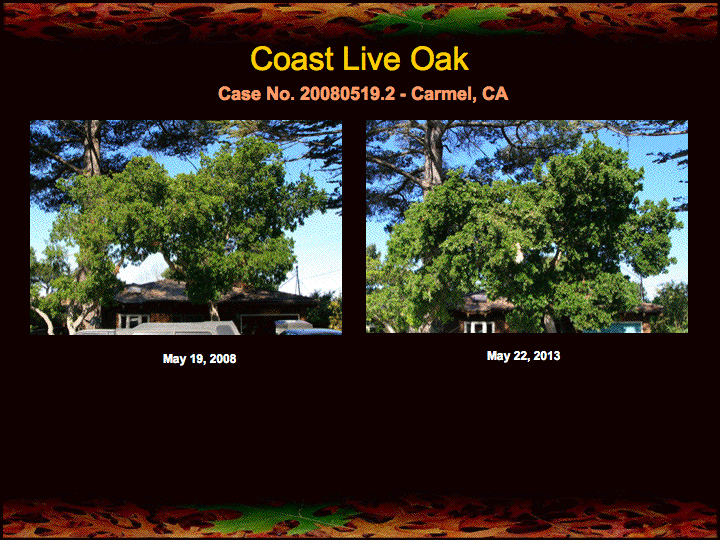
Five years ago I began fire mimicry treatments on these coast live oaks in Carmel, CA. Last week I checked on the oaks and re-photographed them. Here are the results:

20080519.1.5

20080519.2.5


Glen Ellen oaks on the mend

18 05 2013

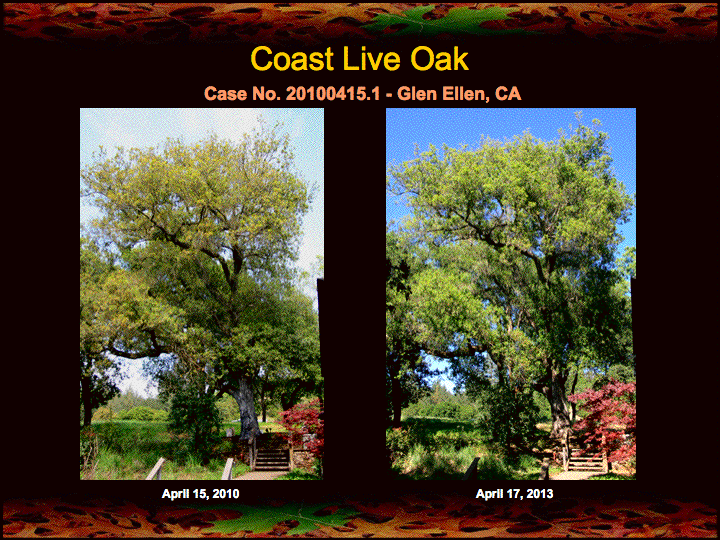
Three years ago I began fire mimicry treatments on a number of coast live oaks and valley oaks near Glen Ellen, in Sonoma County, CA. I recently did my annual checkup on these oaks and re-photographed them to assess their response. 

Here are the results.

20100415.1.3

20100415.6.3 Read the rest of this entry »


Hillsborough oaks respond to fire mimicry

3 05 2013

20120417.3

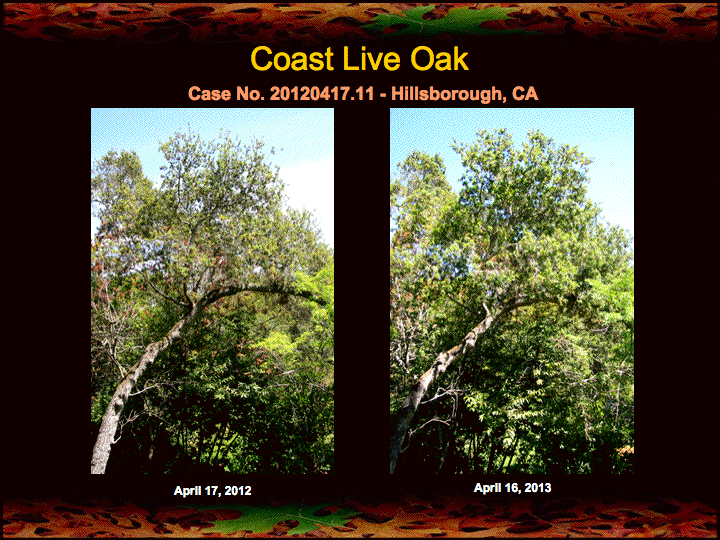
Last year I began restoration work using fire mimicry on a stand of oaks in Hillsborough, CA. I did some clearing of woody understory and moss removal from the trunks, and added alkaline-rich minerals and compost tea to the soils. I also applied a lime spray to the trunks.

Here are the results after just one year.

20120417.11

20120417.8 Read the rest of this entry »


Sick pines respond to fire mimicry

21 04 2013

20100415.24.3

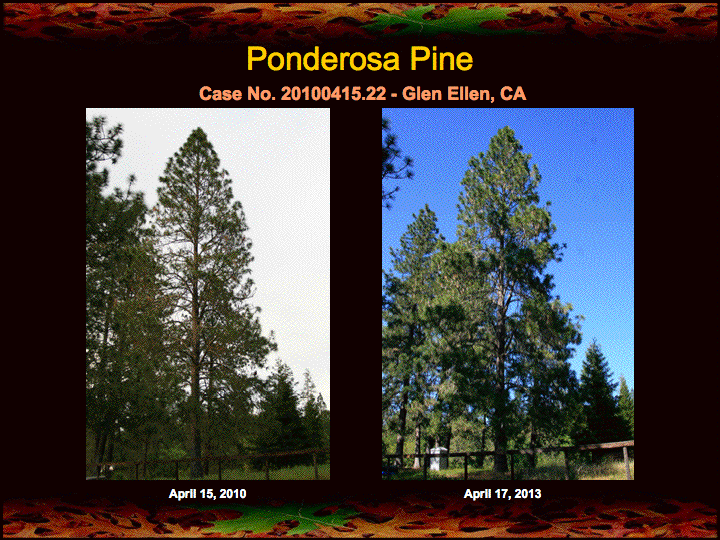
While the focus of work here at Sudden Oak Life is on oak health, there are lots of other kinds of trees that respond to fire mimicry treatments. Today I would like to share with you the results of some work being done on several ponderosa pine trees. These photo sets show how the pines have responded after three years of treatments. Note that the last photo set is of an adjacent UNTREATED pine.

20100415.22.3

20100415.23.3 Read the rest of this entry »


City of Piedmont oaks respond quickly to fire mimicry treatments

19 04 2013

20120330.7

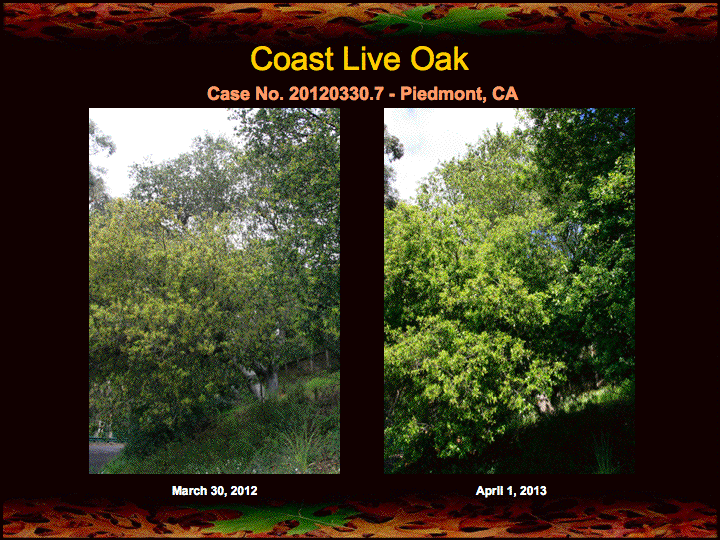
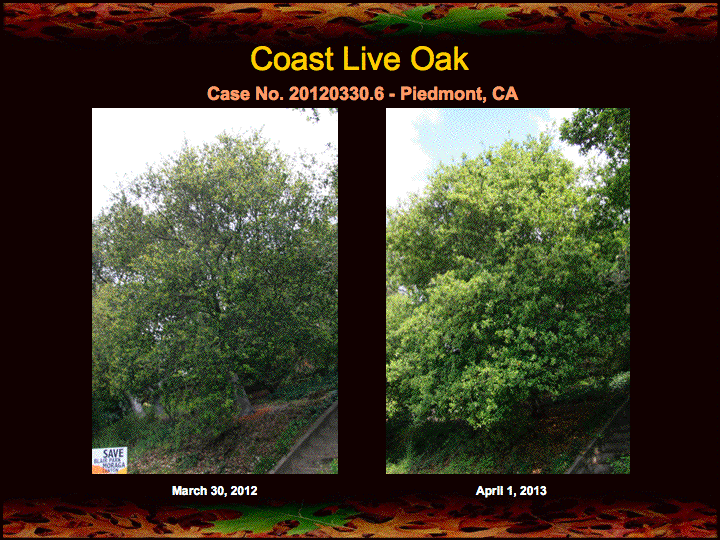
In April of 2012 I was asked by the City of Piedmont to treat several oaks along Moraga Ave. that were appearing unhealthy. Some of the oaks were on a cliff, so I set up a belay and worked spreading minerals and compost tea underneath the oak canopies and applying a lime spray to the trunks. In addition to the City of Piedmont oaks, I also treated several oaks on an adjacent private property at the same time.  Here are the results after just one year.

20120330.4


20120330.6 Read the rest of this entry »


Oakland oaks get a reprieve from the chainsaws

27 02 2013
Healthy grove of oaks in Oakland slated for removal.

Healthy grove of oaks in Oakland slated for removal (January 2013)

As is evident in the city’s name, Oakland was named for the large area of oak woodland that originally grew in the region back when it was settled. These days, however, most of original oaks have died or been removed, and those that do remain are mostly limited to the Oakland hills. So it seems baffling why the East Bay Municipal Utility District (EBMUD) would want to remove a flourishing oak grove from its lands within the city of Oakland.

Yet that is exactly the situation I came across last month when a friend contacted me about a large oak grove near her home in Oakland that had been slated for removal by EBMUD.  At that time the removal of the trees was imminent. My concerned friend who lives near the oak grove requested I come assess the situation. She felt, based on photographs she had taken, that the oak grove was not in poor health, as was suggested in a consulting firm’s report to EBMUD. The report, written in August of 2010, stated that several oaks were showing signs of the sudden oak death pathogen or were otherwise in poor health, and that the majority of the oaks should be removed. About 50 trees, mostly oaks, but also some redwood, cedar, and pine trees, were recommended and eventually marked for removal. Read the rest of this entry »


Oaks in Santa Barbara thriving after 4 years of fire mimicry

7 02 2013

20090203.1.4

I’ve had several recent posts showing how oaks in Santa Barbara are flourishing after fire mimicry treatments. Here is another set of photos from a grove of oaks in Santa Barbara that have been receiving fire mimicry treatments for the past four years. Compare these results with the results in this same grove posted last year after three years of treatments.

Enjoy! Read the rest of this entry »