What is fire mimicry?

8 02 2010

People often ask me why the oaks and other trees in California need to be tended. Oaks have been growing in California for many thousands of years, so why would they need our help now?

The answer is clear. The great oak woodlands and savannas of California are not the result of mother nature doing what she does best. The iconic oaks are largely the product of thousands of years of tending by Native Americans. It is well documented that the native people here managed the oaks with fire, keeping the ecosystem in an early successional state that is optimal for oaks. Acorns from the oaks were a primary food source for the native people of California.

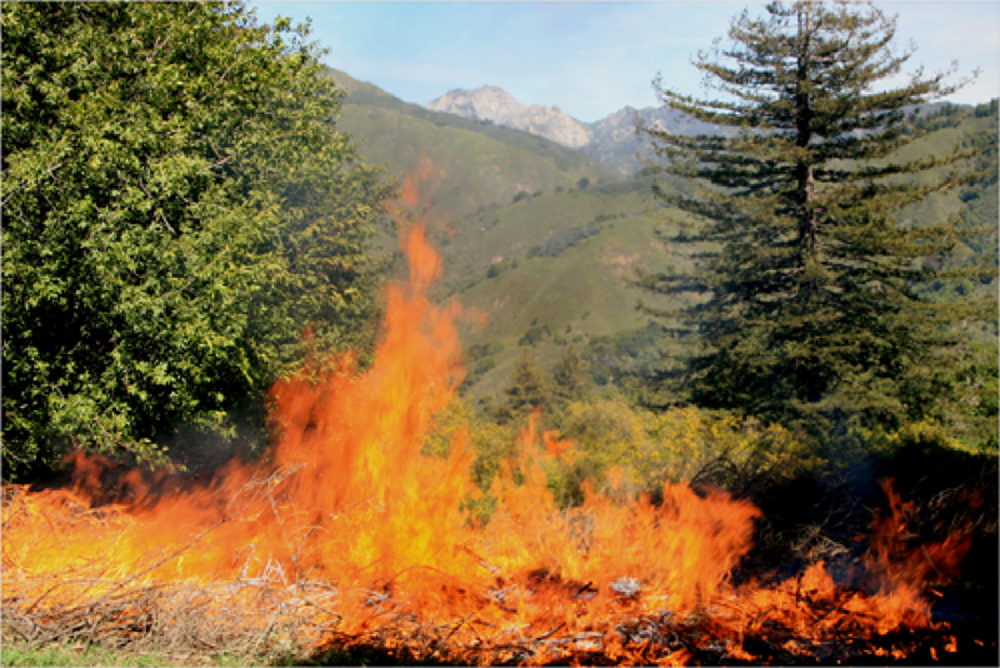
Tending the land with fire in Big Sur (photo by Lee Klinger)

Read the rest of this entry »


Acid rain in Big Sur – Jan. 2010 update

8 02 2010

Acid rainbow in Big Sur (photo by Lee Klinger)

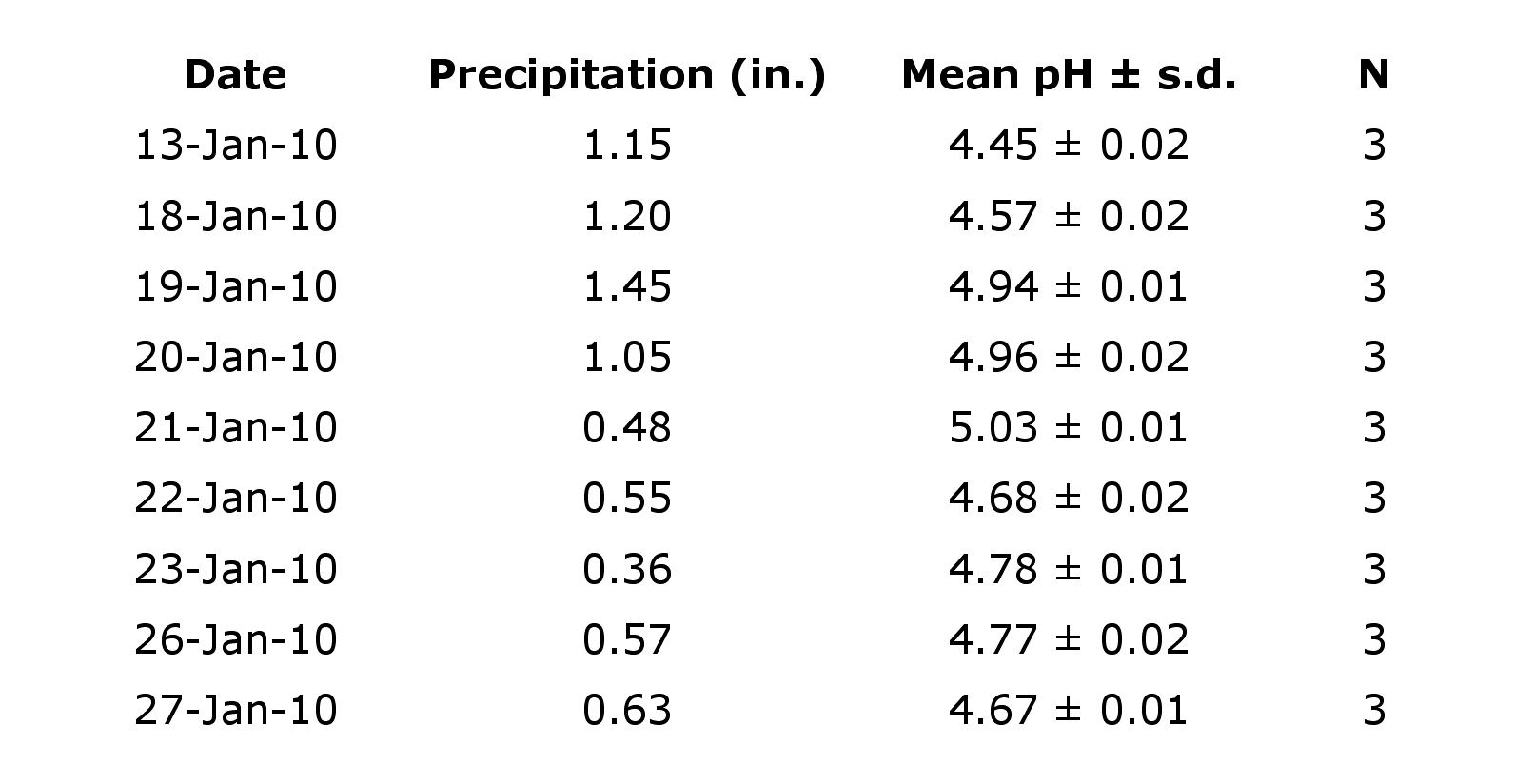
Big Sur rainfall and pH data have been tabulated for January 2010 and the numbers are as follows:

Rainfall amounts and pH in Big Sur

I’m noticing that when the storms are particularly windy the rainfall pH seems to be higher (less acidic) than other rainstorms with less wind. I don’t have any data to verify this, but it’s something I plan to pay more attention to in the future. Could this be due to all the particles blown off the surrounding trees? Or from sea spray? Dunno.

Still, the majority of the rainfall events here in Big Sur are acidic as they have been for several years (see here, here, and here) and folks should be wondering why . . .


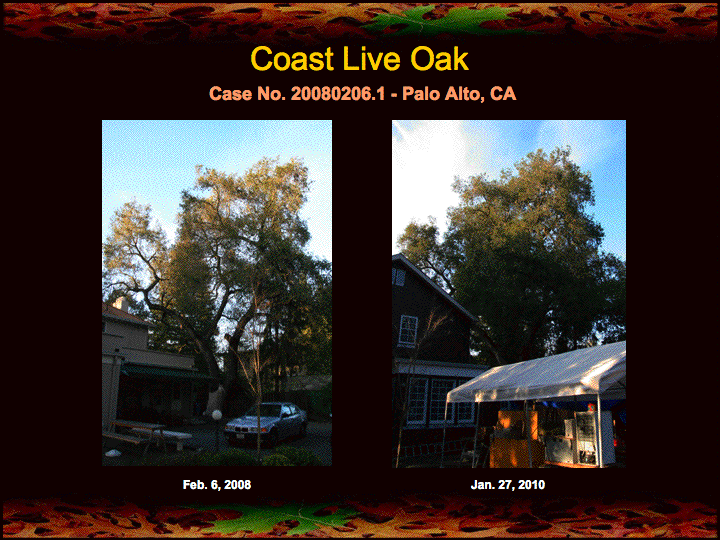
Palo Alto oaks responding to fire mimicry

2 02 2010

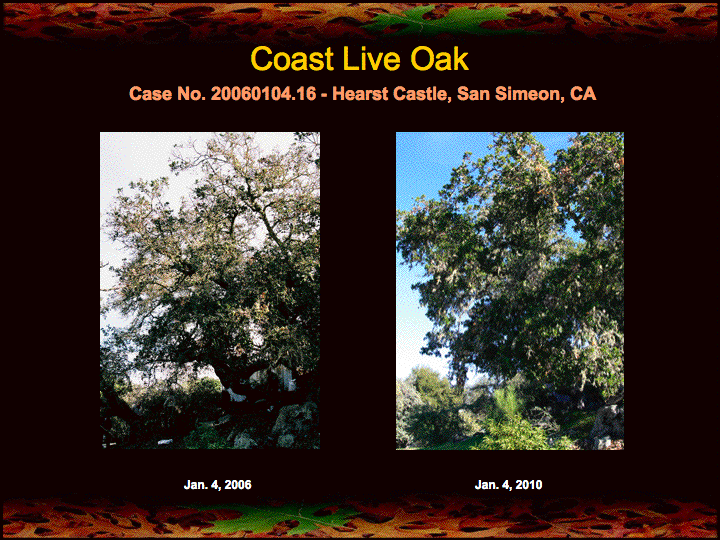
Last week I checked up on several coast live oaks in Palo Alto that were treated with fire mimicry two years ago. Check out the results below.

Read the rest of this entry »


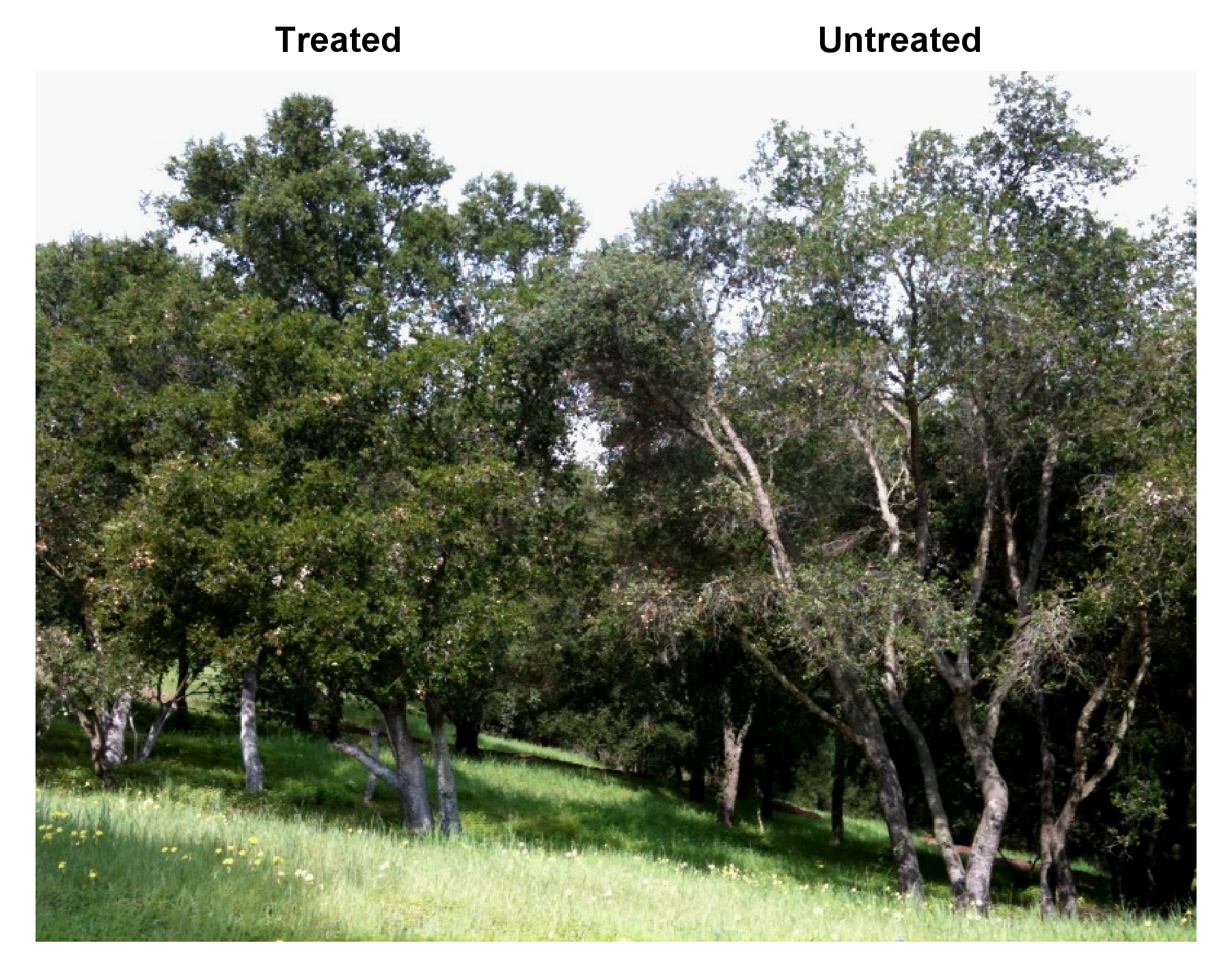
Treated vs. untreated oaks

2 02 2010

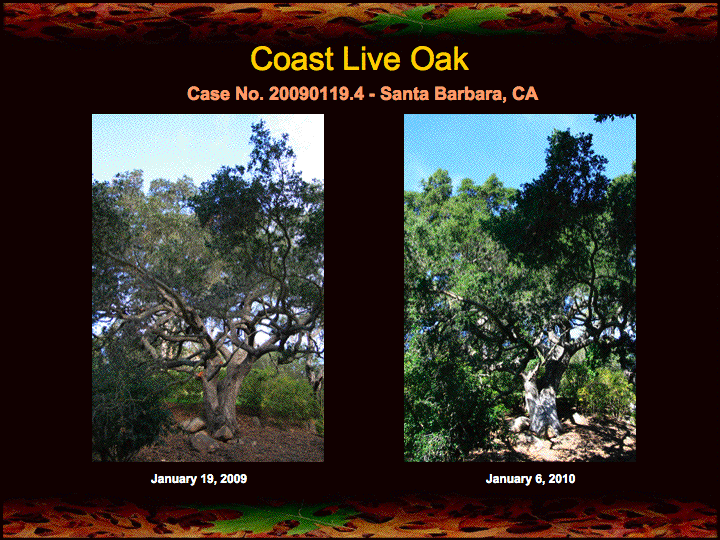
Today I was examining some coast live oaks that were treated last year with fire mimicry in Toro Canyon near Santa Barbara. I came across the example below where there were both treated and untreated oaks growing next to each other. The photo I believe is self-explanatory. As you can see there is no reason why we can’t have healthier oaks here in California.

To see images of the oaks before they were treated check out my earlier post Toro Canyon oaks.

Coast live oaks in Toro Canyon (photo by Lee Klinger)


Ancient redwoods in decline

21 01 2010

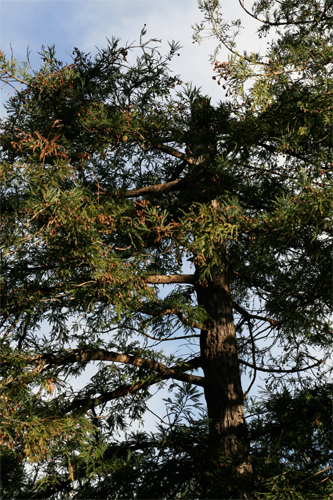
A week or so ago a large redwood tree growing near my home here in Big Sur lost its top. The wind blew hard and broke off the upper part of the redwood as shown in Photo 1. In many places around Big Sur ancient redwood trees have lost their tops during the winter storms. Some of these tops are more than three feet in diameter and you don’t want to be around when they come crashing to the ground.

Photo 1 (photo by Lee Klinger)

I realize, of course, that it is not unusual for large trees to succumb to high winds, but what does seem unusual is that in some groves nearly half of the ancient trees have lost their tops within the past 20 years or so. By all appearances these redwoods have grown healthily together in these groves for three, four, five centuries or more, so why are they suddenly losing their tops?

The answer is not too hard to figure out. Yes, there is acid rain falling in Big Sur (see here, here, and here) and that no doubt has some effect on the redwood ecosystem. But recent changes in land practices, most notably fire suppression, are causing dramatic shifts in the successional status of the redwood forests. In the past the native people set fires that revitalized the soil and kept the young redwoods from crowding out the older ones. Read the rest of this entry »


The potential role of peatland dynamics in ice-age initiation

10 01 2010

As I mentioned in a previous post I am putting up some of my earlier work on feedback mechanisms by which the planet cools itself. This background will be useful in an upcoming post on planetary temperature regulation.

The potential role of peatland dynamics in ice-age initiation

by Lee F. Klinger, John A. Taylor, & Lars G. Franzen

Quaternary Research 45: 89-92 (1996)

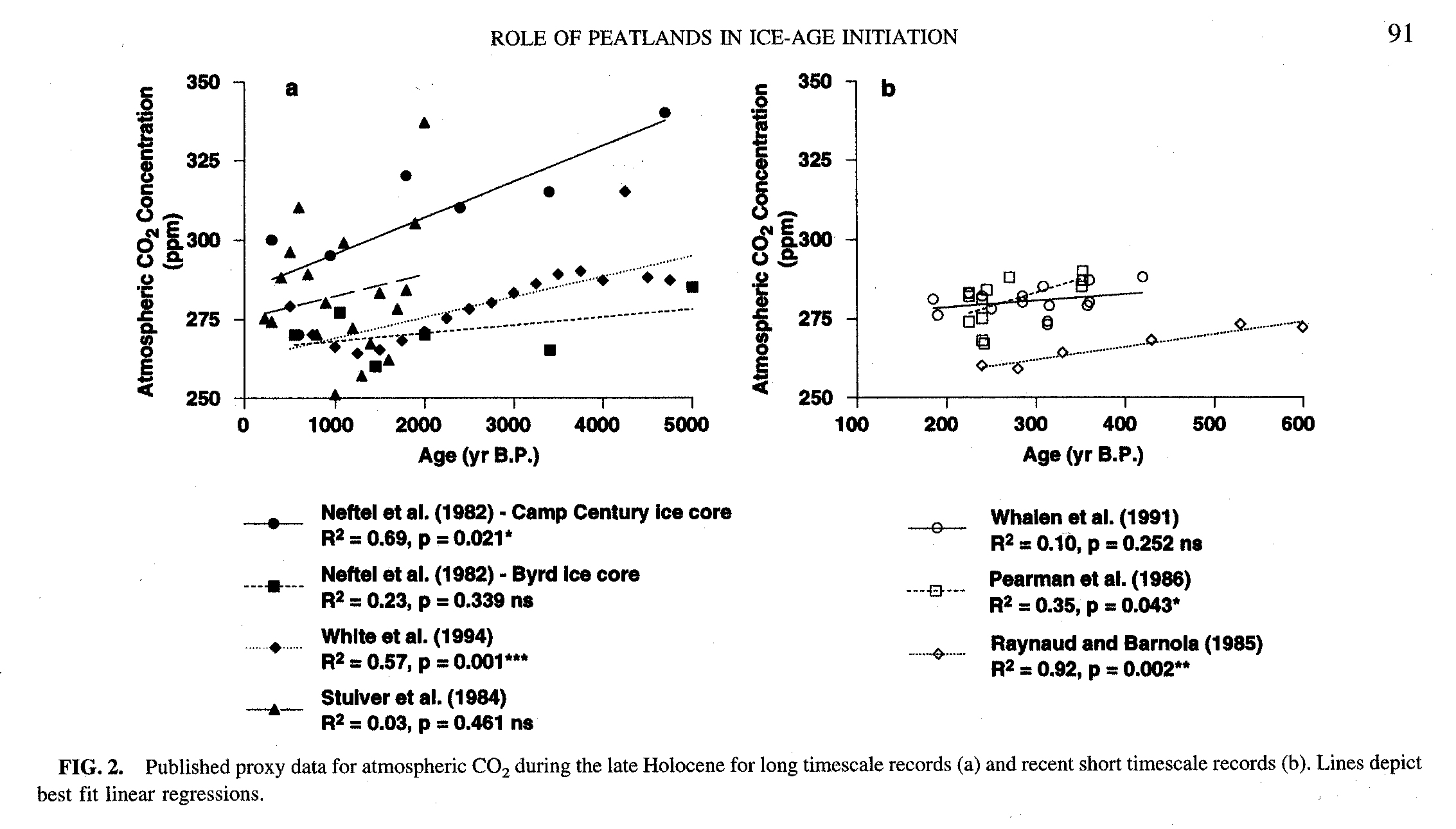
Summary – Physical and chemical coupling of peatland vegetation, soils and landforms and atmosphere creates feedbacks which may be important in ice-age initiation. A box diffusion CO2 exchange model shows that a transient forcing of 500Gt C (the amount proposed to have accumulated in peatlands during the last interglacial-glacial transition) over 5000 yr results in a lowering of atmospheric CO2 by about 40 ppm. Proxy data indicate that a decrease in atmospheric CO2 may have occurred over the last 5000 years up to pre-industrial times, and the amount (~22 ppm lowering in 5000 yrs) is similar to that calculated from Holocene peatland expansion. These results suggest that models should consider the role of peatlands in ice-age initiation.

View the entire paper here.

In Fig. 2 (see below) we present evidence that prior to the industrial era atmospheric CO2 was undergoing a decline. We attribute the decline to large-scale landscape transformation involving the replacement of forests by peatlands. Peatlands store immense amounts of carbon and, as described in an earlier publication, are potentially powerful organs that help cool the planet.


Toro Canyon oaks

7 01 2010

These oaks growing in Toro Canyon near Santa Barbara were first treated last year with fire mimicry practices. Check out the results below.

Read the rest of this entry »


Peatland formation and ice ages: a possible Gaian mechanism related to vegetation succession

6 01 2010

To prepare readers for some upcoming posts on the implications of Gaia theory in climate change predictions I would like to provide some background literature of my earlier work in this area. Below is a paper I gave at the American Geophysical Union Chapman Conference on the Gaia Hypothesis held in San Diego, CA in 1988. This paper was published as a chapter in a 1991 book on the proceedings of the conference: Scientists on Gaia. Here is the summary of my paper:

Peatland formation and ice ages: a possible Gaian mechanism related to vegetation succession

by Lee F. Klinger

Summary – Terrestrial areas, which support over 99% of the earth’s biomass, have considerable potential for being involved in biosphere-atmosphere feedback loops as postulated by the Gaia hypothesis. This paper presents a model of a possible Gaian mechanism related to landscape-level successional changes during a glacial-interglacial cycle. The model is based on the view that terrestrial successions converge toward bogs, rather than toward old-growth forest, and that bogs represent structurally and compositionally stable (climax) communities. The model also assumes, as in classical successional theory, that during the course of succession the biota modifies the environment, both the soil and the atmosphere, to favor the progression of succession toward the climax state. Feedback mechanisms between peatlands (landscapes of bogs and bog forests) and the atmosphere are proposed which should favor the initiation and maintenance of relatively stable, ice age climates. These cooling mechanisms are related to increased albedo, increased evapotranspiration, and decreased atmospheric CO2 associated with the succession from woodlands to peatlands. Ice core and ocean core data for CO2, CH4, and delta 13C and delta 14C isotope ratios are consistent with the proposed terrestrial dynamics involving organic carbon.

Here is the full reference for my paper:

Klinger, L.F. 1991. Peatland formation and ice ages: a possible Gaian mechanism related to vegetation succession (Chap. 28). In: S.H. Schneider & P.J. Boston (eds.), Scientists on Gaia. The MIT Press, Cambridge, pp. 247-255.

Acid rain in Big Sur – Dec. 2009 update

5 01 2010

Acid rain continues to fall at my home here in Big Sur. During December 2009 there were seven measurable days of rain with the following values:

Date        Amount      Mean pH          N

Dec. 7         0.29″           4.74              3

Dec. 11       0.42″           4.53              3

Dec. 12       0.53″           4.31              3

Dec. 13       0.62″           4.71              4

Dec. 22       0.20″           4.52              2

Dec. 27       0.19″           4.36              2

Dec. 30       0.23″           4.60              2

The pH readings from Dec. 12 are some of the lowest (highest acidity) yet recorded here in Big Sur in over three years of measurements.

Meanwhile, oaks, pines, and bays are dying by the thousands. Don’t suppose there’s a connection, eh?


Hearst Castle 4-year results

4 01 2010

Today I visited Hearst Castle and photographed several coast live oaks that have been under treatment with fire mimicry practices for four years. Some results from last year can be seen here. Below are the photos I took today showing changes in both treated and untreated oaks after four years. Be sure to examine the last two sets of photos which show results from some untreated oaks. Enjoy!

Read the rest of this entry »