Early season rainfall pH measurements in Big Sur

19 10 2009

Here is some news for those of you interested in following the story of acid rain in Big Sur. The first rains have arrived here in Big Sur in a big way, 8.45″ of rain fell between Oct. 12 and 14. The pH readings on the first 3 inches of rain averaged 5.41, the highest value (lowest acidity) yet recorded in over three years of measurements.

Another small storm brought some rain today (Oct. 19) which totaled just 0.14″, with a pH value of 4.79. This value is more in line with readings from the previous three years and represents a significant drop (increase in acidity) compared to the heavy rains last week.

What do you suppose is going on?


Upcoming workshop on tree and soil care at La Casa de Maria

15 09 2009

THE HISTORY AND PRACTICE OF NATIVE TREE CARE

Saturday, October 10, from 9:30 am to 3:00 pm
La Casa de Maria Retreat Center, 800 El Bosque Road, Santa Barbara, CA

For thousands of years the native Chumash people tended the oak forests in the Santa Barbara. Now California’s oaks are endangered. Come for a workshop that will include presentations, time in La Casa’s oak woodland and a hands-on demonstration of tree care.

The Chumash used prescribed fire and other methods of traditional land management. To them, living on a living earth meant that the trees and forests were essentially organs of the planet. Keeping the trees healthy was fundamental for maintaining their quality of life.

Now-a-days, oaks and other trees are experiencing accelerated rates of decline in many parts of California, including the Santa Barbara area. A holistic view of the problem reveals that many of our aging trees and their soils are undergoing a major ecological shift brought on by changes in land management, especially fire suppression.

By revisiting the practices of the native people we are provided with an effective means of intervening in the decline of trees without the use of synthetic chemicals. Details will be presented on how fires and fire mimicry methods act to improve the fertility of soils and the health of trees. Results will be shown of case studies involving a suite of techniques to restore oak trees, including fire, mineral fertilizers, limewashing, brush clearing and mulching.

There will also be a presentation on the practical applications of the theories of agroecology that are now used in ornamental horticulture. By shifting from conventional techniques that utilize synthetic chemicals and pesticides to non-toxic organic products focused on improving soil fertility and insect ecology plant health is significantly improved.

This workshop will include a demonstration on traditional tree care using all-natural materials.

Lee Klinger, MA, PhD is an independent scientist and ecological consultant from Big Sur, with over 25 years of professional experience in the fields of biogeochemistry, forest ecology and soil science. He has held scholarly appointments at the University of Colorado, the University of Oxford, and the Chinese Academy of Sciences.

Corey Welles is the Plant Health Care Coordinator at Lotusland. He has seen dramatic improvements in the health of their plant collections since using agroecology based practices.

For more information and to register online go to: www.lacasademaria.org


Dr Lee Klinger interviewed on Sustainable World Radio

22 08 2009

Yesterday there was an interview about my work with the trees on Sustainable World Radio. Here is the podcast:

http://www.pdcastsusworldradio.libsyn.com/index.php?post_id=517650

I haven’t listened to it yet, but after I do I will post comments as needed.

Grandfather&Al

Heritage valley oak in Lake County (photo by Lee Klinger)


More coast live oaks on the mend

29 07 2009

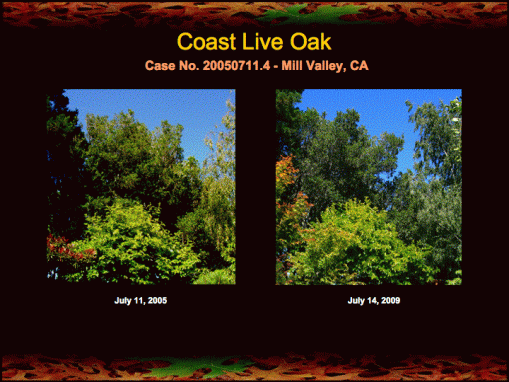
Here’s further evidence that fire mimicry treatments are helping our diseased oaks. In 2005 I began treatment of two sick coast live oaks (Quercus agrifolia) growing in acidic soils in Mill Valley, CA. Each of the oaks had thin canopies and bleeding stem cankers. The owner informed me at the time that UC Berkeley scientists had confirmed the presence of Sudden Oak Death (Phytophthora ramorum) in trees on the property.

The photos below show how, after four years, the oaks have responded to fire mimicry treatments. The first photo shows a nice recovery of the leaf canopy, and the second photo shows how well the oaks are able to fend off the stem cankers. Bleeding is seen to have completely ceased in one of the oaks in less than four years!
20050711.4a
20050711.5
UC scientists and other Sudden Oak Death researchers, those who truly want to help the oaks – we should be talking. Comments, at least?


Using fire mimicry to treat early leaf senescence in California buckeyes

15 07 2009

The buckeye (Aesculus californica) is a deciduous tree, low and broad in stature, that is endemic to California. Every year these trees extend their gratitude by offering up a harvest of enormous size nuts. The species is a vital part of the California ecosystem and ever so worthy of our attention. Some even believe that tending the buckeyes is a responsibility passed on to us by the native people, who for the past few thousand years have been tending California’s buckeye groves.

Buckeyes do very well in open forests and savannas, especially in places where fires have been allowed to burn. However, on unburned lands buckeyes are often seen to be in poor health. Where forests are overgrown and acidified the buckeyes are experiencing serious health problems, including stem failure, canopy dieback, and any numbers of leaf blights including anthracnose and sudden oak death.

One of the first symptoms of ill health in buckeyes is the early seasonal onset of leaf senescence. Several years ago an astute friend of mine began noticing that for several years the buckeyes near her home had been losing their leaves earlier than usual. She contacted me about the problem and I suggested we try fire mimicry, the same treatments that I’ve been using on the oaks.

After four years of ongoing treatment here are the results . . .

20050711.8

Read the rest of this entry »


Coast live oaks responding to fire mimicry

22 06 2009

The use of repeat photography to document temporal changes in trees and landscapes was one of the many fine techniques I learned from my PhD advisor Prof. Tom Veblen. He taught me the importance of replicating details such the lens focal length, sky conditions, and time of day. My photos don’t always live up to his standards, but it’s not for lack of trying.

Today I would like to show repeat photographs for several coast live oak trees that have been undergoing fire mimicry treatments for exactly four years. Much of the credit for these results should go to Demetrios Sgouros, Leith Carstarphen, and Daniel Brooke who were among the first tree care specialists to recognize the utility of fire mimicry techniques in helping the many sick oaks here in California.
20041129.3
Read the rest of this entry »


Fire mimicry effects on Douglas firs

28 05 2009

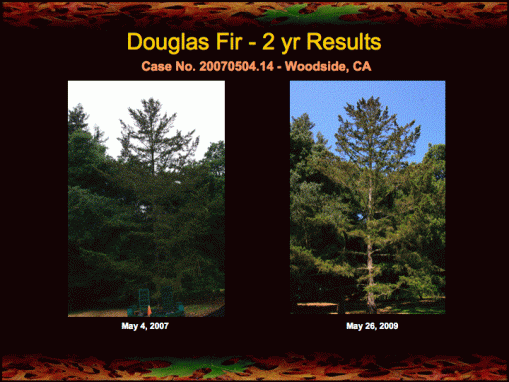
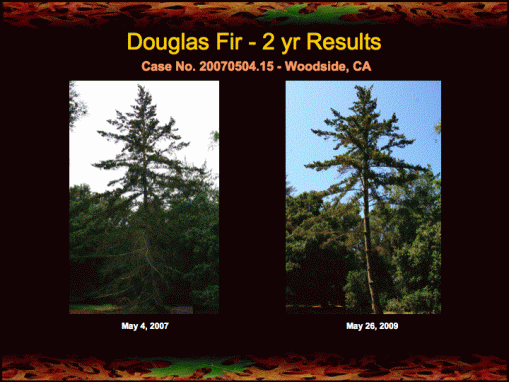
As some of you may have observed, it’s not just the oaks that are suffering here in California. Problems are seen in the pines, the bay laurels, the sycamores, and the redwoods. Douglas firs are sick and dying in many places, especially towards the coast. Symptoms such as a thin canopy, a heavy cover of cryptogams (mosses and lichens), and bark deterioration are consistent with problems in soil fertility due to fire suppression and systemic acidification.

Fire mimicry methods were applied to these two sick Douglas fir trees in Woodside, California in May of 2007, with some additional work in 2008. Below are the photos showing the canopy changes after two years. Sorry, no control trees here, the owners rightly want to keep all their trees healthy.20070504.1420070504.15


California Agriculture paper on Sudden Oak Death: Can conclusions of treatment efficacy be made in trials where n = 5?

27 05 2009

Earlier this year pathologists M. Garbelotto and D. Schmidt from the University of California at Berkeley published a paper in California Agriculture (a journal published by the University of California) in which they claim to have tested my holistic methods, and found that the application of “azomite soil amendment and bark lime wash was always ineffective, and did not reduce either growth or infection rates” of Phytophthora ramorum. Conversely, they report that “phosphonate treatments, legally registered in California to control sudden oak death, were effective in slowing both infection and growth rates”. They pretty much make it seem like it’s an open and shut case. But wait, there’s more. Read the rest of this entry »


KQED report on Sudden Oak Death: Fertilizing with minerals could have a “detrimental effect” on sick oaks

11 05 2009

Reporter David Gorn recently wrote on the KQED blog about Sudden Oak Death, relaying claims by UC Berkeley researcher Matteo Garbelotto that the mineral treatments I use are “like giving a glass of orange juice to someone with a terminal disease”. Furthermore, Garbelotto says that fertilizing with minerals could have a “detrimental effect” on sick oaks.

I have two questions:

What is the basis for these claims (no sources are given)? Why did the KQED reporter not do a balanced story?  Why was I not contacted by the reporter about these claims against my work?

I know, that’s three – still if anyone can help provide answers to these questions please leave a comment or email me. Let’s not speculate on motives here, just the facts.

UPDATE (May 27, 2009): David Gorn appears to be responding to my request for sources of the above claims in his KQED science blog comment here. He offers no apology for the glaring lack of balance in his piece. As for the claims I questioned him about, he writes:

“California Agriculture is a peer-reviewed academic journal. The research of Matteo Garbelotto is summarized here: http://calag.ucop.edu/0901JFM/resrchNews01.html”

The paper he seems to be referring to is “Phosphonate controls sudden oak death pathogen for up to 2 years” [California Agriculture, 63 (1): 10-17].

I’ll discuss this paper with regards to claims of inefficacy in a post following this update.

With regards to the claim that my treatments could have a “detrimental effect” on the oaks, no data or evidence is given in this paper. So I’m still left wondering if the “detrimental effect” claims have any scientific merit or basis.

This is not merely an academic matter. It’s time to resolve these differences. We need to take what we know and start helping the trees and soils. Countless oaks are at stake.


On the origins of fire scars in California redwoods

10 05 2009

UPDATE: For a more detailed discussion of the science and traditional knowledge on this subject please refer to Chapter 3 “The redwood giants” in my book Forged by Fire https://www.amazon.com/dp/B0D3ZVMB3P

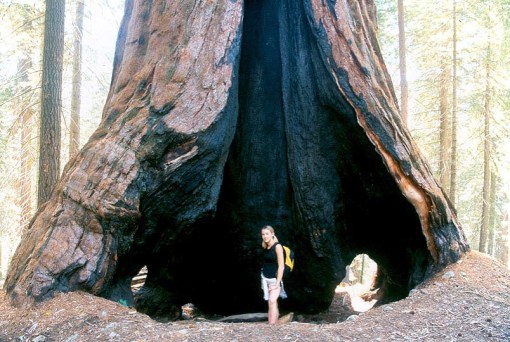
Anyone who has spent time with the redwoods has no doubt seen and even ventured inside the giant trees with fire-scarred trunks. Certain trees are so severely scarred that you wonder how they are even able to stand. Some trees contain cavernous fire-carved rooms in their base with multiple entrances and even window-like openings. I’ve marveled at these trees and looked carefully at the orientations and shapes of their scars, and in doing so have found some odd things.

Huge fire scar

Huge fire scar in giant sequoia (photo by Lee Klinger)

Having worked on fire lines in Alaska, Colorado, and California I’ve seen how fire scars are formed. A large quantity of fuel piled at the base of the tree is usually required to ignite a fire hot enough to penetrate the bark and scorch the cambium.

A characteristic burn pattern is seen on slopes where the vast majority of fire scars occur on the uphill face of the trunk (more than 90% in places)[1]. This is due to a couple of factors. First, hot air currents tend to drive ground fires upslope, especially during the day when fires burn hottest. (Keep in mind we’re talking about large ground fires, not large canopy fires which would more likely kill the tree.) The wind-driven fires tend to burn relatively quickly around the lower parts of the trunk, but eddy effects allow the fire to linger on the uphill side. Second, fallen leaves and branches tend to move downhill and accumulate on the uphill side of the trunk. Together these factors seem to account fairly well for the uphill side tendency of fire scars.

So imagine my confusion . . .  Read the rest of this entry »