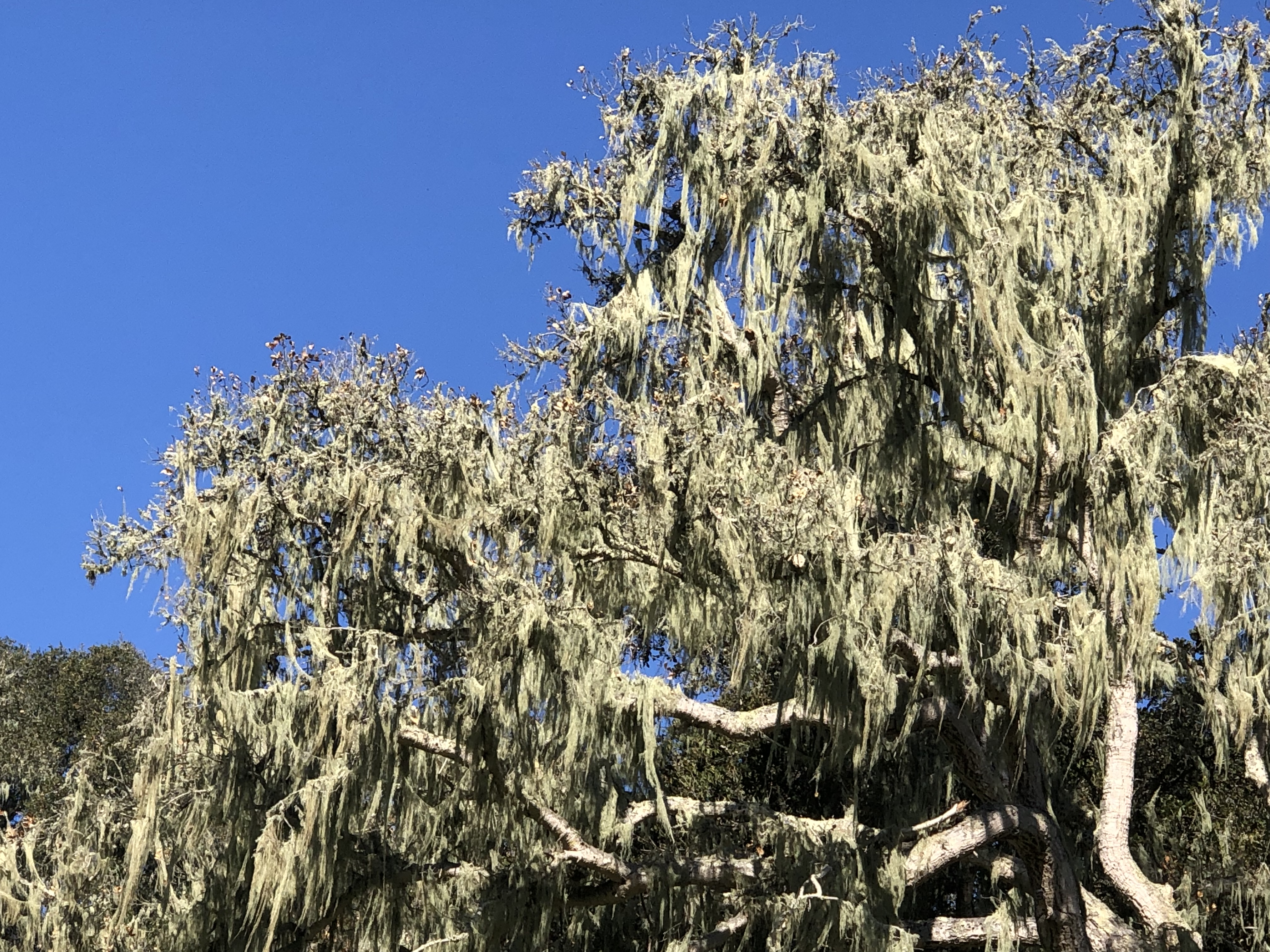
One of the most popular posts on this blog has been “Do lichens play a role in oak decline?” with nearly 4K views since it was published in 2018. With all those views I’m surprised that only a single reader has so far responded. It seems that photographing and identifying lichens is cool, but the ecology of lichens isn’t all that interesting to most folks.
Today I present readers a more detailed discussion on the ecology of epiphytic lichens and their possible effects on tree health. The following are excerpts from Chapter 6: The Cryptic Ecology of Mosses and Lichens, in my book “Forged by Fire: The Cultural Tending of Trees and Forests in Big Sur and Beyond”.

From p. 81 – “There are various beneficial roles that mosses and lichens serve in forest ecosystems. Their spongelike bodies hold an abundance of moisture that, upon evaporation, acts to cool the forest atmosphere. They also provide habitat for arboreal fauna such as salamanders and tree frogs, as well as offering nesting materials for birds and forage for deer. Mats of feathermosses on the forest floor provide stable, moist substrates for the germination of some, but not all, tree seedlings. Many moss and lichen species also support various kinds of cyanobacteria that fix nitrogen, thus providing an additional source of this essential nutrient to the forest ecosystem.
There are, however, properties of mosses and lichens that can pose problems for tree health and soil fertility. In their attempts to grow, lichens and mosses exude acidic compounds that break down substrates and free essential nutrients. Given that mosses and lichens are known for their ability to decompose rocks to form soils, one must wonder about the damage they may be doing to the bark and roots of living trees.”
From pp. 82-84 – “The Native People seem to have been well aware of the ecology of lichen epiphytes. Describing Native use of fire in the forests along the present-day Montana/Idaho border, an explorer’s journal from July 1860 states:
In returning, the Indian set fire to the woods himself, and informed us that he did it with the view to destroy a certain kind of long moss [not a moss but an epiphytic lichen] which is a parasite to the pine trees in this region, and which the deer feed in the winter season. By burning this moss [lichen] the deer are obliged to descend into the valleys for food, and thus (the Indians) have a chance to kill them.[i]
This account suggests that at least some Native Peoples recognized lichens as being harmful to trees. Furthermore, they understood that fire reduces lichen cover.
The earliest reports I can find on the harmful effects of lichens in the Western scientific literature come from D.C. Peattie who, in 1950, wrote about the long trailing beards of lichens that typically clothe old specimens of Monterey cypress. As he writes in his book The Natural History of Western Trees:
The Ramalina [Ramalina reticulata] is indeed an enemy of the Cypresses, for it smothers its foliage and, always gaining headway, eventually kills the tree without actually parasitizing it, but by a sort of suffocation.[ii]
And he goes on to morbidly describe a similar situation with nearby Monterey pines, also draped in R. reticulata lichens:
Though it is not a true parasite, but merely a perching plant, the lichen harms the Pines mechanically by shutting out the light and blanketing the leaves, so that boughs are smothered and starved to death, and sometimes whole trees may die from the high cost of playing host to this dependent.[iii]
Coast live oaks in this same region appear to be affected similarly (see first figure above).
More recent studies have examined the chemical and ecological effects of epiphytic lichens such as Evernia spp. and Usnea spp. and found that they and many other lichen species produce acids, namely evernic and usnic acids, which are known to have detrimental effects on trees, especially oaks. Findings specifically indicate that the lichen Evernia prunastri releases evernic acid into the xylem of Spanish oaks which inhibits both respiration and the appearance of foliar buds, as well as slowing leaf formation.[iv] Evernic acid is also tied to chlorophyll depletion and decreased photosynthetic activity in the leaves of holm oaks.[v] Other researchers report that lichen penetration through the bark produces clear symptoms of chlorosis and aging of leaves by injecting metabolic inhibitors, often inducing early abscission (i.e., leaf fall).[vi] With regard to usnic acid, studies have shown it, too, is a growth inhibitor that negatively affects root length, shoot length, and the root-to-shoot ratio of Scots pine and Norway spruce seedlings.[vii]
Given that lichens are sources of acidic compounds known to have direct impacts on trees, I wondered whether there might be other, indirect impacts of lichens in forests. Specifically, I asked: Could acidification of canopy throughfall, caused by lichen substances absorbed by rainwater, enhance the leaching of nutrient cations from the forest soils below? To me this seemed quite plausible, so I performed a cursory experiment.
In the late summer of 2004, while visiting my dear friend Jeff “Willy” Wilson who lives along the Rogue River in Oregon, I tried a simple test on the epiphytic lichens growing on his sick Oregon white oak trees. Using a high-quality pH meter with buffered standards, I first determined the pH of the distilled water used as a solution. It measured 5.6, typical also of atmospheric precipitation. I then added a handful of lichens (Usnea sp.) gathered from the branches of Willy’s white oaks and remeasured the pH of the solution after a few minutes. This time the pH read 3.6, about two orders of magnitude more acidic than the original solution. From this I concluded that lichens likely do release acidic compounds during precipitation events.
I have searched the lichen literature and reached out to the professional lichenology community, but have found no works that demonstrate, as is often claimed, a benign effect of lichens on trees. Considering the reports described above on the detrimental impacts of lichens, both direct and indirect, it seems fair to say that excessive lichen cover can and does harm trees.
[i] Barrett and Arno (1999), p. 52.
[ii] Peattie (1950), p. 242.
[iii] Peattie (1950), p. 118.
[iv] Legaz et al. (1988).
[v] Orús et al. (1981); Ascaso and Rapsch (1986).
[vi] Legaz et al. (2004).
[vii] Pizňak and Bačkor (2019); Pizňak et al. (2019).
Ascaso, C., Rapsch, S., 1986. “Ultrastructural changes in chloroplasts of Quercus rotundifolia Lam. in response to evernic acid.” Annals of Botany 57, 407–413. https://doi.org/10.1093/oxfordjournals.aob.a087123
Barrett, S.W., Arno, S.F., 1999. “Indian fires in the Northern Rockies,” in: Boyd, R. (Ed.), Indians Fire and the Land in the Pacific Northwest. Corvallis: Oregon State University Press, pp. 50–64.
Legaz, M.E., Monsó, M.A., Vicente, C., 2004. “Harmful effects of epiphytic lichens on trees.” Recent Research Developments in Agronomy and Horticulture 1, 1–10.
Legaz, Me., Perez-Urria, E., Avalos, A., Vicente, C., 1988. “Epiphytic lichens inhibit the appearance of leaves in Quercus pyrenaica.” Biochemical Systematics and Ecology 16, 253–259. https://doi.org/10.1016/0305-1978(88)90002-6
Orús, M.I., Estévez, M.F., Vicente, C., 1981. “Manganese depletion in chloroplasts of Quercus rotundifolia during chemical simulation of lichen epiphytic states.” Physiologia Plantarum 52, 263–266. https://doi.org/10.1111/j.1399-3054.1981.tb08503.x
Peattie, D.C., 1950. A Natural History of Western Trees. Lincoln: University of Nebraska Press.
Pizňak, M., Bačkor, M., 2019. “Lichens affect boreal forest ecology and plant metabolism.” South African Journal of Botany 124, 530–539. https://doi.org/10.1016/j.sajb.2019.06.025
Pizňak, M., Kolarčik, V., Goga, M., Bačkor, M., 2019. “Allelopathic effects of lichen metabolite usnic acid on growth and physiological responses of Norway spruce and Scots pine seedlings.” South African Journal of Botany 124, 14–19. https://doi.org/10.1016/j.sajb.2019.04.011


 Sudden Oak Life by Lee Klinger
Leave a comment