The Marin Waldorf School is hosting a Sudden Oak Life workshop on Saturday, April 2, 2011 from 10:30 am to 2 pm. I will be presenting information on the science and practice of fire mimicry techniques (including a demonstration) in the care of oaks and other trees. Marin Waldorf School is located at 755 Idylberry Rd. in San Rafael, CA. This “hands on” event is open to the public and the cost is $30, with a sliding scale. Please RSVP with the school front office at 415-479-8190.
Sudden Oak Life workshop in Marin
24 03 2011Comments : Leave a Comment »
Categories : Announcements, Fire mimicry, Oak health, Sudden Oak Death
Press coverage of the Hidden Villa Workshop
2 02 2011
Arborists gather at Hidden Villa for a workshop on organic methods of preventing sudden oak death. Photo by Pam Walatka
Published Monday, January 31, 2011 in the Los Altos Patch:
An Ecological Approach to Sudden Oak Death Prevention
A workshop with Lee Klinger promotes fire-mimicking techniques to help oak trees survive, without burning a thing.
In workshops offered recently by Hidden Villa, ecologist Lee Klinger demonstrated ways to prevent Sudden Oak Death. If you’ve driven through our hills and noticed whole oaks turned brown and dead, you may be looking at an example of this blight on our oak trees.
Klinger’s method mimics the effects of forest fires. His theory is that oaks are fire-adapted and thus need periodic fires to remain healthy.
“Fire replenishes minerals, removes competition and reduces sources of acidity such as mosses and lichens.” With Sudden Oak Death, the plant pathogen, Phytophthora ramorum, attacks the trees through the trunks.
To mimic the effects of forest fires, he recommends cutting back underbrush that crowds the tree, removing mosses and lichens from the trunk of the oaks, spraying the tree trunk with lime, adding minerals to the soil and topping with compost and mulch.
Klinger heads an organization called Sudden Oak Life, which promotes a soil-replenishing method to promote healthy, natural forest conditions. Many local arborists and land managers attended the first workshop; the second workshop was for nonprofessionals.
I watched Klinger demonstrate his method on a big, old oak tree at Hidden Villa. First he used loppers to cut back underbrush that was crowding the tree. Then he used a gallon-sized scoop to take minerals out of a bucket and spread them under the tree, advising workshop participants to keep looking up to see that they were covering beyond the drip line (the outer-most edges of the tree). He said that the roots often extend beyond the drip line.
Then he used a hand-pump sprayer to thoroughly coat the tree trunk (as high as he could reach with the sprayer) with a mixture of hydrated lime, sea salt and milk—making sure to get into all the cracks in the trunk bark.
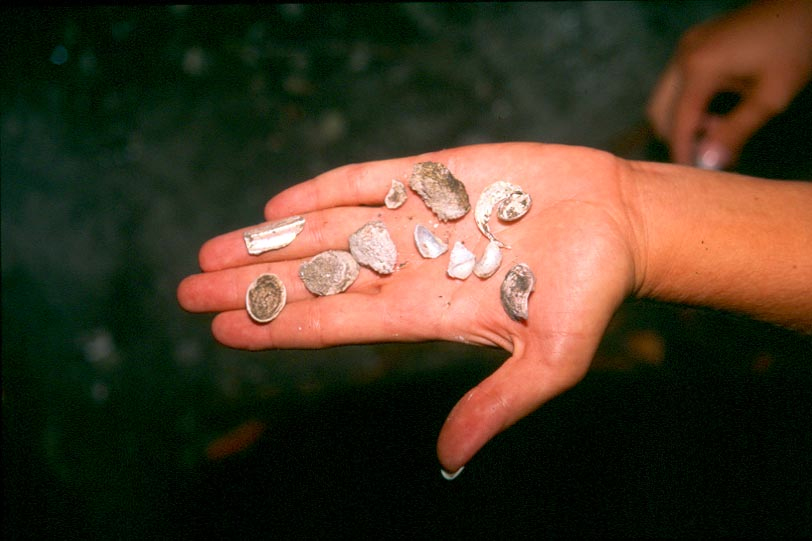
He used a wheelbarrow to mix the minerals: azomite, oyster shell calcium, and rock phosphate. For a very large tree, shoveling these minerals from the wheelbarrow is an alternative to using buckets and scoops.
Klinger recommended watering deeply after spreading the minerals, rather than digging the minerals into the ground.
After the minerals, for one big tree, he adds a cubic yard of manure-compost and then covers that with two or three cubic yards of mulch. He also adds compost tea.
“All the materials I use are natural fertilizers typically used in organic agriculture,” Klinger said. “The treatment I offer does not involve any synthetic chemicals, fungicides or pesticides.”
It seems to me that Klinger’s method is an organic, sustainable, ecologically sound way of preserving our native ancient giant beautiful oak trees.
For more information, see the Sudden Oak Life website, or contact: Lee Klinger, P.O. Box 664, Big Sur 93920. Phone: 831-917-7070. E;mail: lee@suddenoaklife.org
About This Column: Each week Pam Walatka will explore life in Los Altos Hills. Pam has lived in Los Altos Hills since 1978 and has been gardening organically and sustainably since 1968. Contact Pam at pamwalatka@yahoo.com or visit pamwalatka.com.
Comments : Leave a Comment »
Categories : Fire mimicry, Oak health, Sudden Oak Death
Toro Canyon oaks after two years of fire mimicry
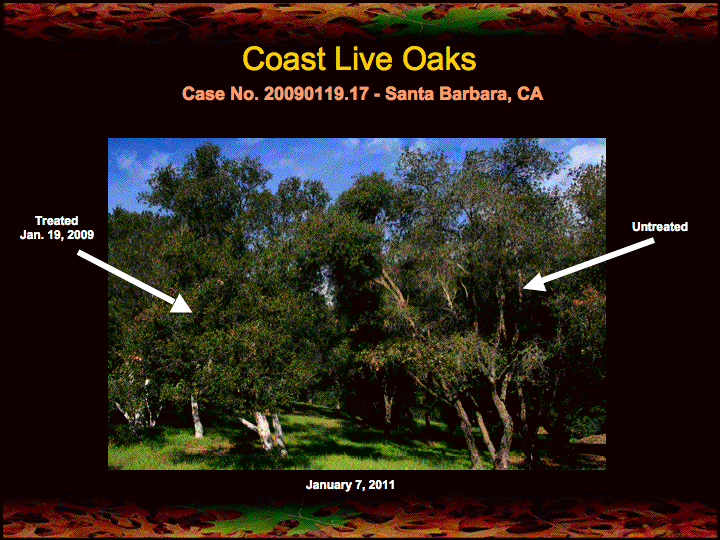
13 01 2011Coast live oaks in Toro Canyon new Santa Barbara were treated two years ago with fire mimicry. The photo comparisons are presented below. While these oaks have shown a very good response to the treatments, they are not significantly different from what was seen last year (see Toro Canyon oaks). This I believe is because the owner, upon seeing the good results after one year, opted to pass on the second-year treatments. The owner has now decided to schedule another round of treatments.
Comments : Leave a Comment »
Categories : Case studies, Fire mimicry, Oak health, Repeat photography, Sudden Oak Death
Hearst Castle oaks after five years of fire mimicry
13 01 2011Last week I visited Hearst Castle and re-photographed the oaks that have been undergoing treatments with fire mimicry for the past five years. Below are the results. Note that the last two oaks of this series are included as untreated controls. Last year’s results can be seen here.
Comments : 2 Comments »
Categories : Big Sur, Case studies, Fire mimicry, Oak health, Repeat photography
After five years of fire mimicry treatments . . .
17 11 2010Five years ago fire mimicry treatments were implemented to help the trees on this property in Hillsborough, CA. I’ll let the photos tell the rest of the story . . .
Comments : Leave a Comment »
Categories : Case studies, Fire mimicry, Oak health, Repeat photography, Sudden Oak Death
Six-year response of coast live oaks to fire mimicry
13 11 2010Last week I visited and re-photographed several coast live oaks that were initially treated with fire mimicry in 2004. You can follow the progress of these treatments in previous posts here and here. Leith Carstarphen of EcoLogic Landscaping has been doing the fire mimicry work under my direction, and as you can see from the photographs he is doing an excellent job on these trees.
Comments : 5 Comments »
Categories : Case studies, Fire mimicry, Oak health, Repeat photography, Sudden Oak Death
Sea shells to help sick pine trees
11 08 2010From the Daily Yomiuri Online (h/t Ralph):
Scallop shells may help save pine trees
The Yomiuri Shimbun
A fishing town in northeastern Miyagi Prefecture has turned to the lowly scallop to save its pine trees from a weevil blight.
Minami-Sanrikucho is experimentally grinding the shells of scallops, the town’s speciality, into nutrient-rich powdered fertilizer that it hopes will make the pines resistant to weevils.
The town has about 1,924 hectares of pine woods, but since around 1970 weevils have been badly damaging the trees, mainly in a coastal area of the town. About 20,000 damaged trees have been cut down.
Local residents fear not only that the blight may ruin one of the town’s scenic attractions, but that loss of the trees may result in landslides. Pine trees also absorb carbon dioxide, thus helping reduce global warming.
Since the blight began, the town office has spent about 10 million yen a year on such measures as spraying pesticide and cutting down withered trees, to little effect.
A town official heard that another municipality suffering from the same problem had found it effective to spread oyster shells as fertilizer on the soil in pine woods. Calcium and minerals contained in the shells promoted growth of the trees and made them strong enough to withstand the weevils.
Scallops are farmed in Minami-Sanrikucho, producing from three to five tons of shells that are thrown out every day. A marine products processing company in the town developed a technology to grind the shells into powder.
As powder made from scallop shells is finer than that from oyster shells, it can more easily permeate soil. Also, as the powder contains strongly alkaline calcium, it is expected to more effectively protect pine trees against the weevils.
On July 7, the town started the experiment using the new fertilizer. Town officials and local residents spread a total of 60 kilograms of the fertilizer around 22 dying red pine trees that are 57 years old. The town will check the condition of these trees every three months and spend two years monitoring the fertilizer’s effectiveness.
“I hope the pine woods will be revived and help curb global warming,” a 74-year-old resident in the town who helped spread the fertilizer said.
Comments : 5 Comments »
Categories : Fire mimicry, Pine health, Soil science
El Capitan oaks responding to fire mimicry
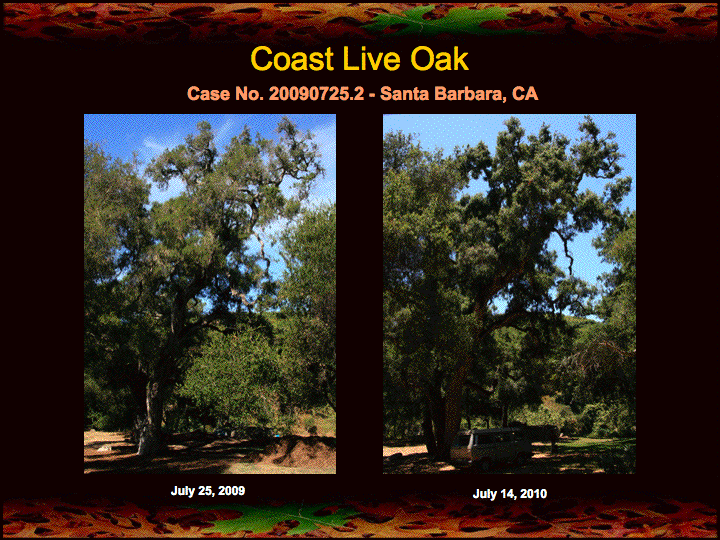
21 07 2010Last week I visited and re-photographed several coast live oaks near El Capitan Ranch outside of Santa Barbara that were treated last year with fire mimicry. Most of the oaks have shown significant improvement in canopy health in just one year. Here is a sample of the results:
Comments : Leave a Comment »
Categories : Case studies, Fire mimicry, Oak health, Repeat photography
Encino heritage oak – 2010 update
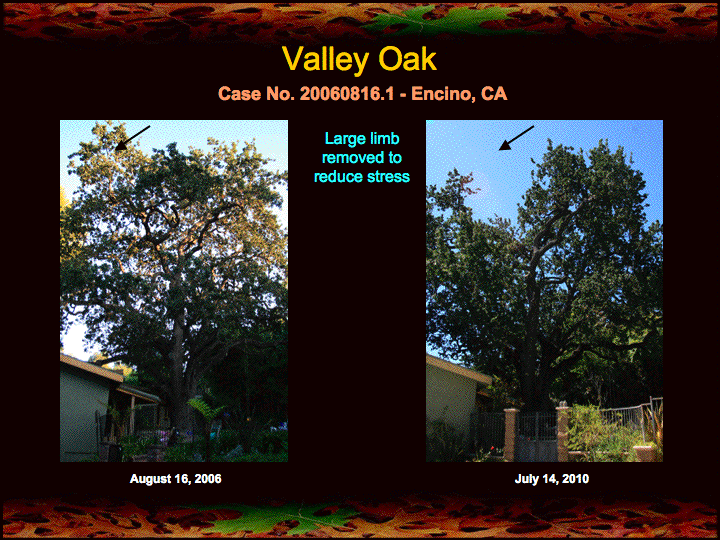
15 07 2010Yesterday I visited and tended a huge valley oak which, at about 500 years old, is possibly the oldest valley oak in Encino, CA. This oak appears to have been pollarded (pruned in a way that encourages broad, spreading branches) by the native people hundreds of years ago. Last year I posted a story about this Encino heritage oak, and presented photos that showed a significant improvement in the health of the tree in response to fire mimicry treatments.
We are now in the 4th year of fire mimicry treatments and the oak continues to show a very good response, as the photos below indicate:
Comments : Leave a Comment »
Categories : Case studies, Fire mimicry, Native people, Oak health, Repeat photography
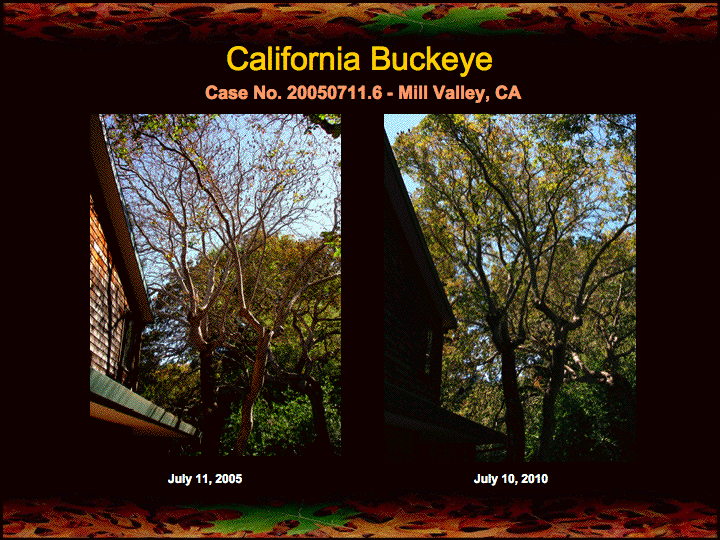
Five-year response of California buckeyes to fire mimicry
12 07 2010Last year I posted a piece on using fire mimicry to treat early leaf senescence in California buckeyes. A few days ago I checked up on these buckeyes and re-photographed them. As you can see in the photos posted here the buckeyes are continuing to show improvement after tending with fire mimicry practices.
When I first saw these trees in 2005 they appeared to be severely stressed due to soil acidification. The lawn areas around their base had a dense cover of mosses growing among the grasses. The mosses were removed by thatching the lawn areas and the soils were treated with several hundred pounds of soil minerals (Azomite and calcitic limestone).
These and other results (see here and here) are showing that the fire mimicry practices which are working so well in restoring the health of the oaks (see here, here, here, here, here, etc.) are also useful in restoring the health of other kinds of trees. This certainly makes sense if the problem is ecological (e.g. fire suppression, soil acidification, overcrowding, etc.) rather than pathological (e.g. disease, insect pests).
I encourage anyone who is interested in getting more information on the methods and services of tree care and forest restoration shown here to please contact me. Read the rest of this entry »
Comments : Leave a Comment »
Categories : Buckeye health, Case studies, Fire mimicry, Moss ecology, Repeat photography


Recent Comments