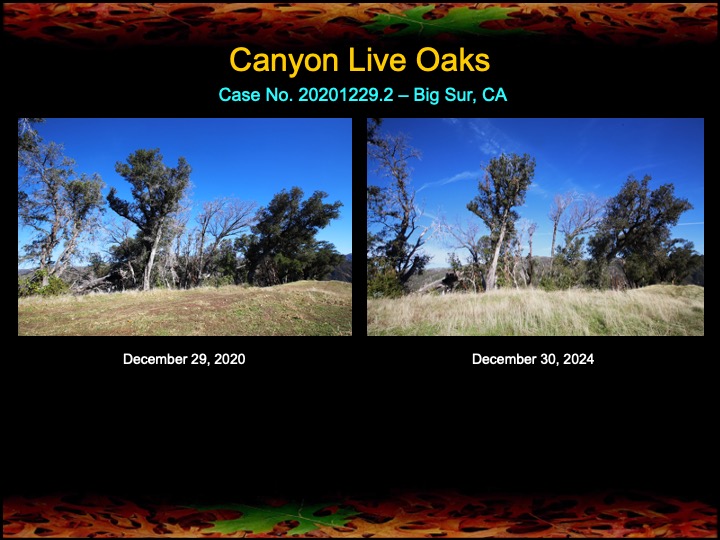
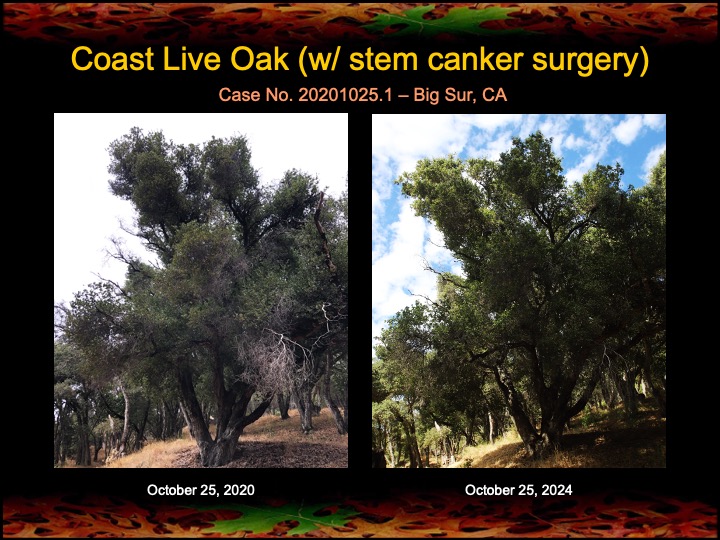
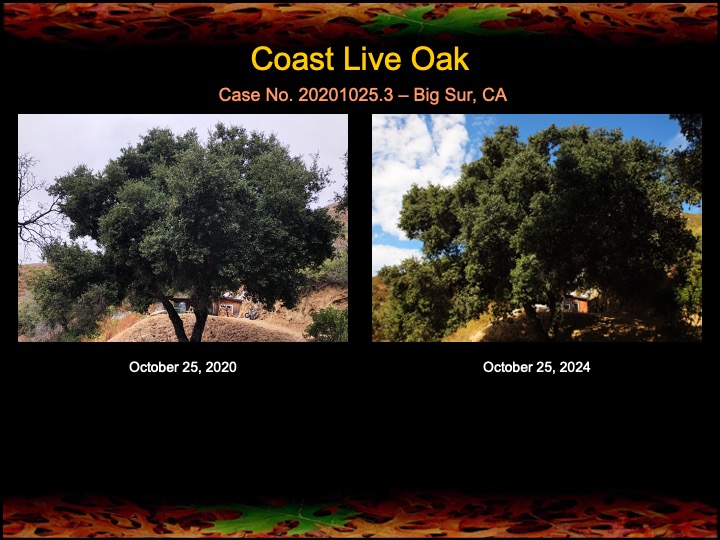
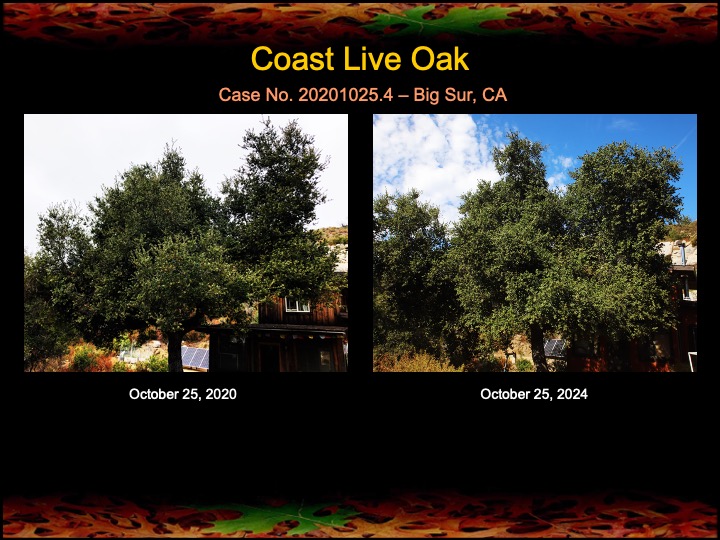
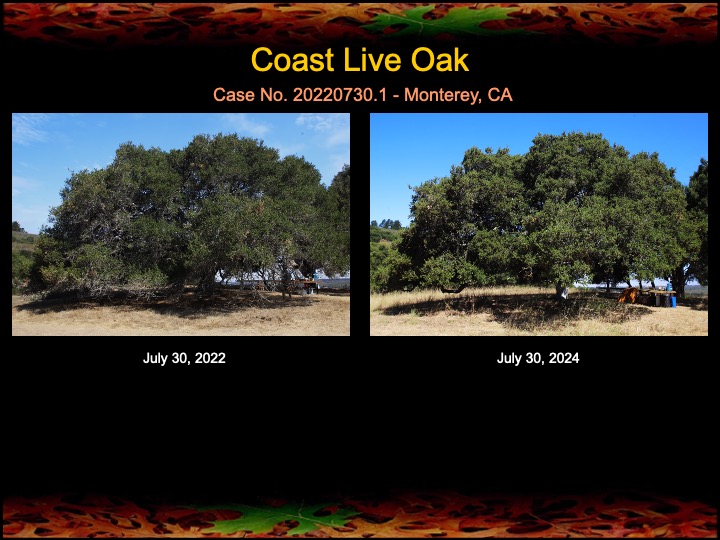
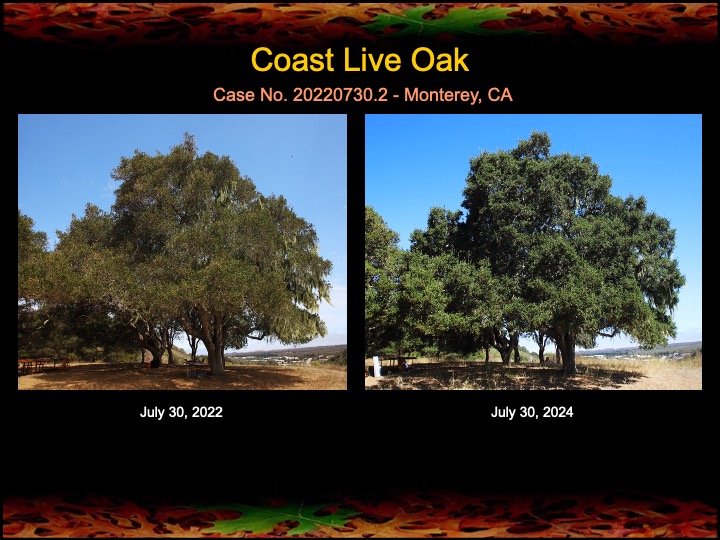
Yesterday I examined a grove of coast live oaks that have undergone fire mimicry treatments for the past five years. Some of these oaks are centuries old and show signs of being tended by the Native Awaswas People. Here are the latest before-and-after photos showing a significant increase in health of the canopy foliage in ALL of the treated oaks. Enjoy!
(The above photo set may appear to be of different locations, but they are both taken from nearly the same spot.)
Today’s KSQD show Talk of the Bay with host Christine Barrington features my work with the Esselen Tribe, and includes a few spoilers from my new book “Forged by Fire”.
With regards to the recent catastrophic wildfires burning in LA, please consider what I have to say. I am a survivor of a wildfire that burned here in Big Sur several years ago which, despite my fire-fighting skills, took my home. As a PhD scientist my understanding of the ecology of the California forests and their decline runs deep, which has proven useful in consulting with landowners on how to prevent the decline of their trees and reduce the fire hazard on their properties. I served for many years as a volunteer and paid firefighter and, with respect to climate change, I worked as a staff scientist for 14 years at the National Center for Atmospheric Research (NCAR). Currently I serve as the Staff Ecologist with the Esselen Tribe of Monterey County.
Climate change is so often invoked as the “cause” of these wildfire disasters, that it is hard for most folks to parse the more nuanced explanations of what is really going on. In my opinion, the wildfire problem in California and elsewhere has been hijacked by climate activists, who wish to divert the attention of wildfires to climate change, despite knowing that climate is only part of the problem. This emphasis on climate change leaves people with few real-world solutions to the wildfire problem. Buy a Tesla perhaps?
But the LA fires were preventable, without changing the climate. How do I know? Because of the real world work I do which has not only saved homes, it has also saved entire forests – and I didn’t change the climate!
To put it simply, in my opinion, if climate change was not happening, or even if we were able to stop or reverse climate change right now, these wildfires would still happen. Present day climate change may be exacerbating the frequency of these events, but the wildfires would still happen. Suppose we were to develop better firefighting technologies and skills, the wildfires would still happen. Let’s rebuild with more fireproof homes, well then maybe not so many homes would be lost, but the wildfires would still happen!
The catastrophic wildfires in California and elsewhere are NOT the result of an altered climatology, they are the result of an altered ecology. For thousands of years the forests, chaparral, and prairies of California were managed by the Native Peoples, mainly with fire. Now that the Native People have been largely removed, the lands are no longer being tended. This has resulted in rapid shifts in the succession of ecosystems. Prairie ecosystems are being invaded by chaparral and oak savannas are quickly becoming overcrowded oak forests.
Thankfully, the Native Peoples have solutions, which they are willing to share. Maybe it’s time to listen and learn!
Many are asking about my thoughts on the LA fires. I plan to eventually share these once the scope of the tragedy is better known. For now let me show some images depicting the transformation of the land of my youth. Even though this place is in Ohio, the ecological changes happening here are dramatic and relevant to the devastating fires currently burning in Los Angeles.
Historically, grasslands in Ohio were maintained by a combination of cultural burning by the Native Peoples and grazing by the native herbivores. After colonization, although there were fewer fires, the grasslands in many areas persisted mainly due to cattle grazing.
When I first arrived at my Uncle Huck and Aunt Joan’s southern Ohio farmhouse in the late 1950s it was surrounded by cattle pasture as far as I could see. I remember how my cousin Scooter and I would climb the fence and throw stones at the Brahma bull, who then charged at us until we safely retreated behind the fence. I will never forget being reprimanded by Aunt Joan after she eventually caught us. We never did THAT again.
Anyway the point of this post, besides allowing me to wax nostalgic, is the transformation I’ve observed on this land over my lifetime. Below are two photos of the Huck’s farmhouse, one from 1956 and the other from 2014 taken from nearly the same spot. Farmhouse is still there, but mostly hidden by trees. The photo from 2014 was taken after cattle grazing had ended in the early 1970s. All of the previously grazed areas are now either mowed to maintain the grasses or are covered in dense deciduous forests. That may be OK (for now) in the midwest, but here in California the SAME THING is happening, and that is not OK! Our lands need more tending!
I often tell people inquiring on how to best care for their oaks that doing nothing is not an option! It seems that most people see oaks as native trees of California that have adapted and endured here for thousands of years, so they should not need our care.
Missing from this understanding is that the great oak forests here are the result of thousands of years of care by the Native Peoples. That is why those of us who know this are tending the oaks with fire and/or fire mimicry and seeing clear improvement in their health. Indeed, most of the information on this blog addresses mainly the positive results of tending trees.
But what happens to oaks when we do nothing?
Here I present four-year photo sets of numerous canyon live (Valparaiso) oaks where nothing has been done, save for one oak that received a partial fire mimicry treatment in January of 2021. Most of the oaks are showing noticeable decline in canopy leaf density, a fair measure of the trees’ overall health. Several show no clear change in canopy density, and one or two seem to have improved over the past four years.
Can anyone guess which of these oaks received a partial fire mimicry treatment?
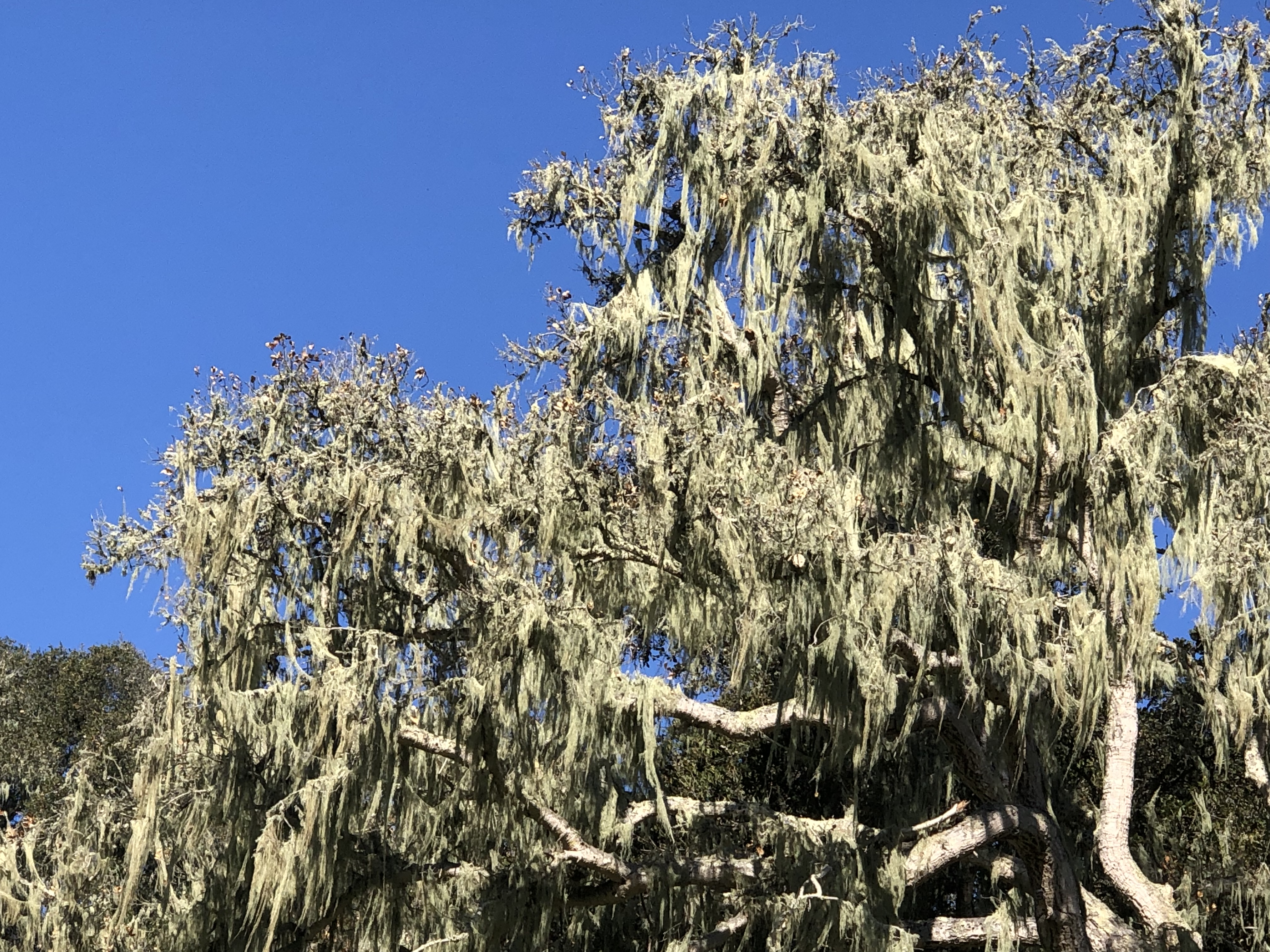
Dying coast live oak, centuries old, “smothered” in Ramalinareticulata and Usnea sp. lichens.
One of the most popular posts on this blog has been “Do lichens play a role in oak decline?” with nearly 4K views since it was published in 2018. With all those views I’m surprised that only a single reader has so far responded. It seems that photographing and identifying lichens is cool, but the ecology of lichens isn’t all that interesting to most folks.
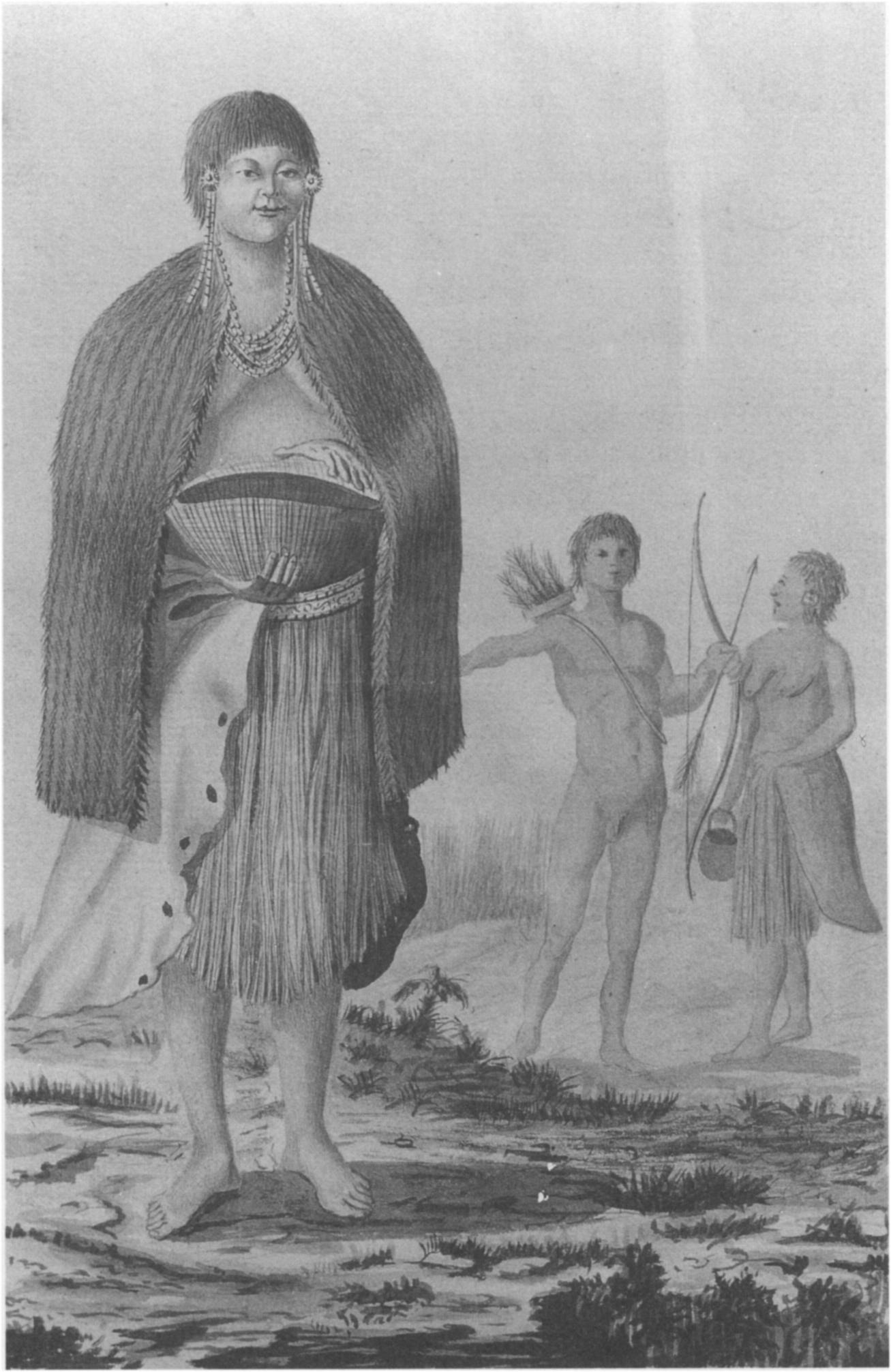
For thousands of years the Native Peoples living here along the central coast of California, the Esselen and the Rumsen (Figure 1), tended the lands with cultural fire and other management practices, creating mosaics of oak forests, redwood forests, savannas, chaparral, and scores of other land and marine ecosystems, which together helped sustain the People, the plants, and the wildlife. Over time, the lowlands and hillsides surrounding Monterey Bay, like in many other places in California, came to be dominated by old-growth oak forests and woodlands, as these provided rich sources of acorns and other important foods.
Figure 1. Native Indians of the Monterey, California area circa 1791 as drawn by José Cardero.
On the evening of December 16, 1602, this all began to change when the first western colonizers, the Spanish Vizcaino Expedition, sailed into Monterey Bay (Figure 2). They were, no doubt, noticed by the nearby Rumsen People, but it wasn’t until the next day that first contact was made. That morning, Ensign Alarcon arrived in a landing boat with orders from the admiral to “make a hut where a mass could be said and to see if there was water, and what the country was like.” He soon reported back that there was fresh water and “a great oak near the shore”, where a hut and arbor were prepared for mass. Upon hearing this news Sebastian Vizcaino and crew embarked to shore and a Catholic mass was said at the improvised altar under this “great oak.”
Here are four coast live oaks and a black oak we treated back in 2020. Some additional surgery was done in 2022 to remove lingering canker infections on the oak above. While the above ancestor oak (300+ years old) is still diseased, further surgery and fire mimicry treatments should keep it alive for decades.
There’s a special place near Monterey that is an oak lover’s dream – over 600 acres of undeveloped, intact old-growth oak forest and savanna, never burned, that I’ve been commissioned to tend. In 2022 I surveyed about 25% of the property and identified over 200 ancient, culturally-modified coast live oaks (“ancestor” oaks) that date from the time when the Rumsen-Ohlone Indians were the sole human occupants of the land (> 300 years old). Every one of these oaks is a living cultural artifact of the Rumsen-Ohlone People. I’m guessing there may be nearly 1000 “ancestor” oaks on the property, many of which are over 500 years old. Thus, I refer to this place as “The Old Oaks Home”.
These ancient oaks are in a precarious situation. Given that fires have not burned here in well over 100 years, the forests are now overcrowded with young oaks and the grassland savannas have been mostly replaced by chaparral. A single spark could end the lives of hundreds of these ancient beings in just a day or two. So far, luck has been on the side of these elders, but their luck is running out for every year we postpone care.
In lieu of fire, I have been applying fire mimicry treatments to several of the ancestor oaks over the past couple years and am seeing a significant improvement in the density and lushness of the canopies of these trees. The above and below photos show the treated oaks today, compared to their appearance two years ago. Enjoy!
The CBS Saturday Morning News show ran a segment on the work that Little Bear (Chairman of the Esselen Tribe), I, and others are doing to restore the forests in Big Sur. Here is the CBS link to that well-done piece of reporting:









 Sudden Oak Life by Lee Klinger
Recent Comments