Fire mimicry practices, which involve clearing (shrubs and young trees, especially bays), pruning, trunk care, and amending soils with mineral and organic rich fertilizers, are continuing to have a positive effect on sick oaks here in California. Below are some repeat photography results for several coast live oaks in Carmel, Pebble Beach, Santa Barbara that have been treated with fire mimicry for three years. The main caveat is that the oaks in these pictures, while ill, are not severely diseased. The oaks that are severely diseased are not faring as well. Scroll down to see the results.
Oak restoration results with fire mimicry
7 06 2011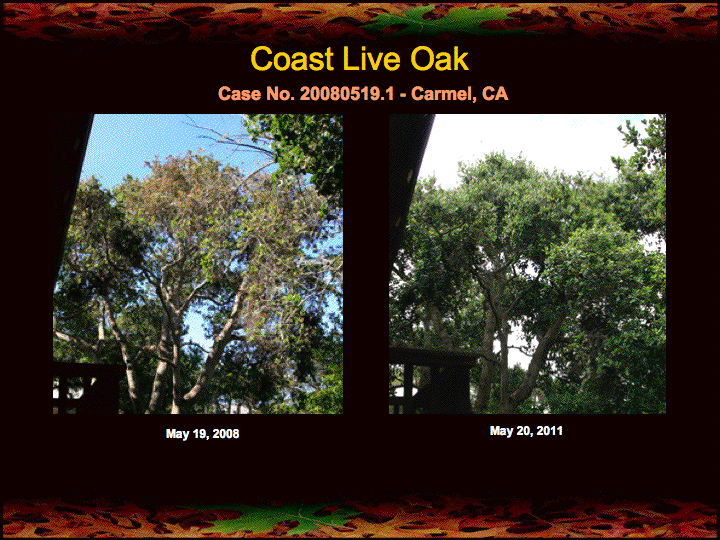
Comments : 2 Comments »
Categories : Case studies, Fire mimicry, Oak health, Repeat photography, Sudden Oak Death
Grandfather oak – April 2011 update
15 05 2011Last April I reported on the progress being made in helping ‘grandfather oak‘, a very old and diseased coast live oak on King Mountain in Marin Open Space. I returned this past April along with a small contingent of volunteers to continue the efforts we started 3.5 years ago. We cleared the genista, poison oak, and small bays, fertilized with Azomite, oyster shell flour, and soft rock phosphate, and applied a lime spray to the trunk. Below is a photo of all the volunteers. They are (from left to right) Kathleen Cannon, John Furnas, Roger Diehnel, Greg Reza (Parks & Open Space Volunteer Coordinater), Dick Gale, Donna Shoemaker (project leader), and Carl Thoelicke.

Volunteers caring for Grandfather Oak
Our efforts for Grandfather Oak are not about treating any disease or pests. Indeed, the oak is probably well past being cured of sudden oak death. This is an attempt to give this oak a fighting chance to extend its life and live out the remainder of its years in a healthier, more nourishing state.
The photos below show that, indeed, our efforts seem to be helping. Read the rest of this entry »
Comments : Leave a Comment »
Categories : Case studies, Fire mimicry, Oak health, Repeat photography, Sudden Oak Death
Sudden Oak Life workshop resources
2 04 2011Thanks to all the interested homeowners and tree professionals who attended my workshop today at Marin Waldorf School. As promised, here are the links to some of the papers and books discussed in my talk. Enjoy!
Forest vegetation and soil succession
A 2009 scientific paper by L. Klinger Read On>>
A holistic approach to mitigating pathogenic effects on trees
A 2008 scientific paper by L. Klinger Read On >>
Bryophytes and soil acidification effects on trees: the case of Sudden Oak Death
A 2005 scientific paper by L. Klinger Read On >>
Examining the relationship between fire history and sudden oak death patterns
A scientific paper by M. Moritz and D. Odion Read On >>
Ecological evidence for large-scale silviculture by California Indians (Chapter 6)
by L. Klinger; in Unlearning the Language of Conquest edited by Four Arrows Read On >>
Tending the wild
An excellent book by M Kat Anderson Read On>>
Comments : Leave a Comment »
Categories : Announcements, Fire mimicry, Oak health, Sudden Oak Death
Sudden Oak Life workshop in Marin
24 03 2011
Applying fire mimicry methods on a sick coast live oak. Photo by Lee Klinger.
The Marin Waldorf School is hosting a Sudden Oak Life workshop on Saturday, April 2, 2011 from 10:30 am to 2 pm. I will be presenting information on the science and practice of fire mimicry techniques (including a demonstration) in the care of oaks and other trees. Marin Waldorf School is located at 755 Idylberry Rd. in San Rafael, CA. This “hands on” event is open to the public and the cost is $30, with a sliding scale. Please RSVP with the school front office at 415-479-8190.
Comments : Leave a Comment »
Categories : Announcements, Fire mimicry, Oak health, Sudden Oak Death
Press coverage of the Hidden Villa Workshop
2 02 2011
Arborists gather at Hidden Villa for a workshop on organic methods of preventing sudden oak death. Photo by Pam Walatka
Published Monday, January 31, 2011 in the Los Altos Patch:
An Ecological Approach to Sudden Oak Death Prevention
A workshop with Lee Klinger promotes fire-mimicking techniques to help oak trees survive, without burning a thing.
In workshops offered recently by Hidden Villa, ecologist Lee Klinger demonstrated ways to prevent Sudden Oak Death. If you’ve driven through our hills and noticed whole oaks turned brown and dead, you may be looking at an example of this blight on our oak trees.
Klinger’s method mimics the effects of forest fires. His theory is that oaks are fire-adapted and thus need periodic fires to remain healthy.
“Fire replenishes minerals, removes competition and reduces sources of acidity such as mosses and lichens.” With Sudden Oak Death, the plant pathogen, Phytophthora ramorum, attacks the trees through the trunks.
To mimic the effects of forest fires, he recommends cutting back underbrush that crowds the tree, removing mosses and lichens from the trunk of the oaks, spraying the tree trunk with lime, adding minerals to the soil and topping with compost and mulch.
Klinger heads an organization called Sudden Oak Life, which promotes a soil-replenishing method to promote healthy, natural forest conditions. Many local arborists and land managers attended the first workshop; the second workshop was for nonprofessionals.
I watched Klinger demonstrate his method on a big, old oak tree at Hidden Villa. First he used loppers to cut back underbrush that was crowding the tree. Then he used a gallon-sized scoop to take minerals out of a bucket and spread them under the tree, advising workshop participants to keep looking up to see that they were covering beyond the drip line (the outer-most edges of the tree). He said that the roots often extend beyond the drip line.
Then he used a hand-pump sprayer to thoroughly coat the tree trunk (as high as he could reach with the sprayer) with a mixture of hydrated lime, sea salt and milk—making sure to get into all the cracks in the trunk bark.
He used a wheelbarrow to mix the minerals: azomite, oyster shell calcium, and rock phosphate. For a very large tree, shoveling these minerals from the wheelbarrow is an alternative to using buckets and scoops.
Klinger recommended watering deeply after spreading the minerals, rather than digging the minerals into the ground.
After the minerals, for one big tree, he adds a cubic yard of manure-compost and then covers that with two or three cubic yards of mulch. He also adds compost tea.
“All the materials I use are natural fertilizers typically used in organic agriculture,” Klinger said. “The treatment I offer does not involve any synthetic chemicals, fungicides or pesticides.”
It seems to me that Klinger’s method is an organic, sustainable, ecologically sound way of preserving our native ancient giant beautiful oak trees.
For more information, see the Sudden Oak Life website, or contact: Lee Klinger, P.O. Box 664, Big Sur 93920. Phone: 831-917-7070. E;mail: lee@suddenoaklife.org
About This Column: Each week Pam Walatka will explore life in Los Altos Hills. Pam has lived in Los Altos Hills since 1978 and has been gardening organically and sustainably since 1968. Contact Pam at pamwalatka@yahoo.com or visit pamwalatka.com.
Comments : Leave a Comment »
Categories : Fire mimicry, Oak health, Sudden Oak Death
Toro Canyon oaks after two years of fire mimicry
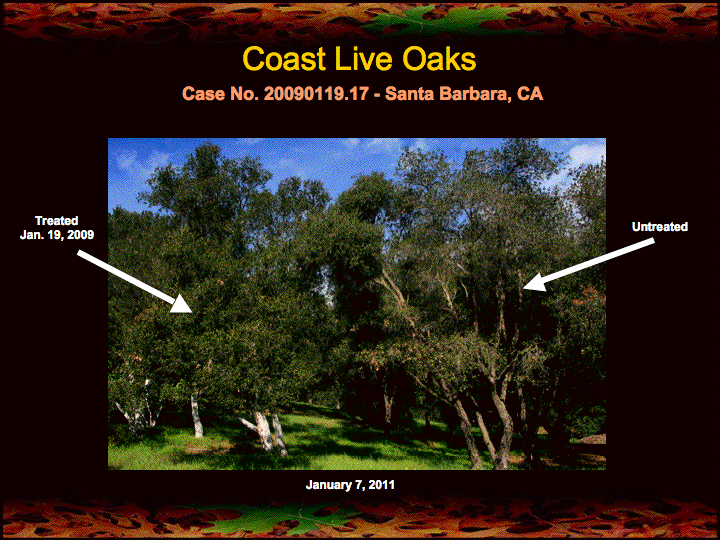
13 01 2011Coast live oaks in Toro Canyon new Santa Barbara were treated two years ago with fire mimicry. The photo comparisons are presented below. While these oaks have shown a very good response to the treatments, they are not significantly different from what was seen last year (see Toro Canyon oaks). This I believe is because the owner, upon seeing the good results after one year, opted to pass on the second-year treatments. The owner has now decided to schedule another round of treatments.
Comments : Leave a Comment »
Categories : Case studies, Fire mimicry, Oak health, Repeat photography, Sudden Oak Death
Hearst Castle oaks after five years of fire mimicry
13 01 2011Last week I visited Hearst Castle and re-photographed the oaks that have been undergoing treatments with fire mimicry for the past five years. Below are the results. Note that the last two oaks of this series are included as untreated controls. Last year’s results can be seen here.

Comments : 2 Comments »
Categories : Big Sur, Case studies, Fire mimicry, Oak health, Repeat photography
Message from an arborist
13 01 2011Yesterday I received this email from Don Cox, an arborist who has been involved with the Sudden Oak Death problem since the very beginning. He has agreed to let me post it here:
Dear Dr. Klinger,
As a California arborist involved with the “Sudden Oak Death” syndrome since 1995, I have been aware of your work in this area. I know you are on the right track with ‘Sudden Oak Life’ and mineralization of the soils.
Since the 1990’s even before we had a positive ID of P. ramorum as a primary factor in SOD and the emphasis was directed on the pathogen as the primary cause, I believed that there was a complex set of circumstances for the advance of this species decline. I saved some significant trees for my clients in the midst of SOD killing fields of Marin, Sonoma and Santa Cruz counties, with a comprehensive PHC (plant health care) approach including soil re-mineralization. I see that you have taken up this comprehensive approach with soil health as the focus and you have had the determination to stick with your convictions in spite of the opposition.
I’ve been reviewing the Sudden Oak Life website and the results you are getting with your tree care programs; you have a lot of good information there. Keep up the good work.
ISA Certified Arborist WE-3023A, Tree Maintenance and Plant Health Care Advisor
Don has pointed me to two important websites:
soilminerals.com – which has a wealth of information on the use of minerals to improve plant health and soil fertility
treesolutions.com – with information and services on health care for trees of the Central Coast of California
Thank you Don for your support of a broader, more ecological approach in addressing Sudden Oak Death.
Comments : 1 Comment »
Categories : Oak health, Soil science, Sudden Oak Death, Testimonials
Oak health workshops at Hidden Villa
31 12 2010In late January I will be giving two workshops on oak health at Hidden Villa, an educational wilderness preserve in Los Altos Hills, CA. The workshop on January 27 (Thursday) will be tailored for tree and land care professionals, and the workshop on January 29 (Saturday) will be for the public. Please see the flyer below for full details. Information can also be found on the Hidden Villa website calendar page. Feel free to leave a comment below if you have any questions for me directly, or email me (see Contacts page).

Comments : Leave a Comment »
Categories : Announcements, Oak health, Soil science, Sudden Oak Death
After five years of fire mimicry treatments . . .
17 11 2010Five years ago fire mimicry treatments were implemented to help the trees on this property in Hillsborough, CA. I’ll let the photos tell the rest of the story . . .

Comments : Leave a Comment »
Categories : Case studies, Fire mimicry, Oak health, Repeat photography, Sudden Oak Death
 Sudden Oak Life by Lee Klinger
Recent Comments