Last week I visited and re-photographed several coast live oaks that were initially treated with fire mimicry in 2004. You can follow the progress of these treatments in previous posts here and here. Leith Carstarphen of EcoLogic Landscaping has been doing the fire mimicry work under my direction, and as you can see from the photographs he is doing an excellent job on these trees.
Six-year response of coast live oaks to fire mimicry
13 11 2010
Comments : 5 Comments »
Categories : Case studies, Fire mimicry, Oak health, Repeat photography, Sudden Oak Death
El Capitan oaks responding to fire mimicry
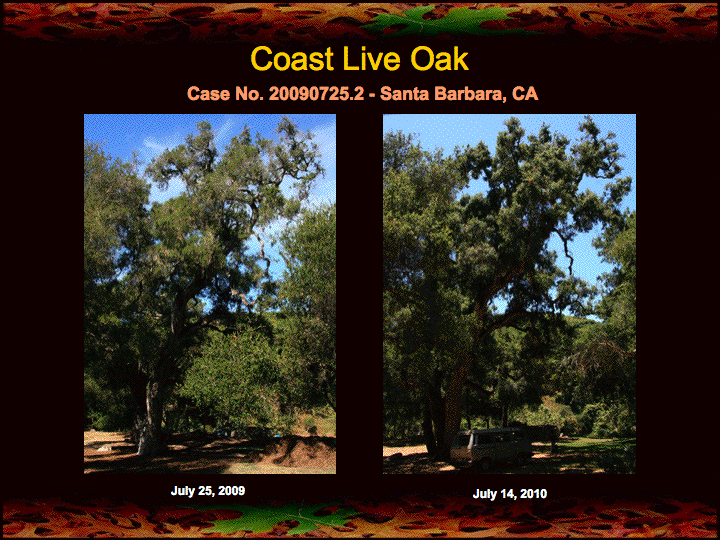
21 07 2010Last week I visited and re-photographed several coast live oaks near El Capitan Ranch outside of Santa Barbara that were treated last year with fire mimicry. Most of the oaks have shown significant improvement in canopy health in just one year. Here is a sample of the results:
Comments : Leave a Comment »
Categories : Case studies, Fire mimicry, Oak health, Repeat photography
Encino heritage oak – 2010 update
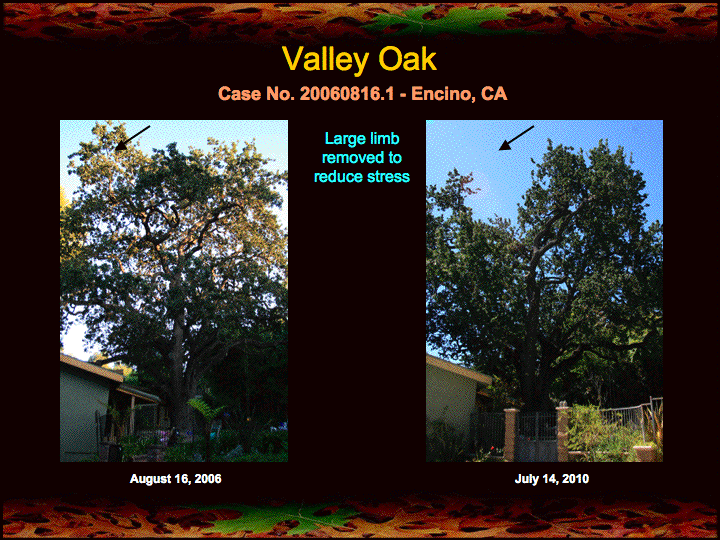
15 07 2010Yesterday I visited and tended a huge valley oak which, at about 500 years old, is possibly the oldest valley oak in Encino, CA. This oak appears to have been pollarded (pruned in a way that encourages broad, spreading branches) by the native people hundreds of years ago. Last year I posted a story about this Encino heritage oak, and presented photos that showed a significant improvement in the health of the tree in response to fire mimicry treatments.
We are now in the 4th year of fire mimicry treatments and the oak continues to show a very good response, as the photos below indicate:
Encino heritage oak
Comments : Leave a Comment »
Categories : Case studies, Fire mimicry, Native people, Oak health, Repeat photography
Using repeat photography to assess the response of oaks to fire mimicry
12 06 2010Last week I checked up on some oaks in Santa Barbara that have been undergoing fire mimicry treatments for the past two years. One way I assess the change in health of a tree is through repeat photography analysis of the tree’s canopy. Repeat photography is not as simple as it seems. Photographs are taken at the time the oaks are first treated. Subsequent photos are taken at annual intervals, meaning I get to visit the trees I treat every year, year-after-year. It’s quite a commitment to schedule yearly visits to all the oaks I’ve treated. In re-photographing the trees it is important to match the time of year, time of day, sky condition, camera angle, and exposures as closely as possible to the original photos. I don’t get it precise every time, but I do my best. Changes in tree health can be detected in the photographs as increases or decreases in canopy density (the amount of background sky seen through the canopy), and in changes in the amount of gray or brown foliage vs. green foliage.
Below are the results of the repeat photography analysis of the canopy health in the Santa Barbara oaks I visited last week . . .

Comments : Leave a Comment »
Categories : Case studies, Fire mimicry, Oak health, Repeat photography
Monterey Bay area oaks responding to fire mimicry
14 05 2010Yesterday I went to check on some sick coast live oaks in the Monterey Bay area that have been undergoing fire mimicry treatments for the past two years. The results I believe are encouraging . . .

Comments : Leave a Comment »
Categories : Case studies, Fire mimicry, Oak health
Acute Oak Decline in the UK – Part 2
30 04 2010In my previous post on Acute Oak Decline I posed the question of whether ecological factors are predisposing oaks to this “new” disease. My concern is that research groups led by the plant pathologists will remain focused on the disease model and not consider the ecology of the problem. I encourage scientists studying Acute Oak Decline to pause for a moment, take a breath, and consider things like rain pH, soil fertility, and ecosystem structure before launching into a costly vortex of biological studies on whatever bacterial species is determined to be the “cause”.
In this post I would like to present some preliminary findings of soil fertility in a stand of diseased and non-diseased English oaks (Quercus robur) in Bushy Park, London, UK. Several oaks showed bleeding symptoms characteristic of Acute Oak Decline (see photos below), although the bacterial species was not positively ID’d.

English oak with Acute Oak Decline in Bushy Park, London (photo by Lee Klinger)

Closeup view of Acute Oak Decline bleeding symptoms. Note deep cracks in the bark. (photo by Lee Klinger)
Upon inspecting the soils I noticed that near the diseased trees there were large mats of mosses, whereas few mosses were found around the non-diseased oaks. Having a strong interest in the influence that mosses may have on soil fertility, and thus oak health, I, along with Neville Fay of Treework Environmental Practice and Vinodh Krishnamurthy of Soil Foodweb Lab Services and Research, devised a simple test. Read the rest of this entry »
Comments : Leave a Comment »
Categories : Acute Oak Decline, Moss ecology, Oak health, Soil science
Acute Oak Decline in the UK – Part 1
29 04 2010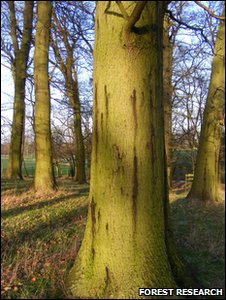
Acute Oak Decline (photo from BBC)
Yesterday the BBC ran a story on Acute Oak Decline in the UK titled “Oak disease threatens landscape”. The lead in to the article states –
“The continuing spread of a deadly disease that affects the UK’s native oak trees is causing concern among tree professionals and conservation groups.”
The article goes on to describe the problem as Acute Oak Decline (AOD), which is caused by a bacterial infection that can “kill an infected tree in just a few years.”
Further down in the article is the following alarm –
“I have never seen anything like it,” said Peter Goodwin, co-founder of Woodland Heritage.
“Its spread over the last two years has been quite alarming.”
And –
“We’ve never had a bacterium that is capable of doing what this one is doing.”
In the words of Yogi Bera, “It’s like deja vu all over again”.
When similar alarms were being raised about Sudden Oak Death in the early 2000’s, the plant pathologists were able to muster up many millions of dollars in taxpayer money all to study a single disease-causing organism, Phytophthora ramorum. If you didn’t buy into their disease model then you simply didn’t get funded. Believe me, I tried – three times.
My concern with the hype around Sudden Oak Death, as it is with Acute Oak Decline, is that the role of ecology in predisposing oaks to disease is not being adequately addressed.
In the case of Acute Oak Decline, I suspect that there may be problems with the fertility of the soils that are predisposing the oaks to infection. Given the good results we’re getting here in California by adding mineral fertilizers to soils around oaks infected with Sudden Oak Death, it would be wise for the scientists studying Acute Oak Decline to pay close attention to the soil ecology.
In Part 2 of this post I will present and discuss some soil chemistry results obtained in February 2009 from an area around English oaks with Acute Oak Decline in the Royal Parks of London.
Comments : Leave a Comment »
Categories : Acute Oak Decline, Oak health, Soil science, Sudden Oak Death
Sudden Oak Death researchers acknowledge fire suppression link to disease
24 04 2010There is an exciting new video out titled – “The Teakettle Experiment: Fire and Forest Health” released by The Video Project. A summary of the film states:
“The film documents the Teakettle Experiment, a ten-year collaboration of forest managers and scientists from diverse disciplines that investigated the effects of prescribed fire and forest thinning on restoring forest health.
A century of fire suppression has significantly changed many western forests, leaving them overcrowded and susceptible to disease, pests, and catastrophic crown fires that endanger lives and property.”
Here is the trailer (YouTube):
Besides describing the science behind the use of fire and fire mimicry practices in restoring forests, there is something else remarkable about this film. Read the rest of this entry »
Comments : 4 Comments »
Categories : Fire ecology, Fire mimicry, Oak health, Sudden Oak Death
Mimicking fire in western US forests
24 04 2010
There is an important book on fire mimicry that was written several years ago that I just came across. The authors are Stephen Arno and Carl Fiedler, both well-known experts in forest management, and book is titled “Mimicking Nature’s Fire: Restoring Fire-prone Forests in the West” (2005) Island Press.
From the Introduction –
“After decades of studying western forests, the authors recognized that the magnificent old-growth trees that survived and depended on periodic fires disappear when deprived of this essential disturbance process. When forests of these venerable trees are managed using traditional timber harvesting methods, the features that made them famous ultimately disappear. When these forests are protected in ‘natural areas’ that fail to restore the historical role of fire – as in the majority of parks, wilderness, and primitive areas – the big old fire-resistant trees gradually die and are replaced by thickets of small trees. Our experience revealed that long-lived trees and other important features of fire-prone forests can be restored through management that mimics the effects of historical fires. Although research studies and practical examples indicate how to restore forests and reduce potential damage from wildfires, insects, and disease, they get little play in the media. However, it is these topics – scientific findings and real-world management examples – that we bring together in this book.” (my bold – lk)
Also from the Introduction –
“When people learn that more than one hundred million acres of fire-prone western (US) forests harbor deteriorating conditions outside of the historical range of variability, they are struck by the staggering extent of this problem. Given the difficulties of applying restoration, some may judge the situation hopeless. However, our experience suggests that any strategically located restoration treatments can produce noticeable benefits in reducing wildfire hazard to homes and communities and return important features of historical forests.”
Leave it to the experts to explain in abundant detail the critical reasons for implementation of fire mimicry practices to restore our oaks in California.
Comments : Leave a Comment »
Categories : Fire ecology, Fire mimicry, Oak health, Sudden Oak Death
Grandfather oak
9 04 2010Today my dear friend Donna Shoemaker, her friends Dick and Bob (real characters), Greg from Marin County Open Space (our helpful guide), and I ventured up King Mountain to do another fire mimicry treatment on an ancient coast live oak affectionately known as “grandfather oak”.

Donna, Dick, Bob, and grandfather oak (photo by Lee Klinger)
Comments : Leave a Comment »
Categories : Case studies, Fire mimicry, Oak health, Sudden Oak Death
 Sudden Oak Life by Lee Klinger
Recent Comments