California oak, pine, and toyon trees responding to fire mimicry

4 05 2015

Slide06

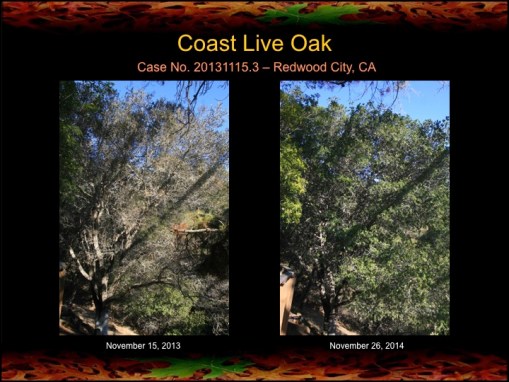
Here are some assorted results on oaks, pines, and one toyon tree that I collected over the past two weeks. All have been treated with fire mimicry. As you can see some trees are responding better than others. Some of the trees here are showing only a slight improvement in canopy size and density. But results are results, so here they are. Fortunately, I found no infections of sudden oak death disease in any of the oaks here.

Slide12 Read the rest of this entry »


Coast live oaks in Hillsborough responding to fire mimicry

1 05 2015

Slide02

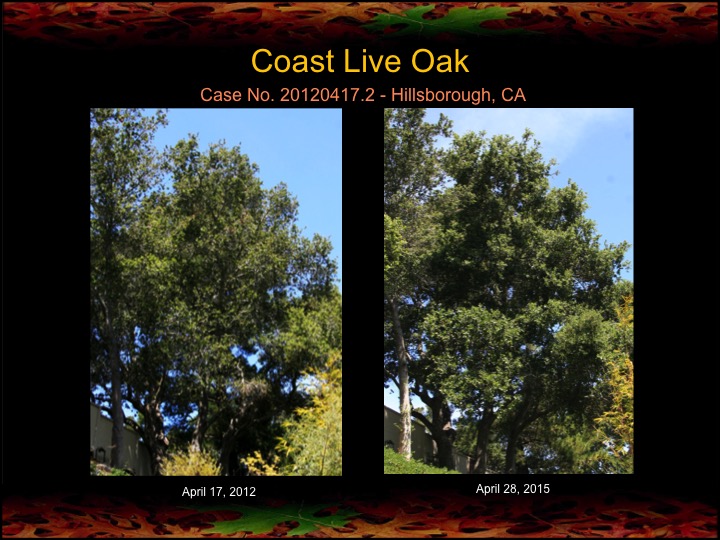
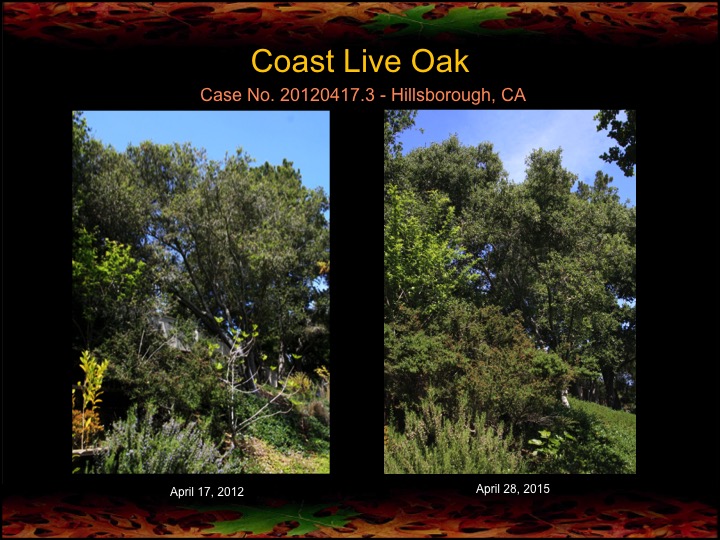
A few days ago I checked up on some oaks treated with fire mimicry techniques twice in the past three years. Here are the results. I’m pleased to see that all the oaks are showing noticeable improvement in the health of their canopies. Also happy to report that none of these oaks have become infected with sudden oak death, despite this area being a hotspot for the disease.

Slide03 Read the rest of this entry »


Ponderosa pines responding to fire mimicry

26 04 2015

Slide24

In the same area as the oaks I reported on in the previous post, I also inspected some ponderosa pine trees that have received fire mimicry treatment. These are photos of the pines after 5 years of treatment. While the responses of the pines are not as dramatic as seen in the nearby oaks, there is a noticeable improvement in canopy density of the pines. For comparison, the last photo set shown is of an untreated pine.

Slide22 Read the rest of this entry »


Five-year results of fire mimicry on coast live oaks, valley oaks, and black oaks in Glen Ellen, CA

25 04 2015

Slide21

Last week I checked up on some oak trees in Glen Ellen, CA to see how they are faring after five years of fire mimicry treatments. I took photos of the oaks and compared them to photos taken five years ago at the same time of year. These are the results. I’m pleased to report that most of the oaks are responding noticeably in terms of canopy density and greenness, and some have improved dramatically. A few of the oaks have a stem canker disease, possibly sudden oak death. These oaks have not shown much response, though it is relevant to note that there are no clear indications of decline in canopy health of these diseased trees in five years. This may even be considered a positive result.

Slide20 Read the rest of this entry »


Marin oaks respond to fire mimicry

4 04 2015

20130302.1.2

I’ve been away for the past 5 weeks, working on a project in Ireland. (Hint: the project made front page of the New York Times one week ago today.) While I was away I received messages from two clients concerned about the health of their oaks. In both cases they noticed a sudden browning of the oak canopy. The reports were definitely cause for alarm considering the prevalence of Sudden Oak Death, and other diseases and inspect pests that are afflicting the oaks in Marin.

Upon my return I promptly inspected the oaks and and am happy to report that in both cases the sudden “browning” was due to a heavy bloom of male flower clusters, which give the tree a brown appearance. I took photos of both trees, showing that they both are improving noticeably since their initial treatment with fire mimicry.

20130302.2.2

20140319.1.1

20140319.2.1

Ive


Fire mimicry shows promising results on oaks after just one year

1 02 2015

Slide3

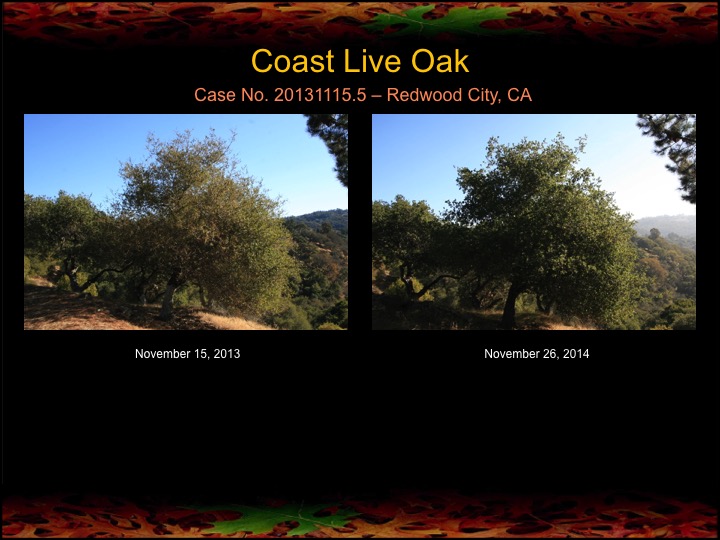
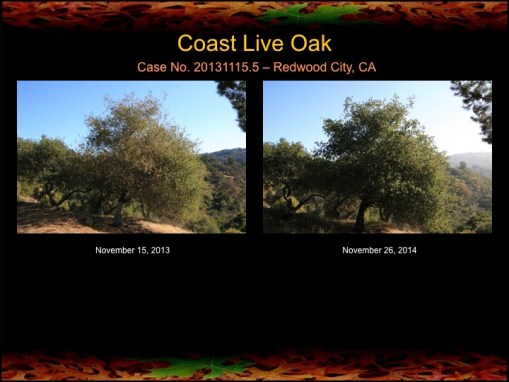
In November of 2013 I met with a property owner in Redwood City, CA who had some rather sick coast live oak trees. His wife had alerted him my work with fire mimicry and he was interested, though quite skeptical, of my approach to helping oaks. I provided a report of my findings and recommendations, and he responded with a number of good questions, showing me that he had done his homework on the subject. In the end he opted to try my approach, noting that his decision was swayed by the fact that the mineral and compost fertilizers I apply are all natural, non-toxic compounds typically used in organic agriculture.

One year later, in November of 2014, we met again as I did my annual inspection his treated oaks. Even before I had time to re-photograph the trees he admitted he had seen significant improvement in several oaks, and was no longer a skeptic of my work.

Bear in mind that these photos show the treated oaks after only one year’s time. A few oaks show no noticeable improvement in canopy density or greenness, nor do they show any noticeable decline. Other oaks have responded with clear improvement in canopy density and greenness.

Needless to say, the owner opted to treat his oaks again, and we’ll see their response again next year . . .
Slide5 Read the rest of this entry »


Oaks in Woodside, CA flourishing with fire mimicry

16 01 2015

Slide7

In 2010 I began fire mimicry treatments on a grove of coast live oaks in Woodside, CA, which are at risk of Sudden Oak Death. Here are the results after four years. None of the oaks has contracted disease, and their canopies are clearly showing an increase in size, greenness, and density. Some light pruning occurred in 2011.

Slide6 Read the rest of this entry »


Recent directions in the science of Gaia

15 01 2015

Congo Canopy

In June of 1988 I attended the first Chapman Conference on the Gaia Hypothesis held in San Diego, CA. There I was introduced to James Lovelock and a host of other influential scientists studying Gaia, including Lynn Margulis, Stephen Schneider, Tyler Volk, and Lee Kump. This pivotal meeting set the stage for my career in exploring the science of Gaia.

In the 1990s I attended the three Gaia in Oxford meetings, which drew scientists like Stephan Harding, Andrew Watson, Susan Canney, and Tim Lenton, all of whom have made significant contributions to the science of Gaia. Read the rest of this entry »


Gaia and Climate Change

10 01 2015

Earth

Today an article I wrote on Gaia and climate change was published in The Ecologist [link here]. The article summarizes my thoughts and concerns around the science of climate change. This is the comment and discussion thread for that article.


Ten year milestone for Sudden Oak Life

31 12 2014

Thank you readers for your patience during the extended quiet time here on my blog in 2014. This year started off with the challenge of recovering from the loss of my home during the Big Sur fire in December 2013, where many of my friends and neighbors also lost their homes. Fortunately, with the generous help of the Big Sur community, family, and friends I’ve been able to set up a new home and am back doing my forest restoration work.

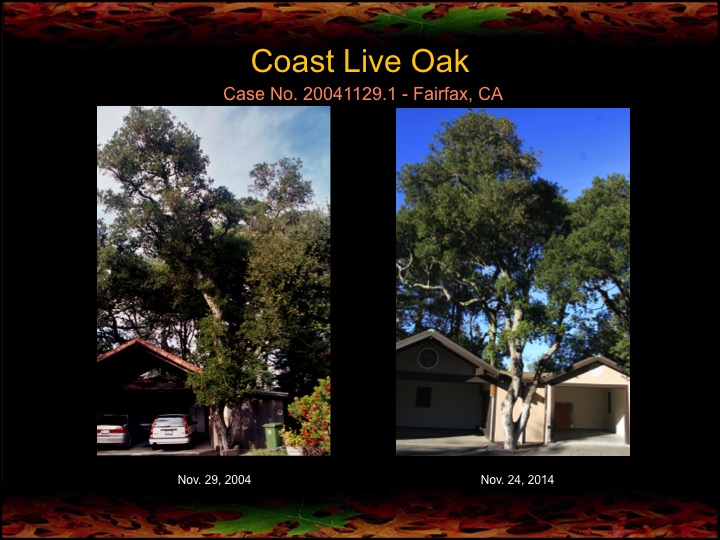
There are many results from the past year that I plan to show in coming posts in 2015. Let me start with a milestone, the first 10-year results of fire mimicry methods employed on oaks that I have documented. These results come from Fairfax, CA and much of the credit goes to Leith Carstarphen who has been applying the methods I showed him 10 years ago on the coast live oaks below.

20041129.1.10 Read the rest of this entry »