New study with implications for fire management of oak woodlands

8 07 2011

Managed fire in a California oak woodland. Photo by Lee Klinger.

A recent study reported at Science Daily on the fire history of post oaks in Illinois reads like page from the history of California oak woodlands:

Old-Growth Tree Stumps Tell the Story of Fire in the Upper Midwest

The new study, in the journal Castanea, confirms that the people who lived in Illinois before European settlers arrived [Native Americans] were in the habit of setting fires in the region nearly every year, with fires in the Hamilton County woodland occurring at least every two or three years, McClain said. This repeated burning actually stabilized the prairies and open woodlands that dominated the region until the late 19th century, when the fire-suppression efforts of the new settlers allowed different plant species to take over, the researchers said.

The study was conducted by William McClain, a botanist with the Illinois State Museum along with researchers John Ebinger and Greg Spyreas, of the Illinois Natural History Survey at the University of Illinois. They also report:

“For hundreds, maybe thousands of years, this was a stable post oak woodland,” Spyreas said. “And then you have a gap of a couple of decades where there were no fires and suddenly the whole system is completely different. It’s amazing how, from Kansas to Ohio, these ecosystems completely depend on fire to be stable.”

See the full report here.

To all you Californian’s concerned about the oaks, this study is highly relevant.


Acid rain in Big Sur – 2010-2011 season summary

14 06 2011

[Update: Another late season storm moved through Big Sur yesterday (June 28) depositing 0.42″ of rain with a mean pH of 4.74. I’ve adjusted the seasonal rainfall data below. These new data have no effect on the overall mean weighted pH for the 2010-2011 rain season.]

The 2010-2011 rain season in Big Sur seems to be over, finally, after a late season June storm. This season we received a total of 32.66” 33.08″ of rain, which is very near the average of the previous three years (32.0”). The rainy season lasted for 8 full well over 8 months, with the first rains arriving on October 6, 2010 and the last rains falling on June 6, June 28, 2011.

Sun casting on the side of my home in Big Sur being dissolved by acid rain. Photo by Lee Klinger.

Rainfall from 36 37 events, totaling 23.04” 23.46″, was measured for pH. The season volume-weighted average pH was 4.66 ± 0.10. This mean pH was lower than the average of the previous seasons (mean volume weighted pH 2007-2010 = 4.78).

Season length: October 6, 2010 to June 6, June 28, 2011

Total rainfall: 32.66″ 33.08″

Measured rainfall from 36 37 events: 23.04” 23.46″

Mean volume-weighted pH (± s.d.): 4.66 ± 0.10

For summaries of previous years see “Acid rain in Big Sur 2009-2010 season summary” and “Acid rain in Big Sur”.

The graph below shows the mean volume-weighted pH values recorded from Big Sur for the past 5 rain years, along with the mean volume-weighted pH values reported from six National Acid Deposition Program (NADP) sites along the Pacific coast, from southern California (Tanbark) to southeast Alaska (Juneau). Note that the NADP sites have data only through the 2009-2010 rain year. Data for the most recent rain year are not yet available from NADP. Read the rest of this entry »


Oak restoration results with fire mimicry

7 06 2011

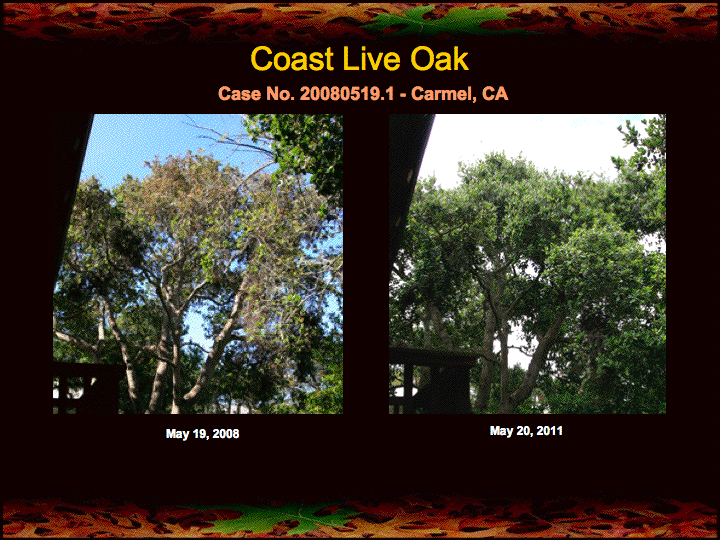
Fire mimicry practices, which involve clearing (shrubs and young trees, especially bays), pruning, trunk care, and amending soils with mineral and organic rich fertilizers, are continuing to have a positive effect on sick oaks here in California. Below are some repeat photography results for several coast live oaks in Carmel, Pebble Beach, Santa Barbara that have been treated with fire mimicry for three years. The main caveat is that the oaks in these pictures, while ill, are not severely diseased. The oaks that are severely diseased are not faring as well. Scroll down to see the results.

  Read the rest of this entry »


Acid rain in Big Sur – May 2011

6 06 2011

Acid rain falling on Big Sur. Photo by Lee Klinger.

It has been an unusually rainy spring here in Big Sur. We received 1.86″ of rain in May and have just had another full on winter storm here in the first week of June. I’ll be summarizing the 2010-2011 rain season data once it is clear the rainy season had ended.

The rains in May were notably acidic. There were five measurable rainfall events with pH values ranging between 4.46 to 4.63. The table below shows all the results for May 2011. Read the rest of this entry »


Life and the Planet – Part 3 (The Hockey Stick still lives in 2011)

23 05 2011

The Hockey Stick graph, presented in May 2011 by Dr Jan Zalasiewicz as evidence for unprecedented anthropogenic warming

The final talk of the meeting was by Jan Zalasiewicz titled ‘Looking back from the future at the Anthropocene’. It is clear from this talk that some geologists have already decided humans are having a dramatic effect on the earth, which reinforces efforts to give the current geological period of the earth a separate classification, the Anthropogene. I find this kind of science disturbingly self-serving. A few days after the talk after I wrote Dr. Zalasiewicz the following letter: Read the rest of this entry »


Life and the Planet – Part 2

23 05 2011

Lynn Margulis, who as Lovelock said earlier “put the flesh and bones” on Gaia, spoke on ‘Evolutionary novelty in the Proterozoic eon: Symbiogenesis in Gaia’. She described a sequence of evolutionary events involving eubacteria and thermobacteria coming together to form the first eukaryotes. This occurred not through random mutations but through symbiosis occurring over evolutionary time scales, or symbiogenesis. While Lynn is often credited with the theory of symbiogenesis she emphatically states that others preceded her in this idea, particular a Russian scientist, Boris Mikhaylovich Kozo-Polyansky, who in 1924 published a book “Symbiogenesis: A New Principle in Evolution”. Still, Lynn undoubtedly put the “flesh and bones” on the theory of Symbiogenesis as well.

Nicholas Butterfield spoke on ‘Multicellularity in deep time’ where he described the early fossil record of various multicellular life forms. He pointed out that by ~1 Ga ago there is evidence for clonal colonies of cyanobacteria, coenobial and filamentous green algae, and branched multicellular filaments of red algae. There is even a 850 Ma old fungus-like fossil with complex multicellular vesicles/hyphae. He states, however, that at this time there is “not a whisper of land plant fossils”. Doubting that this is a preservation issue, he left open the question of plant and animal life on land in the Proterozoic.

Speaking on ‘Neoproterozoic glaciation: Microbes at work in terrestrial oases’ Ian Fairchild acknowledged that even under the most extreme conditions of Snowball Earth life must have persisted and even flourished in places. He described stratigraphic sequences from northern Svalbard which bear units of sandstone, rhythmites, and carbonates which appear to owe their origin, in part, to microbial mats of cyanobacteria. He concludes that “extremophile” life flourished at this time and provided a geochemical record of the Cryogenian (Snowball Earth) period. Unfortunately, he offered no ideas on possible biological feedbacks on the climate. Read the rest of this entry »


Life and the Planet – Part 1

23 05 2011

Life and the Planet meeting at the Geological Society of London

I recently attended the Life and the Planet meeting (May 5-6) held at Burlington House, home of the Geological Society of London, of which I am a fellow. In attendance were many of my friends and colleagues from the Gaia in Oxford meetings, including Jim and Sandy Lovelock, Lynn Margulis, Susan Canney, Tim Lenton, Andrew Watson, David Wilkinson, Anne and Mark Primavesi, and Bill Chaloner.

While the meeting had a Gaia theme, the program consisted of a number of speakers mainly from the geological sciences who are new to the discussion of Gaia. In general the speakers did a fair job of characterizing many of the dramatic shifts in earth’s history, such as the great oxygenation event, snowball earth, and the effects of the first plants on the planet, but many avoided mention of feedbacks, regulation, chaos, and complexity.

The one exception, of course, was the opening talk by James Lovelock. His keynote address was masterful, starting with a concise historical overview of Gaia theory for the many newcomers to the debate. He pointed out that the “atmosphere is almost entirely a biological product”. In his unapologetically alarmist voice he warned of “massively harmful climate change”, and suggested that climate change should mobilize science to geoengineer a fix. He then brought Gaia into the discussion of snowball earth by proposing a set of phytoplankton-driven ocean/atmosphere feedbacks involving sulfur pathways that could help drive the onset and termination of ice age conditions. Acknowledging ocean scientist Brian von Herzen in helping formulate this biotic ice age feedback, he stated “We have no notion if it offers a correct explanation but I put it to you as an example of the need for a whole science approach when seeking explanations of planetary scale phenomenon on a live planet like the Earth” (my bold). He then added, “This is especially true of the next catastrophe, the climate change we are now causing by the excessive excretion of CO2.” Read the rest of this entry »


Grandfather oak – April 2011 update

15 05 2011

Last April I reported on the progress being made in helping ‘grandfather oak‘, a very old and diseased coast live oak on King Mountain in Marin Open Space. I returned this past April along with a small contingent of volunteers to continue the efforts we started 3.5 years ago. We cleared the genista, poison oak, and small bays, fertilized with Azomite, oyster shell flour, and soft rock phosphate, and applied a lime spray to the trunk. Below is a photo of all the volunteers. They are (from left to right) Kathleen Cannon, John Furnas, Roger Diehnel, Greg Reza (Parks & Open Space Volunteer Coordinater), Dick Gale, Donna Shoemaker (project leader), and Carl Thoelicke.

Volunteers caring for Grandfather Oak

Our efforts for Grandfather Oak are not about treating any disease or pests. Indeed, the oak is probably well past being cured of sudden oak death. This is an attempt to give this oak a fighting chance to extend its life and live out the remainder of its years in a healthier, more nourishing state.

The photos below show that, indeed, our efforts seem to be helping. Read the rest of this entry »


Acid rain in Big Sur – April 2011

15 05 2011

Big Sur coast, April 2011. Photo by Lee Klinger.

April 2011 was a relatively dry month here in Big Sur, with just 0.66″ of rain at my station, ~750 ft in elevation. There were 3 rainfall events sampled for pH. As shown below all three readings are fairly acidic, compared to what one would expect for ‘pristine’ rainwater (~5.6).

Rainfalls amounts and pH readings in Big Sur for April 2011

It is raining here in Big Sur at the time of this posting (May 15), so I’ll have some May numbers to report before summarizing the 2010-2011 rainy season. For previous seasonal summaries see my posts, Acid rain in Big Sur, and Acid rain in Big Sur – 2009-2010 rain year summary.


Life and the Planet

30 04 2011

I’m off to England next week to attend this meeting on the science of Gaia at the Geological Society of London. The program includes many new voices offering (hopefully) some fresh perspectives on the biological and ecological feedbacks in the earth system. Veteran Gaian scientists James Lovelock and Lynn Margulis are the featured speakers. I plan to write up the notes and post them on my blog after my return.