Press coverage of the Hidden Villa Workshop

2 02 2011

Arborists gather at Hidden Villa for a workshop on organic methods of preventing sudden oak death. Photo by Pam Walatka

Published Monday, January 31, 2011 in the Los Altos Patch:

An Ecological Approach to Sudden Oak Death Prevention

A workshop with Lee Klinger promotes fire-mimicking techniques to help oak trees survive, without burning a thing.

In workshops offered recently by Hidden Villa, ecologist Lee Klinger demonstrated ways to prevent Sudden Oak Death. If you’ve driven through our hills and noticed whole oaks turned brown and dead, you may be looking at an example of this blight on our oak trees.

Klinger’s method mimics the effects of forest fires. His theory is that oaks are fire-adapted and thus need periodic fires to remain healthy.

“Fire replenishes minerals, removes competition and reduces sources of acidity such as mosses and lichens.” With Sudden Oak Death, the plant pathogen, Phytophthora ramorum, attacks the trees through the trunks.

To mimic the effects of forest fires, he recommends cutting back underbrush that crowds the tree, removing mosses and lichens from the trunk of the oaks, spraying the tree trunk with lime, adding minerals to the soil  and topping with compost and mulch.

Klinger heads an organization called Sudden Oak Life, which promotes a soil-replenishing method to promote healthy, natural forest conditions. Many local arborists and land managers attended the first workshop; the second workshop was for nonprofessionals.

I watched Klinger demonstrate his method on a big, old oak tree at Hidden Villa. First he used loppers to cut back underbrush that was crowding the tree. Then he used a gallon-sized scoop to take minerals out of a bucket and spread them under the tree, advising workshop participants to keep looking up to see that they were covering beyond the drip line (the outer-most edges of the tree). He said that the roots often extend beyond the drip line.

Then he used a hand-pump sprayer to thoroughly coat the tree trunk (as high as he could reach with the sprayer) with a mixture of hydrated lime, sea salt and milk—making sure to get into all the cracks in the trunk bark.

He used a wheelbarrow to mix the minerals: azomite, oyster shell calcium, and rock phosphate. For a very large tree, shoveling these minerals from the wheelbarrow is an alternative to using buckets and scoops.

Klinger recommended watering deeply after spreading the minerals, rather than digging the minerals into the ground.

After the minerals, for one big tree, he adds a cubic yard of manure-compost and then covers that with two or three cubic yards of mulch. He also adds compost tea.

“All the materials I use are natural fertilizers typically used in organic agriculture,” Klinger said. “The treatment I offer does not involve any synthetic chemicals, fungicides or pesticides.”

It seems to me that Klinger’s method is an organic, sustainable, ecologically sound way of preserving our native ancient giant beautiful oak trees.

For more information, see the Sudden Oak Life website, or contact: Lee Klinger, P.O. Box 664, Big Sur 93920. Phone: 831-917-7070. E;mail: lee@suddenoaklife.org

About This Column: Each week Pam Walatka will explore life in Los Altos Hills. Pam has lived in Los Altos Hills since 1978 and has been gardening organically and sustainably since 1968. Contact Pam at pamwalatka@yahoo.com or visit pamwalatka.com.


Hidden Villa workshop resources

27 01 2011

Thanks to all the tree and land care professionals who attended the Oak Health Workshop that I taught today at Hidden Villa. Thanks also to Lisa, Maggie, Bill, and others on the staff at Hidden Villa who helped make this workshop happen. Below are the links to some of the papers and books discussed in my talk.

Forest vegetation and soil succession
A 2009 scientific paper by L. Klinger   Read On>>

A holistic approach to mitigating pathogenic effects on trees
A 2008 scientific paper by L. Klinger   Read On >>

Bryophytes and soil acidification effects on trees: the case of Sudden Oak Death
A 2005 scientific paper by L. Klinger   Read On >>

Examining the relationship between fire history and sudden oak death patterns
A scientific paper by M. Moritz and D. Odion   Read On >>

Ecological evidence for large-scale silviculture by California Indians (Chapter 6)
by L. Klinger; in Unlearning the Language of Conquest edited by Four Arrows   Read On >>

Tending the wild
An excellent book by M Kat Anderson  Read On>>


Toro Canyon oaks after two years of fire mimicry

13 01 2011

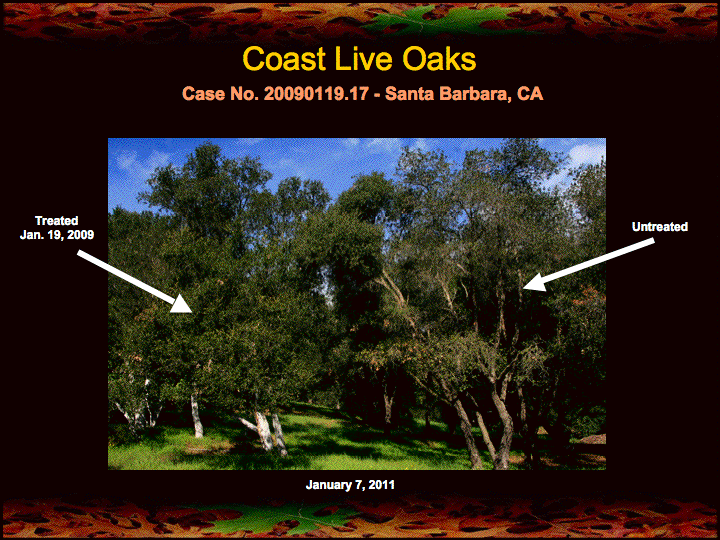
Coast live oaks in Toro Canyon new Santa Barbara were treated two years ago with fire mimicry. The photo comparisons are presented below. While these oaks have shown a very good response to the treatments, they are not significantly different from what was seen last year (see Toro Canyon oaks). This I believe is because the owner, upon seeing the good results after one year, opted to pass on the second-year treatments. The owner has now decided to schedule another round of treatments.

Read the rest of this entry »


Hearst Castle oaks after five years of fire mimicry

13 01 2011

Last week I visited Hearst Castle and re-photographed the oaks that have been undergoing treatments with fire mimicry for the past five years. Below are the results. Note that the last two oaks of this series are included as untreated controls. Last year’s results can be seen here.

Read the rest of this entry »


Message from an arborist

13 01 2011

Yesterday I received this email from Don Cox, an arborist who has been involved with the Sudden Oak Death problem since the very beginning. He has agreed to let me post it here:

Dear Dr. Klinger,

As a California arborist involved with the “Sudden Oak Death” syndrome since 1995, I have been aware of your work in this area. I know you are on the right track with ‘Sudden Oak Life’ and mineralization of the soils.

Since the 1990’s even before we had a positive ID of P. ramorum as a primary factor in SOD and the emphasis was directed on the pathogen as the primary cause, I believed that there was a complex set of circumstances for the advance of this species decline. I saved some significant trees for my clients in the midst of SOD killing fields of Marin, Sonoma and Santa Cruz counties, with a comprehensive PHC (plant health care) approach including soil re-mineralization. I see that you have taken up this comprehensive approach with soil health as the focus and you have had the determination to stick with your convictions in spite of the opposition.

I’ve been reviewing the Sudden Oak Life website and the results you are getting with your tree care programs; you have a lot of good information there. Keep up the good work.

Don Cox

ISA Certified Arborist WE-3023A, Tree Maintenance and Plant Health Care Advisor

Don has pointed me to two important websites:

soilminerals.com – which has a wealth of information on the use of minerals to improve plant health and soil fertility

treesolutions.com – with information and services on health care for trees of the Central Coast of California

Thank you Don for your support of a broader, more ecological approach in addressing Sudden Oak Death.


Sudden Oak Life blog 2010 in review

3 01 2011

The stats helpers at WordPress.com mulled over how this blog did in 2010, and here’s a high level summary of its overall blog health:

Healthy blog!

The Blog-Health-o-Meter™ reads Fresher than ever.

Crunchy numbers

This blog was viewed about 10,000 times in 2010. In 2010, there were 37 new posts, growing the total archive of this blog to 61 posts. There were 105 pictures uploaded, taking up a total of 40mb. That’s about 2 pictures per week.

The busiest day of the year was January 5th with 128 views. The most popular post that day was Newsroom.

Where did they come from?

The top referring sites in 2010 were suddenoaklife.org, woodlands.co.uk, facebook.com, mail.yahoo.com, and wattsupwiththat.com.

Some visitors came searching, mostly for sudden oak life, acid rain 2010, lee klinger, acid rain in 2010, and acute oak decline.

Attractions in 2010

These are the posts and pages that got the most views in 2010.

1

Newsroom April 2009

2

Acid rain in Big Sur – Feb. 2010 update March 2010
2 comments

3

On the origins of fire scars in California redwoods May 2009
2 comments

4

About February 2009

5

Case Studies April 2009


Acid rain in Big Sur – December 2010

3 01 2011

Big Sur coast, December 2010 (photo by Lee Klinger)

The December 2010 rain pH data for Big Sur are in and the results are posted in the table below. Note that I was away on travels during November 2010 , so I do not have pH data to report for that month. Rainfall amount, however, was recorded and totaled 1.89″ (h/t Lauren Gamblin). Read the rest of this entry »


Oak health workshops at Hidden Villa

31 12 2010

In late January I will be giving two workshops on oak health at Hidden Villa, an educational wilderness preserve in Los Altos Hills, CA. The workshop on January 27 (Thursday) will be tailored for tree and land care professionals, and the workshop on January 29 (Saturday) will be for the public. Please see the flyer below for full details. Information can also be found on the Hidden Villa website calendar page. Feel free to leave a comment below if you have any questions for me directly, or email me (see Contacts page).


Ecoliteracy in Action

29 11 2010

On December 18 I will be speaking at the Ecoliteracy in Action course being held at Esalen Institute in Big Sur, CA at the invitation of Kat Steele, the course coordinator. The title of my talk is “Gaia theory and climate change”. Prior to my talk on the 18th my good friend Daniel Peterson will be presenting on “Primitive skills and the Esselen tribal ways”, a discussion and hands on workshop relating to living off the land and crafting tools from natural materials. See the flyer below:


After five years of fire mimicry treatments . . .

17 11 2010

Five years ago fire mimicry treatments were implemented to help the trees on this property in Hillsborough, CA. I’ll let the photos tell the rest of the story . . .

Read the rest of this entry »