Fire mimicry practices, which involve clearing (shrubs and young trees, especially bays), pruning, trunk care, and amending soils with mineral and organic rich fertilizers, are continuing to have a positive effect on sick oaks here in California. Below are some repeat photography results for several coast live oaks in Carmel, Pebble Beach, Santa Barbara that have been treated with fire mimicry for three years. The main caveat is that the oaks in these pictures, while ill, are not severely diseased. The oaks that are severely diseased are not faring as well. Scroll down to see the results.
Oak restoration results with fire mimicry
7 06 2011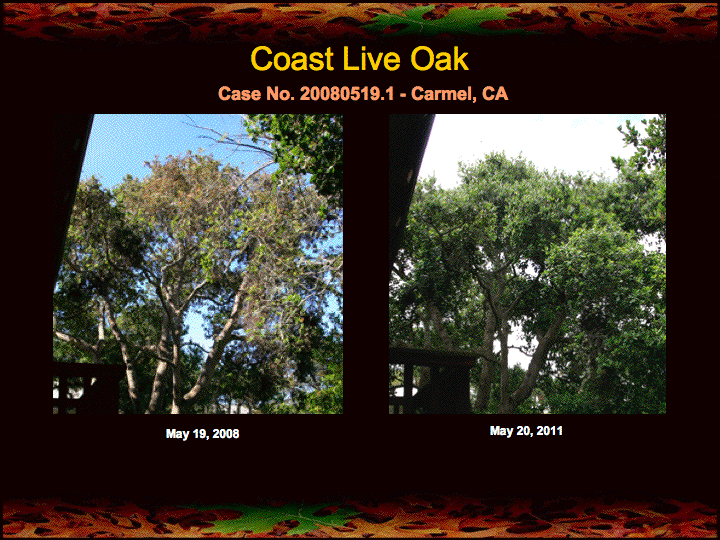
Comments : 2 Comments »
Categories : Case studies, Fire mimicry, Oak health, Repeat photography, Sudden Oak Death
Acid rain in Big Sur – May 2011
6 06 2011
Acid rain falling on Big Sur. Photo by Lee Klinger.
It has been an unusually rainy spring here in Big Sur. We received 1.86″ of rain in May and have just had another full on winter storm here in the first week of June. I’ll be summarizing the 2010-2011 rain season data once it is clear the rainy season had ended.
The rains in May were notably acidic. There were five measurable rainfall events with pH values ranging between 4.46 to 4.63. The table below shows all the results for May 2011. Read the rest of this entry »
Comments : Leave a Comment »
Categories : Acid rain, Big Sur, Climate change, Plant succession
Grandfather oak – April 2011 update
15 05 2011Last April I reported on the progress being made in helping ‘grandfather oak‘, a very old and diseased coast live oak on King Mountain in Marin Open Space. I returned this past April along with a small contingent of volunteers to continue the efforts we started 3.5 years ago. We cleared the genista, poison oak, and small bays, fertilized with Azomite, oyster shell flour, and soft rock phosphate, and applied a lime spray to the trunk. Below is a photo of all the volunteers. They are (from left to right) Kathleen Cannon, John Furnas, Roger Diehnel, Greg Reza (Parks & Open Space Volunteer Coordinater), Dick Gale, Donna Shoemaker (project leader), and Carl Thoelicke.

Volunteers caring for Grandfather Oak
Our efforts for Grandfather Oak are not about treating any disease or pests. Indeed, the oak is probably well past being cured of sudden oak death. This is an attempt to give this oak a fighting chance to extend its life and live out the remainder of its years in a healthier, more nourishing state.
The photos below show that, indeed, our efforts seem to be helping. Read the rest of this entry »
Comments : Leave a Comment »
Categories : Case studies, Fire mimicry, Oak health, Repeat photography, Sudden Oak Death
Acid rain in Big Sur – April 2011
15 05 2011
Big Sur coast, April 2011. Photo by Lee Klinger.
April 2011 was a relatively dry month here in Big Sur, with just 0.66″ of rain at my station, ~750 ft in elevation. There were 3 rainfall events sampled for pH. As shown below all three readings are fairly acidic, compared to what one would expect for ‘pristine’ rainwater (~5.6).

Rainfalls amounts and pH readings in Big Sur for April 2011
It is raining here in Big Sur at the time of this posting (May 15), so I’ll have some May numbers to report before summarizing the 2010-2011 rainy season. For previous seasonal summaries see my posts, Acid rain in Big Sur, and Acid rain in Big Sur – 2009-2010 rain year summary.
Comments : Leave a Comment »
Categories : Acid rain, Big Sur
Acid rain in Big Sur – March 2011
10 04 2011
Quadruple rainbow over Black Rock desert in Nevada, 2010. Photo by Valerie Velardi.
Update: After a bit of searching I have found that the photo above actually depicts a supernumerary rainbow, not a true quadruple rainbow.
March was a particularly wet month in Big Sur with 8.81” of rain measured at my home, compared to the March average of 5.60” over the past 10 years measured at Big Sur station, just a mile or so away. The wet March triggered landslips and mudslides that closed Highway 1 and prevented me from getting home to record the pH during the height of the rains. (As of this writing, Highway 1 is still closed between Big Sur and Carmel with a projected opening date of early May.) However, I was able to record the pH of four rainfall events and the data are shown below. Read the rest of this entry »
Comments : Leave a Comment »
Categories : Acid rain, Big Sur
Sudden Oak Life workshop resources
2 04 2011Thanks to all the interested homeowners and tree professionals who attended my workshop today at Marin Waldorf School. As promised, here are the links to some of the papers and books discussed in my talk. Enjoy!
Forest vegetation and soil succession
A 2009 scientific paper by L. Klinger Read On>>
A holistic approach to mitigating pathogenic effects on trees
A 2008 scientific paper by L. Klinger Read On >>
Bryophytes and soil acidification effects on trees: the case of Sudden Oak Death
A 2005 scientific paper by L. Klinger Read On >>
Examining the relationship between fire history and sudden oak death patterns
A scientific paper by M. Moritz and D. Odion Read On >>
Ecological evidence for large-scale silviculture by California Indians (Chapter 6)
by L. Klinger; in Unlearning the Language of Conquest edited by Four Arrows Read On >>
Tending the wild
An excellent book by M Kat Anderson Read On>>
Comments : Leave a Comment »
Categories : Announcements, Fire mimicry, Oak health, Sudden Oak Death
Sudden Oak Life workshop in Marin
24 03 2011
Applying fire mimicry methods on a sick coast live oak. Photo by Lee Klinger.
The Marin Waldorf School is hosting a Sudden Oak Life workshop on Saturday, April 2, 2011 from 10:30 am to 2 pm. I will be presenting information on the science and practice of fire mimicry techniques (including a demonstration) in the care of oaks and other trees. Marin Waldorf School is located at 755 Idylberry Rd. in San Rafael, CA. This “hands on” event is open to the public and the cost is $30, with a sliding scale. Please RSVP with the school front office at 415-479-8190.
Comments : Leave a Comment »
Categories : Announcements, Fire mimicry, Oak health, Sudden Oak Death
Santa Barbara area oak health alert!
13 03 2011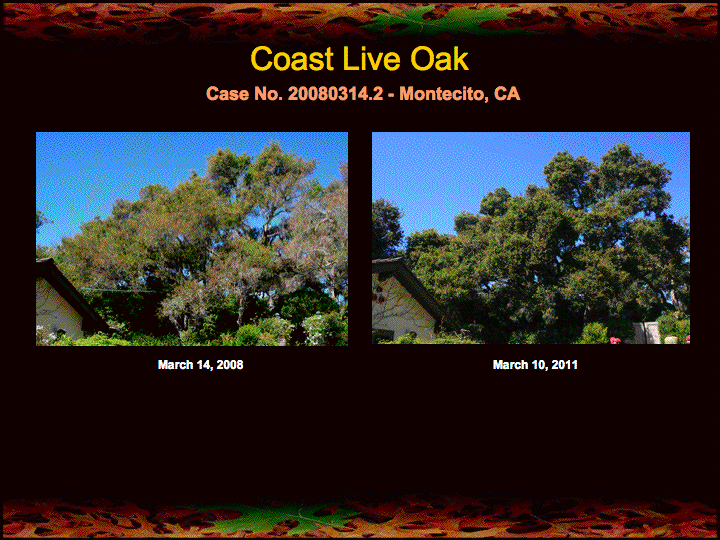
I’ve just returned from a visit to Santa Barbara where I am working on a number of properties with sick oaks. I’m not sure very many people are aware, but many of the coast live oaks in Santa Barbara are suffering. I’ve inspected dozens of properties in Santa Barbara and Montecito and in almost every case I’ve found one or more coast live oaks that are infected with bleeding stem cankers. Often associated with this stem canker disease (which exhibits symptoms similar to Phytophthora infections) are a variety of fungal pathogens (e.g. Hypoxylon) and insect pests (e.g. oak bark beetles). The sad thing is that the trees which are most affected by this decline are the large, centuries-old heritage oaks.
Of course, while these diseases and pests are clearly involved in the final demise of the oaks, they are not the real problem. Decades of fire suppression in these fire-adapted oak ecosystems has led to nutrient deficiency in the soils, declining canopy cover, a buildup of acidifying mosses and lichens, and bark deterioration.
For the past several years I have been using fire mimicry techniques to help the oaks in the Santa Barbara area. Today I would like to show the results on three large oaks I’ve been treating on a property in Montecito. As you can see in the photos above and below that two of the three oaks have responded quite nicely to the fire mimicry work. However, one severely diseased oak did not make it. I estimated that this oak was at least 200 years old when it died. Read the rest of this entry »
Comments : Leave a Comment »
Categories : Uncategorized
Acid rain in Big Sur – February 2011
2 03 2011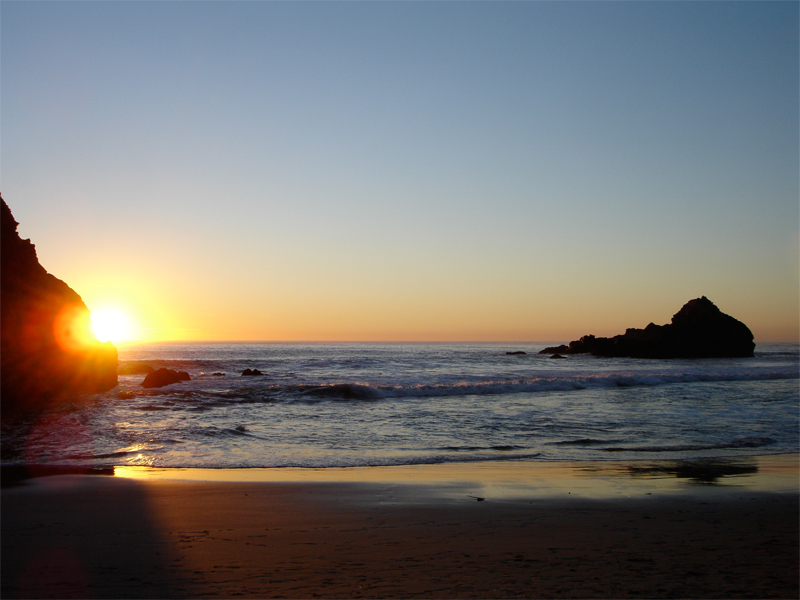
Sunset at Pfeiffer Beach in Big Sur. Photo by Sonya Klinger.
February 2011 in Big Sur was typically wet. There were nine precipitation events totaling 5.75”. Readings were taken for eight events and the results are reported below. Read the rest of this entry »
Comments : Leave a Comment »
Categories : Uncategorized
Acid rain in Big Sur – January 2011
18 02 2011
Sunset in Big Sur. Photo by Lee Klinger
January 2011 in Big Sur was relatively dry and mild. There were only three precipitation events totaling 1.83”. Readings were taken for two events and the results are reported below. Read the rest of this entry »
Comments : Leave a Comment »
Categories : Uncategorized


Recent Comments