Last week I visited and re-photographed several coast live oaks that were initially treated with fire mimicry in 2004. You can follow the progress of these treatments in previous posts here and here. Leith Carstarphen of EcoLogic Landscaping has been doing the fire mimicry work under my direction, and as you can see from the photographs he is doing an excellent job on these trees.
Six-year response of coast live oaks to fire mimicry
13 11 2010
Comments : 5 Comments »
Categories : Case studies, Fire mimicry, Oak health, Repeat photography, Sudden Oak Death
Acid rain in Big Sur – October 2010
31 10 2010The first rains of the season have fallen here in Big Sur and the data are rather surprising . . .

Another double acid rainbow in Big Sur (photo by Lee Klinger)
Comments : Leave a Comment »
Categories : Acid rain, Big Sur
Talking Trees – October 2010
17 10 2010The last couple months have been full of productive but grueling work tending oaks and restoring native trees and soils. I appreciate readers’ patience while I’m off working in the forests and unable to blog. Remember, if I’m not blogging that’s usually good news for the trees. Hopefully the coming rainy season will give me some respite from work and allow me time to share more results.
Speaking of the rainy season, it has begun here in Big Sur and I’ve measurements already from two (small) storm events. Watch for the October rainfall pH data in a post in early November.
My good friend Kevin Feinstein has a recent post on the masting behavior (production of bumper crops of acorns) of valley oaks. He notes that this year there has been very few (“virtually none”) acorns produced by valley oaks across the region. My observation is the same, that this is not a “mast” year. He also has some interesting observations on the frequency of valley oak masting events over the past 7 years. Please check out this and other posts at FeralKevin.com.
Another good friend, photographer Jack Gescheidt who took the photo below, writes me to say:

Here before the prophets
Comments : 1 Comment »
Categories : Uncategorized
Sea shells to help sick pine trees
11 08 2010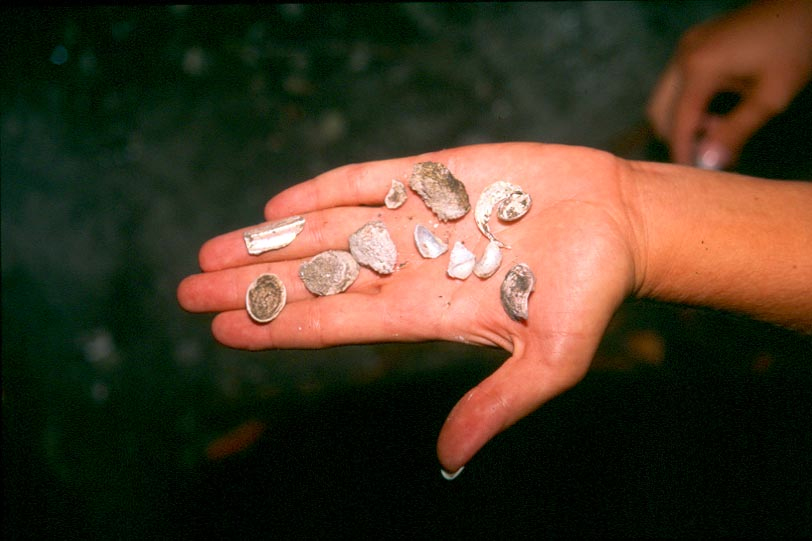
Sea shells to make soil fertilizers for sick trees
From the Daily Yomiuri Online (h/t Ralph):
Scallop shells may help save pine trees
The Yomiuri Shimbun
A fishing town in northeastern Miyagi Prefecture has turned to the lowly scallop to save its pine trees from a weevil blight.
Minami-Sanrikucho is experimentally grinding the shells of scallops, the town’s speciality, into nutrient-rich powdered fertilizer that it hopes will make the pines resistant to weevils.
The town has about 1,924 hectares of pine woods, but since around 1970 weevils have been badly damaging the trees, mainly in a coastal area of the town. About 20,000 damaged trees have been cut down.
Local residents fear not only that the blight may ruin one of the town’s scenic attractions, but that loss of the trees may result in landslides. Pine trees also absorb carbon dioxide, thus helping reduce global warming.
Since the blight began, the town office has spent about 10 million yen a year on such measures as spraying pesticide and cutting down withered trees, to little effect.
A town official heard that another municipality suffering from the same problem had found it effective to spread oyster shells as fertilizer on the soil in pine woods. Calcium and minerals contained in the shells promoted growth of the trees and made them strong enough to withstand the weevils.
Scallops are farmed in Minami-Sanrikucho, producing from three to five tons of shells that are thrown out every day. A marine products processing company in the town developed a technology to grind the shells into powder.
As powder made from scallop shells is finer than that from oyster shells, it can more easily permeate soil. Also, as the powder contains strongly alkaline calcium, it is expected to more effectively protect pine trees against the weevils.
On July 7, the town started the experiment using the new fertilizer. Town officials and local residents spread a total of 60 kilograms of the fertilizer around 22 dying red pine trees that are 57 years old. The town will check the condition of these trees every three months and spend two years monitoring the fertilizer’s effectiveness.
“I hope the pine woods will be revived and help curb global warming,” a 74-year-old resident in the town who helped spread the fertilizer said.
(Aug. 11, 2010)
Comments : 5 Comments »
Categories : Fire mimicry, Pine health, Soil science
Soil minerals stimulate olive trees
27 07 2010Today I received an interesting email from Chuck Cunningham, a tree grower in Buellton, CA who has taken a keen interest in the work I am doing. He writes:
I forgot to mention an unusual occurrence in my “fruitless” olive trees. I have been tending and growing some 40-50 Olea Europae “low fruiting” olives that for the last several years have only developed perhaps 6 olives grand total. After using Azomite on the trees they are all fruiting? I am not sure if they will hold, but it is interesting since to my knowledge nothing else has changed.
Over the years I’ve seen a number of cases where stressed, poorly-producing olive trees have responded nicely to topical treatments with soil minerals. I am aware of several olive growers who are improving their yields significantly by amending soils with alkaline-rich minerals, which improve soil fertility and, thus, tree health and productivity. The soil minerals that I use in my practice are a combination of finely-ground Azomite and calcitic limestone. Azomite is a volcanic ash that is loaded in trace minerals. The calcitic limestone helps to buffer soil acidity and provide calcium, a major constituent of bark and wood.
Comments : Leave a Comment »
Categories : Soil science, Testimonials
El Capitan oaks responding to fire mimicry
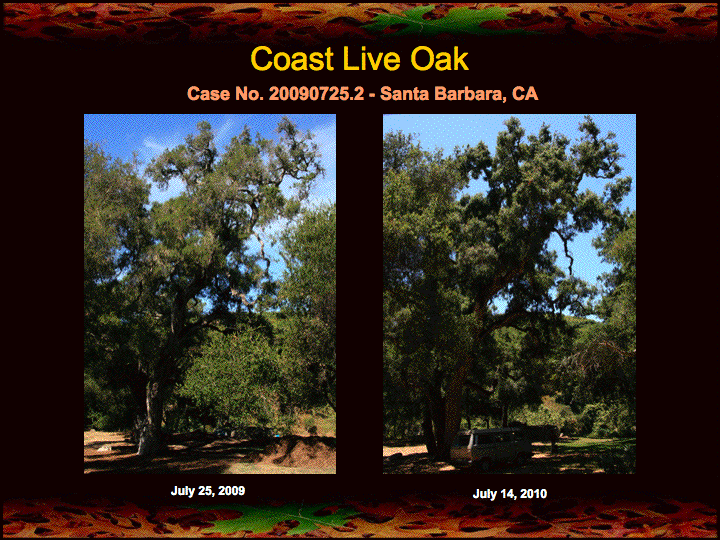
21 07 2010Last week I visited and re-photographed several coast live oaks near El Capitan Ranch outside of Santa Barbara that were treated last year with fire mimicry. Most of the oaks have shown significant improvement in canopy health in just one year. Here is a sample of the results:
Comments : Leave a Comment »
Categories : Case studies, Fire mimicry, Oak health, Repeat photography
Encino heritage oak – 2010 update
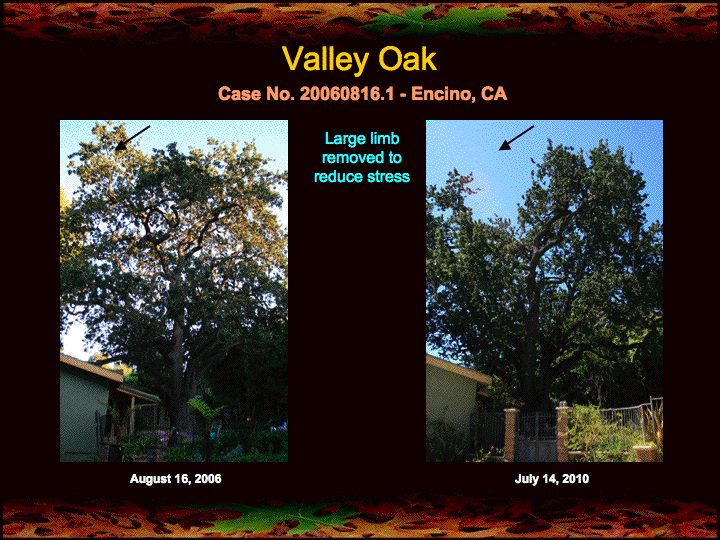
15 07 2010Yesterday I visited and tended a huge valley oak which, at about 500 years old, is possibly the oldest valley oak in Encino, CA. This oak appears to have been pollarded (pruned in a way that encourages broad, spreading branches) by the native people hundreds of years ago. Last year I posted a story about this Encino heritage oak, and presented photos that showed a significant improvement in the health of the tree in response to fire mimicry treatments.
We are now in the 4th year of fire mimicry treatments and the oak continues to show a very good response, as the photos below indicate:
Encino heritage oak
Comments : Leave a Comment »
Categories : Case studies, Fire mimicry, Native people, Oak health, Repeat photography
Five-year response of California buckeyes to fire mimicry
12 07 2010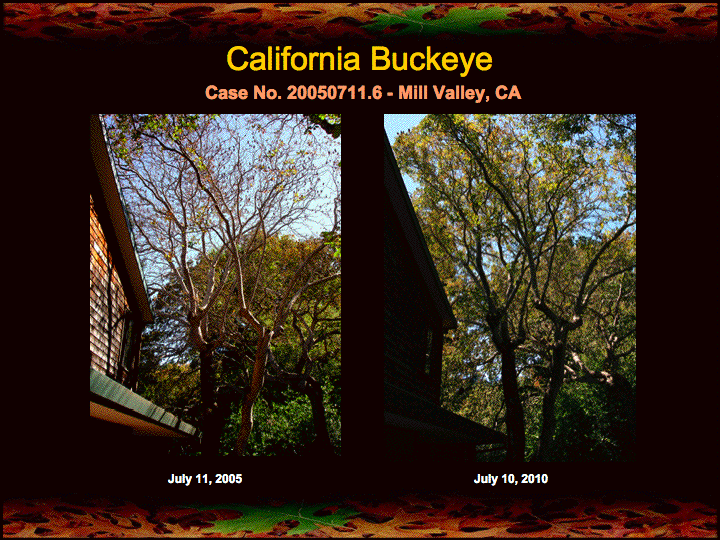
Last year I posted a piece on using fire mimicry to treat early leaf senescence in California buckeyes. A few days ago I checked up on these buckeyes and re-photographed them. As you can see in the photos posted here the buckeyes are continuing to show improvement after tending with fire mimicry practices.
When I first saw these trees in 2005 they appeared to be severely stressed due to soil acidification. The lawn areas around their base had a dense cover of mosses growing among the grasses. The mosses were removed by thatching the lawn areas and the soils were treated with several hundred pounds of soil minerals (Azomite and calcitic limestone).
These and other results (see here and here) are showing that the fire mimicry practices which are working so well in restoring the health of the oaks (see here, here, here, here, here, etc.) are also useful in restoring the health of other kinds of trees. This certainly makes sense if the problem is ecological (e.g. fire suppression, soil acidification, overcrowding, etc.) rather than pathological (e.g. disease, insect pests).
I encourage anyone who is interested in getting more information on the methods and services of tree care and forest restoration shown here to please contact me. Read the rest of this entry »
Comments : Leave a Comment »
Categories : Buckeye health, Case studies, Fire mimicry, Moss ecology, Repeat photography
Acid rain in Big Sur – 2009-2010 rain year summary
16 06 2010During the 2009-2010 rainy season the precipitation gauge at my home here in Big Sur received a total of 36.24” of rain, which was more than the totals for any of the previous three years. It was a particularly long rainy season, lasting from October 13, 2009 to May 28, 2010.
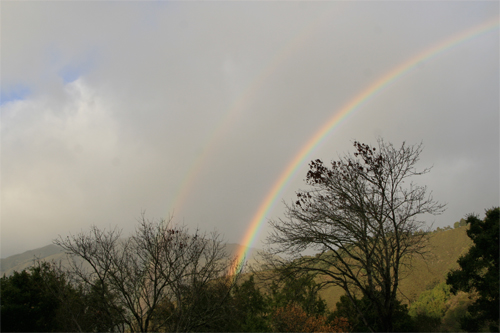
Double acid rainbow in Big Sur (photo by Lee Klinger)
With regards to rain pH there were 39 measurable events with a mean volume-weighted pH (± s.d.) of 4.80 ± 0.13. The lowest pH reading this past rain year was 4.37 recorded on December 27, 2009, and the highest pH reading was 5.65 recorded on May 18, 2010. Read the rest of this entry »
Comments : Leave a Comment »
Categories : Acid rain, Big Sur, Gaia theory
Using repeat photography to assess the response of oaks to fire mimicry
12 06 2010Last week I checked up on some oaks in Santa Barbara that have been undergoing fire mimicry treatments for the past two years. One way I assess the change in health of a tree is through repeat photography analysis of the tree’s canopy. Repeat photography is not as simple as it seems. Photographs are taken at the time the oaks are first treated. Subsequent photos are taken at annual intervals, meaning I get to visit the trees I treat every year, year-after-year. It’s quite a commitment to schedule yearly visits to all the oaks I’ve treated. In re-photographing the trees it is important to match the time of year, time of day, sky condition, camera angle, and exposures as closely as possible to the original photos. I don’t get it precise every time, but I do my best. Changes in tree health can be detected in the photographs as increases or decreases in canopy density (the amount of background sky seen through the canopy), and in changes in the amount of gray or brown foliage vs. green foliage.
Below are the results of the repeat photography analysis of the canopy health in the Santa Barbara oaks I visited last week . . .

Comments : Leave a Comment »
Categories : Case studies, Fire mimicry, Oak health, Repeat photography


Recent Comments