These oaks growing in Toro Canyon near Santa Barbara were first treated last year with fire mimicry practices. Check out the results below.
Toro Canyon oaks
7 01 2010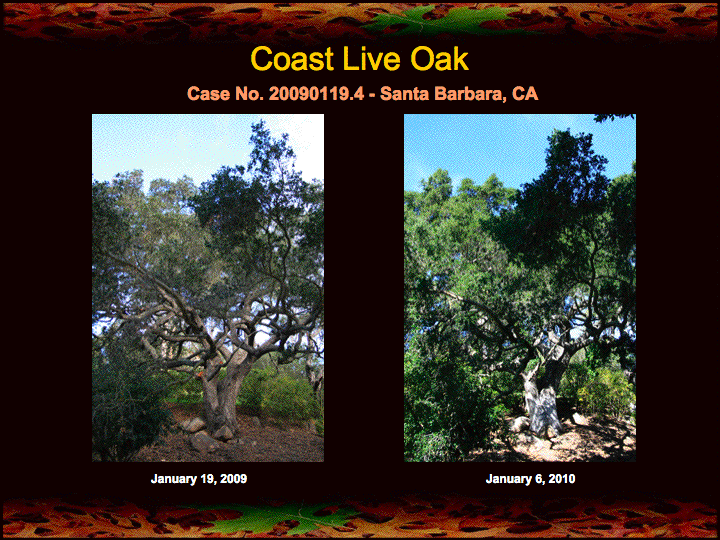
Comments : Leave a Comment »
Categories : Case studies, Fire mimicry, Oak health
Peatland formation and ice ages: a possible Gaian mechanism related to vegetation succession
6 01 2010To prepare readers for some upcoming posts on the implications of Gaia theory in climate change predictions I would like to provide some background literature of my earlier work in this area. Below is a paper I gave at the American Geophysical Union Chapman Conference on the Gaia Hypothesis held in San Diego, CA in 1988. This paper was published as a chapter in a 1991 book on the proceedings of the conference: Scientists on Gaia. Here is the summary of my paper:
Peatland formation and ice ages: a possible Gaian mechanism related to vegetation succession
by Lee F. Klinger
Summary – Terrestrial areas, which support over 99% of the earth’s biomass, have considerable potential for being involved in biosphere-atmosphere feedback loops as postulated by the Gaia hypothesis. This paper presents a model of a possible Gaian mechanism related to landscape-level successional changes during a glacial-interglacial cycle. The model is based on the view that terrestrial successions converge toward bogs, rather than toward old-growth forest, and that bogs represent structurally and compositionally stable (climax) communities. The model also assumes, as in classical successional theory, that during the course of succession the biota modifies the environment, both the soil and the atmosphere, to favor the progression of succession toward the climax state. Feedback mechanisms between peatlands (landscapes of bogs and bog forests) and the atmosphere are proposed which should favor the initiation and maintenance of relatively stable, ice age climates. These cooling mechanisms are related to increased albedo, increased evapotranspiration, and decreased atmospheric CO2 associated with the succession from woodlands to peatlands. Ice core and ocean core data for CO2, CH4, and delta 13C and delta 14C isotope ratios are consistent with the proposed terrestrial dynamics involving organic carbon.
Here is the full reference for my paper:
Klinger, L.F. 1991. Peatland formation and ice ages: a possible Gaian mechanism related to vegetation succession (Chap. 28). In: S.H. Schneider & P.J. Boston (eds.), Scientists on Gaia. The MIT Press, Cambridge, pp. 247-255.
Comments : Leave a Comment »
Categories : Climate change, Gaia theory, Peatlands, Plant succession
Acid rain in Big Sur – Dec. 2009 update
5 01 2010Acid rain continues to fall at my home here in Big Sur. During December 2009 there were seven measurable days of rain with the following values:
Date Amount Mean pH N
Dec. 7 0.29″ 4.74 3
Dec. 11 0.42″ 4.53 3
Dec. 12 0.53″ 4.31 3
Dec. 13 0.62″ 4.71 4
Dec. 22 0.20″ 4.52 2
Dec. 27 0.19″ 4.36 2
Dec. 30 0.23″ 4.60 2
The pH readings from Dec. 12 are some of the lowest (highest acidity) yet recorded here in Big Sur in over three years of measurements.
Meanwhile, oaks, pines, and bays are dying by the thousands. Don’t suppose there’s a connection, eh?
Comments : Leave a Comment »
Categories : Acid rain, Big Sur
Hearst Castle 4-year results
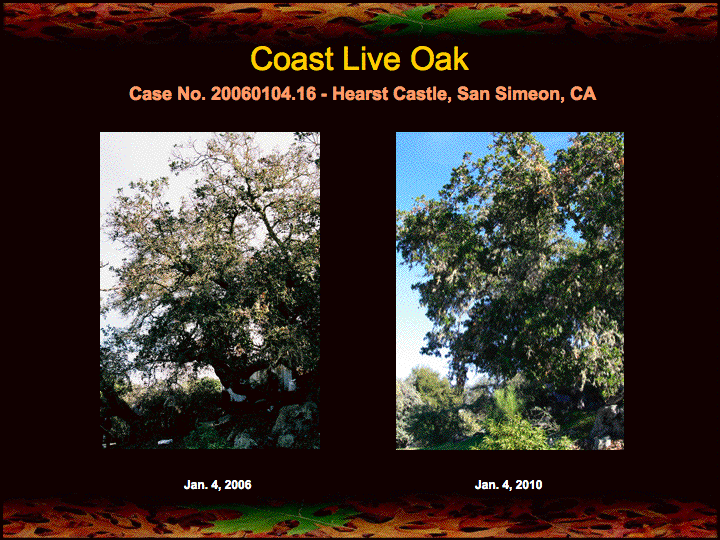
4 01 2010Today I visited Hearst Castle and photographed several coast live oaks that have been under treatment with fire mimicry practices for four years. Some results from last year can be seen here. Below are the photos I took today showing changes in both treated and untreated oaks after four years. Be sure to examine the last two sets of photos which show results from some untreated oaks. Enjoy!
Comments : Leave a Comment »
Categories : Case studies, Fire mimicry, Oak health, Sudden Oak Death
Forest vegetation and soil succession
25 12 2009Readers who are interested in more details of the general theory and empirical studies of forest decline and soil acidification please consult this paper:
Forest vegetation and soil succession
by Lee Klinger MA PhD
Presented at: Treework Environmental Practice Seminar XIII
Linnean Society, Burlington House, London, UK – 30th June 2009
Summary
Forest communities are complex systems comprised of populations of organisms representing every kingdom of life – plants, animals, fungi, protists, and monists – living and growing together on the land. They are part of a larger group of communities that constitute the regional ecosystem, or landscape. Forest communities are developmentally related to the surrounding communities in ways that can be characterized through chronosequence studies. Chronosequences from southeast Alaska and subarctic Canada are described and interpreted as indicating that, while early successional processes facilitate forest growth and productivity, later successional processes tend to slow and inhibit forest growth and regeneration. In many places forests are seen to have transitioned into peat bogs over the course of several thousand years. This is thought to reflect the true climax nature of bog ecosystems.
Forest to bog transitions are linked to two main developmental processes: podzolization and paludification. Podzolization affects many northern forests and involves the translocation of iron, aluminium, clays and organic compounds in response to vegetation, especially mosses, acidifying and leaching the soils. This is often followed by paludification, which occurs as peat-forming mosses, such as Sphagnum species, become established and expand.
From the perspective of succession, forests are seen to flourish under early successional conditions, conditions that are enhanced by periodic or regular disturbances. However, where disturbances are eliminated, forests begin to show decline as a consequence of natural successional changes. This work points to the potential for managing forest ecosystems through the maintenance of disturbance regimes and the remediation of acidification tendencies in the vegetation and soils.
Download the complete paper here.
Comments : Leave a Comment »
Categories : Plant succession, Soil science
A holistic approach to mitigating pathogenic effects on trees
25 12 2009For those of you who would like to read more about the details of the science and techniques involved in fire mimicry practices for oak restoration, here is a paper I wrote last year:
A holistic approach to mitigating pathogenic effects on trees
by Lee Klinger MA PhD
Presented at: Treework Environmental Practice Seminar XII
National Museum Cardiff, Cardiff, UK – 13th November 2008
Summary
The conventional ‘disease model’ approach to tree health focuses on identifying and controlling a specific pathogen (or pest) implicated as the causal agent of tree decline. Alternatively there are more holistic approaches in tree health that address a broader suite of processes occurring at the ecosystem level which may be predisposing the trees to infection by disease. Here I describe a holistic methodology that takes into account not only the proximal agents involved in tree decline, but also the age and structure of the forest, the abundance of cryptogams, the fire history, the acidity of the precipitation, the fertility of the soil, and the historical land care practices. This methodology is being implemented in the oak forests of coastal California which are experiencing high levels of mortality attributed, by most scientists, to the pathogen Phytophthora ramorum (aka sudden oak death). Evidence reported here of 1) acid rain, 2) acidifying effects of mosses and lichens, 3) the presence of acidic and nutrient deficient soils, and 4) a much lowered incidence of disease in recently burned areas, points to the likelihood that fire suppression has radically altered the structure and successional status of the forests, leading to enhanced competition and systemic acidification. Case study results of sick and diseased coast live oaks receiving holistic care, aimed not at treating P. ramorum but at reducing the environmental acidity, fertilizing the soils, and otherwise mimicking the effects of fire, show noticeable improvement in the health of the oaks after one year (78%, n=152), with further improvement in years two (84%, n=134) and three+ (81%, n=80). While the results do not indicate that the incidence of P. ramorum has changed significantly in the population of treated oaks, there is evidence that the sick, non-diseased trees are better able to resist infection.
Download the complete paper here.
Comments : 4 Comments »
Categories : Acid rain, Big Sur, Case studies, Fire ecology, Fire mimicry, Native people, Oak health, Soil science, Sudden Oak Death
Trees, Roots, Fungi, & Soils (Part 2)
22 12 2009On June 30 of this year I presented a paper titled “Forest Vegetation and Soil Succession” at a gathering of UK and US arboriculturists at the Linnean Society, Burlington House, London. The event, “Trees, Roots, Fungi, & Soils 2”, was the second of two meetings on the topic of soils in arboriculture organized by Neville Fay of Treework Environmental Practice.
The first meeting, “Trees, Roots, Fungi, & Soils 1”, was held in November of 2008 at the National Museum at Cardiff, Wales. At that meeting I presented the paper “A holistic approach to mitigating pathogenic effects on trees”. A copy of that paper can be found here.
Catharine Stott attended the second meeting in London and has written an excellent recap of the talks here.
Excerpts from Catharine Stott’s article:
“Independent scientist Dr Lee Klinger was once again over from California with a fascinating take on climax vegetation. He explained that, contrary to popular belief, forests and woodlands continue to evolve beyond what we regard as their climax state of ancient trees, particularly if there is no natural disturbance to halt and hinder succession. Indeed, if left alone and undisturbed, forest vegetation will succeed into peat bogs. Dr Klinger cited his studies of ancient forests and successions of vegetation on the slopes of Mount Edgecombe in Alaska, where all stages of vegetation succession can be seen. He argued that if we want to keep our old growth forests as forests, it is important that we allow and perhaps manage natural disturbances, such as landslips and fires.”
“In summing up the day, Neville Fay spoke more about Treework Environmental Practice’s plans to develop arboricultural practices that focus more coherently on the soil environment as a means of assessment and treatment. He has a suspicion that in the future arboriculturists will become soil specialists and relatively speaking most assessment and work will take place in that region, and very little to the crown. Without ignoring the huge weight of nursery and in vitro experimental investigation, his preferred approach is from an ecosystem perspective, hoping to find ways to look at the whole tree growing in its context, informed more by the organic model. With this in mind he is working with Laverstoke Laboratories, Lee Klinger, Olaf Ribeiro, Myerscough College and others to explore soil factors associated with rapid decline in mature trees and to compare a range of remediation measures.”
A copy of the June 2009 paper I gave at the Linnean Society is available here.
Comments : Leave a Comment »
Categories : Fire mimicry, Plant succession, Soil science
Winter solstice oaks
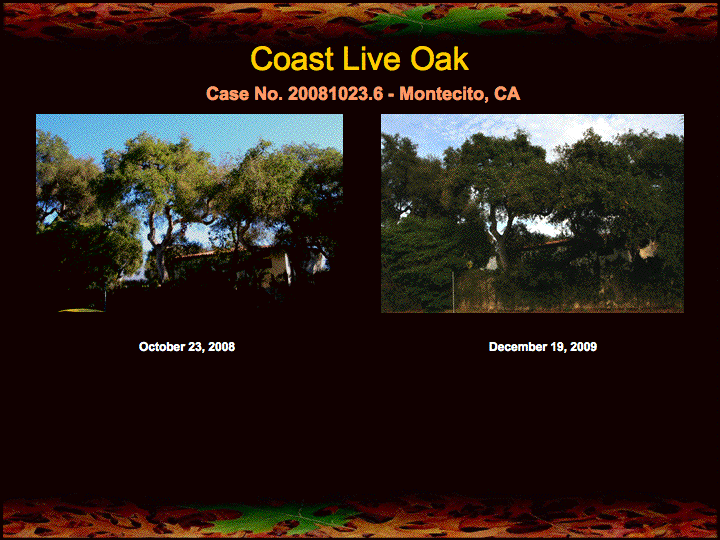
21 12 2009Winter solstice is upon us and I’m taking this day to rest my body after many days of hard work restoring oaks with fire mimicry practices in Santa Barbara. During my visit I re-photographed several oaks that I treated last year in Santa Barbara. I thought I would share the results as a winter solstice gift to readers.
Happy holidays. Enjoy!
Comments : Leave a Comment »
Categories : Case studies, Fire mimicry, Oak health
More good news . . .
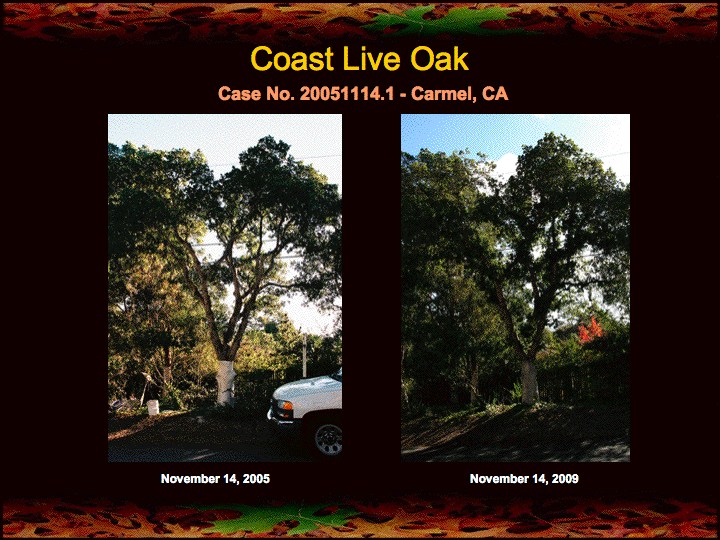
29 11 2009Fire mimicry effects after 4 years:
Comments : 2 Comments »
Categories : Case studies, Fire mimicry, Oak health
Sustainable Agriculture Pest Management Conference
22 11 2009Dr. Lee Klinger, Soil Specialist, Sudden Oak Life and Dr. Doug Fodge, Chief Scientist and President, DF International, L.L.C. will be speaking on the “Importance and role of micronutrient trace minerals in bolstering pest resistance” at the Sustainable Agriculture Pest Management Conference in San Luis Obispo, California on December 4, 2009. The conference is sponsored by the California Certified Organic Farmers. For more information click here.
Comments : Leave a Comment »
Categories : Announcements


Recent Comments