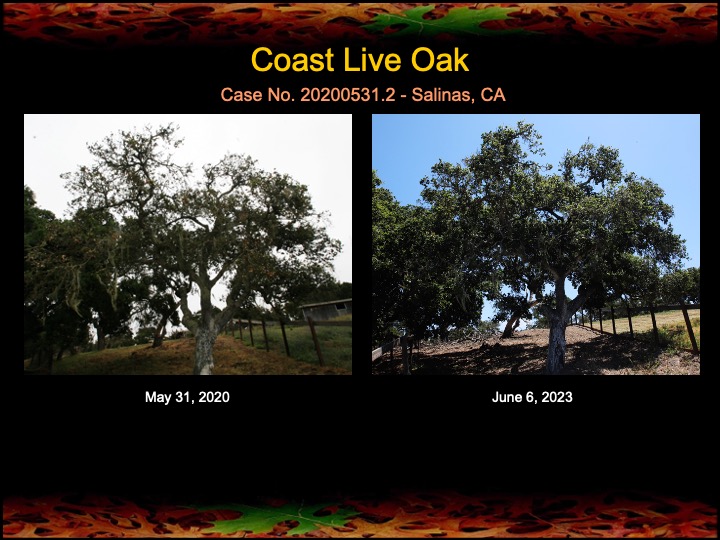
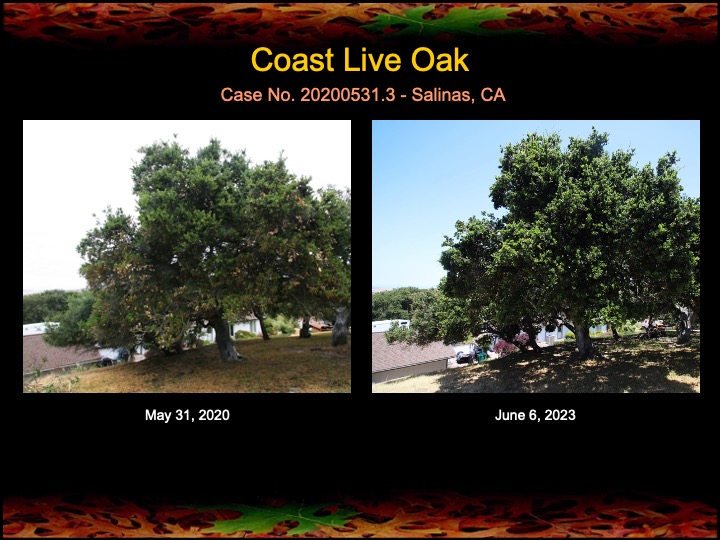
In 2020, at the height of the COVID pandemic, I kept my focus on tending trees and began fire mimicry treatments on a grove of sick and diseased coast live oaks in Salinas, CA. Well here they are, three years later, flourishing! One diseased oak, however, did not survive despite a valiant recovery effort in the first year. Note also, in the final photo set, that the untreated (control) oak has died.
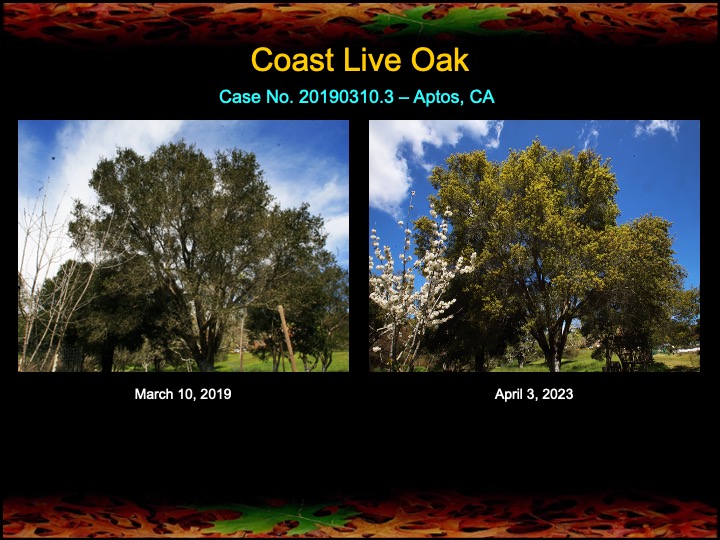
Fours years ago I initiated fire mimicry treatments on a grove of sick and diseased coast live oaks in Aptos, CA. Many of these are “Ancestor” oaks, centuries-old trees that thrived under the care of the Ohlone People – living Native artifacts if you will. Sadly, one of these ancient oaks was too sick to be saved, and died in 2021.
The images here indicate that most of the oaks have responded favorably to the treatments as seen in the increase in foliage density and lushness. It still truly amazes me that a few hours of work once a year can make such a difference for an oak grove.
I’ve haven’t been posting many results lately due to my focus on a major writing project that you will hear more about soon. Thanks for your patience! Meanwhile, let me take some time and share some recent results in the next few posts.
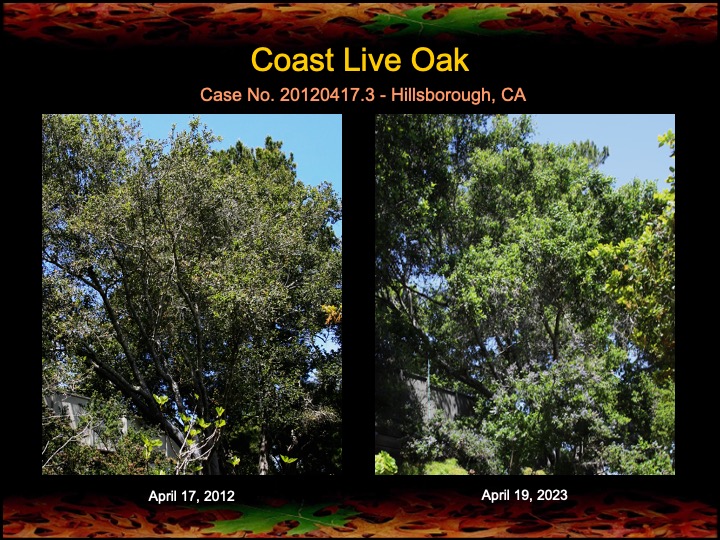
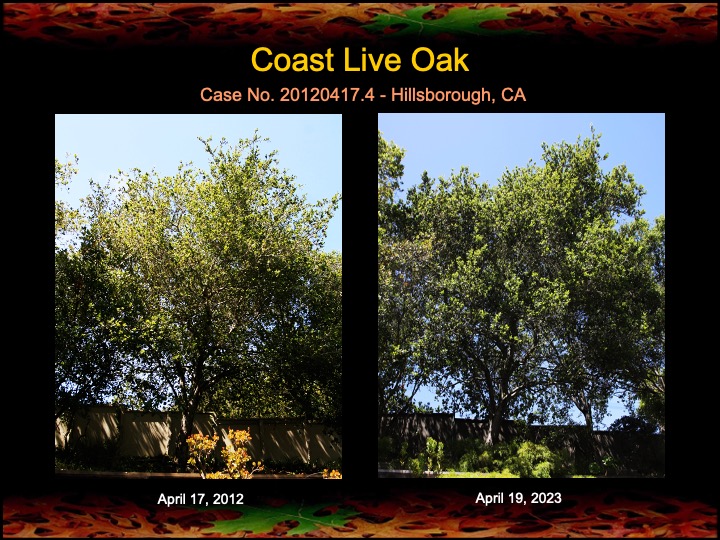
Today I want to show you a grove of oaks in Hillsborough, CA that I’ve been treating with fire mimicry every few years since 2012. Notice how the trees have developed denser, lusher canopies. This is mainly due improved soil fertility from compost tea and mineral amendments.
Coast live oak with roots compromised by adjacent construction still faring well
In November 2020 I began fire mimicry treatments on several coast live oaks and Pacific madrones in Felton, CA. Last year, when I checked on these trees, they were already showing a nice improvement (see here). Now after two years nearly all of the trees are showing noticeable positive responses to the treatments, even at the height of drought conditions. Several of the oaks have undergone major stem canker surgeries, but still seem to be on the mend. Hope you enjoy these results as much as these trees.
In October of 2020 I began fire mimicry treatments on 4 coast live oaks and one black oak here in Big Sur. The above oak also received a major stem canker surgery. Yesterday I checked on the progress of the oaks at the two year mark, nearly to the minute. I’ll never tire of seeing trees get healthier!
Here’s a clip of some fire mimicry work we did today around an ancient coast live oak in Carmel Valley, CA. The focus in this first stage of fire mimicry is to remove ladder fuels and reduce the competition from nearby woody shrubs. Afterwards, we will fertilize the soils with biochar (produced from burning the slash piles), along with compost tea and alkaline-rich minerals, then apply limewash to the trunks.
Yesterday our crew of fire mimicry practitioners began treatment of an ancient oak grove in Carmel Valley, CA. The videos here show the results of clearing ladder fuels to help prevent a healthy ground fire from becoming a destructive canopy fire. The video below was cut short by an unfriendly encounter with a wasp nest, an ever-present menace along with all the poison oak.
The latest efforts here at Sudden Oak Life have involved the restoration of about 20 acres of oak woodland and native prairie habitat in the Central Coast. I have pulled together a strong team of workers who are well trained in the principles and practices of fire mimicry.
On one particular hillside young coast live oaks have been invading an adjacent prairie of native bunchgrasses dominated by California fescue. Coastal prairie is one of the most endangered ecosystems in California due to fire suppression and conversion to agricultural uses. In places, the oak trees have shaded out and all but replaced the native prairie species. Our work here focused on removing many of the woody shrubs and young oaks along the prairie margin, and thinning and pruning oaks in nearby woodlands that still support substantial bunchgrass cover. Efforts were made to preserved many of the native understory species including toyon, currant, sage, and mountain mahogany. All the removed oaks were less than 6″ in diameter, per county regulations.
Here are several time-lapse videos from today showing our efforts to prepare a grove of ancient coast live oaks for reintroduction of cultural fire via fire mimicry. Notice that our focus is on removing ladder fuels in ensure that any cultural fires remain on the ground (good fire), rather than spreading into the canopies (bad fire).





Recent Comments