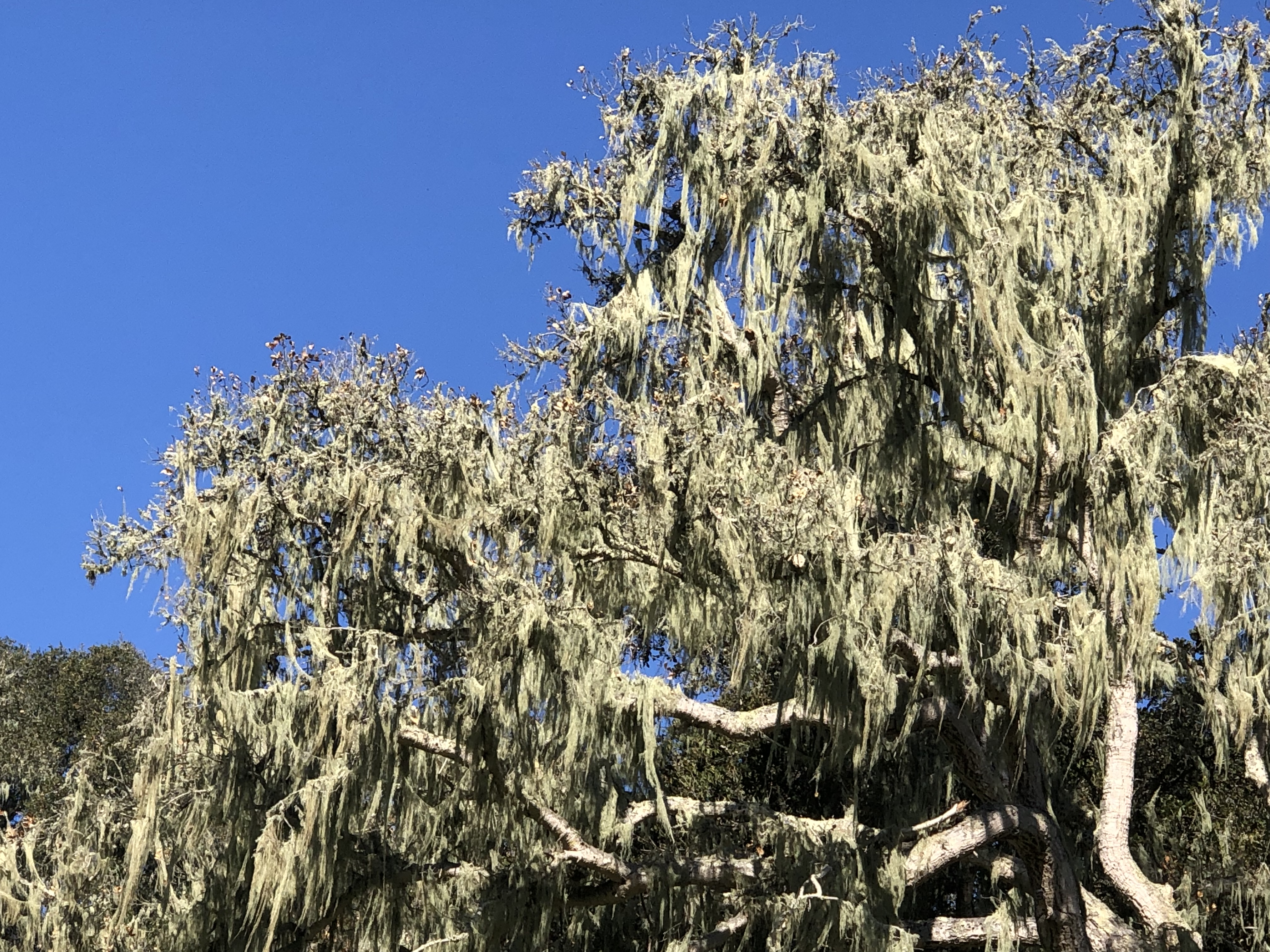
Dying coast live oak, centuries old, “smothered” in Ramalinareticulata and Usnea sp. lichens.
One of the most popular posts on this blog has been “Do lichens play a role in oak decline?” with nearly 4K views since it was published in 2018. With all those views I’m surprised that only a single reader has so far responded. It seems that photographing and identifying lichens is cool, but the ecology of lichens isn’t all that interesting to most folks.
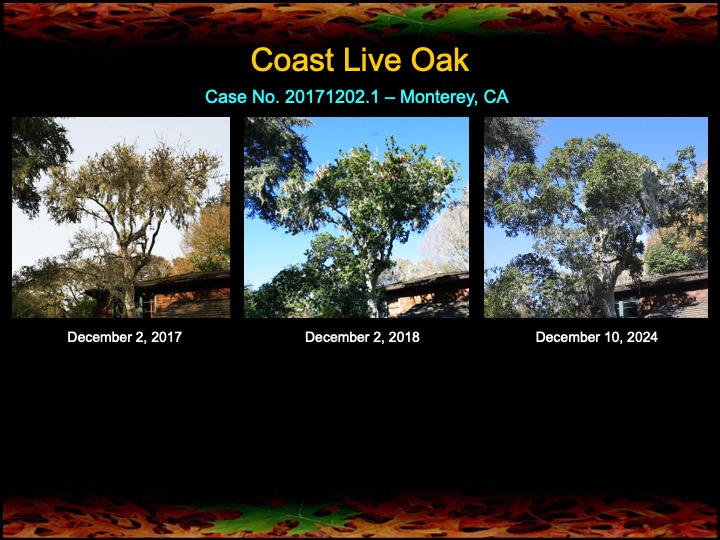
In 2017 there was a severe oakworm infestation of coast live oaks in the Monterey region and elsewhere. I’m often contacted at these times by property owners concerned about their oaks. Many wish to spray the trees with insecticides to reduce the infestation. Upon my advice, I tell property owners that spraying chemical insecticides is not necessary for the oaks to recover from these infestations, provided they are given proper care. Since the oakworm infestations are related to a lack of cultural fires, which controlled their populations in the past, a way forward is to emulate fire effects on the forest ecosystem.
Thus, rather than using chemical sprays as is typically recommended by arborists, I prefer using fire mimicry treatments to oak trees infested with oakworm. In the present case study I recommended to the property owner to do fire mimicry treatments instead of spraying the oaks. Never knowing for sure, I explained to them that the oaks would likely recover from the infestation, and that they would show continued improvement in the following years. A second set of fire mimicry treatments were preformed the following year (2018).
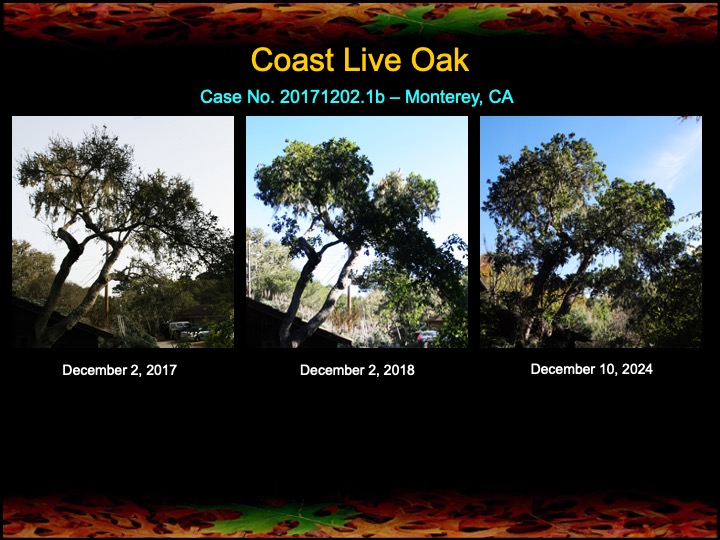
Shown here are repeat photographs of numerous coast live oaks taken upon initial treatments at the height of a severe oak worm infestation (2017), one year afterwards (2018), and seven years afterwards (2024).
Assessing the repeat photography results, the changes in canopy density of all the oaks on this property in Monterey, CA show that, in nearly all case studies, the canopy density increased as expected the year following the oakworm infection. However, the canopy density has continued to increase in nearly all of the oaks after only two years of fire mimicry treatments.
Six years ago I began a forest restoration project in Boulder Creek, CA using fire mimicry treatments to help improve the health of a grove of coast live oaks, some of which are likely more than 250 years old. Additionally, two of the oaks had bleeding stem cankers (probably Sudden Oak Death) that were surgically removed, cauterized, and poulticed.
In 2022 most of the oaks were pruned to help reduce the canopy size, which lowers the risk of both wind and fire damage to the trees. The pruning also allows for more light to reach the lower branches resulting in improved density and lushness of the inner canopy foliage.
Last Tuesday I made my annual pilgrimage to this grove to re-photograph the oaks and to assess their response to the fire mimicry treatments. Here are the case study results showing canopy conditions at the time of initial treatment (2018) and a few days ago (2024).
Note, also, the last two photo sets that show the rapid recovery of two surgical wounds (on the same old-growth oak). The absence of any residual bleeding from the wounds indicates that the surgeries were successful in removing the stem canker infections. I’m calling this a win!
Four years ago I began fire mimicry treatments on several coast live oaks, some of them centuries old. A few days ago I checked on their responses. Enjoy!
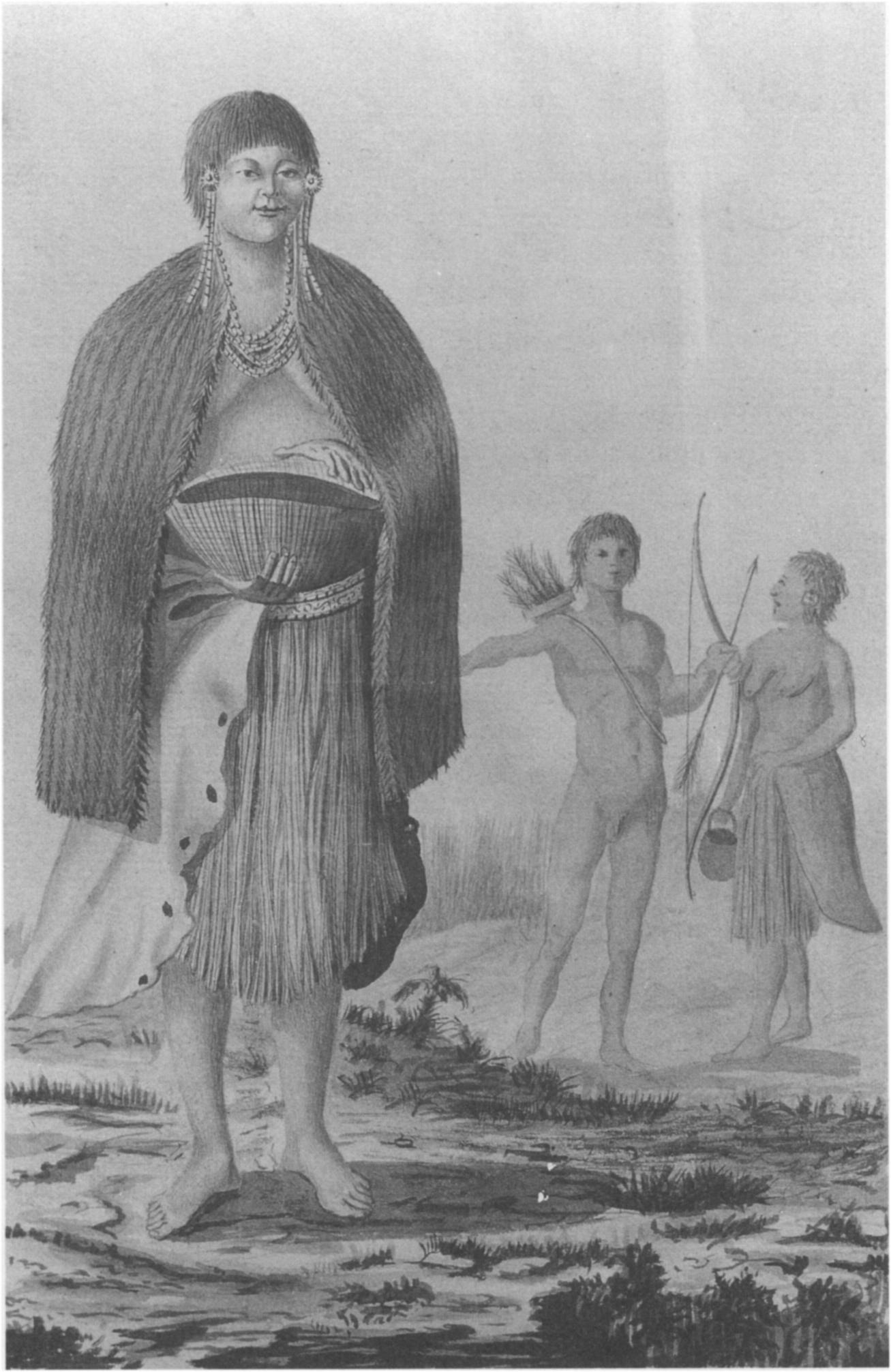
For thousands of years the Native Peoples living here along the central coast of California, the Esselen and the Rumsen (Figure 1), tended the lands with cultural fire and other management practices, creating mosaics of oak forests, redwood forests, savannas, chaparral, and scores of other land and marine ecosystems, which together helped sustain the People, the plants, and the wildlife. Over time, the lowlands and hillsides surrounding Monterey Bay, like in many other places in California, came to be dominated by old-growth oak forests and woodlands, as these provided rich sources of acorns and other important foods.
Figure 1. Native Indians of the Monterey, California area circa 1791 as drawn by José Cardero.
On the evening of December 16, 1602, this all began to change when the first western colonizers, the Spanish Vizcaino Expedition, sailed into Monterey Bay (Figure 2). They were, no doubt, noticed by the nearby Rumsen People, but it wasn’t until the next day that first contact was made. That morning, Ensign Alarcon arrived in a landing boat with orders from the admiral to “make a hut where a mass could be said and to see if there was water, and what the country was like.” He soon reported back that there was fresh water and “a great oak near the shore”, where a hut and arbor were prepared for mass. Upon hearing this news Sebastian Vizcaino and crew embarked to shore and a Catholic mass was said at the improvised altar under this “great oak.”
Happy Halloween! Today’s canker surgery on a ghost (coast) live oak gave off a real Halloween vibe. The surgery was gruesome, deep pockets of dark, discolored diseased tissue spreading inside a centuries-old oak. Let me take this grisly opportunity to show how I’ve been able to remove potentially deadly stem canker infections in oaks.
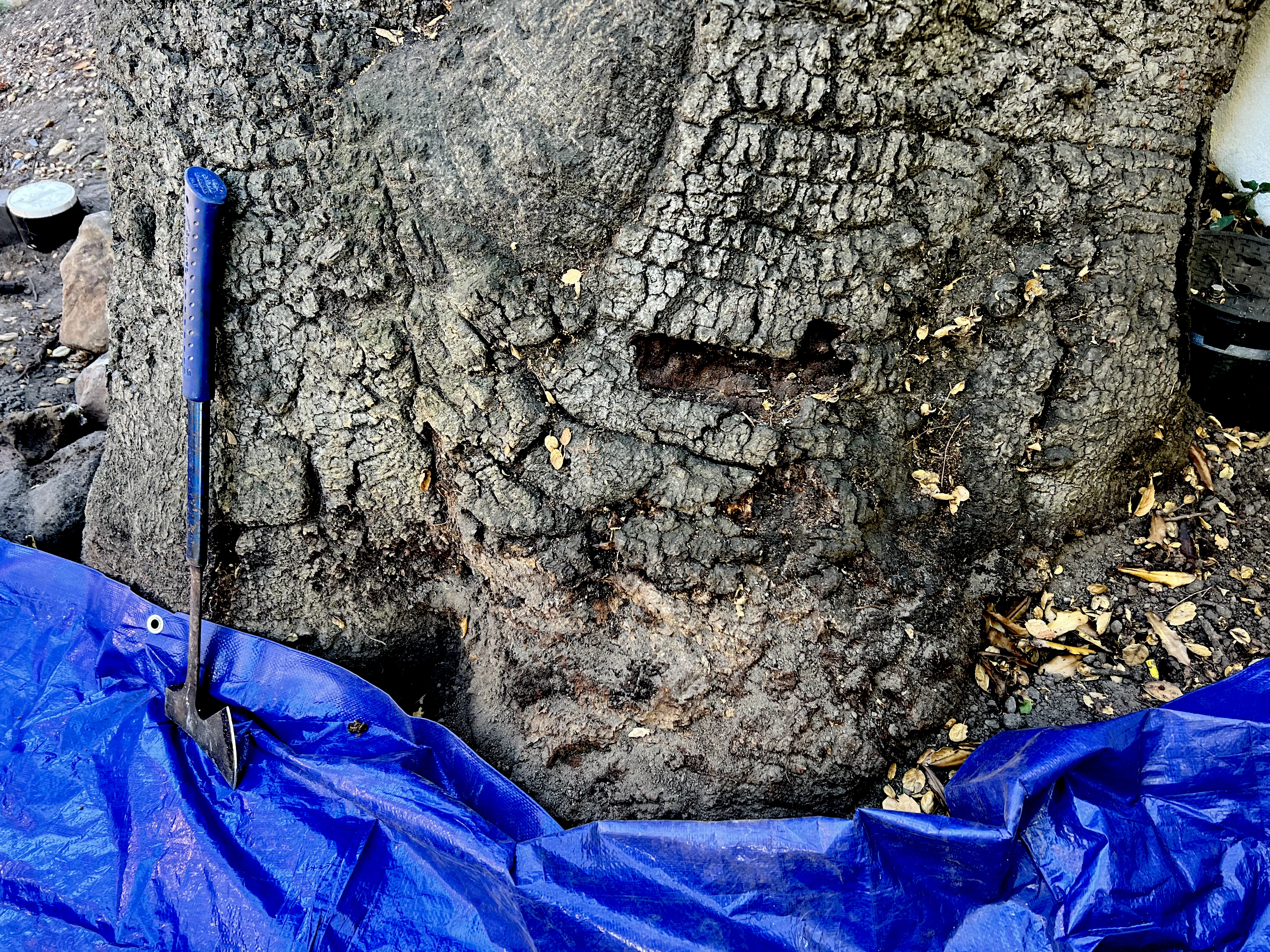
The first steps are to gather the necessary tools (large axe, small axe, multitool, grinder w/ cutting edge), sterilize the tool cutting surfaces with a blow torch, and prepare the surgical area to collect the diseased tissue. I’ve already identified, roughly, the extent of the canker by observing the areas of bleeding, as seen above in the lower trunk just to the left of center.
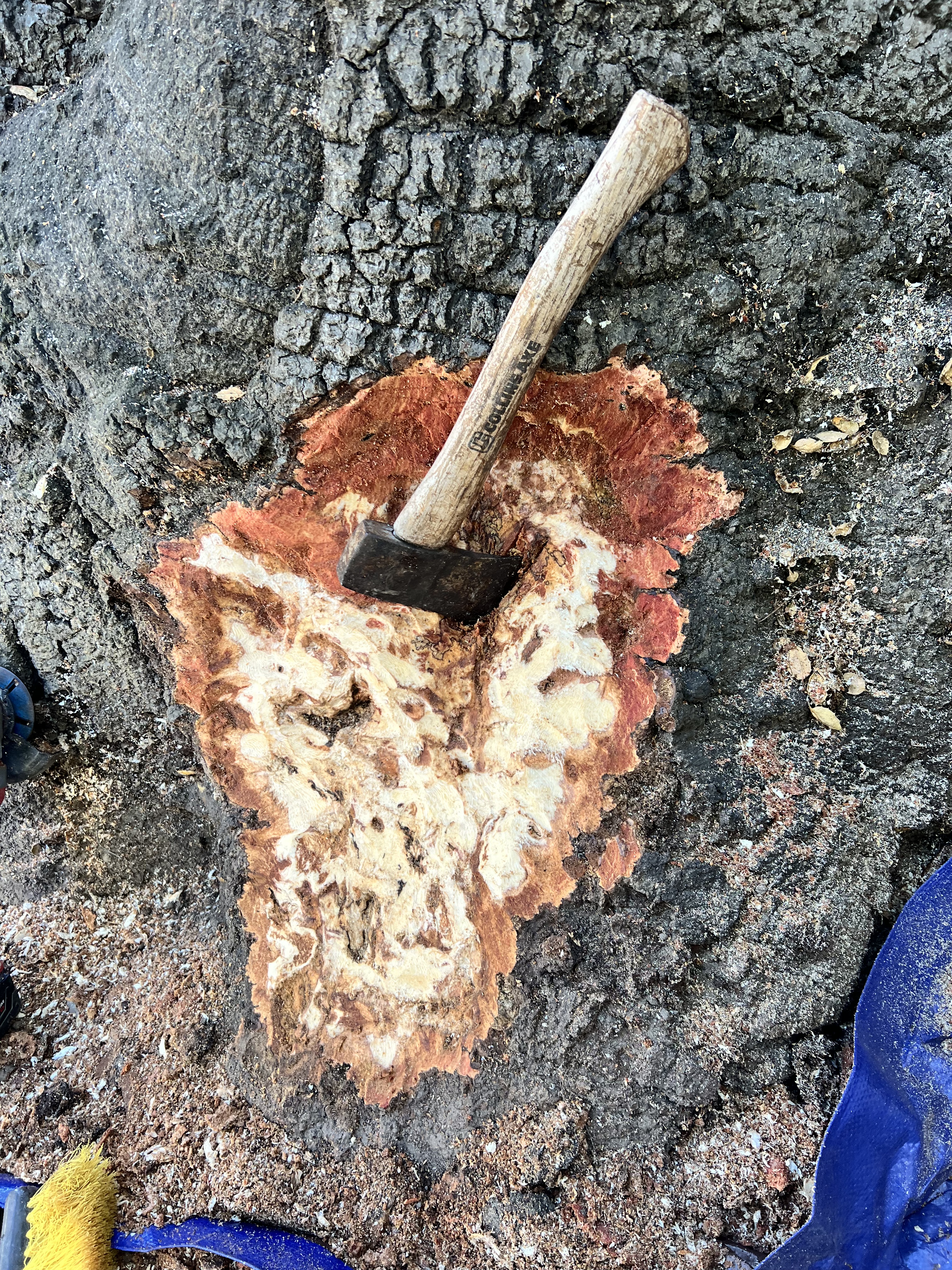
Donning gloves, hat, and eye protection I began the surgery using a large chopping axe with a two-foot handle. For surgeries I prefer to use chopping axes, which have narrower heads than splitting axes. My initial efforts are to find the limits of the infection so as to isolate it from the rest of the tree. In the above photo the dark-colored diseased tissue is clearly visible in the center of the image. The reddish tissue is healthy bark, and the white tissue is healthy wood. I sometimes say “the redder the better” and “wood is good”.
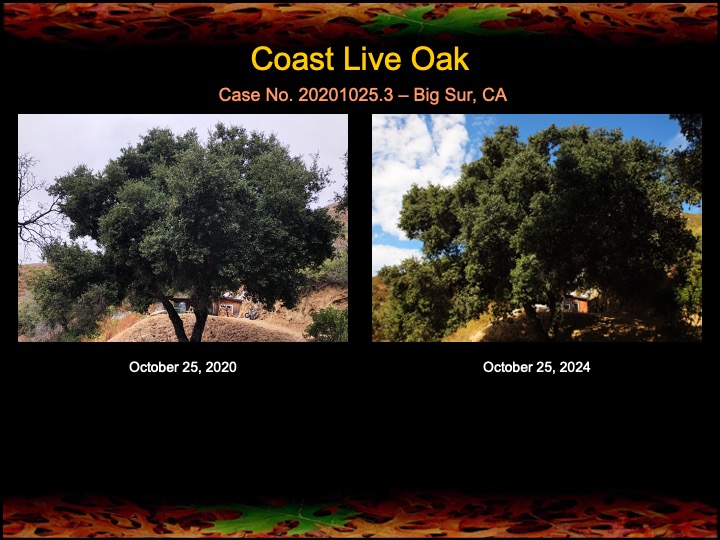
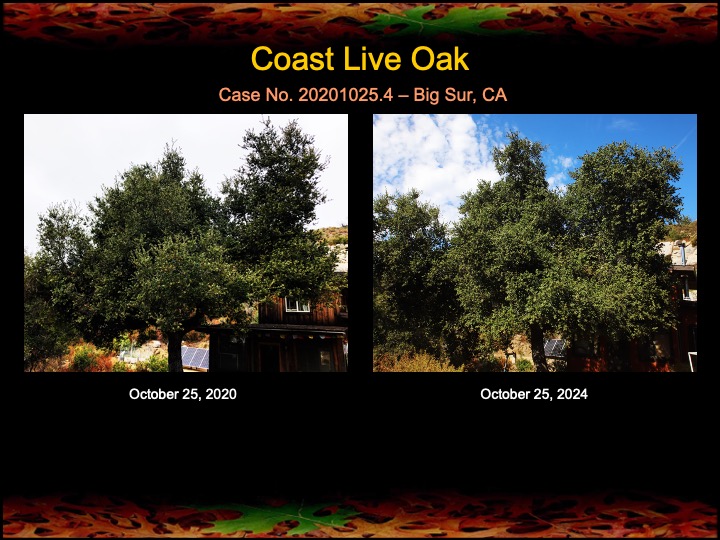
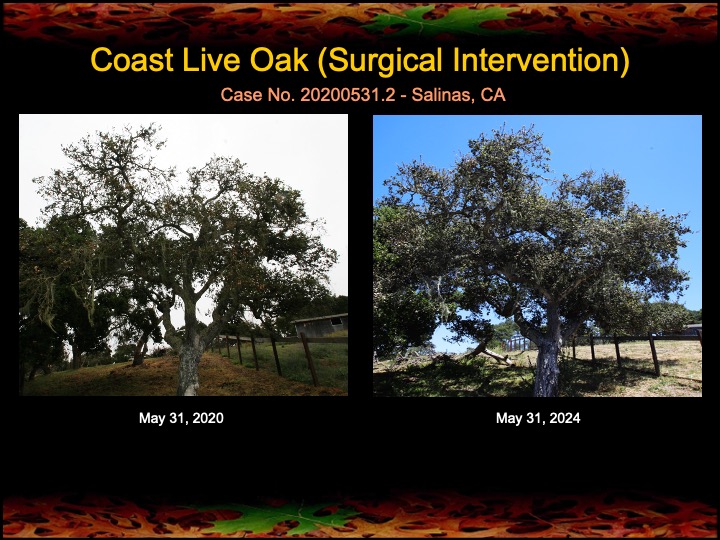
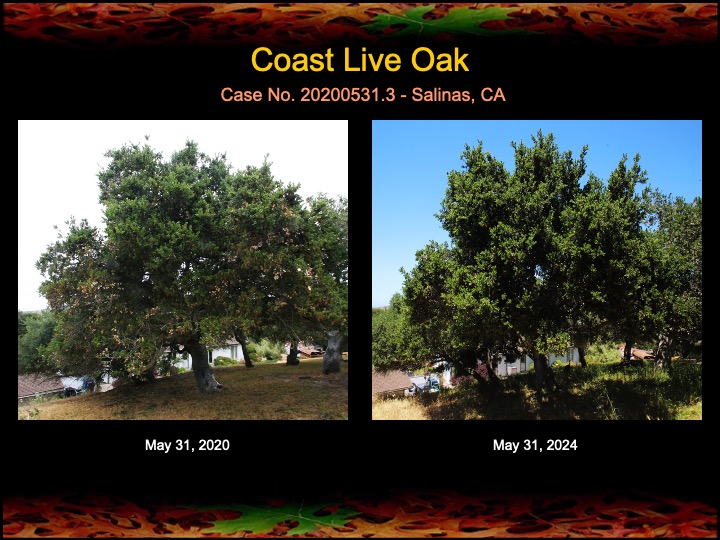
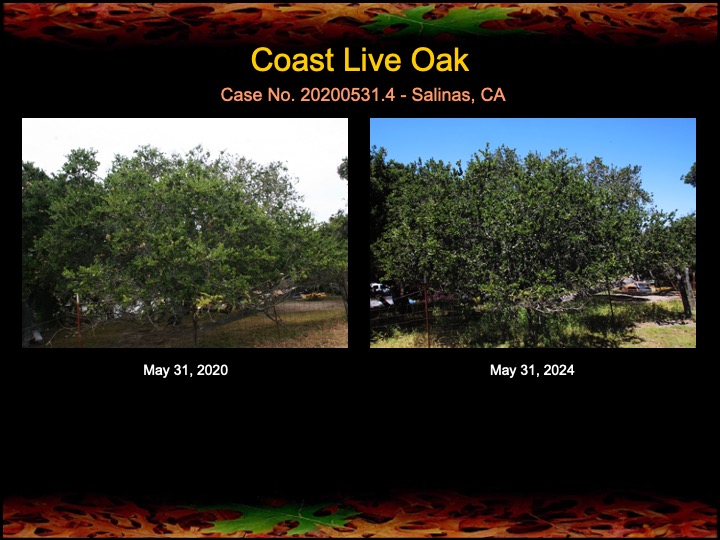
Here are four coast live oaks and a black oak we treated back in 2020. Some additional surgery was done in 2022 to remove lingering canker infections on the oak above. While the above ancestor oak (300+ years old) is still diseased, further surgery and fire mimicry treatments should keep it alive for decades.
There’s a special place near Monterey that is an oak lover’s dream – over 600 acres of undeveloped, intact old-growth oak forest and savanna, never burned, that I’ve been commissioned to tend. In 2022 I surveyed about 25% of the property and identified over 200 ancient, culturally-modified coast live oaks (“ancestor” oaks) that date from the time when the Rumsen-Ohlone Indians were the sole human occupants of the land (> 300 years old). Every one of these oaks is a living cultural artifact of the Rumsen-Ohlone People. I’m guessing there may be nearly 1000 “ancestor” oaks on the property, many of which are over 500 years old. Thus, I refer to this place as “The Old Oaks Home”.
These ancient oaks are in a precarious situation. Given that fires have not burned here in well over 100 years, the forests are now overcrowded with young oaks and the grassland savannas have been mostly replaced by chaparral. A single spark could end the lives of hundreds of these ancient beings in just a day or two. So far, luck has been on the side of these elders, but their luck is running out for every year we postpone care.
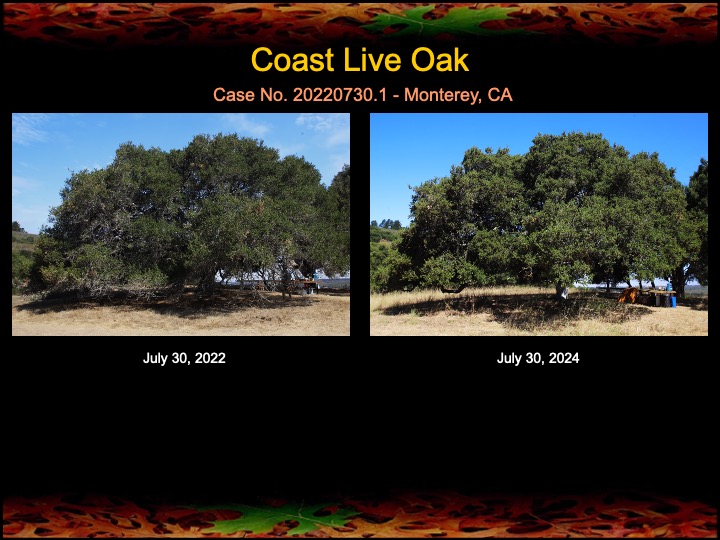
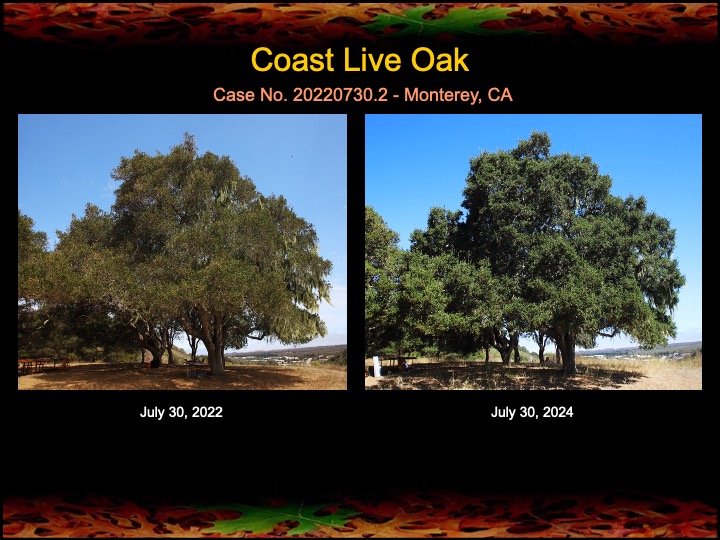
In lieu of fire, I have been applying fire mimicry treatments to several of the ancestor oaks over the past couple years and am seeing a significant improvement in the density and lushness of the canopies of these trees. The above and below photos show the treated oaks today, compared to their appearance two years ago. Enjoy!
The CBS Saturday Morning News show ran a segment on the work that Little Bear (Chairman of the Esselen Tribe), I, and others are doing to restore the forests in Big Sur. Here is the CBS link to that well-done piece of reporting:
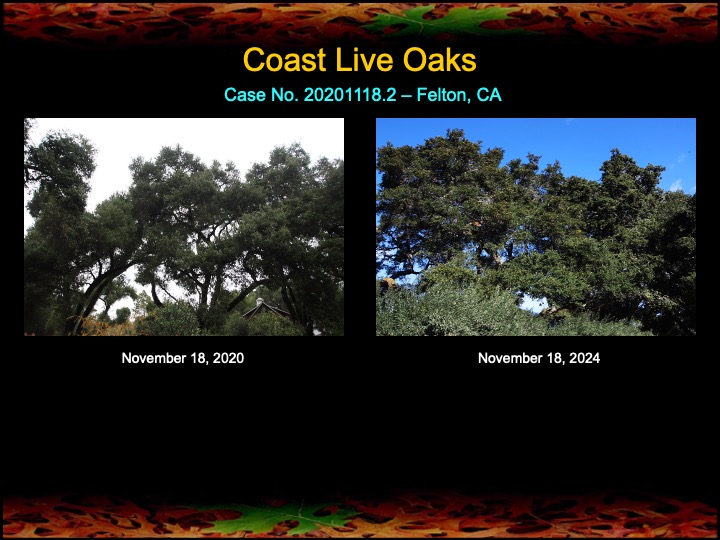
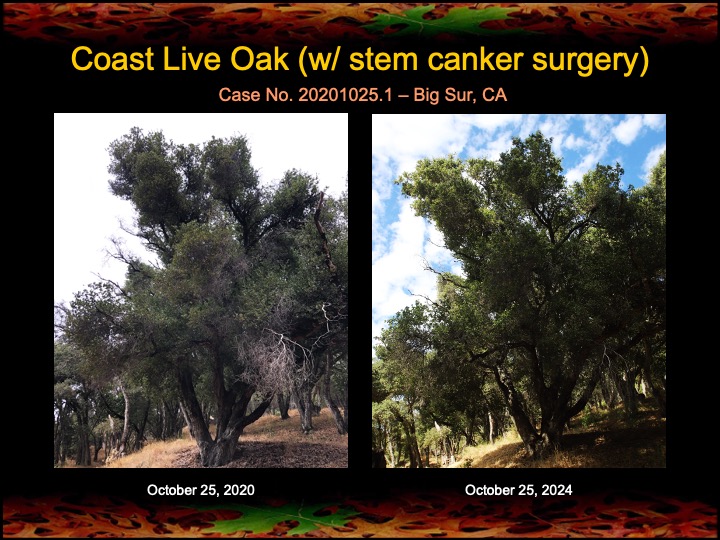
In 2020 a good friend contacted me about care for his sick oaks. I immediately responded and applied fire mimicry treatments on several of his oaks, including a control oak that I did not treat (see below). Here are the results after four years. Note below that one of the diseased oaks initially began to recover nicely in 2021, but ended up dying in 2022. The oak shown above had a stem canker infection (probably Sudden Oak Death) that was surgically removed in 2020, and now shows no sign of lingering infection.











Recent Comments